
TL;DR
- DeFi lending is borrowing and lending crypto through smart contracts. On public, permissionless protocols such as Aave, Compound and Sky there is no credit check, so loans are overcollateralised: you lock up assets worth more than you borrow, and that collateral is the protocol's protection. Permissioned on-chain lenders such as Maple's institutional pools underwrite borrowers and may lend with less collateral.
- The three numbers are loan-to-value (how much you borrowed against your collateral), the liquidation threshold (the line where liquidation can begin), and the health factor (a single figure showing how close you are to that line). The names differ between protocols; the idea does not.
- DeFi interest rates are set automatically by code, and they rise and fall with utilisation, the share of a lending pool that is currently borrowed.
- An oracle is the price feed a protocol uses to value your collateral. If the feed is wrong, the protocol can liquidate positions that were adequately collateralised at market prices or miss undercollateralised ones, so the design of the price feed is a central risk.
In one block
Overcollateralised DeFi lending, as run by Aave, Compound and Sky, is a form of crypto credit that runs on smart contracts and secures each loan with collateral worth more than the debt. The protocol scales the collateral's value by a liquidation threshold and compares it with the debt.
What is DeFi lending, and why is it overcollateralised?
Quick answer
DeFi lending is borrowing and lending crypto through smart contracts. On public, permissionless protocols such as Aave, Compound and Sky there is no credit check, so loans are overcollateralised: you lock up assets worth more than you borrow, and that collateral is the protocol's protection. Permissioned on-chain lenders such as Maple's institutional pools underwrite borrowers and may lend with less collateral.
On the public protocols this guide covers (Aave, Compound, Morpho and Sky), the smart contract does not know who you are, cannot verify your income and cannot take you to court, so it lends against collateral. You lock up assets worth more than the loan you take out, and that excess value is what protects the lender. This design is called overcollateralisation, and it is the foundation of almost everything that follows.
Overcollateralised, permissionless pools are one design among several. Maple's institutional pools, for example, admit lenders only after KYC checks, which add their wallets to an allowlist, and set loan terms through "Maple's credit underwriting and risk management" (Maple documentation, Lending); Maple's glossary assigns "all Loan underwriting and due-diligence" for a pool to its Pool Delegate (Maple documentation, Glossary). Maple's interface terms state that "many loans made via the Interface are either undercollateralized or uncollateralized", so a borrower default can cost lenders crypto-assets (Maple, Interface Terms of Use, last modified 14 April 2025). The health factors, thresholds and liquidation models below describe the overcollateralised protocols named in this guide; underwritten credit handles risk through loan terms, due diligence and default procedures, which this guide does not cover.
The basic loop is simple. A borrower deposits collateral, receives a loan worth less than that collateral, and pays interest until repaying. If the collateral falls in value the buffer shrinks, and once the loan plus interest is repaid the collateral is unlocked. A hypothetical worked example, used throughout this guide, makes it concrete. A borrower deposits $10,000 of ETH and borrows $5,000 of a stablecoin. The borrower still carries ETH's price movements in both directions and now also holds a stablecoin balance, while the ETH is locked as collateral, can be liquidated if its price falls far enough, and the loan accrues interest. Tax treatment of borrowing against crypto differs by jurisdiction, and professional advice applies.
What are the three numbers that govern a DeFi loan?
Quick answer
The three numbers are loan-to-value (how much you borrowed against your collateral), the liquidation threshold (the line where liquidation can begin), and the health factor (a single figure showing how close you are to that line). The names differ between protocols; the idea does not.
Once you borrow against collateral, your position lives or dies by three related figures. Reading them shows how close a position is to forced sale, and they carry across the protocols in this guide with only small differences in naming.
Loan-to-value (LTV): how much you borrowed against your collateral
Loan-to-value is the size of your loan divided by the value of your collateral, written as a percentage. Borrow $5,000 against $10,000 of collateral and your LTV is 50 percent. Every collateral asset has a maximum LTV, the most you may borrow against it at the start; Compound III calls the equivalent parameter a borrow collateral factor and gives the example of 85 percent for WBTC (Compound III documentation, Collateral and Borrowing, checked 23 September 2026). A volatile asset might allow around 75 percent, while a stablecoin used as collateral might allow more. That ceiling sits below 100 percent on purpose, to leave room for prices to move against you. Exact values are set per asset by each protocol's governance and can change by governance vote.
Liquidation threshold: the line where liquidation can begin
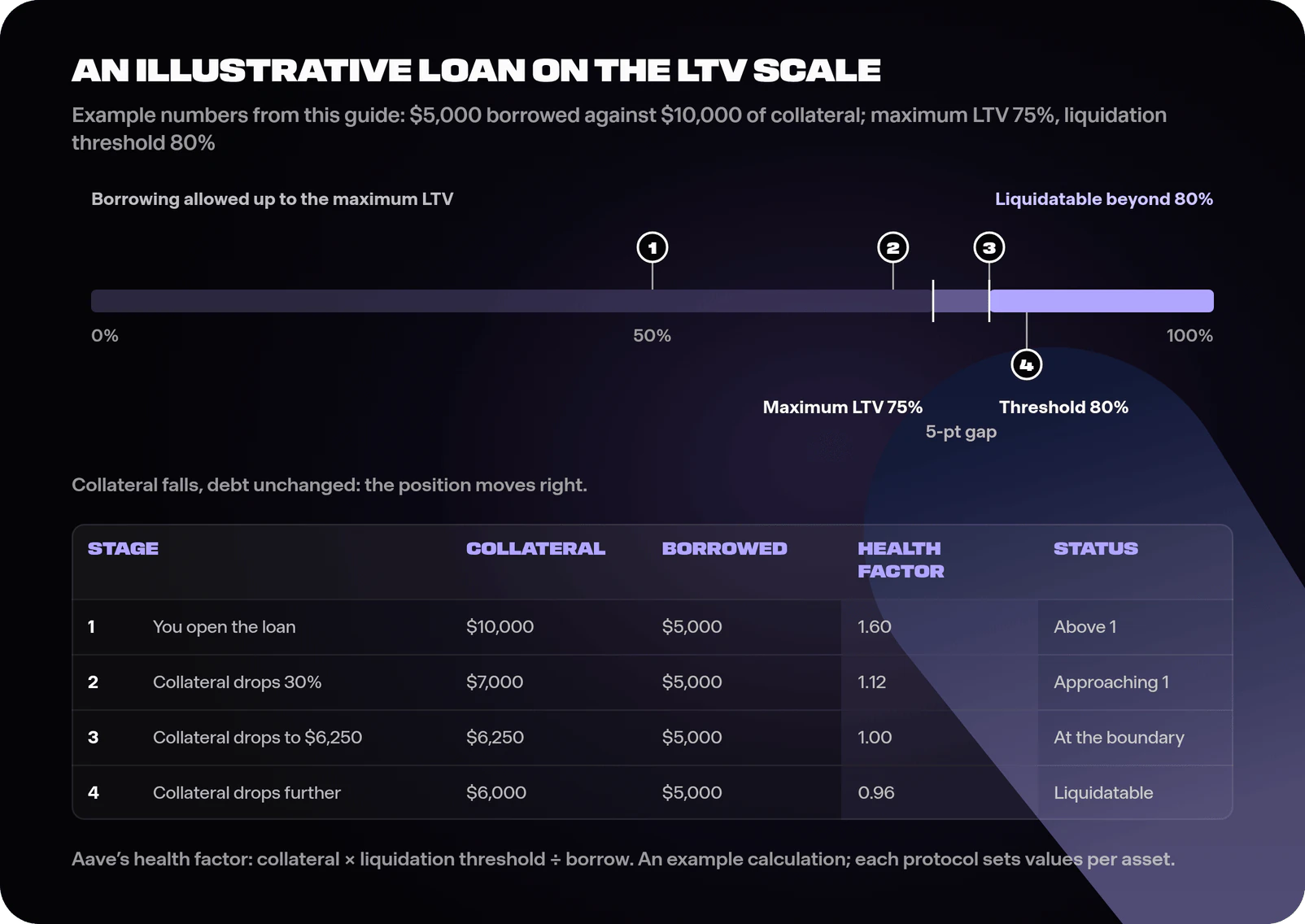
The liquidation threshold sits a little above the maximum LTV and marks the point where the position becomes eligible for liquidation and the protocol is allowed to step in. An asset might let you borrow up to 75 percent but only liquidate you once your effective LTV climbs to 80 percent. Compound III makes the same distinction with a liquidation collateral factor that is set higher than the borrow collateral factor (Compound III documentation, Liquidation). The gap between those two numbers is a buffer, and as the figure below shows, that buffer can be thinner than it looks.
Health factor: one number for how close you are to liquidation
The health factor folds everything into a single number. Aave defines it as total collateral value multiplied by the weighted average liquidation threshold, divided by total borrow value, and a liquidation in the Aave protocol occurs when the health factor falls below 1 (Aave, liquidations help page). The value 1 is therefore a threshold in Aave's model, and in models built the same way; it is a convention of those models, and other protocols draw the boundary differently. Morpho expresses the same boundary as a per-market liquidation loan-to-value, with a position becoming liquidatable when its LTV exceeds that LLTV (Morpho documentation, Liquidation). Sky tracks a vault's collateralisation ratio against a per-asset Liquidation Ratio. Compound III compares collateral, scaled by liquidation collateral factors, against the borrow.
The table below follows one hypothetical Aave-style position toward the edge as its collateral falls, with the threshold set at 80 percent. It is an example calculation only; it does not suggest a level to hold.
| Stage | Collateral | Borrowed | Health factor | Status |
|---|---|---|---|---|
| You open the loan | $10,000 | $5,000 | 1.60 | Above 1 |
| Collateral drops 30% | $7,000 | $5,000 | 1.12 | Approaching 1 |
| Collateral drops to $6,250 | $6,250 | $5,000 | 1.00 | At the boundary |
| Collateral drops further | $6,000 | $5,000 | 0.96 | Liquidatable |
Notice the debt never changed. The health factor fell only because the collateral lost value, which means two forces move it: a falling collateral price and a rising price on the asset you borrowed. In the hypothetical example, a position reading 1.6 would read 0.96 after a 40 percent fall in the collateral, which in volatile markets can happen within hours, and in the same example adding $250 of collateral at the boundary would lift the reading from 1.00 to 1.04, as would repaying $200 of debt. Those figures show the arithmetic only; they are not a suggested level. Whether any given cushion is enough depends on how far and how fast the collateral can move, which no formula can promise in advance. One naming caution matters later: the pooled markets call this number a health factor, but the vault-based protocols in the Maker and Sky family track the same idea as a collateralisation ratio measured against a Liquidation Ratio. The question is identical, namely how much cushion stands between your collateral and your debt, but the machinery that fires when the cushion runs out is different.
How are DeFi interest rates set?
Quick answer
DeFi interest rates are set automatically by code, and they rise and fall with utilisation, the share of a lending pool that is currently borrowed.
DeFi interest rates float with utilisation, the share of a lending pool that is currently borrowed. When most of the pool is already lent out, capital is scarce, so the borrow rate rises to slow new borrowing and the supply rate rises to draw in more capital. When little is borrowed, the rate falls to attract demand. On the pooled design that Compound v2 popularised, each asset has its own borrow and supply rate that adjusts continuously with supply and demand, and interest accrues on every block (Compound v2 documentation, Protocol Math).
Three consequences follow. The rate you pay can move while your loan is open, because it tracks utilisation rather than being fixed. The supply rate sits below the borrow rate, with the gap funding the protocol's reserves; Compound III, for example, describes its reserves as accumulating from the spread between what borrowers pay and what suppliers receive (Compound III documentation, Liquidation). And on most pooled venues the rate updates with every new block, so it can change many times a day. Many protocols also hand lenders an interest-bearing token, a receipt that steadily becomes redeemable for more of the underlying asset as interest builds. Who pays that interest, and what a lender can lose, is covered in our guide to where crypto rewards come from.
How do DeFi protocols liquidate, and why does the method matter?
Quick answer
The protocols in this guide liquidate in three ways: direct repayment (Aave, Morpho), where a liquidator repays your debt and takes your collateral at a discount; a collateral auction (Sky), where the protocol seizes and auctions your collateral; and absorption (Compound III), where the protocol takes the position onto its own books first, then sells the collateral.
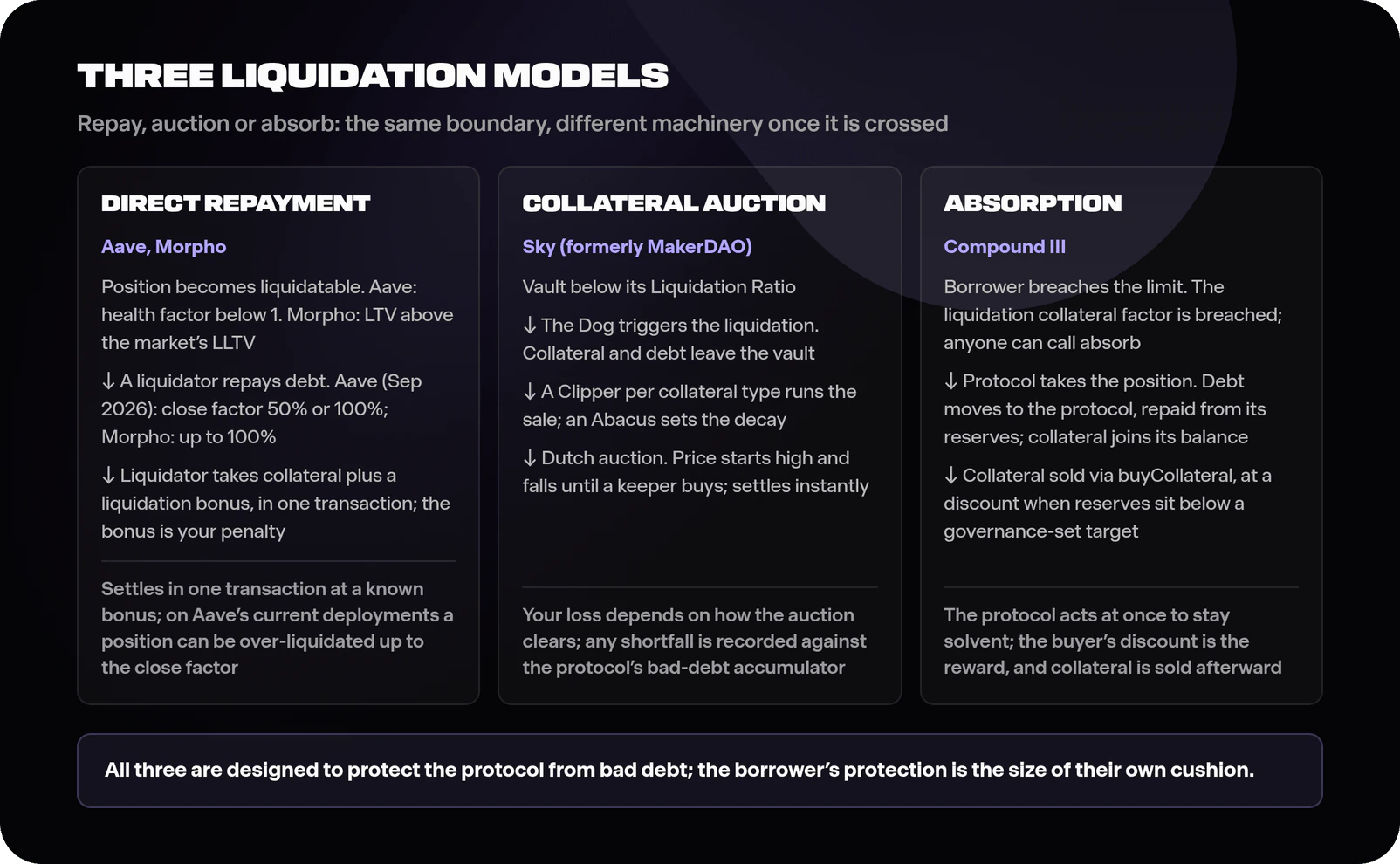
When a position crosses the protocol's liquidation boundary, the contract does not call you or send a warning. It simply acts, selling or seizing the collateral to clear the debt, often at a worse price than you would have obtained yourself. Beyond that shared outcome, the major protocols liquidate in genuinely different ways, and being able to tell them apart is what separates an intermediate understanding from a beginner's. Three models cover the protocols this guide names: direct repayment, used by Aave and Morpho; a collateral auction, used by Sky; and absorption, used by the current Compound version, Compound III. The figure below sets the three side by side, and each is described in turn.
Model one: direct repayment (Aave, Morpho)
In the direct-repayment model, when a borrower's position becomes liquidatable, an independent participant called a liquidator repays part of the debt straight to the protocol and immediately receives an equivalent value of the borrower's collateral plus a liquidation bonus (Aave, liquidations help page). From the borrower's side that bonus is a penalty, value lost on top of the collateral used to clear the debt.
Two details deserve precision. First, the bonus is set per collateral asset by governance and is not flat: stable, liquid collateral tends to carry a smaller bonus than volatile collateral, because a liquidator needs a bigger reward to act in the middle of a crash. Morpho makes this explicit with a formula that scales the liquidation incentive to the market's LLTV, giving roughly 5 percent on an 86 percent LLTV market (Morpho documentation, Liquidation, checked 23 September 2026). Second, how much of the debt one liquidation can clear is set by a close factor, which governance can change. On Aave's deployments as documented on 23 September 2026, up to 50 percent of the debt can be liquidated when the health factor is above 0.95 and both collateral and debt are worth at least $2,000; up to 100 percent can be liquidated when the health factor is 0.95 or below, or when either side is worth less than $2,000; and a partial liquidation must leave at least $1,000 of both collateral and debt behind, otherwise the position is cleared in full (Aave, liquidations help page, checked 23 September 2026). One consequence is that a borrower can be over-liquidated, with more collateral sold than was strictly needed to restore health. Aave's documentation describes a different approach for Aave v4, where a liquidator can repay only enough to bring the position back to a healthy state and liquidation bonuses follow a Dutch auction that rises as the health factor falls (Aave Protocol Documentation, Liquidations). Which version governs your position depends on the deployment you use.
Morpho's design, per its own documentation, is built from isolated markets. Each market pairs one collateral asset with one borrowable asset under a single fixed liquidation loan-to-value, so trouble in one market does not directly change the parameters of another. A position becomes liquidatable the moment its LTV exceeds the market's LLTV, a liquidator can repay up to 100 percent of the debt in one transaction, and when a liquidation leaves debt with no collateral behind it, the loss is realised and shared proportionally among the market's lenders (Morpho documentation, Liquidation). On top of this base sits a curation layer of vaults that route depositor funds across markets, which is one route by which some exchange and wallet products connect customer deposits to on-chain lending, adding that product's own terms and counterparty risks to the market's liquidation risk.
Model two: collateral auctions (Sky, formerly MakerDAO)
The vault-based protocols in the Maker and Sky lineage work differently, and treating them as a variant of the pooled model is a real misunderstanding. Here you do not borrow from a shared pool. You lock collateral in a vault and mint a stablecoin against it (Sky Protocol Docs, CDP Manager). For most of this protocol's history that stablecoin was DAI; MakerDAO became the Sky Ecosystem in 2024 and USDS became its core stablecoin, with DAI continuing alongside it (Sky Ecosystem, How It Works). Your position is tracked by a collateralisation ratio against a per-asset Liquidation Ratio rather than a pool-style health factor.
When a vault falls below its Liquidation Ratio, the protocol does not let a liquidator repay it instantly. It transfers the collateral and debt out of the vault and starts an auction to sell the collateral, a Dutch auction where the asking price starts high and falls with time until a keeper buys. Sky coordinates this through a set of contracts: the Dog, which triggers the liquidation; a Clipper per collateral type, which runs the sale; and an Abacus, the pricing module that sets how fast the price decays (linear, stair-step or exponential). Sky's documentation states that this "Liquidation 2.0" design settles instantly, which is why a participant with no stablecoin on hand can still buy from an auction by routing the collateral through other protocols within the same transaction, and that any shortfall is recorded against the protocol's own bad-debt accumulator (Sky Protocol Docs, Collateral Liquidation). The practical difference is this: in the direct-repayment family, liquidation is an instant repayment at a fixed discount, while in the auction family it is a price-discovery process whose outcome depends on how the auction clears.
Model three: absorption (Compound III)
Compound III, the current version of Compound, deserves its own treatment because it does neither of the above in the usual way. Older Compound deployments (Compound v2) used a direct-repayment model with a close factor and a liquidation incentive, much like Aave (Compound v2 documentation, Comptroller). Compound III splits liquidation into two steps. First, when a borrower breaches the liquidation collateral factor, anyone can call absorb, which transfers the account's debt to the protocol account, draws on the protocol's cash reserves to repay the borrow, and adds the collateral to the protocol's own balance (Compound III documentation, Liquidation). Second, that seized collateral is offered for sale at a discount through a separate buyCollateral call, which increases protocol reserves; Compound's documentation says the discount is available when reserves sit below a governance-set target. The effect is that the protocol absorbs the bad position immediately, then sells the collateral at its own pace, and the liquidator's reward comes from buying that collateral cheaply rather than from a direct repayment bonus. Knowing which of these three models governs your loan tells you how a liquidation against you would unfold.
The table below summarises how the three models differ on the points that matter to a borrower.
| Model | Used by | How it clears the debt | What the borrower should know |
|---|---|---|---|
| Direct repayment | Aave, Morpho | A liquidator repays the debt and takes collateral plus a bonus, in one transaction | Settles in one transaction at a known bonus; on Aave's deployments as documented in September 2026 a position can be over-liquidated up to the close factor |
| Collateral auction | Sky (formerly MakerDAO) | The protocol seizes the vault and sells collateral in a falling-price Dutch auction | Your loss depends on how the auction clears rather than on a fixed discount |
| Absorption | Compound III | The protocol absorbs the position against its reserves, then sells collateral separately | The protocol takes the position at once to protect its solvency; collateral is sold afterwards, and any shortfall falls on protocol reserves |
All three models are designed to protect the protocol from bad debt; the borrower's protection is the size of their own cushion. Knowing whether your protocol repays, auctions, or absorbs tells you how a liquidation would cost you, and by roughly how much.
What is a liquidation cascade?
Quick answer
A liquidation cascade is a chain reaction in which forced sales of collateral, and forced closures of leveraged long positions, drive a price down, which triggers more liquidations, which drive the price down further. It can turn an ordinary correction into a crash.
In a lending market the loop runs as shown below: a price drop pushes a wave of positions below their thresholds, the seized collateral is sold (by liquidators who took it at a discount, by auction buyers, or by the protocol), that selling pushes the price down further, and the lower price drags the next tier of positions under. Liquidators do not always sell at once, and on derivatives venues the direction depends on the position: closing a long sells, closing a short buys.
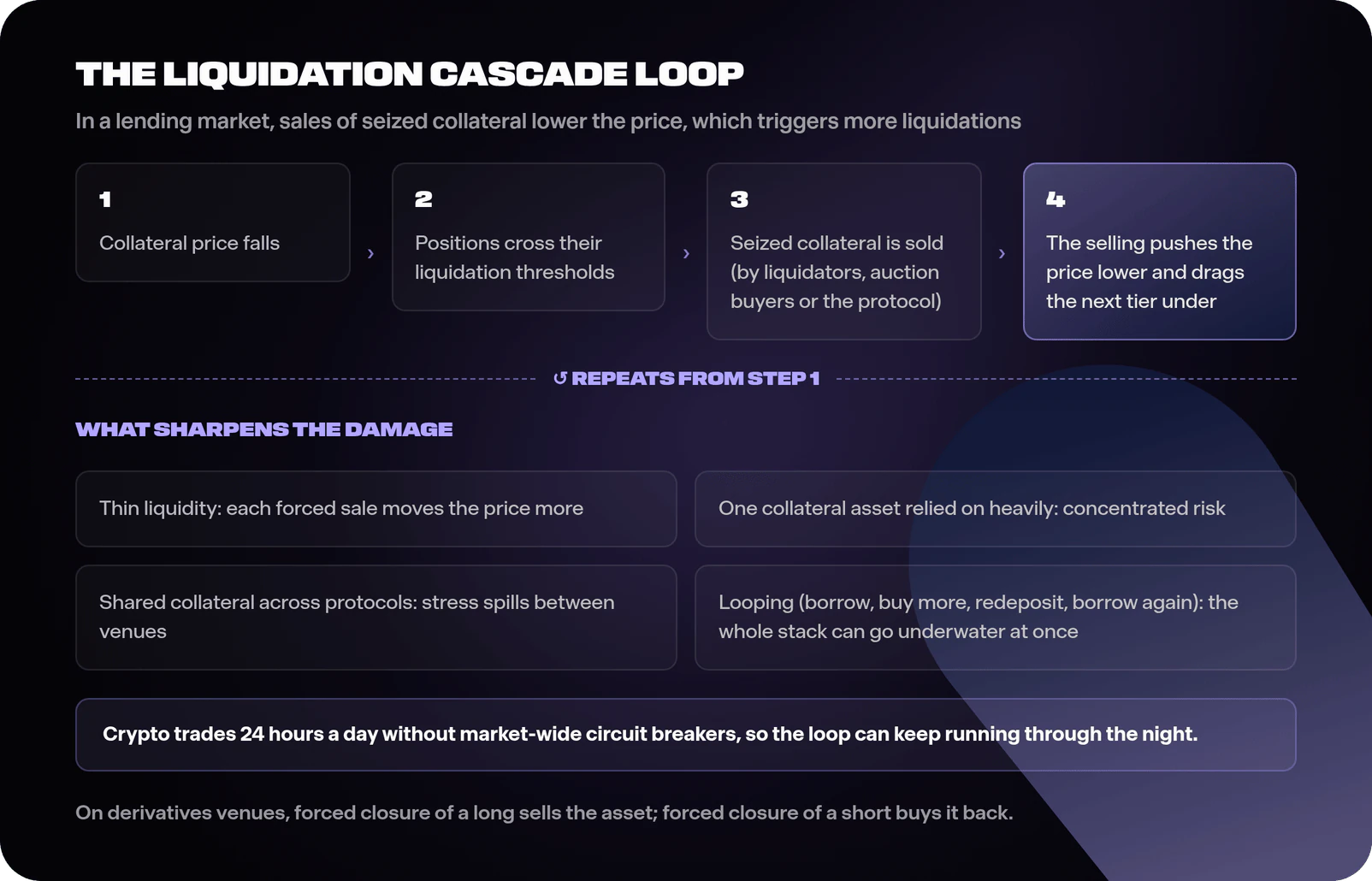
Leverage and volatility feed each other here, and the loop is made worse by looping strategies, where a user borrows against an asset, buys more of it, redeposits that as fresh collateral, and borrows again. A single price drop can put the whole stack underwater at once. Three conditions sharpen the damage: thin liquidity means each forced sale moves the price more, heavy reliance on one collateral asset concentrates the risk, and shared collateral across protocols lets stress in one venue spill into others.
The same loop has run in earlier market-wide sell-offs, including the falls of May 2021 and the collapse of the Terra ecosystem in May 2022; this guide does not attach liquidation totals to those episodes because the available figures come from data aggregators whose methods differ. A recent illustration arrived on 10 October 2025.
Case study: what happened on 10 October 2025?
Quick answer
On 10 October 2025 a sharp, market-wide crypto sell-off brought heavy forced liquidations across exchanges. Inside it, a Binance notice refers to a "price depeg" of USDe, BNSOL and wBETH and says Binance would compensate Futures, Margin and Loan users who held those tokens as collateral and were impacted between 21:36 and 22:16 UTC (Binance notice, 11 October 2025).
On 10 October 2025, prices across crypto markets fell sharply during a broad sell-off in risk assets.
Market structure helped turn a sharp drop into a cascade. Crypto trades 24 hours a day without market-wide circuit breakers, so selling can continue through the night. Exchanges close leveraged futures positions automatically as margin runs out. Forcing a leveraged long closed means selling, which adds to the selling described above; forcing a short closed means buying the asset back, which pushes the other way. That is the loop from Figure 3, running across many venues at once; this guide does not attribute the day's losses to a single cause or venue.
The collateral pricing episode inside the sell-off
The most instructive part of the day, and the reason it belongs in a lending guide, is what happened to collateral pricing on one major venue. Binance's own notice, titled "Resolution of USDE, BNSOL, and WBETH Price Depeg and Risk Control Enhancements", says that "All Futures, Margin, and Loan users who held USDE, BNSOL, and WBETH as collateral and were impacted by the depeg between 2025-10-10 21:36 and 22:16 (UTC) will be compensated, together with any liquidation fees incurred", and that the amount "will be the difference between the market price at 2025-10-11 00:00 (UTC) and their respective liquidation price" (Binance, 11 October 2025). The notice covers Binance's own platform only and gives no root cause. It does list changes: adding the redemption price to the BNSOL, WBETH and USDE price index weights, adding a minimum price threshold to the USDE index rule, and increasing the frequency of risk-control parameter reviews.
Why did it happen? Binance's notice does not say, so what follows is an inference; Binance has not published it as a finding. One account came from the issuer of USDe. As reported by CoinDesk on 13 October 2025, Ethena Labs founder Guy Young wrote in a post on X that the "severe price discrepancy was isolated to a single venue, which referenced the oracle index on its own orderbook, not the deepest pool of liquidity". On that account, the tokens were valued for margin largely from one venue's own order book, so when liquidity there thinned during the sell-off, that venue's price fell further than prices elsewhere. This is the issuer's account, which this guide has not independently verified; Binance's announced changes to its price indexes are consistent with it without confirming it. The figure below sets the notice beside this inference in simplified form.
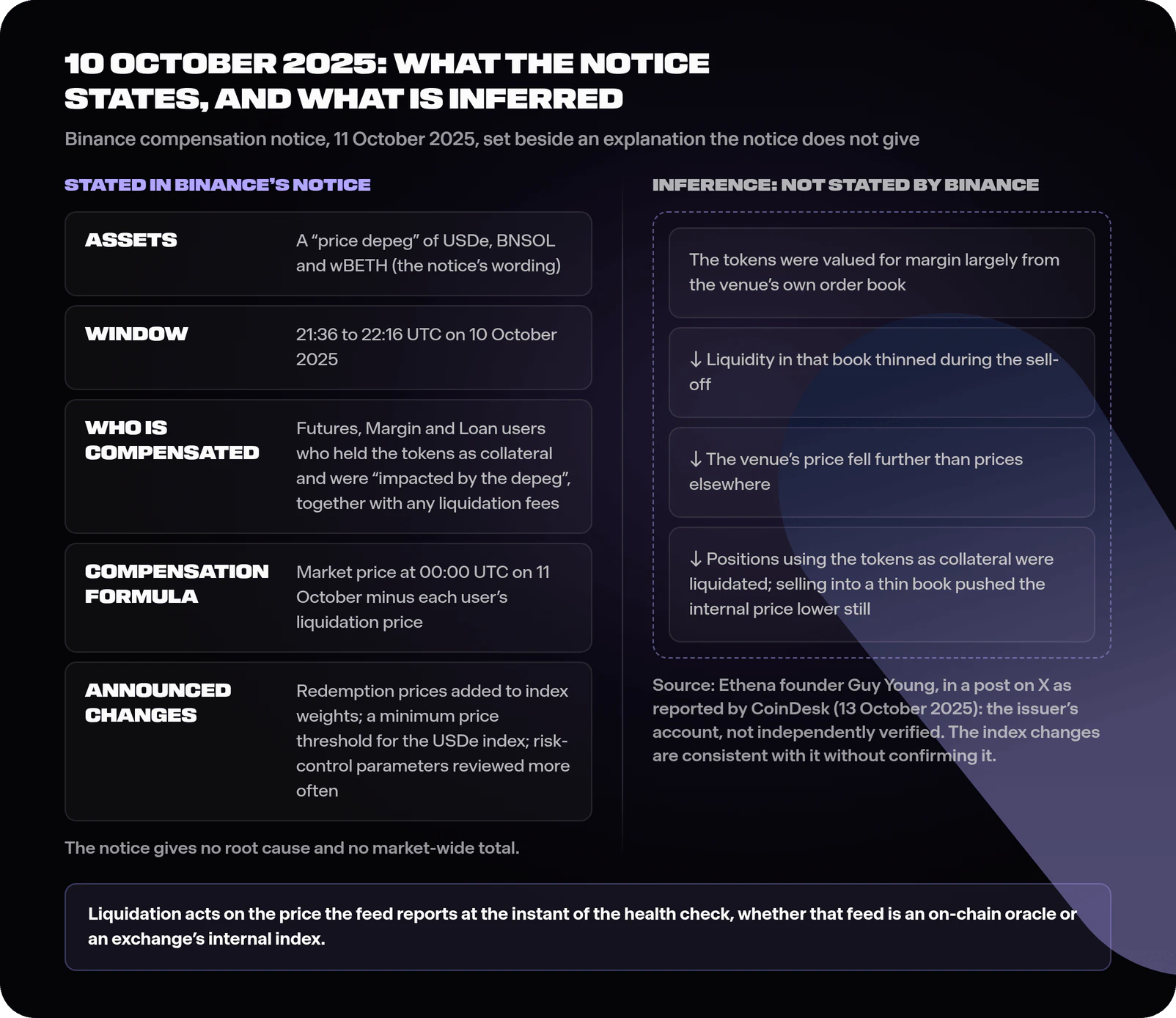
If that account is right, the cascade and the pricing lesson combined within the venue: as the internal price of the collateral fell, positions backed by it were liquidated, the liquidations sold more of the collateral into a thin book, and that selling pushed the internal price lower still. USDe's design and risks are discussed in our guide to stablecoin stability and failure modes. What Binance's notice does establish is narrow and important: for that window, Binance said it would compensate collateral holders impacted by the depeg, measured as the gap between the market price at 00:00 UTC on 11 October and each user's liquidation price.
The episode illustrates this guide's themes. A liquidation check reads only the price the feed reports at the instant the health check runs; the collateral's backing and longer-run value do not enter the calculation. Whether that feed is an on-chain oracle or an exchange's internal index, how it is constructed decides whether it reflects the market or amplifies a local dislocation.
What decides how far a position sits from liquidation?
Quick answer
Four things: how much cushion the position started with, how volatile the collateral and borrowed assets are, whether the borrower notices the cushion shrinking in time to act, and which liquidation machinery and price feed the protocol uses. Each involves a trade-off, and this guide sets no level for any of them.
You cannot control the market, and this guide does not prescribe a health factor. What it can do is show how each choice changes the outcome. Cushion size is a trade-off between capital efficiency and distance from the boundary: the hypothetical table above shows a position opened at a 50 percent LTV reaching Aave's threshold after a 37.5 percent fall in collateral value, while the same debt against $20,000 of collateral (a 25 percent LTV, health factor 3.2) would reach it only after a 69 percent fall. The wider cushion ties up twice the collateral for the same loan.
Volatility sets how quickly a cushion can vanish. A single volatile token as collateral means the buffer swings hard on every move, and on a direct-repayment protocol a sharp gap down can trigger a 50 or even 100 percent close-factor liquidation before anyone reacts. Borrowing a volatile asset against stable collateral produces the mirror image, since the debt side can rise.
Timing is about attention. The number moves with prices rather than with the borrower's awareness, and many interfaces can notify a user as a position approaches its threshold; whether that notice arrives in time depends on how fast the market moves and how quickly the borrower can add collateral or repay.
Finally, the penalty and the price feed are protocol properties the borrower inherits. Knowing the liquidation bonus and whether the protocol repays, auctions, or absorbs tells you what a liquidation will cost; knowing where the protocol's price comes from tells you whether a dislocation on one venue can reach your position. Beyond price, the layered risks remain: smart-contract bugs, price-feed problems of the kind seen on one exchange in October 2025, and platform risk. Liquidation is only one of the ways a position can go wrong.
Frequently asked questions
What does it mean to be liquidated in DeFi?
It means the protocol sold, auctioned or absorbed some or all of the collateral to repay the loan, usually at a discount, so the borrower loses more than the debt cleared. A hypothetical worked example: take this guide's position at a health factor of 0.96 ($6,000 of collateral, $5,000 of debt, 80 percent threshold). Under Aave's close-factor rules as documented on 23 September 2026, with the health factor above 0.95 and both sides above $2,000, a liquidator may repay up to half the debt (Aave, liquidations help page). Repaying $2,500 with an illustrative 5 percent bonus takes $2,625 of collateral, leaving $3,375 against $2,500 of debt, a health factor of about 1.08. The position survives smaller, and the borrower has paid $125 in bonus.
Is a health factor of 1 the liquidation point on every protocol?
No. It is the threshold in Aave's model, where a position becomes liquidatable when its health factor falls below 1 (Aave, liquidations help page). Morpho compares a position's LTV against a per-market liquidation LTV, Sky compares a vault's collateralisation ratio against a Liquidation Ratio, and Compound III scales collateral by liquidation collateral factors. Each is a different way of drawing the same boundary.
Can a stablecoin used as collateral get you liquidated even if it is fully backed?
Yes. A liquidation check reads the price the protocol or exchange uses, and backing does not enter that calculation. If that price reports the collateral below its value elsewhere, even briefly, positions backed by it can be liquidated. Binance's notice of 11 October 2025 is one example of a venue's price diverging: it refers to a "price depeg" of USDe, BNSOL and wBETH and says Binance would compensate Futures, Margin and Loan users impacted between 21:36 and 22:16 UTC on 10 October. The notice says nothing about the tokens' backing, which is a separate question covered in our guide to stablecoin stability and failure modes.
Is DeFi lending risk-free?
No, it carries real and layered risk. Price moves can trigger liquidation, and there is also smart-contract risk, oracle risk, and platform risk. On overcollateralised protocols such as Aave, Compound and Sky, overcollateralisation protects the protocol; the borrower's protection is the size of the cushion and the speed with which it can be restored, and neither is guaranteed to be enough.
Is all on-chain lending overcollateralised and open to anyone?
No. The public protocols in this guide (Aave, Compound, Morpho and Sky) are permissionless and require collateral worth more than the debt. Permissioned designs also run on-chain. Maple's institutional pools, for example, add lenders to an allowlist after KYC checks, set loan terms through credit underwriting, and state in their interface terms that many loans are undercollateralised or uncollateralised (Maple documentation, Lending; Maple, Interface Terms of Use). In those pools a lender's main risk is borrower default, which health-factor liquidation does not cover in the same way.
What is the difference between a liquidation bonus and a liquidation penalty?
They are the same discount seen from two sides. The liquidator receives the collateral at a discount (their bonus), which is value the borrower loses on top of the debt cleared (the borrower's penalty).
Educational use only. Not financial, investment, legal, or tax advice. Protocol parameters described as checked on 23 September 2026 and subject to change.
How did you do?
Answer key: 1 b; 2 c; 3 b; 4 b; 5 b.
Question 1: on overcollateralised protocols such as Aave, Compound and Sky, overcollateralisation is the mechanism that replaces a credit check. Lock up more than you borrow and the protocol does not need to know who you are. Permissioned on-chain lenders such as Maple's institutional pools do check participants and underwrite loans.
Question 2: in Aave's model, a health factor below 1 makes the position liquidatable, so 1.00 is the boundary itself. Other protocols draw the same line under different names.
Question 3: rates float with utilisation. The more of the pool is borrowed, the higher the rate climbs, and it can move while your loan is still open.
Question 4: Aave and Morpho use direct repayment, where a liquidator clears part of the debt and takes collateral plus a bonus in one transaction. Sky runs a falling-price Dutch auction. Compound III does neither in the usual way: it absorbs the position onto its own books first.
Question 5: the notice establishes the window and the compensation Binance said it would pay. It gives no root cause, says nothing about the tokens' backing, and says nothing about the wider sell-off.
Sources and further reading
Primary sources checked on 23 September 2026. Protocol parameters change; re-check each protocol's documentation before relying on any figure.
- Liquidations (help page). Aave, undated, accessed 23 September 2026. https://aave.com/help/borrowing/liquidations (accessed 23 September 2026)
- Liquidations, Aave Protocol Documentation (includes Aave v4 liquidation behaviour). Aave, undated. https://aave.com/docs/concepts/liquidations (accessed 23 September 2026)
- Aave v3 overview, Aave Protocol Documentation. Aave, undated. https://aave.com/docs/aave-v3/overview (accessed 23 September 2026)
- Liquidation, Compound III documentation. Compound, undated. https://docs.compound.finance/liquidation/ (accessed 23 September 2026)
- Collateral and Borrowing, Compound III documentation. Compound, undated. https://docs.compound.finance/collateral-and-borrowing/ (accessed 23 September 2026)
- Comptroller, Compound v2 documentation. Compound, undated. https://docs.compound.finance/v2/comptroller/ (accessed 23 September 2026)
- Protocol Math, Compound v2 documentation. Compound, undated. https://docs.compound.finance/v2/ (accessed 23 September 2026)
- Liquidation on Morpho. Morpho, undated. https://docs.morpho.org/learn/concepts/liquidation/ (accessed 23 September 2026)
- Collateral Liquidation, Sky Protocol Docs. Sky, undated. https://developers.skyeco.com/protocol/vaults/collateral-liquidation/ (accessed 23 September 2026)
- CDP Manager, Sky Protocol Docs. Sky, undated. https://developers.skyeco.com/protocol/vaults/cdp-manager/ (accessed 23 September 2026)
- Sky Ecosystem: How It Works. Sky, undated. https://www.skyeco.com/ecosystem (accessed 23 September 2026)
- Lending, Maple Institutional for Lenders. Maple, undated. https://docs.maple.finance/maple-institutional-for-lenders/lending (accessed 24 September 2026)
- Glossary (Pool Delegate), Maple documentation. Maple, undated. https://docs.maple.finance/technical-resources/protocol-overview/glossary (accessed 24 September 2026)
- Interface Terms of Use. Maple, last modified 14 April 2025. https://docs.maple.finance/legal/interface-terms-of-use (accessed 24 September 2026)
- Resolution of USDE, BNSOL, and WBETH Price Depeg and Risk Control Enhancements. Binance, 11 October 2025. https://www.binance.com/en/support/announcement/detail/0989d6c7f32545bfb019e3249eaabc3f (accessed 24 September 2026)
- No, Ethena's USDe Didn't De-peg During Friday's Crash. CoinDesk, 13 October 2025. https://www.coindesk.com/markets/2025/10/13/no-ethena-s-usde-didn-t-de-peg (accessed 24 September 2026)
Quick quiz: did it stick?
Five quick questions, no pressure. Pick the answer that feels right, then check the answer key below.


You have completed a quiz on “How DeFi Lending and Liquidations Actually Work”! Share your achievement on social media.
 Was this helpful?