
TL;DR
- Pseudonymous: your transactions are public under an alias, and your privacy is exactly as strong as the alias's separation from your name. Bitcoin's designer said as much in the original paper, recommending a new key pair for every payment to limit linkage.
- A full financial dossier: balance, lifetime history, every counterparty, and behavioural patterns such as time zone, habits and pay cycles. All of it is free, legal to read, and impossible to retract.
- By exploiting how wallets mechanically behave: addresses spent together almost certainly share an owner, so heuristics fold thousands of addresses into single wallet clusters. The technique was demonstrated academically in 2013 and has been industrial practice ever since.
- At the edges, where crypto meets the regulated and social world: exchange KYC records, public payment links, name services, merchant records and leaked databases. Chain analysis links addresses to addresses; these anchors link addresses to you.
In one block
On-chain privacy is the degree to which blockchain activity can be linked to a real-world identity. Transparent blockchains publish every transaction, amount, address and timestamp forever, so privacy rests entirely on unlinkability: keeping addresses unconnected to each other and to a name.
Is crypto anonymous or pseudonymous?
Quick answer
Pseudonymous: your transactions are public under an alias, and your privacy is exactly as strong as the alias's separation from your name. Bitcoin's designer said as much in the original paper, recommending a new key pair for every payment to limit linkage.
On a transparent blockchain, every transaction records sending addresses, receiving addresses, the amount, and the time, and every node in the world keeps a copy indefinitely. There is no privacy setting. A block explorer turns any address into a bank statement: balance, complete history, counterparties, patterns.
The privacy model, described in section 10 of the Bitcoin whitepaper, is that addresses are unlinked pseudonyms: the public sees that someone paid someone, without names. The paper also flagged the model's weak point in the same breath: if the link between an address and an owner is ever established, every transaction that address touched is exposed at once, past included.
Contrast this with the traditional system it is often measured against. Your bank knows your transactions, and so can authorities through the bank, but your neighbour, employer, ex-partner and a stranger on another continent cannot pull your statement. On a transparent chain, they can, if they learn one address. Crypto privacy failures are public in a way banking privacy failures rarely are.
Account-based chains such as Ethereum concentrate the effect. Where Bitcoin wallets naturally scatter funds across many addresses, an Ethereum user typically reuses one account for everything: tokens, applications, names, years of activity in one place. A single identified Ethereum address is usually a richer dossier than a single identified Bitcoin address.
So the question "is crypto anonymous" has a precise answer: no. It is a system of public records under aliases, and the rest of this article is about how aliases fall.
What can anyone learn from a single address?
Quick answer
A full financial dossier: balance, lifetime history, every counterparty, and behavioural patterns such as time zone, habits and pay cycles. All of it is free, legal to read, and impossible to retract.
Start with the direct contents. An address's balance and complete transaction history are one explorer query away. Every inflow and outflow names its counterparty address, so your dossier immediately extends one hop outward: the exchange you withdrew from, the merchant you paid, the friend who paid you back.
Amounts and timing carry more than people expect. Regular identical inflows look like salary and reveal both employer rail and pay level; transaction timestamps cluster in your waking hours and leak your rough time zone; a burst of activity can date a purchase, a sale or a panic. Analysts read these patterns the way accountants read ledgers, because that is what they are.
Counterparty context does the labelling. Chain analysis firms and public communities maintain vast tag databases: this cluster is a named exchange, that one a gambling site, this contract a mixer, that address a sanctioned entity. Your dossier is automatically annotated with the company you keep, and services you touch may treat you differently for it, since exchanges routinely score deposits by their history.
Token holdings and applications extend the picture on smart-contract chains: governance tokens reveal affiliations, NFT collections reveal tastes and communities, lending positions reveal leverage. A human-readable name attached to an address, such as an ENS name matching your public handle, gift-wraps the whole file.
The permanence deserves its own sentence. This record cannot be edited, expired or deleted, and analysis run in 2030 will read your 2026 activity with 2030's tools. On-chain privacy mistakes are retroactive in a way almost no other privacy mistake is.
How does clustering link your addresses together?
Quick answer
By exploiting how wallets mechanically behave: addresses spent together almost certainly share an owner, so heuristics fold thousands of addresses into single wallet clusters. The technique was demonstrated academically in 2013 and has been industrial practice ever since.
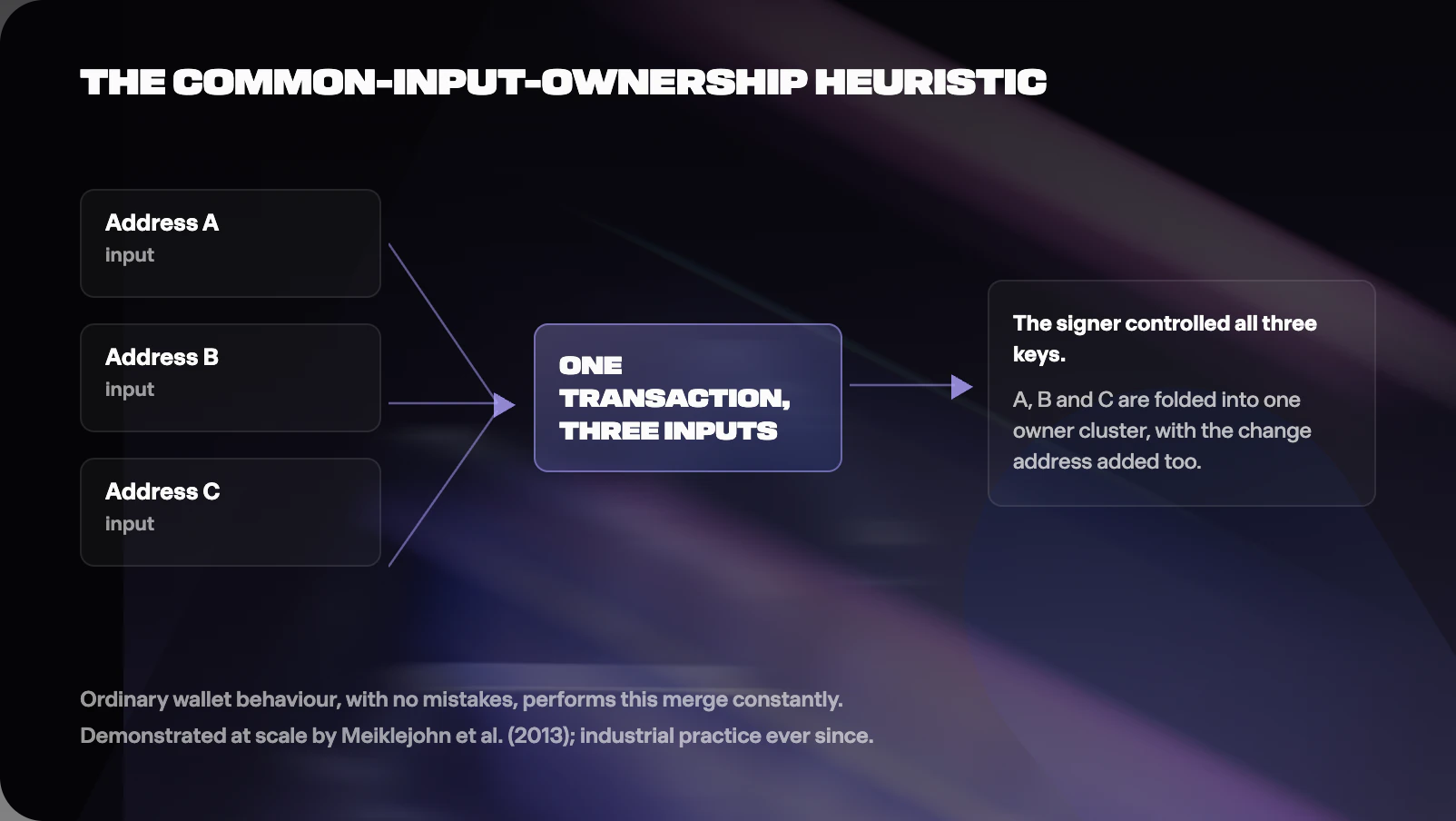
The workhorse is the common-input-ownership heuristic. When a transaction spends from several addresses at once, the signer had to control all their keys, so the addresses are grouped as one owner. Wallets do this constantly and automatically when assembling payment amounts from fragments, which means ordinary use, with no mistakes, steadily merges your addresses into one cluster. Satoshi's whitepaper flagged this exact leak: multi-input transactions, it noted, unavoidably reveal that their inputs share an owner.
Change detection extends it. A payment usually returns leftover funds to a fresh address the payer's wallet created; heuristics identify which output is the change, by amount patterns, script types and wallet fingerprints, and add it to the payer's cluster. Following chains of change, so-called peel chains, lets analysts track a balance through hundreds of hops, a standard technique in tracing stolen funds.
The academic lineage is public. The 2013 study A Fistful of Bitcoins, by Meiklejohn and colleagues, clustered addresses at scale with these heuristics, then identified clusters by simply transacting with services and seeing where the coins landed, mapping exchanges, marketplaces and gambling sites. Follow-up work, including a 2022 USENIX study validating clustering against ground truth, found the core heuristics to be highly reliable in practice, with correctable error sources. Commercial platforms refine the same ideas with proprietary tags at global scale, and their output is bought by exchanges, payment processors and investigators alike.
Two consequences follow. First, one careless link contaminates a whole cluster: if any address in it ever touches your identity, the entire cluster is yours. Second, clustering is probabilistic, and its occasional errors cut both ways, sometimes merging strangers, sometimes splitting one owner. Sophisticated wallets resist some heuristics deliberately; ordinary wallets do not try.
Where does your real name actually attach?
Quick answer
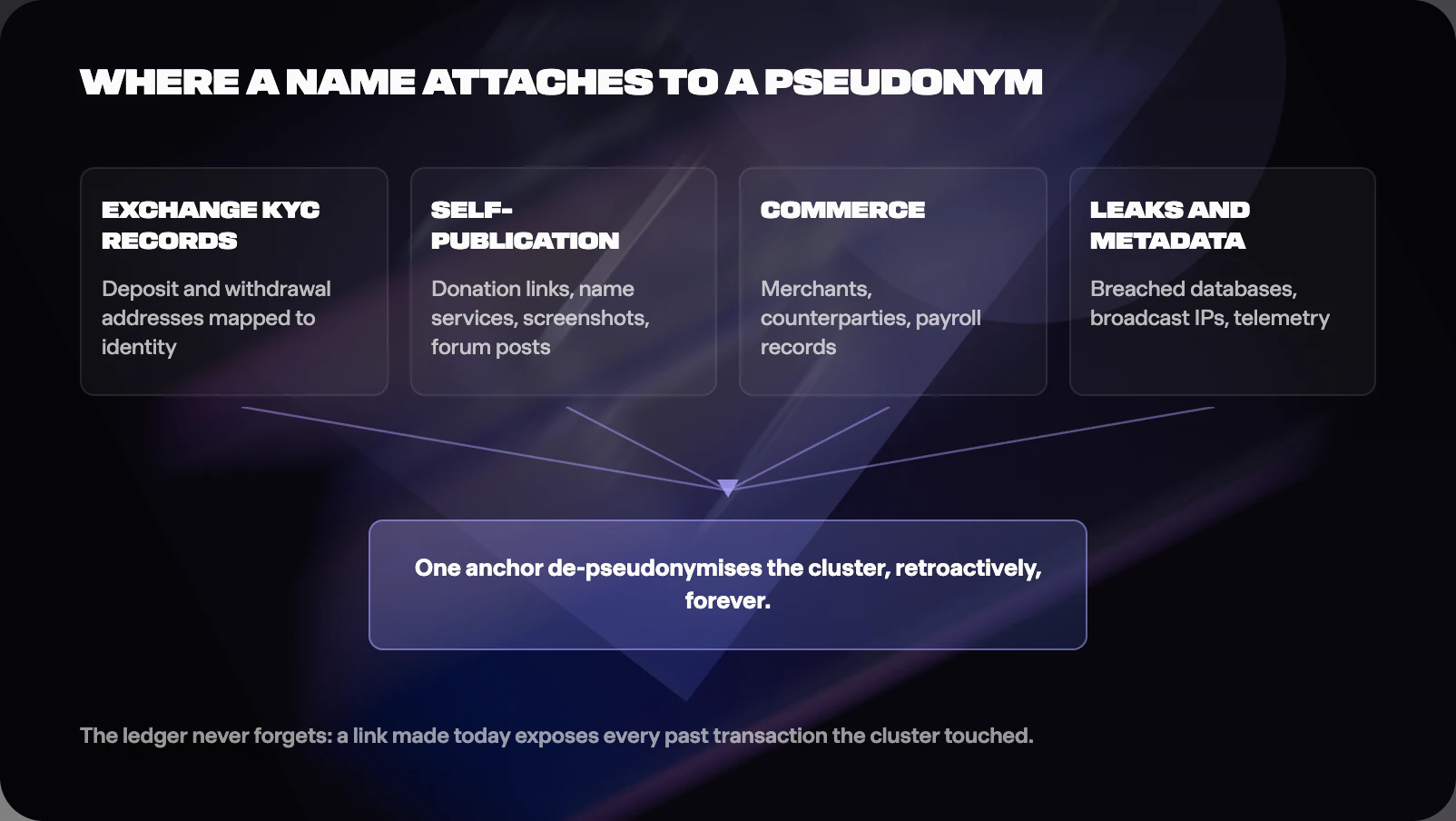
At the edges, where crypto meets the regulated and social world: exchange KYC records, public payment links, name services, merchant records and leaked databases. Chain analysis links addresses to addresses; these anchors link addresses to you.
The strongest anchor is the KYC exchange. Buying or cashing out through a regulated venue ties your verified legal identity to specific deposit and withdrawal addresses in the venue's records. That mapping is private to the exchange and available to authorities through legal process, and every cluster your withdrawals feed inherits the association. This is the normal, lawful route by which investigators put names on clusters.
Self-publication is the anchor people control and squander. A donation address in a profile, a payment link in a bio, an ENS or similar name matching a public handle, a screenshot with an address visible, a forum post asking about a specific transaction: each is a voluntary, timestamped signature connecting identity to cluster. The physical security article in this cluster documents where that can lead; France's 2025 kidnapping wave drew targeting data partly from exactly such self-published trails combined with leaked customer records.
Commerce and counterparties leak steadily. A merchant who ships goods knows the paying address and the delivery name; a peer who pays you knows one of your addresses and can watch it afterwards; payroll in crypto ties an address to an employer's books. Any counterparty's knowledge can propagate: their records breach, their curiosity turns to a block explorer, their compliance vendor tags you.
Network metadata adds a quieter channel: the IP address from which a transaction is broadcast, wallet telemetry, and explorer lookups of your own addresses from your own connection all correlate activity with infrastructure that has your name on a bill somewhere.
The asymmetry to internalise: pseudonymity fails once, permanently. One anchor, made at any point in an address's life, even years after the transactions it exposes, converts the pseudonymous record into an attributed one retroactively.
What are dusting and address poisoning attacks?
Quick answer
Both are attacks on the address layer: dusting plants tiny traceable amounts to map wallet clusters, and address poisoning plants lookalike addresses in your history hoping you will copy one when sending. Neither can take funds by itself; both exploit human habits around addresses.
A dusting attack sends minuscule amounts, dust, to large numbers of addresses. The attacker then watches what happens to each grain. If your wallet later sweeps the dust into a payment alongside your other funds, the common-input-ownership heuristic does the attacker's work, confirming that the dusted address belongs to the same cluster as the rest, and enriching whatever profile is being built. Dust arriving unrequested is a tracking beacon: the defence is to leave it untouched, and wallets with coin control can mark it never to be spent. Dust cannot steal anything, and ignoring it costs nothing.
Address poisoning targets the sending moment. The attacker generates a vanity address whose first and last characters match one of your frequent counterparties, then sends a tiny or zero-value transfer so the lookalike appears in your transaction history. The bet is behavioural: many users copy addresses from their history and check only the ends. One inattentive copy sends a real payment to the attacker. Chainalysis and others have documented large campaigns, with individual losses in 2023 to 2025 reaching into the tens of millions of dollars in the worst single cases. The defence is procedural: never source addresses from history, use an address book of verified entries, verify more than the ends of an address before signing, and for large transfers send a small test amount first.
Both attacks are cheap to run at scale, which is why every active wallet eventually sees them. Treat unexpected inbound transfers, however small, as hostile marking, and your response, ignore the funds, never trust the history, defeats both.
What hygiene actually improves your on-chain privacy?
Quick answer
Separation and restraint: fresh addresses where the chain supports them, distinct wallets for distinct purposes with no transfers between them, and ruthless economy in publicly linking name to address. No single tool matters as much as consistent compartments.
Use fresh addresses where the design allows. On Bitcoin, modern wallets derive a new address for every receipt at zero cost; accepting that default keeps incoming payments unlinked until spending merges them. Merging is where discipline pays: avoid casually sweeping many small fragments into one transaction, since each such consolidation is a signed confession of common ownership. Wallets with coin control make consolidation a choice instead of an accident.
Compartmentalise by purpose. A public-facing wallet for anything attached to your name, donations, invoices, name-service identities; a private holding wallet that never appears in public and never transacts directly with the public one; passage between compartments only through venues that break the direct on-chain link, accepting that a KYC venue then holds the mapping privately. On account-based chains where address reuse is structural, compartments are the whole game: separate accounts for separate contexts, funded separately, never bridged by a lazy direct transfer.
Withhold anchors. Every public address disclosure is permanent; prefer per-invoice addresses over one published donation address, think twice before pointing a human-readable name at a wealth-bearing account, and assume anything posted once is archived forever.
Know the tool landscape honestly. Privacy-enhancing techniques, from coin mixing to privacy-focused chains, exist and are lawful in many places, and are also entangled with sanctions actions, exchange risk scoring and evolving regulation; funds with mixer history are routinely flagged or refused by compliant venues. For most holders, the rational conclusion is that hygiene, separation, and restraint deliver most of the achievable benefit with none of the regulatory ambiguity. This guide stops at that line deliberately.
Finally, connect privacy to safety. The point of all this is control over who can read your finances: strangers, counterparties, markets, and, at the sharp end, criminals selecting targets. Privacy hygiene is the quiet half of physical security.
Frequently asked questions
Can anyone really see my crypto balance?
Anyone who knows one of your addresses can see that address's balance and history instantly and lawfully, and clustering may extend that view to your other addresses. If no address is linked to you, the record stays pseudonymous. The practical question is how many people, services and databases hold an address-to-you link, and for most active users the answer is more than they think.
Does using a new address for every transaction make me anonymous?
It raises the cost of linking and is worth doing, and it is defeated the moment your wallet spends several of those addresses together, which routine use eventually forces. Fresh addresses are one layer; the durable layers are compartmentalised wallets and restraint in publishing anchors.
Is it illegal to want privacy in crypto?
Wanting and practising financial privacy through hygiene, address management and compartments is lawful in the jurisdictions this academy addresses. Specific tools sit in contested regulatory territory: mixing services have faced sanctions and prosecutions, and compliant venues may refuse or flag funds with certain histories. Privacy as a goal is legitimate; evading legal obligations is a different thing entirely, and this guide addresses only the former.
Someone sent tiny coins I never requested. Am I being hacked?
Almost certainly dusting or poisoning rather than hacking: unsolicited small transfers cannot take anything from you. The risk is what you do next. Spending dust links your addresses; copying a lookalike address out of your history misdirects a real payment. Ignore the funds, never source addresses from history, and nothing further happens.
If my old transactions are already public, is it too late?
The past record is permanent and analysis of it will only improve, so links already made cannot be unmade. What you can change is everything forward: new compartments, cleaner habits, and no fresh anchors. Retroactive exposure is also an argument for modesty about what your current addresses hold, which is where custody design, covered elsewhere in this academy, meets privacy.
Sources and further reading
Key references for this article, current as of July 2026. Volatile figures are re-checked at each quarterly review.
- Nakamoto, Bitcoin: A Peer-to-Peer Electronic Cash System, section 10 (Privacy). https://bitcoin.org/bitcoin.pdf
- Meiklejohn et al., A Fistful of Bitcoins: Characterizing Payments Among Men with No Names (IMC 2013). https://cseweb.ucsd.edu/~smeiklejohn/files/imc13.pdf
- Kappos et al., How to Peel a Million: Validating and Expanding Bitcoin Clusters (USENIX Security 2022). https://www.usenix.org/system/files/sec22-kappos.pdf
- USENIX ;login:, A Fistful of Bitcoins summary article. https://www.usenix.org/system/files/login/articles/03_meiklejohn-online.pdf
- Chainalysis, Anatomy of an Address Poisoning Scam. https://www.chainalysis.com/blog/address-poisoning-scam/
- Blockchain Address Poisoning (arXiv 2501.16681): large-scale measurement of poisoning campaigns. https://arxiv.org/html/2501.16681v1
- Chainalysis, 2026 Crypto Crime Report. https://www.chainalysis.com/blog/2026-crypto-crime-report-introduction/
- ethereum.org, developer and user documentation on accounts and transaction transparency. https://ethereum.org/en/developers/docs/accounts/
- TRM Labs, Understanding Address Poisoning on the TRON Blockchain. https://www.trmlabs.com/resources/blog/understanding-address-poisoning-on-the-tron-blockchain
- Bitcoin Core documentation and Bitcoin design guidance on address reuse. https://en.bitcoin.it/wiki/Address_reuse
- OFAC actions concerning mixing services (regulatory context for privacy tools). https://home.treasury.gov/policy-issues/financial-sanctions/recent-actions
- Wikipedia, Privacy and blockchain (overview with academic references). https://en.wikipedia.org/wiki/Privacy_and_blockchain
Quick quiz: did it stick?
A few questions to check the fundamentals landed. Answers with explanations follow, and nobody is grading you except your future portfolio.


You have completed a quiz on “On-Chain Privacy: What Your Wallet Reveals”! Share your achievement on social media.
 Was this helpful?