TL;DR
- Threshold cryptography divides the ability to perform a cryptographic operation among several participants. The operation succeeds only when an authorised threshold cooperates. In threshold signing, the participants jointly produce a normal digital signature under one group public key without first reconstructing the complete private key.
- The notation t-of-n means that at least t of n participants are required for the intended operation. A secure scheme usually aims to protect key secrecy against fewer than t corruptions and preserve availability while at least t suitable participants remain online. Those guarantees depend on the stated adversary, network and implementation model.
- Shamir secret sharing divides a stored secret so a threshold can reconstruct it. Plain Shamir sharing does not define how to compute an ECDSA, Schnorr or EdDSA signature while the secret remains split. A threshold signature protocol may use Shamir shares internally, but it adds interactive computation, proofs, nonce handling and verification so reconstruction is unnecessary.
- Sometimes. In a DKG-based system, participants jointly create shares and a group public key so no single participant learns the complete private key under the protocol assumptions. A trusted dealer, imported-key conversion or reconstruction backup may create a complete key at setup or recovery. The lifecycle, not the marketing label, determines the answer.
In one block
Threshold cryptography distributes a cryptographic operation across several parties so no single party can act alone. In a t-of-n threshold signature, any authorised set of at least t participants can jointly produce one ordinary signature under one group public key, while fewer than t should not recover the signing key.
What is threshold cryptography?
Quick answer
Threshold cryptography divides the ability to perform a cryptographic operation among several participants. The operation succeeds only when an authorised threshold cooperates. In threshold signing, the participants jointly produce a normal digital signature under one group public key without first reconstructing the complete private key.
A conventional signature key is a concentrated authority. Whoever can use the private key can sign, and whoever permanently loses it may lose access. Backups improve availability but create additional copies of the same authority. Threshold cryptography changes the structure: participants hold shares, and the cryptographic operation is computed jointly. The goal is to make one device, operator or breach insufficient for both theft and permanent loss.
The word threshold describes a policy such as 2-of-3 or 3-of-5. In a 2-of-3 signing design, any two authorised participants can complete the operation. One participant alone should be unable to sign or learn the underlying secret. The shares may live on devices, hardware security modules, servers, offline systems or with different people. The architecture matters as much as the arithmetic: three shares controlled through one cloud administrator may behave like one failure domain rather than three independent parties.
MPC is broader than threshold signatures. Secure multi-party computation studies how parties can evaluate functions over private inputs while controlling what is revealed. Threshold key generation, signing, decryption and randomness generation are specialised applications. A wallet marketed as "MPC" may therefore use very different protocols, thresholds, recovery designs and security models. The label alone says little about the actual guarantees.
What does t-of-n actually guarantee?
Quick answer
The notation t-of-n means that at least t of n participants are required for the intended operation. A secure scheme usually aims to protect key secrecy against fewer than t corruptions and preserve availability while at least t suitable participants remain online. Those guarantees depend on the stated adversary, network and implementation model.
A threshold is not one universal guarantee. Experts separate secrecy, unforgeability, availability, robustness and accountability. A design can protect the key yet allow one malicious participant to abort every signing attempt. It can identify a saboteur but still be unable to finish the signature without replacing that participant. It can tolerate one compromised signer under a static adversary model and fail if an attacker compromises different signers over time.
| Property | Question it answers | Why it matters |
|---|---|---|
| Secrecy / key privacy | Do fewer than t shares reveal the private key or enough information to reconstruct it? | Protects the underlying authority from sub-threshold compromise. |
| Unforgeability | Can an attacker produce a valid signature without an authorised threshold? | The core security goal of a threshold signature. |
| Liveness | Can honest participants complete the operation when enough of them are available? | A secure but permanently aborting wallet is unusable. |
| Robustness | Can the protocol finish despite malformed messages or malicious participants, rather than merely abort? | Determines resilience to denial of service. |
| Identifiable abort | If the protocol fails, can honest parties determine which participant misbehaved? | Supports exclusion, accountability and operational recovery. |
| Proactive security | Can shares be refreshed so compromises at different times do not accumulate indefinitely? | Limits the attacker to one refresh window under the model. |
| Adaptive security | What happens if the attacker chooses whom to corrupt during or after observing protocol sessions? | More closely models long-lived production systems. |
| Composability | Do the guarantees survive many concurrent sessions and surrounding protocols? | Important for services signing at scale. |
Even the phrase "fewer than t shares reveal nothing" needs scope. Perfect Shamir secret sharing gives an information-theoretic statement about the mathematical shares. A deployed threshold wallet also produces transcripts, public commitments, logs, timing information and error messages. Those surrounding systems can leak metadata, enable chosen-input attacks or expose implementation flaws without contradicting the ideal secret-sharing theorem.
Takeaway: t-of-n tells you the quorum. It does not tell you the adversary model, whether a malicious signer can halt the system, whether shares can be refreshed, or whether the code has been independently validated.
Why is Shamir secret sharing not the same as threshold signing?
Quick answer
Shamir secret sharing divides a stored secret so a threshold can reconstruct it. Plain Shamir sharing does not define how to compute an ECDSA, Schnorr or EdDSA signature while the secret remains split. A threshold signature protocol may use Shamir shares internally, but it adds interactive computation, proofs, nonce handling and verification so reconstruction is unnecessary.
Shamir's 1979 construction represents a secret as the constant term of a random polynomial. Each participant receives a point on that polynomial. Any required threshold can interpolate the polynomial and recover the secret; fewer points leave the secret undetermined. This is an elegant and powerful way to protect backups, escrow material and recovery secrets.
The operational limitation appears when the secret must be used. If the only available tool is Shamir reconstruction, the authorised participants combine their fragments on one machine, obtain the full private key and call an ordinary signing algorithm. At that moment the reconstruction device, memory, process logs, swap space and operator become a single point of exposure. The secret can be erased afterwards, but the attack surface existed.
A threshold signature performs arithmetic over shares. Participants create partial values, prove or verify that those values are well formed, and combine the partial results into a signature. The complete signing key does not need to appear during the signing session. Many threshold schemes use Shamir-style polynomial sharing as one component. The real distinction is between secret storage with reconstruction on one hand and a full distributed signing protocol on the other.
| Capability | Plain Shamir backup | Threshold signature |
|---|---|---|
| Store a secret across locations | Yes. | Yes, as live key shares or protocol state. |
| Use fewer than the threshold | No reconstruction. | No valid signature under the security model. |
| Sign without reconstructing the key | No, not by itself. | Yes. |
| Produce one ordinary signature | Only after reconstruction and ordinary signing. | Yes, by combining signature shares. |
| Need nonce and transcript controls | Not for storage alone. | Yes; these are central to signing security. |
| Change participants without changing the public key | Requires an explicit reshare process. | Possible only if the scheme supports refresh or resharing. |
| Best fit | Cold backup and disaster recovery. | Repeated operational signing with distributed authority. |
Does the complete private key ever exist?
Quick answer
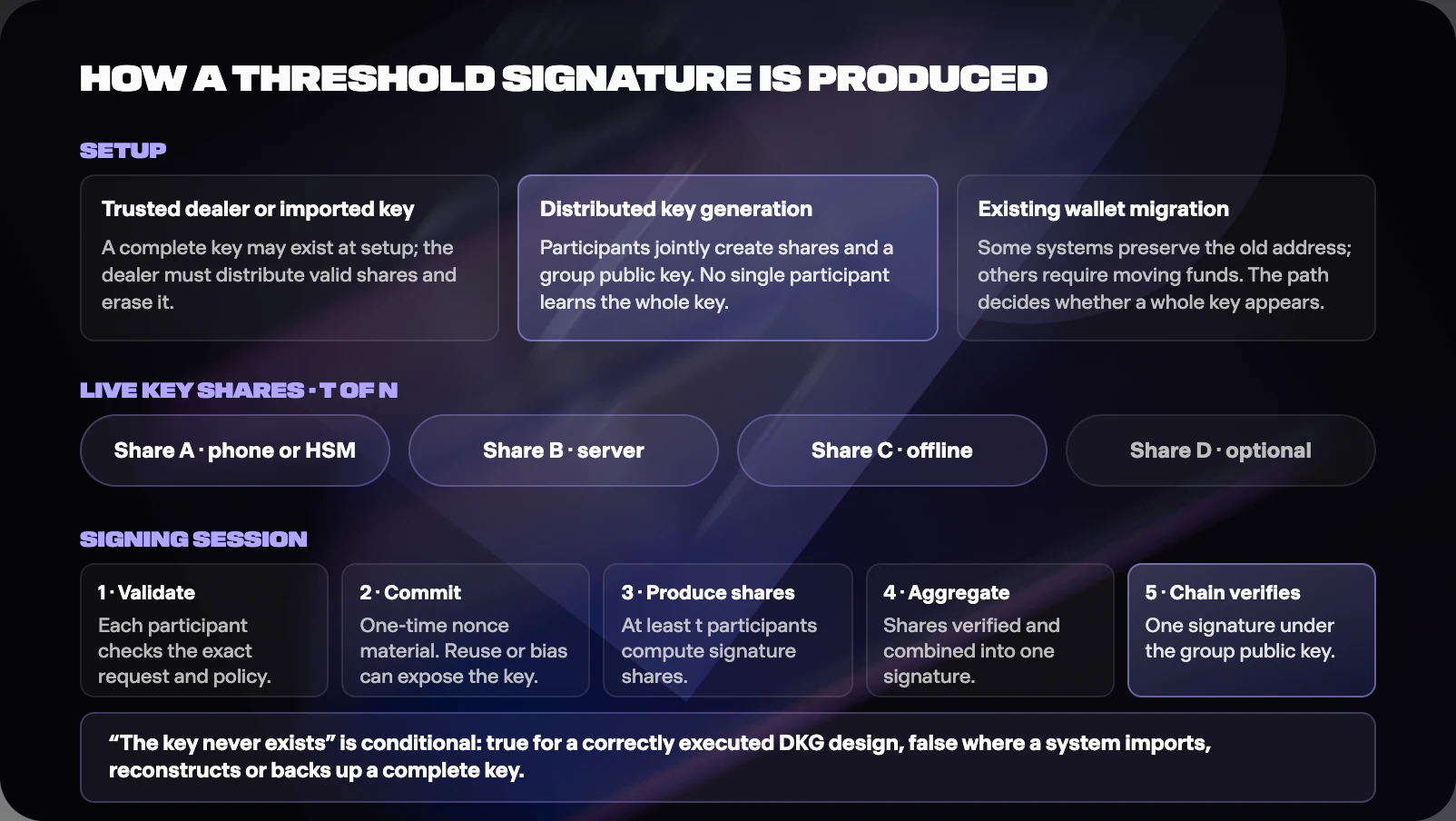
Sometimes. In a DKG-based system, participants jointly create shares and a group public key so no single participant learns the complete private key under the protocol assumptions. A trusted dealer, imported-key conversion or reconstruction backup may create a complete key at setup or recovery. The lifecycle, not the marketing label, determines the answer.
Trusted dealer
A dealer generates a normal private key, creates shares and distributes them. This can be secure if the dealer uses strong randomness, authenticates every participant, verifies the sharing commitments and reliably erases the original secret and unused shares. It nevertheless creates a moment and an actor with complete-key knowledge. RFC 9591 places key generation outside the main FROST protocol and includes a trusted-dealer procedure only as an appendix.
Distributed key generation
A DKG protocol lets participants contribute randomness and jointly derive shares plus a common public key. No single party should learn the corresponding private key, provided the protocol is correctly implemented and the corruption threshold is not exceeded. DKG is not a single algorithm: different schemes make different assumptions about broadcasts, authenticated channels, complaints, malicious parties and participant availability.
Importing an existing key
Institutions may want to preserve an existing address, account history or public key. Some protocols support converting or sharing an existing key. That process may require the key owner to handle the complete key, or it may use specialised import protocols. The security history before import still matters: distributing a key does not undo an earlier copy, photograph, backup or compromise.
Recovery and emergency reconstruction
Some systems retain a break-glass path that reconstructs the key from backup material. That can improve disaster recovery and simultaneously reintroduce the single-key exposure the threshold design was meant to avoid. Other systems deliberately offer no reconstruction path and require a threshold of live participants for every recovery action. Neither is automatically correct; the choice should be explicit, tested and included in the threat model.
Why do nonces, preprocessing and coordinators matter?
Quick answer
Threshold signing introduces protocol state around one-time nonce material, participant commitments and a shared transcript. Reusing or biasing a nonce, mixing sessions, accepting malformed proofs or letting participants sign different messages can expose the group key or produce invalid signatures. Preprocessing improves latency but creates valuable presignature inventory that must be protected.
Nonces are part of the secret
Schnorr, EdDSA and ECDSA signatures all depend on per-signature secret values commonly called nonces. In ordinary single-party signing, a sound library can generate or derive the nonce inside one trusted boundary. In a threshold protocol, several parties jointly contribute to or compute nonce-related state. A reused nonce, replayed commitment or deliberately malformed multiplication message can turn one or more signing sessions into a key-extraction attack. RFC 9591 explicitly warns that deterministic nonce derivation suitable for ordinary EdDSA is unsafe in the multi-party setting and requires fresh uniformly random nonce generation.
Preprocessing moves work before the message
Many threshold-ECDSA systems compute expensive material before the transaction is known. The online phase can then be reduced to a small number of messages, which is useful for cold signers and high-latency networks. The trade-off is operational: presignatures become single-use cryptographic inventory. Reuse, rollback, duplication across replicas or loss of state synchronisation can be catastrophic. Backups must not restore consumed presignatures as if they were unused.
Session binding prevents mix-and-match attacks
Every message should be bound to the protocol version, group public key, participant set, message digest, chain, network, signer role and unique session. A participant should reject stale or inconsistent commitments and confirm that the final transaction bytes are the same bytes authorised by policy. This is where application design meets cryptography: a formally secure signing core can still sign the wrong chain, wrong nonce, wrong contract call or wrong destination if the adapter supplies an incorrect payload.
Robustness is not automatic
Some protocols guarantee secrecy and unforgeability but abort when one participant misbehaves. Identifiable abort can name a participant responsible for failure; robustness aims to finish despite some bad parties. RFC 9591 does not claim robustness and notes that a higher-level wrapper such as ROAST can address malicious disruption in some settings.
What is FROST, and what does RFC 9591 standardise?
Quick answer
FROST is a threshold Schnorr protocol that produces a signature after two communication rounds. RFC 9591 specifies the signing protocol, ciphersuites and test vectors. It does not standardise distributed key generation, robustness, metadata protection or a one-round preprocessing variant, and it is an informational IRTF research RFC rather than an Internet Standard.
FROST takes advantage of the linear structure of Schnorr signatures. Each selected participant holds a share of the group signing key. In round one, participants generate one-time nonces and publish commitments. In round two, they compute signature shares bound to the message, signer set and commitments. The coordinator verifies and adds the shares to obtain the final Schnorr signature.
| RFC 9591 includes | RFC 9591 does not by itself provide |
|---|---|
| A two-round FROST signing protocol. | A complete distributed key-generation standard. |
| Ciphersuites for Ed25519, ristretto255, Ed448, P-256 and secp256k1. | Automatic compatibility with every protocol using the same curve. |
| Signature-share verification and aggregation procedures. | Robust completion against malicious participants. |
| Trusted-dealer key generation as an informative appendix. | A guarantee that no complete key existed during setup. |
| Security considerations for nonce reuse, side channels and message validation. | Metadata privacy, downgrade prevention or post-quantum security. |
| Test vectors for the specified suites. | Chain-specific transaction parsing, policy or wallet recovery. |
The distinction between a research RFC and an Internet Standard matters. RFC 9591 represents Crypto Forum Research Group consensus and gives implementers a precise common specification, but its status section states that it is informational and not on the IETF standards track. NIST has separately begun a multi-year evaluation process for threshold schemes; FROST is among the schemes being previewed for that call.
Is the RFC secp256k1 suite Bitcoin Taproot compatible?
Not automatically. Bitcoin BIP340 defines x-only public keys, tagged hashes, a specific challenge equation and a 64-byte encoding. The FROST secp256k1 ciphersuite in RFC 9591 uses its own domain-separated hash construction and generic compressed point handling. A protocol can use the same curve and still produce signatures that a BIP340 verifier rejects. Bitcoin-compatible threshold Schnorr therefore needs a construction and implementation explicitly designed for BIP340 semantics.
Takeaway: "Uses secp256k1" is not a compatibility certificate. The curve is only one layer of a signature system.
Why is threshold ECDSA harder than threshold Schnorr?
Quick answer
Schnorr signatures are linear, so correctly weighted signature shares can be added. ECDSA includes multiplication by the inverse of a secret nonce, which forces parties to compute products and inverses of shared secrets without revealing them. That requires additional MPC machinery, proofs and protocol rounds.
In simplified form, an ECDSA signature contains a value s = k^-1(H(m) + r x) mod q, where x is the private key and k is a one-time nonce. In a threshold setting, neither x nor k should be known to one party. The participants must therefore obtain additive or polynomial shares of products involving x and k, and ultimately of the inverse-related expression, while preventing a malicious party from choosing malformed values that leak another share.
Paillier-based protocols use additively homomorphic encryption and multiplication-to-addition, or MtA, subprotocols. Other families use class groups or oblivious transfer. Zero-knowledge proofs or consistency checks demonstrate that encrypted values and shares lie in the required ranges and satisfy the protocol relations. These components create more implementation surface than threshold Schnorr: large integer arithmetic, proof systems, transcript management, preprocessing, failure attribution and multiple cryptographic assumptions.
| Dimension | Threshold Schnorr / FROST | Threshold ECDSA |
|---|---|---|
| Core algebra | Linear relation; signature shares can be combined additively. | Non-linear relation involving a shared nonce inverse and products of secrets. |
| Typical signing interaction | Two rounds in RFC 9591; preprocessing variants exist outside the RFC. | Varies by protocol; online/offline designs can make the online phase short. |
| Auxiliary primitives | Prime-order group, hashes, secret sharing, commitments and share verification. | May add Paillier or class-group encryption, oblivious transfer, range proofs and zero-knowledge checks. |
| Implementation complexity | Substantial, but comparatively direct. | Higher and historically rich in implementation pitfalls. |
| Verifier output | Ordinary Schnorr or compatible signature for the chosen suite. | Ordinary ECDSA signature when chain-specific encoding rules are satisfied. |
| Protocol landscape | FROST has a shared CFRG specification. | Several protocol families; no single universal deployment standard. |
Threshold ECDSA remains important because Bitcoin legacy and SegWit v0 key spends, Ethereum externally owned accounts and many other deployed systems verify ECDSA. Compatibility with existing addresses and hardware can justify the complexity, but the choice should be made with clear awareness of the larger attack surface.
Which threshold-ECDSA protocol families matter?
Quick answer
The deployed and research landscape includes Paillier/MtA protocols such as Gennaro-Goldfeder and CGGMP, two-party and multiparty protocols from Doerner-Kondi-Lee-shelat, class-group constructions and newer two- and three-round designs. Names such as GG18, GG20 and CGGMP21 identify papers, not one interchangeable industry standard.
The field moves quickly, and protocol nicknames are often used imprecisely. Implementers must identify the exact paper revision, parameter set, security proof and code version. A library described as "GG18" may incorporate later patches, omit required proofs, add proprietary preprocessing or implement an older vulnerable variant. The year in a nickname is not a sufficient security statement.
| Protocol / family | Shape | Important contribution or caveat |
|---|---|---|
| Lindell-Nof and related two-party ECDSA | Primarily 2-of-2 designs. | Practical distributed key generation and signing for two parties; different security assumptions and constructions exist. |
| GG18 / updated Gennaro-Goldfeder | General threshold ECDSA. | Fast dealerless setup and practical multiparty signing using Paillier/MtA; implementation details and revisions matter. |
| GG20 | General threshold ECDSA with preprocessing. | Adds a non-interactive online phase and identifiable abort; published revisions corrected issues. |
| CGGMP / CGGMP21 | Any number of signers; proactive and UC-oriented design. | Combines preprocessing, proactive refresh, adaptive security and identifiable abort under stated assumptions. |
| DKLS two-party and multiparty families | OT-based ECDSA protocols. | Avoid Paillier assumptions in some constructions; later work gives three-round dishonest-majority signing. |
| Class-group and newer constructions | Various thresholds and online/offline trade-offs. | Aim to improve bandwidth, rounds, assumptions or accountability; the NIST call is collecting multiple candidates. |
The article does not rank these protocols. Performance depends on participant count, geography, threshold, preprocessing, hardware, availability assumptions and implementation quality. A newer paper is not automatically safer than a mature implementation, and a mature implementation is not safe merely because the underlying paper is well studied.
How do FROST, MuSig2 and ordinary multisig differ?
Quick answer
FROST is a t-of-n threshold Schnorr scheme using shares of one group key. MuSig2 aggregates several independent Schnorr keys and requires all n signers, so it is n-of-n rather than a general threshold scheme. Ordinary on-chain multisig asks the blockchain script or contract to verify several keys or signatures according to its own policy.
| Feature | FROST | MuSig2 | On-chain multisig / contract wallet |
|---|---|---|---|
| Signer structure | Shares of one group secret. | Several complete independent private keys. | Several complete keys or other contract-defined authorities. |
| Quorum | t-of-n. | n-of-n. | Chain-specific m-of-n or programmable policy. |
| Verifier sees | One signature and one group public key. | One aggregate Schnorr signature and aggregate key. | Multiple signatures, script execution or contract call - unless hidden by a construction such as Taproot key path. |
| Key generation | Dealer or DKG / distributed setup. | Non-interactive aggregation of existing public keys. | Each signer creates an ordinary key; policy is deployed on-chain. |
| Participant replacement | May preserve group public key through resharing if supported. | Changing signers changes the aggregate key. | Often requires a new script, contract state update or new address; design varies. |
| Main standard reference | RFC 9591 for two-round FROST signing. | BIP327 for BIP340-compatible MuSig2. | Bitcoin script/Taproot rules, Ethereum contract code or another chain-specific mechanism. |
MuSig2 is sometimes called a threshold signature because several parties cooperate. BIP327 is explicit that it is an n-of-n multisignature scheme, not a t-of-n threshold signature. Every key used in the aggregation remains a complete signing key. If one participant is unavailable, the group cannot sign unless a separate fallback path exists.
Taproot complicates the visibility comparison. A MuSig2 or other aggregate key-path spend can look like an ordinary single-signer BIP340 spend, and optional script paths remain hidden unless used. A script-path spend reveals the executed branch and proof, not necessarily every unused branch. Therefore "multisig is visible, threshold is invisible" is too absolute.
Threshold signing vs on-chain multisig: which trade-offs change?
Quick answer
On-chain multisig makes the blockchain enforce the quorum using independent keys or contract logic. Threshold signing enforces the quorum off-chain and presents one public key and signature to the chain. Multisig usually offers simpler, independently verifiable policy; threshold signing offers compact signatures, policy privacy and potential address continuity at the price of more complex off-chain cryptography.
The comparison is not a universal ranking. Bitcoin script, Taproot and Ethereum smart-contract accounts expose different capabilities. Some chains support efficient native multisignature; others require contract wallets or lack a flexible script at all. Threshold signing can make the chain see a familiar signature, but the off-chain protocol becomes part of the trusted computing base.
| Dimension | On-chain multisig | Threshold signature |
|---|---|---|
| Where quorum is enforced | By blockchain validation rules or contract code. | By an off-chain cryptographic protocol. |
| Keys | Each signer normally holds a complete independent key. | Each participant holds a share of one group signing key. |
| Auditability | Policy and signatures may be inspectable on-chain, depending on the construction. | The verifier normally sees one key and one signature; internal quorum is not proven on-chain. |
| Fees and footprint | May require more data or contract execution; Taproot aggregation can reduce this. | Usually one ordinary signature at the chain layer. |
| Failure isolation | A bug in one signer does not necessarily expose the other complete keys. | A protocol or implementation flaw can sometimes extract the group key from honest participants. |
| Address continuity | Changing policy often changes script or contract state; design varies. | Some resharing protocols preserve the same group public key and address. |
| Portability | Depends on chain script or contract support. | Depends on exact signature compatibility plus chain adapter correctness. |
| Recovery | Can encode backup keys, delays or governance directly on-chain. | Depends on off-chain refresh, resharing, backup and service design. |
A useful design may combine both. For example, a Taproot output can use an aggregate or threshold key path for routine spending and retain hidden script paths for time-delayed or emergency recovery. An Ethereum smart account can require a threshold-produced ECDSA signature plus contract-level limits. Layering can reduce one risk and add operational complexity, so every recovery branch must be tested rather than merely documented.
Does a threshold signature work on any blockchain?
Quick answer
No. A threshold protocol must produce exactly the signature, public-key format and message digest the target chain verifies. Matching the elliptic curve is necessary in some cases but not sufficient. Chain-specific hashing, encoding, canonicalisation, recovery identifiers, address derivation and transaction semantics can all break compatibility.
A blockchain signature stack has several layers: the mathematical curve, signature equation, public-key encoding, signature encoding, transaction serialisation, signing digest, domain separation, canonical-value rules and account or script semantics. Threshold signing must match all of them. The phrase "works on any chain with the same curve" ignores most of this stack.
| Compatibility layer | Example of why it matters |
|---|---|
| Curve and group | secp256k1, P-256 and Ed25519 use different groups and encodings. |
| Signature equation | Generic Schnorr over secp256k1 is not automatically Bitcoin BIP340 Schnorr. |
| Challenge hash / domain separation | The same R and public key can produce a different challenge under different hash rules. |
| Signature encoding | Bitcoin BIP340 uses a fixed 64-byte encoding; ECDSA systems may use DER, compact or r/s plus recovery metadata. |
| Canonicalisation | Ethereum and Bitcoin policies restrict high-s ECDSA signatures in different ways; a threshold adapter must output accepted values. |
| Signing digest | Bitcoin sighash flags, Ethereum typed transactions and contract-specific messages sign different byte sequences. |
| Address derivation | The same public key may map to different addresses on different chains or account types. |
| Application policy | A valid signature can still authorise the wrong network, token contract, nonce, amount or destination. |
Bitcoin
Legacy and SegWit v0 key spends use ECDSA, while Taproot key-path signatures use BIP340 Schnorr. BIP340 has specific x-only keys and tagged hashing. MuSig2 BIP327 is explicitly designed for BIP340. A generic threshold-ECDSA or FROST library needs a Bitcoin adapter that handles sighash construction, script type, key tweaking, nonce rules and accepted signature encoding.
Ethereum
Externally owned accounts use secp256k1 ECDSA and recover an address from signature components. Ethereum transaction types, chain IDs and EIP-712 structured data use distinct signing domains. EIP-2 rejects high-s transaction signatures. A threshold signer must therefore produce canonical r and s values plus the correct recovery information for the exact payload.
Ed25519-based systems
RFC 9591 includes Ed25519-compatible and Ed448-compatible suites whose final signatures can be checked by the corresponding standard verifiers. The application still has to provide the exact chain message, public-key format and transaction policy. Verifier compatibility does not validate the surrounding wallet integration.
How do refresh, resharing, recovery and membership changes work?
Quick answer
A proactive refresh replaces every share with a new share of the same secret, leaving the group public key unchanged. Resharing can also change the threshold or participant set in protocols designed for it. Neither operation is automatic: enough authorised participants, authenticated communication, correct state and explicit protocol support are required.
Proactive refresh
A refresh adds a sharing of zero or otherwise re-randomises the shares so the underlying group secret stays the same. Old shares should become unusable after the refresh. Under a proactive security model, an attacker who compromises different participants over time must gather a threshold within one refresh period rather than accumulating shares forever. Refresh does not repair a compromise that already reached the threshold, and it does not erase copies an attacker may have made of application credentials or policy systems.
Resharing and participant replacement
A resharing protocol can distribute new shares to a new participant set and may change t or n while preserving the same group public key. This can replace a lost device, rotate an employee or alter organisational control without moving on-chain funds. It is possible only when the protocol supports it and a sufficient authorised set cooperates. A product cannot "recreate" a lost share from nothing.
What happens when one share is lost?
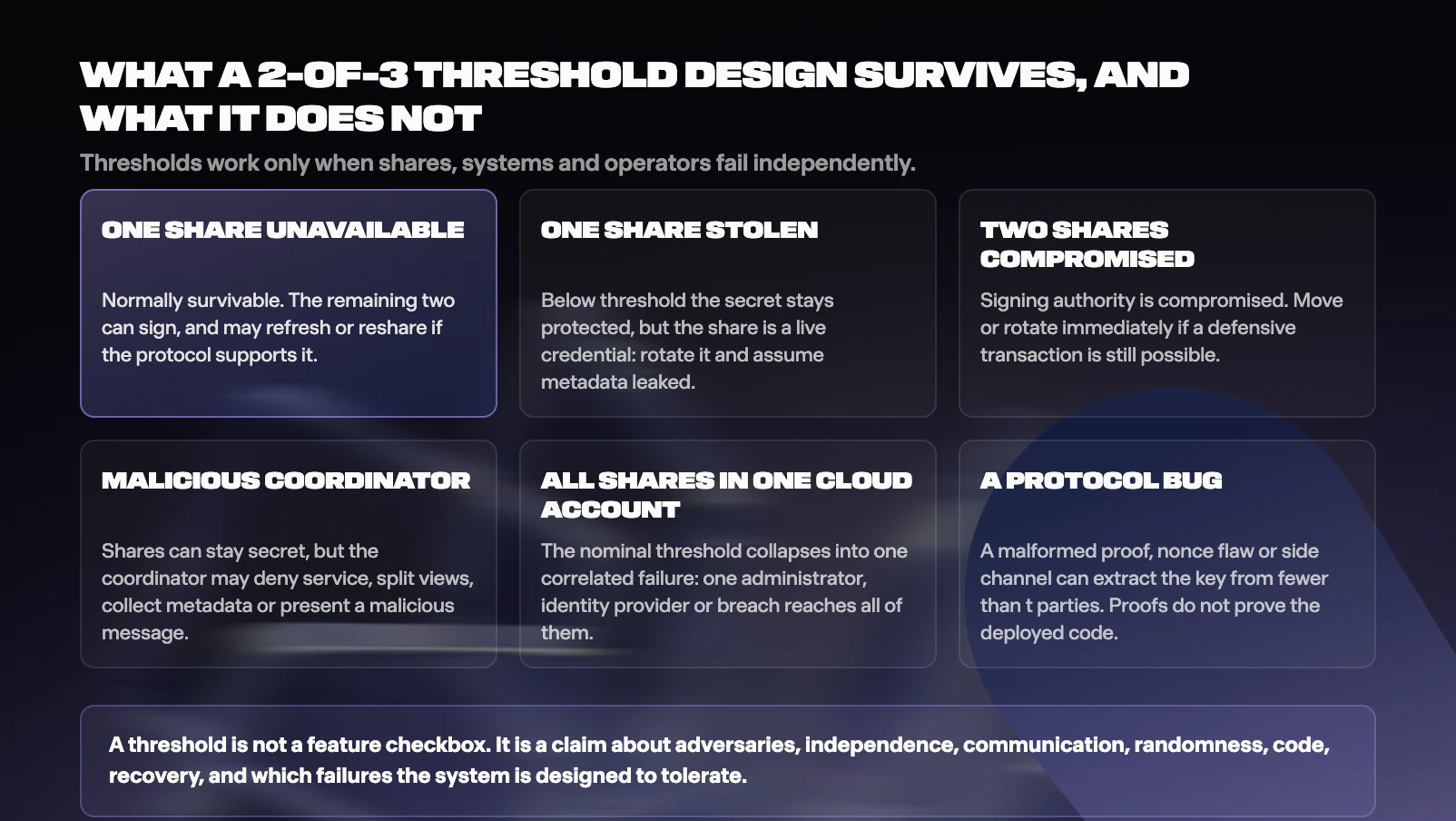
If at least t valid shares remain, the group can normally continue signing. It may be able to create a replacement through resharing. If fewer than t shares survive and there is no separate recovery key, backup or contract path, the signing authority is gone. A threshold scheme improves redundancy; it does not guarantee recovery from every loss pattern.
What happens when one share is stolen?
In an ideal t-of-n secret-sharing model, fewer than t shares do not reveal the secret and cannot sign. Operationally, a stolen share is still a live security incident. The attacker may use it in protocol sessions, combine it with future compromises, exploit implementation bugs or learn metadata. The correct response is to halt risky sessions, investigate, refresh or reshare, rotate surrounding credentials and verify that the remaining participants are independent.
What are the main security assumptions and failure modes?
Quick answer
Threshold signing relocates risk rather than eliminating it. The main failure classes are threshold-many compromise, correlated infrastructure, malicious participants, denial of service, nonce or randomness failure, protocol or proof bugs, side channels, incorrect chain integration, unsafe recovery and a policy layer that authorises the wrong message.
| Failure mode | What can happen | Primary controls |
|---|---|---|
| Threshold-many share compromise | The attacker can produce valid signatures under the group key. | Independent devices and operators, refresh, least privilege, monitoring and rapid rotation. |
| Correlated compromise | One cloud identity, administrator, update channel or library reaches several shares. | Separate failure domains, vendors, credentials, networks and operational ownership. |
| Malicious participant | Abort, inconsistent views, malformed protocol messages or chosen-input attacks. | Authenticated transcripts, share verification, identifiable abort, robustness and exclusion procedures. |
| Nonce / presignature failure | Complete key extraction or invalid signatures after reuse, bias, rollback or duplication. | CSPRNGs, single-use state, anti-rollback storage, session binding and inventory controls. |
| Protocol implementation bug | Key extraction despite the paper-level protocol being secure. | Exact-paper implementation, independent audits, test vectors, formal methods where practical and patch governance. |
| Side channel | Secret-share or nonce leakage through timing, cache, power, fault or error behaviour. | Constant-time primitives, HSM/device hardening, fault detection and environment-specific testing. |
| Chain adapter bug | A valid signature over the wrong payload, wrong chain or rejected encoding. | Independent transaction parsing, canonical encodings, testnets, reference vectors and policy validation. |
| Recovery failure | Permanent lockout, secret reconstruction on an unsafe device or unauthorised break-glass use. | Documented and rehearsed recovery, quorum separation, sealed procedures and monitoring. |
| Policy / human failure | The quorum signs a scam, malicious approval or misconfigured transaction. | Clear trusted displays, independent review, limits, allowlists, delays and out-of-band verification. |
Security against abort is different from security against theft
Many dishonest-majority protocols preserve secrecy even when a malicious participant stops the session. That is a successful cryptographic outcome and a failed operational outcome. Treasury systems should define how quickly a bad participant can be excluded, whether alternate signer subsets exist, how stale sessions are cancelled and how the business continues during a dispute.
The coordinator can be non-secret and still powerful
A coordinator may select signers, collect commitments, choose the message, schedule sessions and publish the final signature. Even without a key share it can observe metadata, censor requests, split participant views or repeatedly trigger expensive work. Protocol messages should be authenticated, participants should derive or independently validate the transaction, and monitoring should distinguish ordinary failure from adversarial behaviour.
Threshold signing is not post-quantum by default
FROST, ECDSA and current Schnorr systems rely on discrete-logarithm assumptions. Splitting a key does not make the underlying signature algorithm resistant to a sufficiently capable quantum computer. Post-quantum threshold signatures are an active research and standardisation area, and migration planning must consider both the chain verifier and the distributed key-management layer.
What did Alpha-Rays, TSSHOCK and later key-extraction research show?
Quick answer
They showed that implementation shortcuts in threshold ECDSA can let a malicious participant extract the complete signing key without breaking ECDSA or the elliptic curve. Missing range proofs, malformed Paillier parameters, weak zero-knowledge validation and protocol-specific coding errors turned sub-threshold access into full compromise.
Alpha-Rays
The 2021 Alpha-Rays research described key-extraction attacks against implementations of GG18- and GG20-style threshold ECDSA. The attacks targeted multiplication-to-addition subprotocols and implementation choices such as "fast" modes without the required range proofs. A malicious participant could exploit the interaction to recover the complete key. The result did not break ECDSA; it demonstrated that omitting proof and validation steps invalidates the security argument.
TSSHOCK
TSSHOCK, disclosed in 2023, documented additional attacks against threshold-ECDSA implementations. The research focused on implementation flaws in homomorphic-encryption and proof handling and showed several routes to private-key recovery. The important lesson is broader than the named attacks: threshold ECDSA protocols are sensitive to exact ranges, parameter validation, proof statements and error handling.
BitGo Zero Proof
A publicly disclosed BitGo wallet vulnerability found by Fireblocks illustrated the same pattern in a production integration. Missing proof validation in a two-party ECDSA flow could allow one party to extract the other party's share and reconstruct the key. The affected service was suspended and patched after disclosure. Again, the failure was not the ECDSA primitive; it was the protocol implementation and the missing verification boundary.
Practical key-extraction research in 2024
Later academic and industry research analysed leading MPC-wallet implementations and reported key-extraction attacks requiring different numbers of signing interactions, in one case as few as one signature under the studied conditions. These results reinforce the need to identify exact protocol versions, include every proof and validation step, and treat implementation review as part of the cryptographic security claim.
How should an MPC or threshold-signature implementation be evaluated?
Quick answer
Start with the exact protocol, version and adversary model, then evaluate code, randomness, nonce lifecycle, channels, side-channel resistance, chain adapters, share independence, refresh, recovery and policy. "Uses MPC", "audited" or "the key never exists" is not enough evidence on its own.
Cryptographic specification
- Name the exact paper, revision, ciphersuite and parameter set. Confirm whether the implementation matches the version whose proof is cited.
- Document the threshold, participant count, static or adaptive corruption model, honest- or dishonest-majority assumption, abort behaviour and robustness claims.
- Confirm how keys are generated or imported, whether a trusted dealer exists, and whether any complete key or reconstructable backup is ever created.
- Identify every auxiliary primitive: Paillier parameters, oblivious transfer, class groups, commitments, zero-knowledge proofs, hash functions and random-number generators.
Implementation and testing
- Require independent review by specialists in the exact protocol family, not only a general smart-contract or application audit.
- Test all negative paths: malformed points, scalars, proofs, ciphertexts, participant identifiers, signer sets, duplicate nonces, replayed messages and aborted sessions.
- Use constant-time and side-channel-resistant primitives appropriate to the device environment; protect logs, crash dumps, swap, telemetry and observability systems.
- Verify against published test vectors and build cross-implementation interoperability tests where a specification exists.
- Maintain a vulnerability-response process that can revoke participants, halt signing, refresh shares and migrate funds without hiding operational impact.
Operational architecture
- Place shares in genuinely independent failure domains: different credentials, administrators, devices, networks and preferably different software or hardware roots where practical.
- Protect presignature and nonce state against rollback, cloning and backup restoration. Treat consumed state as permanently consumed.
- Authenticate participant messages and give each signer enough transaction data to validate the economic action, not only a hash with no context.
- Rehearse loss, compromise, employee departure, cloud outage, coordinator failure and disaster recovery. A recovery plan that has never been executed is an assumption.
- Monitor signing attempts, participant selection, failed proofs, refresh events and policy overrides. Cryptographic privacy should not eliminate operational accountability.
| Red flag | Why it is insufficient or dangerous |
|---|---|
| "Military-grade MPC" with no protocol name | There is no technical claim to evaluate. |
| All shares run under one cloud tenant | The threshold may collapse under one credential or administrator compromise. |
| Recovery can recreate any share without a quorum | A hidden master secret or central recovery authority may exist. |
| A generic secp256k1 library is said to support every chain | Curve compatibility ignores message, encoding and verifier differences. |
| Audit report covers only the mobile app or smart contract | The threshold protocol, native cryptography and backend state may remain unaudited. |
| No documented response to a stolen share | The system may lack refresh, resharing or emergency migration. |
| Signers receive only an opaque digest | They cannot independently validate what economic action they are authorising. |
Frequently asked questions
Is MPC the same as threshold signatures?
No. MPC is the broad discipline of computing over private inputs held by several parties. Threshold signing is one MPC application that produces a digital signature under a shared group key. Other MPC applications include threshold decryption, private set intersection and joint randomness generation.
Does a threshold wallet have a private key?
It has signing authority corresponding to a public key, but that authority may exist only as distributed shares. In a DKG-based design, no participant ever holds the complete private key. In a dealer, import or reconstruction design, a complete key may exist at some stage.
Can one stolen share steal the funds?
Under a correctly implemented t-of-n scheme, fewer than t shares should not produce a signature or reveal the key. A stolen share is still an incident: the attacker may combine it with later compromises, abuse protocol sessions or exploit implementation flaws. Refresh or reshare when the design permits.
Can a lost share be replaced?
Only if enough authorised shares remain and the protocol or recovery architecture supports resharing. The surviving participants can sometimes create a new share while preserving the public key. If fewer than the threshold survive and no separate recovery path exists, the key cannot be recovered.
Is FROST an official Internet standard?
No. RFC 9591 is an informational IRTF publication representing Crypto Forum Research Group consensus. It is a precise shared specification, but it is not an IETF standards-track document. NIST is separately evaluating threshold-scheme submissions through a process that began its formal call in 2026.
Does RFC 9591 include key generation?
The main specification covers two-round FROST signing. Key generation is explicitly outside its main scope. An appendix gives a trusted-dealer example, and deployments can use a separate DKG protocol.
Is FROST secp256k1 compatible with Bitcoin Taproot?
The RFC includes a secp256k1 ciphersuite, but that does not automatically make it BIP340-compatible. Bitcoin uses specific x-only keys, tagged hashes and encoding rules. A Bitcoin deployment needs a BIP340-specific threshold construction and chain adapter.
Is MuSig2 a threshold signature?
MuSig2 is a multi-signature scheme that aggregates independent Schnorr keys and requires all n signers. BIP327 explicitly describes it as n-of-n rather than a general t-of-n threshold signature scheme.
Can the blockchain tell that MPC was used?
Often not from the final signature alone: it verifies like an ordinary signature under one public key. The address type, contract code, transaction patterns, service metadata or later disclosures may still reveal the custody design. Taproot can also hide some multisignature and script policies, so invisibility is not unique to MPC.
Is threshold signing safer than multisig?
Neither is universally safer. Multisig offers simpler chain-enforced policy and independent complete keys; threshold signing can reduce on-chain footprint, hide the quorum and preserve an address through resharing. Threshold protocols add off-chain cryptographic and implementation complexity. The correct choice depends on the chain, threat model, recovery needs and operational skill.
Does threshold signing protect against scams?
It can require several approvals and enforce limits, but a legitimate quorum can still sign a malicious transaction. Participants and policy systems must understand the exact destination, amount, contract call, network and permissions before producing shares.
Is threshold cryptography post-quantum?
Current FROST, Schnorr and ECDSA threshold schemes are not post-quantum. They distribute the existing signing authority but retain the security assumptions of the underlying signature algorithm. Post-quantum threshold schemes require different primitives and chain support.
Bottom line
Threshold cryptography solves a real operational problem: one signing secret should not decide the fate of a large balance, system or institution. The solution is not simply to cut a key into pieces. A full threshold-signature design must define how shares are generated, how one-time randomness is protected, how participants agree on one message, how malformed contributions are rejected, how failures are attributed, how shares are refreshed and how the final signature matches the target chain.
The most important correction to the usual marketing language is that every claim is conditional. A DKG-based system can avoid a complete key for its entire lifetime; an imported-key system cannot claim the same history. A lone share can be cryptographically insufficient and operationally urgent. One signature can look ordinary on-chain while depending on a large off-chain trusted computing base. A protocol can be proven secure and implemented insecurely.
Used with independent failure domains, audited code, strict nonce discipline, correct chain adapters, rehearsed recovery and signers that validate what they approve, threshold signing can remove the single point of failure without sacrificing compatibility with ordinary signature verification. Used as a label without those controls, it can conceal a more complicated single point of failure.
Sources and further reading
Key references for this article, current as of July 2026.
- NIST Multi-Party Threshold Cryptography project. https://csrc.nist.gov/projects/threshold-cryptography
- NIST IR 8214: Threshold Schemes for Cryptographic Primitives. https://csrc.nist.gov/pubs/ir/8214/final
- NIST IR 8214A: Roadmap Toward Criteria for Threshold Schemes. https://csrc.nist.gov/pubs/ir/8214/a/final
- NIST IR 8214C: First Call for Multi-Party Threshold Schemes. https://nvlpubs.nist.gov/nistpubs/ir/2026/NIST.IR.8214C.pdf
- Adi Shamir, How to Share a Secret. https://dl.acm.org/doi/10.1145/359168.359176
- RFC 9591: FROST Two-Round Schnorr Signatures. https://www.rfc-editor.org/info/rfc9591/
- Komlo and Goldberg, FROST. https://eprint.iacr.org/2020/852
- BIP340: Schnorr Signatures for secp256k1. https://bips.dev/340/
- BIP327: MuSig2 for BIP340-compatible Multi-Signatures. https://bips.dev/327/
- BIP341: Taproot. https://github.com/bitcoin/bips/blob/master/bip-0341.mediawiki
- Gennaro and Goldfeder, Fast Multiparty Threshold ECDSA with Fast Trustless Setup. https://dl.acm.org/doi/10.1145/3243734.3243859
- Gennaro and Goldfeder, One Round Threshold ECDSA with Identifiable Abort. https://eprint.iacr.org/2020/540
- Canetti et al., UC Non-Interactive, Proactive, Threshold ECDSA with Identifiable Aborts. https://eprint.iacr.org/2021/060
- Doerner et al., Threshold ECDSA from ECDSA Assumptions: The Multiparty Case. https://eprint.iacr.org/2019/523
Quick quiz: did it stick?
A few questions to check the fundamentals landed. Answers with explanations follow, and nobody is grading you except your future portfolio.


You have completed a quiz on “Threshold Cryptography and MPC From First Principles”! Share your achievement on social media.
 Was this helpful?