TL;DR
- It means controlling the signing authority a blockchain checks before moving your assets, which makes you the security team: no support desk, no reset link, no one to call. The wallet is an interface; the key is the asset's real location.
- A software wallet keeps the key on an internet-connected device, which makes it free, instant and ideal for small active balances, and places your entire security inside the most attacked environment you own. It is a jacket pocket: perfect for what you can afford to lose from one.
- A hardware wallet moves the key into a dedicated device designed to generate and use it internally, which, when the design holds, takes the malware-reads-my-key class largely off the table; it still depends on the seed phrase backup, still signs what a compromised computer asks it to, and still fails to one burglar or one flood if phrase and device share a fate. It hardens one link, never the chain.
- MPC removes the single secret through two separate properties: threshold signing avoids reconstructing a whole key at use time, and, where the setup uses distributed key generation, no complete key exists at creation either; in a sound design that combination means no seed phrase or single share can move or surrender the funds. The single point of failure is deleted by the specific implementation, both properties worth confirming, rather than by the acronym.
In one block
A key storage model is the arrangement that decides where a wallet's signing authority lives and what must be compromised, lost or coerced for assets to move. Software wallets hold keys on a connected device, trading safety for convenience. Hardware wallets isolate keys in a dedicated device designed to sign internally and keep key material inside.
What does it actually mean to hold your own keys?
Quick answer
It means controlling the signing authority a blockchain checks before moving your assets, which makes you the security team: no support desk, no reset link, no one to call. The wallet is an interface; the key is the asset's real location.
A quick grounding, since everything below depends on it. Assets live as entries on the blockchain; what a wallet holds is the private key material that can authorise changes to those entries. Whoever can produce a valid signature controls the funds, and once a base-layer transfer confirms it is normally irreversible, narrow issuer, platform and court exceptions aside. This academy's articles on keys and on custody models cover the mechanics; the operational consequence is the point here. Self-custody concentrates every protective duty, secrecy, backup, succession, judgement at the moment of signing, onto you and your arrangement.
That responsibility has two opposite failure directions, and any honest comparison scores both. Theft: someone else obtains signing authority, through malware, phishing, a stolen device, a leaked backup or coercion. Loss: nobody retains signing authority, through a forgotten password, a destroyed backup, a failed device, or a death with no succession plan. The industry's own history takes loss seriously: River's 2025 analysis estimates roughly 1.57 million bitcoin as likely permanently lost, with the caveat that dormancy cannot prove loss or its causes; the causes documented case by case are mundane, discarded drives, lost phrases, estates with no access, and River's on-chain method cannot say how they rank against theft.
So read every model below through the double lens. Guarding against theft alone builds a vault you will eventually lock yourself out of; guarding against loss alone leaves copies of your key lying around. The engineering question is how gracefully each model lets you hold both doors at once.
How do software wallets work, and where do they fail?
Quick answer
A software wallet keeps the key on an internet-connected device, which makes it free, instant and ideal for small active balances, and places your entire security inside the most attacked environment you own. It is a jacket pocket: perfect for what you can afford to lose from one.
A software wallet, mobile app or browser extension, generates a key, encrypts it, stores it on the device, and hands you a seed phrase, typically a BIP39 word list, as the backup from which everything can be regenerated. Signing happens in the device's memory whenever you approve a transaction.
The strengths are real and worth stating plainly: zero cost, immediate availability, and frictionless interaction with applications, which is exactly why nearly everyone's first wallet is one. For daily payments, small DeFi positions and learning, this is a reasonable tool, and this cluster's beginner articles rightly start people here.
The failure surface is the device itself. A phone or laptop runs browsers, messengers and downloads next to your key; malware that reads memory or clipboard, a malicious app update, or a phishing site that talks you into a signature reaches the same environment the key lives in. The wallet-drainer article in this academy documents how industrial that pipeline is. The backup adds a second surface: a seed phrase photographed, typed into a cloud note or stored in a password manager inherits every weakness of wherever it landed, and a phrase in a drawer is one burglary or house fire from being either stolen or gone.
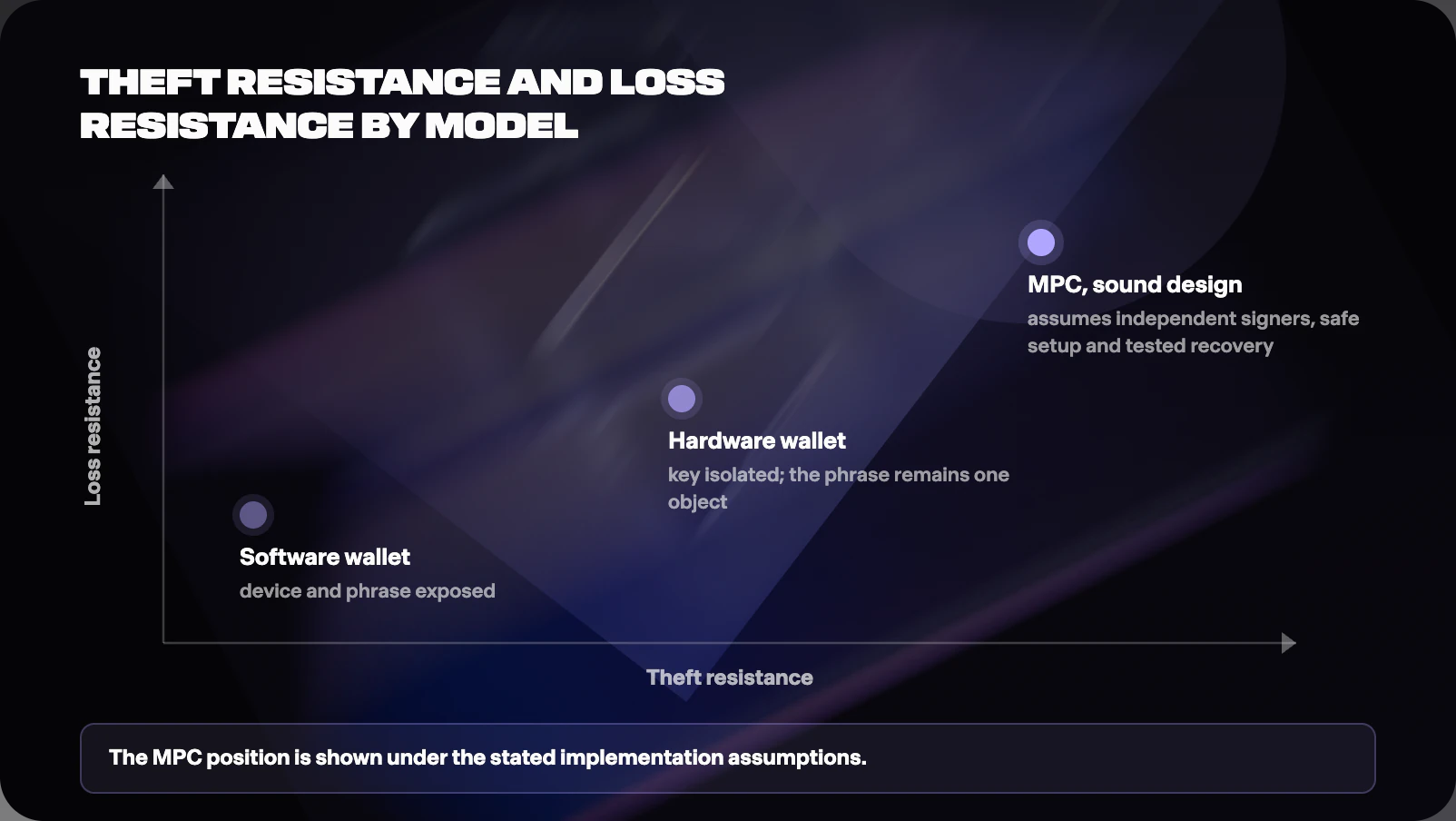
Under the double lens: theft resistance is the model's weak axis, and loss resistance is only as good as one piece of paper. The design conclusion writes itself, and it is the one this article's final section formalises: software wallets suit a float you can afford to lose, rather than long-term savings.
What does a hardware wallet add, and what does it still depend on?
Quick answer
A hardware wallet moves the key into a dedicated device designed to generate and use it internally, which, when the design holds, takes the malware-reads-my-key class largely off the table; it still depends on the seed phrase backup, still signs what a compromised computer asks it to, and still fails to one burglar or one flood if phrase and device share a fate. It hardens one link, never the chain.
The mechanism: keys are generated and stored inside a purpose-built device, often with a certified secure element, and by design do not leave it. Transactions come in from your computer or phone; the device displays what it is being asked to sign and signs inside its boundary; only the signature exits. Under normal operation, malware on the connected machine can propose transactions and cannot extract the key; the design goal has limits in practice, since firmware bugs, supply-chain compromise and some devices' own backup or export features have all produced exceptions, which is why vendor choice and updates matter.
That is a genuine and large upgrade, and it comes with three dependencies that the marketing seldom leads with. First, the backup. Nearly every hardware wallet initialises by handing you the same BIP39 seed phrase a software wallet would, and that phrase can restore the wallet on any compatible software anywhere. Your theft model now includes every place that phrase has ever been, and your coercion model, as the physical security article in this cluster spells out, includes the fact that the entire vault is one recitable sentence. The device is strong; the paper behind it is the actual custodian.
Second, the screen and your attention. The device protects the key, never the judgement. If the connected computer is compromised, the transaction shown for approval is attacker-chosen; clear signing on the device's own display is the defence, and it works only when the human reads it, every time, including the ugly hexadecimal ones. Approval fatigue is a vulnerability class.
Third, the object itself. Devices fail, get lost, burn and get stolen; a PIN and optional passphrase buy time rather than immunity. Recovery then runs entirely through the phrase, returning to dependency one, and a phrase-plus-device stored in the same desk is a single point of failure with two components.
Scored honestly: excellent against remote key extraction, unchanged against signature phishing, and loss-and-coercion resistant exactly to the degree the seed phrase arrangement is, which for most owners means a single sheet of paper is still the whole story.
What does MPC change about holding a key?
Quick answer
MPC removes the single secret through two separate properties: threshold signing avoids reconstructing a whole key at use time, and, where the setup uses distributed key generation, no complete key exists at creation either; in a sound design that combination means no seed phrase or single share can move or surrender the funds. The single point of failure is deleted by the specific implementation, both properties worth confirming, rather than by the acronym.
Threshold cryptography, unpacked from first principles elsewhere in this academy, gives the use-time property in one sentence: keys can be used as multiple shares such that any threshold, say two of three, can sign together, while fewer reveal nothing at all. The signing computation happens without the shares assembling into a whole key on any device, at any moment, including the moment of signing. Whether a complete key ever existed is a separate, setup-time question: distributed key generation creates the shares independently so none ever exists, while a trusted-dealer setup makes the key and then splits it, so the ceremony is worth confirming.
Walk the failure modes from the previous sections through that property. Malware on one device captures one share, and one share is cryptographically useless. A lost phone is replaced and its share refreshed and invalidated, without moving funds or touching the others. There is no seed phrase to photograph, burgle, phish or recite: the coercion scenario from this cluster's physical security article meets a victim who genuinely cannot comply alone, and the loss statistics meet a design where no single forgotten or destroyed object strands anything. Share refresh adds a property nothing else here has: compromise of shares at different times, below threshold at any one time, still yields nothing.
The honest ledger of what MPC adds in exchange. Threshold compromise remains fatal: whoever gathers a quorum of shares, or corrupts the signing ceremony itself, controls the funds, which is why share distribution across genuinely independent devices, locations and parties is the entire design. Implementation is complex cryptographic engineering, and unlike a paper phrase, you cannot audit it by looking at it; protocol maturity, audits and track record carry weight here, as the smart contract risk article argues for code generally. Provider structure matters: consumer MPC wallets typically place shares across your devices and a service or guardians, and the diligence question is the custody question in threshold form: which combinations of parties can sign, and which can lock you out? Recovery, finally, is a designed flow, guardians, backups of shares, rather than a word list, which is both the point and something to understand before, never after, you need it.
Under the double lens, well-implemented MPC is the model where the theft story and the loss story can improve together, because both were downstream of the same design flaw: the existence of one complete secret.
How do the three models compare, and what should you actually do?
Quick answer
Match the model to the balance and to the failure you can least afford, and whatever guards the majority, arrange keys or shares so no single event, place or person is fatal. Tiering beats tribalism, and this comparison recommends structures rather than products.
The comparison, compressed:
| Model | Where the key lives | Worst single event | Recovery story |
|---|---|---|---|
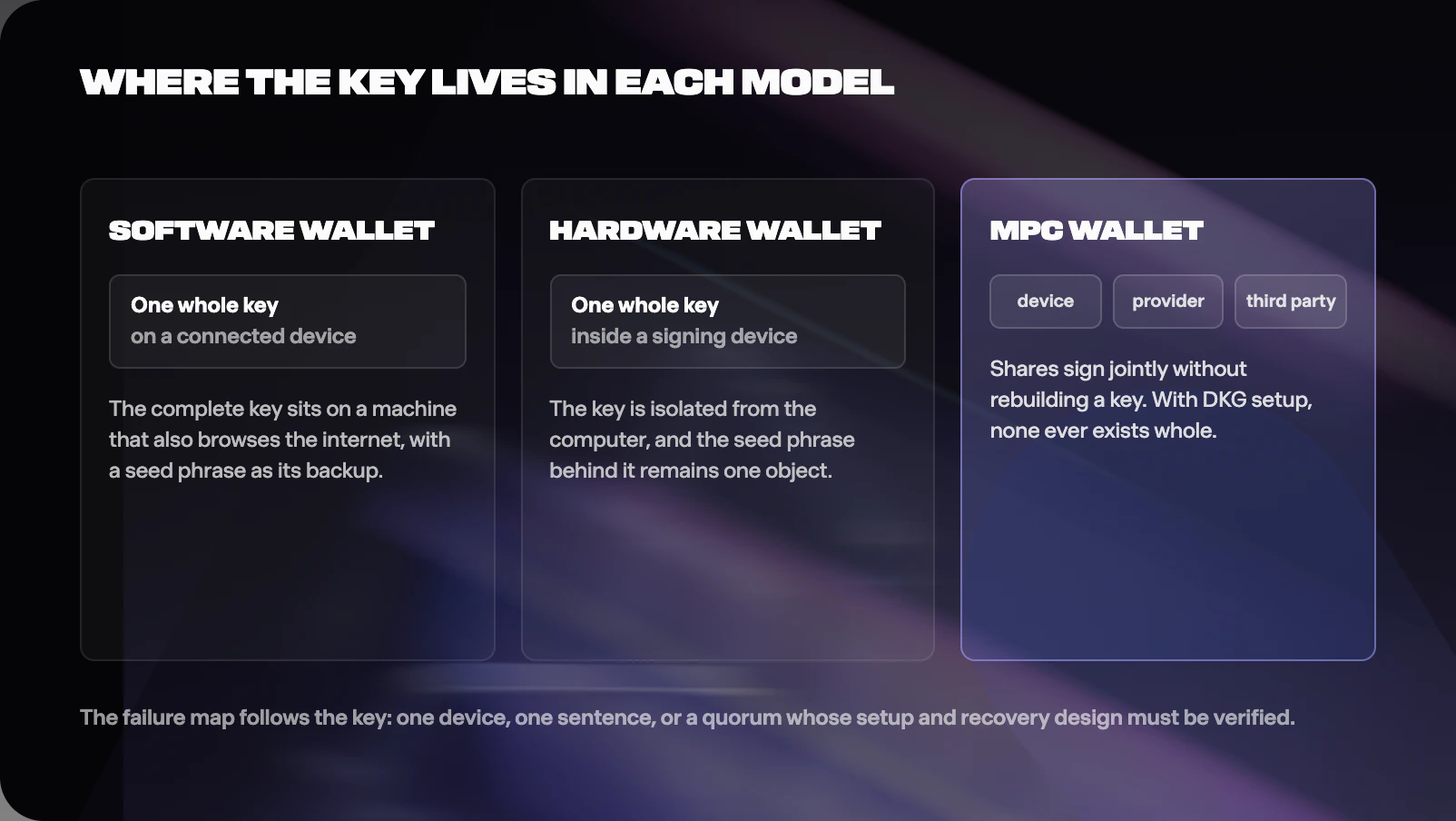
| Software wallet | On a connected device, with a seed phrase backup | Device or phrase compromise takes everything | Seed phrase restores in compatible software; phrase loss strands everything |
| Hardware wallet | Inside a dedicated signing device, seed phrase backup | Phrase compromise or coerced owner takes everything; phrase plus device lost together strands everything | Seed phrase restores in compatible software; same double edge |
| MPC wallet | As distributed shares (non-reconstructing designs) | Threshold-many shares compromised, or flawed implementation | Designed share-refresh and guardian flows; no single object to lose or recite |
Then the placement logic, which matters more than any row and is offered as the pattern many careful holders converge on rather than as advice. Hold in the software tier only what you would carry as cash. Consider holding larger balances behind a model with no single point of failure: for hardware that means engineering it yourself, a multisignature arrangement across devices and places, as the multisig article in this cluster details, or accepting the seed phrase as your true risk and protecting it accordingly; for MPC, verify that the actual signer combinations, recovery and admin paths, update controls and provider dependencies deliver the single-point-of-failure removal the design claims, then choose share distribution and learn the recovery flow. Test recovery with a trivial amount first, in every model, because an untested backup is a hypothesis. Revisit the arrangement when life changes: new family, new country, new balance.
And a note of fairness the content map asks this article to carry: hardware wallets are excellent at what they actually do, isolating keys from connected machines, and pairing one with a distributed arrangement, as a multisig cosigner or an MPC share holder, keeps that strength while retiring the single-sheet-of-paper problem. The models compose. The mistake is treating any single object, device or sentence as a vault.
Frequently asked questions
Is a hardware wallet safer than MPC?
They defend different doors. Hardware isolates signing from your infected laptop; MPC eliminates the single complete secret. A hardware wallet with its one seed phrase remains a single point of failure for loss, theft of the phrase and coercion; an MPC arrangement remains dependent on implementation quality and honest-majority share distribution. For large balances, many careful holders combine both properties: distributed authority with hardware-grade devices holding shares or cosigning, chosen for their situation rather than as a universal ranking.
If MPC has no seed phrase, what happens when I lose my phone?
In a sound design, the lost device holds one share, which alone reveals nothing. Recovery uses the remaining shares plus the wallet's designed flow, guardians, a second device, or an encrypted backup share, to restore signing and refresh shares so the lost one becomes useless. The step to take today, in any MPC wallet, is reading and rehearsing that exact flow, because it replaces the seed ritual and you want to discover its dependencies before an emergency does.
Can I just keep everything on a hardware wallet if I am careful?
Care does not remove structure, and the structure is one recitable sentence and one object. Fire, flood, burglary of the drawer holding both, a coerced evening, or an heir who cannot find the phrase are all single events with total outcomes. Careful hardware users graduate to distribution: multisig across devices and places, passphrase separation, or MPC, so that "careful" stops being the load-bearing component.
Does a seed phrase in a bank safe deposit box solve the backup problem?
It improves fire and burglary risk and imports new dependencies: bank hours against your emergencies, jurisdiction and estate freezes on death, and a complete secret sitting in one third-party location. It is a reasonable component of a distributed design, one share or one key of several, and a poor sole custodian of everything, which is the recurring lesson of this entire comparison.
What are the recurring ways people actually lose crypto?
The documented recurring causes are ordinary rather than exotic: forgotten phrases, destroyed or misplaced backups, deaths without succession, and signatures granted to attackers. River's 2025 analysis estimates roughly 1.57 million bitcoin as likely permanently lost, with wide uncertainty and no way to prove the causes or rank them against theft. Whatever model you choose, its recovery story, tested, distributed and survivable by your heirs, is the feature doing the most work.
Sources and further reading
Key references for this article, current as of July 2026. Volatile figures are re-checked at each quarterly review.
- BIP39, Mnemonic code for generating deterministic keys. https://github.com/bitcoin/bips/blob/master/bip-0039.mediawiki
- BIP32, Hierarchical deterministic wallets. https://github.com/bitcoin/bips/blob/master/bip-0032.mediawiki
- NIST, Threshold Cryptography project. https://csrc.nist.gov/projects/threshold-cryptography
- RFC 9591 (FROST threshold signatures): threshold signing need not reconstruct the key, and setup may use a trusted dealer or distributed key generation. https://www.rfc-editor.org/rfc/rfc9591.html
- NIST, FIPS 140-3, Security Requirements for Cryptographic Modules (secure element certification context). https://csrc.nist.gov/pubs/fips/140-3/final
- Investopedia, hot wallets and cold storage explained. https://www.investopedia.com/terms/c/cold-storage.asp
- River, Bitcoin Custody Report 2025: dormancy-based loss heuristics and stated limitations. https://river.com/content/bitcoin-custody-report-2025
- Chainalysis, 2026 Crypto Crime Report: theft and loss landscape. https://www.chainalysis.com/blog/2026-crypto-crime-report-introduction/
- ethereum.org, wallets documentation. https://ethereum.org/en/wallets/
- ethereum.org, smart accounts and account abstraction overview. https://ethereum.org/en/roadmap/account-abstraction/
- Vitalik Buterin, Why we need wide adoption of social recovery wallets. https://vitalik.eth.limo/general/2021/01/11/recovery.html
- ScamSniffer, phishing and drainer loss reporting (software wallet threat context). https://drops.scamsniffer.io/
- FBI IC3, theft reporting channels. https://www.ic3.gov
Quick quiz: did it stick?
A few questions to check the fundamentals landed. Answers with explanations follow, and nobody is grading you except your future portfolio.


You have completed a quiz on “Ways to Hold Your Keys: Hardware, Software, and MPC Compared”! Share your achievement on social media.
 Was this helpful?