TL;DR
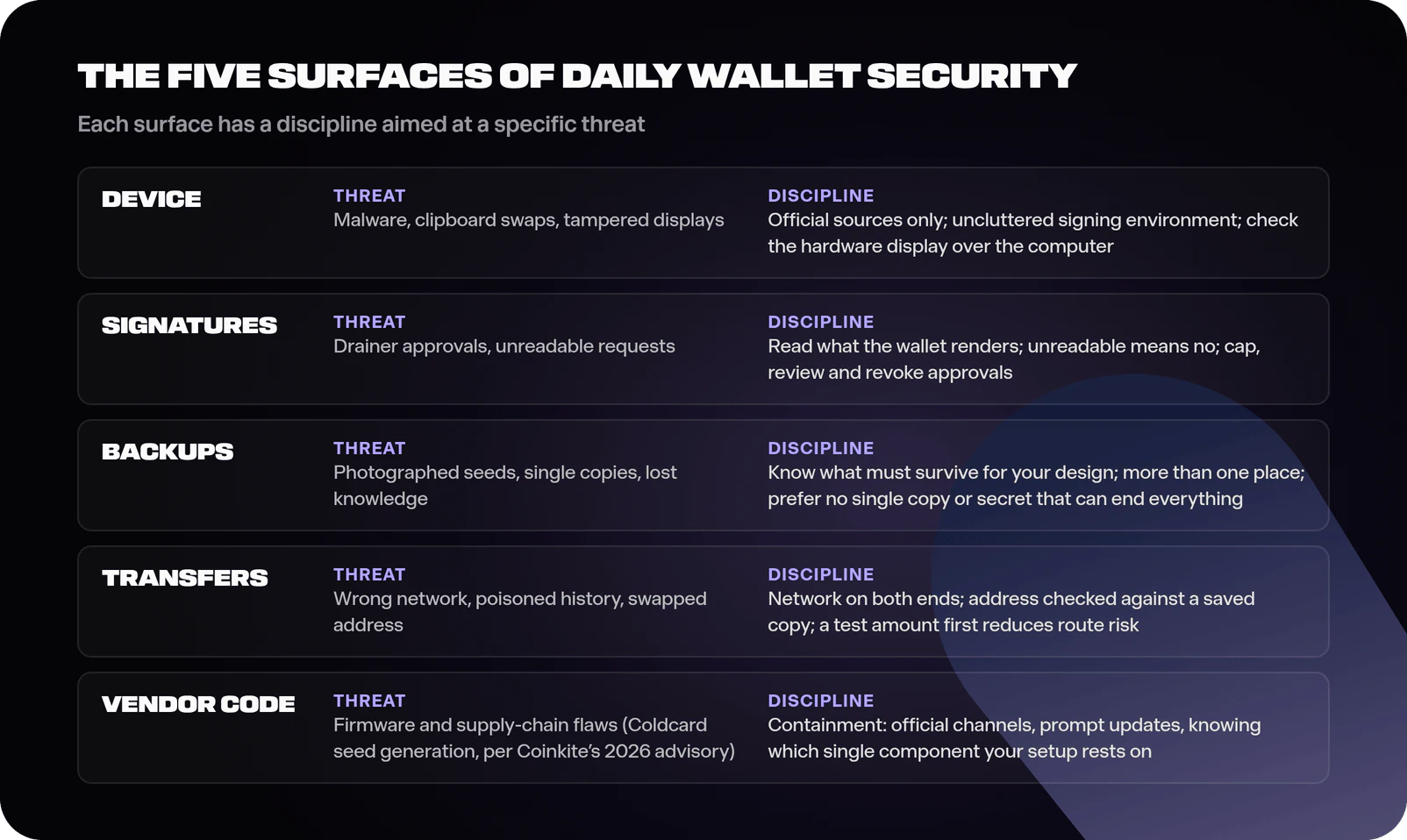
- Five surfaces cover it: the device that signs, the signatures you grant, the backups that restore you, the transfers you send, and the vendor code you run. Attackers reach non-custodial funds through one of these, and each has a discipline aimed at a specific threat.
- Separate wallets by role, size each tier to its exposure, and route all application activity through the tier you can afford to lose. Separation applies the same idea to daily operation by limiting how much any one failure can reach, and it costs little beyond a second wallet and some discipline.
- That a vendor's implementation is part of your attack surface, and that attention to advisories, prompt updates and knowing which single component your setup rests on can contain the damage. The Coldcard seed-generation flaw is documented in Coinkite's own advisory: the weakness shipped in the firmware, so it reached users whose own habits were sound, and its loss totals exist only as third-party estimates.
- This pillar is the map; each surface has its own guide in this cluster, and the custody cluster remains the architectural foundation underneath all of them. Read in the order your situation demands; the map below is the suggested default.
In einem Block
Crypto wallet security is a set of operational practices that keeps control of a self-custodied wallet's keys with its owner during everyday use. It covers five surfaces: the device that signs, the signatures granted to applications, the backups that restore access, the transfers sent, and the vendor software and firmware the wallet runs.
What are you actually defending against, day to day?
Schnelle Antwort
Five surfaces cover it: the device that signs, the signatures you grant, the backups that restore you, the transfers you send, and the vendor code you run. Attackers reach non-custodial funds through one of these, and each has a discipline aimed at a specific threat.
Surface 1: the signing device. Threat model: malware on the computer or phone that logs keys, swaps clipboard contents or alters what you see, so that what you see on screen can differ from what you sign. The academy's guide to how wallet-draining and approval attacks work documents the mechanics. Mitigation, and why it fits: software from official sources only (reduces the chance of installing the malware); a signing environment kept uncluttered (fewer programs, fewer places for it to hide); and, where a hardware signing device is used, checking its own display over the computer's, because a compromised computer can misreport what it is asking you to sign, and a separate screen driven by the device is designed to be outside that computer's control. This mitigation addresses a compromised host. It does nothing against a flaw inside the hardware device itself, which is surface 5.
Surface 2: the signatures you grant. Threat model: the drainer economy, which obtains your authorisation politely through routine-looking requests, standing token approvals and unreadable message blobs, then exercises that authorisation later. ScamSniffer, a phishing-tracking data provider, estimated about $84m in wallet-phishing losses across roughly 106,000 victims in 2025, down 83 percent from its 2024 estimate of $494m; the figures are the provider's own on-chain estimates, and ScamSniffer cautions that the decline may partly reflect a shift toward attacks its drainer statistics do not capture, such as private key compromises and targeted social engineering (ScamSniffer, 3 January 2026). Mitigation, and why it fits: read what the wallet renders, because the request is the attack; treat unreadable as a refusal; cap standing approvals and revoke stale ones on a schedule, because an approval granted months ago can be exercised the day the counterparty contract is compromised. Clear-signing displays and transaction simulation reduce this risk and do not remove it, since they interpret data the wallet is given, as the guide to what blind signing is explains.
Surface 3: the backups that restore you. Threat model: two opposite failures. Exposure, where a photographed or cloud-synced seed leaks to someone else; and loss, where the only copy burns, floods or dies with the person who hid it. Mitigation, and why it fits: know exactly what must survive for your particular design, because recovery material differs. A BIP-39 wallet needs the seed phrase, plus the passphrase if one was set and the derivation path if it is non-standard (BIP-39 applies only to BIP-39 wallets). A multisig needs a quorum of keys plus the wallet descriptor. An MPC or smart-account wallet needs whatever combination of shares, devices or guardians its recovery scheme defines, and a seed alone regenerates none of that. Then hold the material in more than one place, and prefer arrangements where no single copy, and no single secret, can end everything, remembering that each extra copy or share is one more thing to protect and each extra party is one more dependency at recovery time. The guide to backing up a crypto wallet properly covers the design.
Surface 4: the transfers you send. Threat model: irreversibility combined with a wrong destination, whether that comes from the wrong network, an address planted in your history by an attacker (address poisoning), a swapped clipboard, or a typing error. Mitigation, and why it fits: confirm the network on both ends, because a transfer to a valid address on the wrong chain may or may not be recoverable depending on who controls that address there; verify the destination against an independently saved copy rather than by first and last characters alone, because poisoning attacks are built to match those characters; send a test amount first, which reduces but cannot eliminate route risk; and where a hardware device shows the destination on its own screen, compare that. The guides to sending and receiving crypto and to address poisoning and clipboard attacks cover the error and the attack separately.
Surface 5: the vendor code you run. Threat model: a flaw or malicious change in the wallet software, firmware or its dependencies, which reaches users whose personal habits were sound because the weakness ships in the product. In 2026 the example was Coldcard: Coinkite disclosed on 30 July 2026 that a firmware bug weakened seed generation on specific models and firmware ranges, and that attackers were regenerating affected keys offline and taking funds (Coinkite advisory, 30 July 2026, updated 1 August 2026). Mitigation, and why it fits: containment through attention and setup design, covered in the vendor-risk section below, because personal habits rarely prevent a vendor's bug. In this case one did: the advisory describes seeds generated from enough fair dice rolls as protected.
How do you set up daily operations so one mistake is less likely to be fatal?
Schnelle Antwort
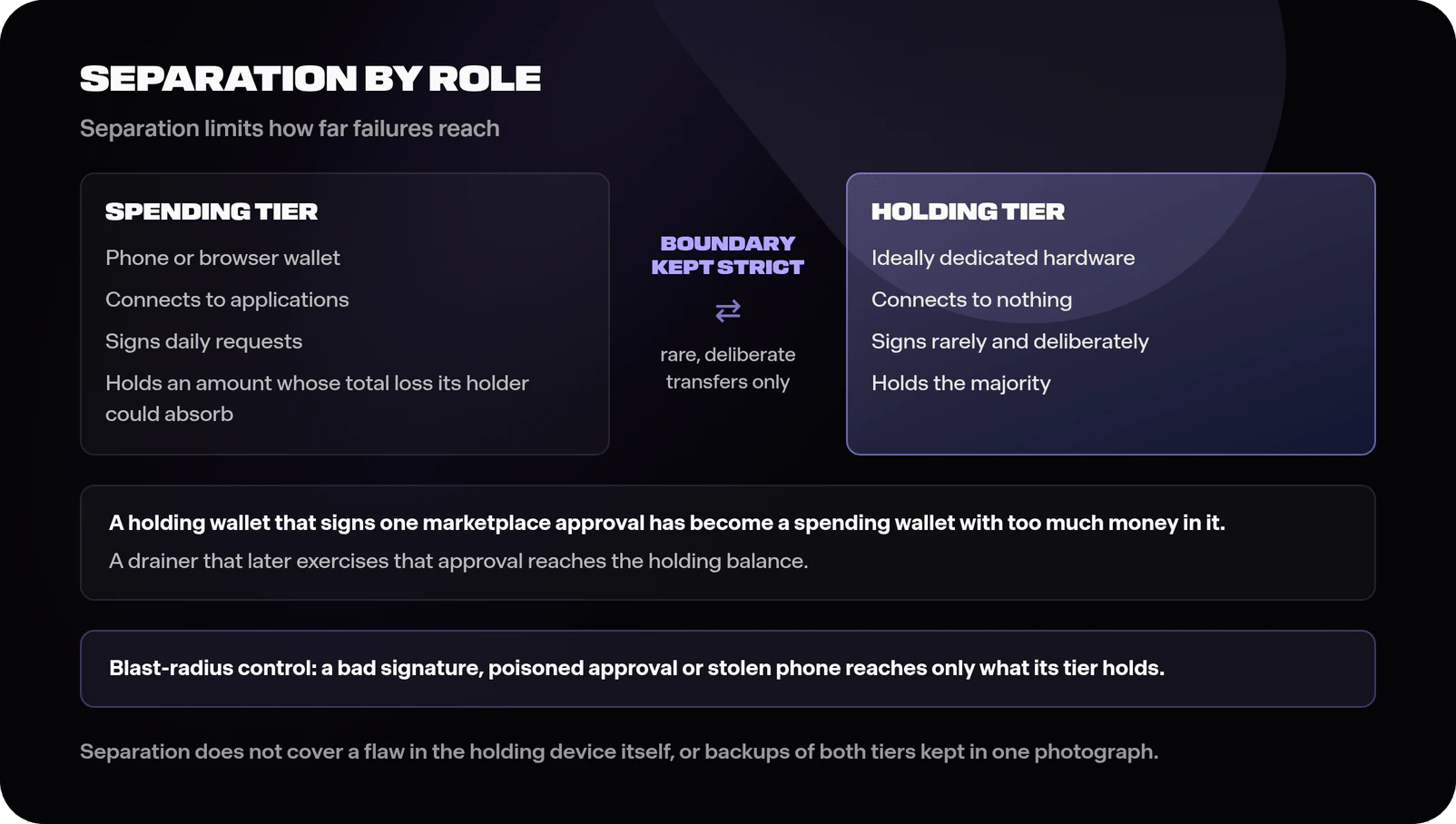
Separate wallets by role, size each tier to its exposure, and route all application activity through the tier you can afford to lose. Separation applies the same idea to daily operation by limiting how much any one failure can reach, and it costs little beyond a second wallet and some discipline.
The pattern is tiers. A spending wallet lives on your phone or browser, connects to applications, signs daily requests, and holds an amount whose total loss you could absorb. A holding tier keeps the majority, connects to nothing, and signs rarely, deliberately and ideally on dedicated hardware. Large holders add further separation, and institutions build the same idea into policy engines, as the academy's guide to how institutions custody crypto describes; the two-tier version is where most individuals start.
What separation buys is blast-radius control. The threat it answers is any compromise of the spending tier: a signature granted to a fake front end, a poisoned approval exercised months later, a phone stolen unlocked. Provided the boundary has been kept, each of these reaches only what the compromised tier holds. The habit that preserves the benefit is strictness about the boundary: the holding tier's keys never touch a browser, never connect to an application, and never sign anything routine. The moment a holding wallet signs a marketplace approval, it has become a spending wallet with too much money in it, and a drainer that later exercises that approval reaches the holding balance.
Separation does not answer every threat. It does not protect against a flaw in the holding tier's own device or firmware (surface 5), and it does not help if the backups of both tiers sit in the same photograph (surface 3). It is one layer in a system.
Two operational routines complete the structure. First, rehearse recovery before you need it. What a rehearsal looks like depends on the design: for a seed-based wallet, restoring a small test wallet's seed on an offline or freshly reset device and checking that the first receive address matches; for multisig, confirming that the descriptor and each cosigner's key restore the same addresses; for MPC or guardian-based recovery, running the provider's documented recovery flow with a test account. Importing your main seed into an ordinary networked spare phone creates the exposure risk from surface 3, so the backup guide describes rehearsal methods that avoid it. Second, put reviews on a calendar rather than trusting occasions to prompt them: approvals audited and stale ones revoked, device and firmware updates applied from official channels, backup locations confirmed intact, and vendor advisories checked. A fixed interval that you will actually keep matters more than the specific interval; reviewing only when something goes wrong means the review arrives after the loss.
What does the 2026 Coldcard flaw add about vendor risk?
Schnelle Antwort
That a vendor's implementation is part of your attack surface, and that attention to advisories, prompt updates and knowing which single component your setup rests on can contain the damage. The Coldcard seed-generation flaw is documented in Coinkite's own advisory: the weakness shipped in the firmware, so it reached users whose own habits were sound, and its loss totals exist only as third-party estimates.
What was disclosed. Coinkite published a security advisory on 30 July 2026, updated 1 August 2026. The affected firmware is: Coldcard Mk2 and Mk3 running versions 4.0.1 to 4.1.9 inclusive; Mk4 and Mk5 running versions before 5.6.0 (Edge builds before 6.6.0X); and Coldcard Q running versions before 1.5.0Q (Edge builds before 6.6.0QX). The advisory states that a firmware bug in the affected releases caused weakened seed generation, that attackers exploited the weak seeds offline by regenerating private keys, and that Mk4, Mk5 and Q seeds had roughly 72 bits of entropy rather than the intended 128. Seeds generated from at least 50 fair, independent dice rolls that were never recorded or exposed are described as protected by the dice contribution alone; fewer rolls, or an uncertain procedure, means the seed should be treated as affected. The advised actions are: update firmware, generate a new seed on the fixed version, verify the backup and receive addresses, send a test transaction, then migrate remaining funds. A passphrase adds a layer on top of an affected seed and the advisory still recommends migration when practical (Coinkite advisory, 30 July 2026, updated 1 August 2026).
Independent technical analysis. Block's engineering team published an analysis on 30 July 2026 describing the mechanism: a build configuration check in a library caused the firmware to fall back to a deterministic software generator instead of the hardware random number generator. On Mk2 and Mk3 firmware 4.0.0 to 4.1.9 there was no secure reseed; on Mk4, Mk5 and Q the fallback persisted with a limited 32-bit reseed, giving at most about 4.3 billion distinguishable output streams. Earlier firmware (Mk1, and Mk2/Mk3 up to 3.2.2) used the hardware generator directly and is described as unaffected. Block reported that active exploitation was under way and that users had reported losing funds, without giving figures (Block Engineering, 30 July 2026).
What is not established by vendor evidence. Neither the Coinkite advisory nor the Block analysis states how many wallets were affected, how many were swept, or how much bitcoin was taken. The loss figures come from third-party research. Galaxy Research's report of 14 August 2026 puts confirmed losses at 1,778.84 BTC (about $112.7m at the time of the report) across more than 8,600 addresses, an estimate built from on-chain analysis and informed by direct contact with 190 victims. Galaxy also gives a possible figure of 2,417.35 BTC (about $153m), which adds medium-confidence sets of possible thefts and a still unconfirmed fourth attack wave; that larger figure is a separate, lower-confidence category and is not added to the confirmed estimate. Galaxy reports that none of the confirmed, high-confidence attack waves occurred after 6 August 2026, and states that the faulty random number generator was introduced on 17 March 2021 (Galaxy Research, 14 August 2026). Coinkite has not published a loss total, so these remain third-party estimates, and the true figure could be higher or lower. None of these sources ranks the incident against other wallet incidents, and this guide makes no such ranking. The Wallet Vulnerability Ledger records the disclosure, the affected ranges and the confidence attached to each figure.
Three habits follow for any vendor's user. Watch the channel: the advisory reached those subscribed to official channels first, and with exploitation already under way, hours mattered. Apply updates from official sources promptly, because fixed firmware protects only devices that have it and, in this case, only seeds generated after the update. And know which single component your setup rests on, then weigh what removing that dependency would add.
In this incident, the single point of failure was one device's random number generator. The advisory itself names one mitigation: seeds built from at least 50 fair, unrecorded dice rolls did not depend on it, at the cost of a slower, error-prone setup ritual. A multisig quorum in which the affected device held one key, with the other keys generated on hardware from different vendors, could have kept a weak Coldcard seed from being enough to move funds on its own; the cost is more devices, a wallet descriptor that must be backed up, and coordination at every signature and every recovery, as the guide to how multisig spreads signing across several keys sets out. MPC and other threshold designs typically generate the key in distributed form (distributed key generation), so that no single device holds the full key, and a threshold of devices or parties signs jointly; where a design works this way, no one device's seed is the whole key. These designs add their own risks: reliance on the provider's availability and recovery process, coordination between parties, and implementation bugs in more complex cryptographic code, which is the same class of risk this incident illustrates. Each of these designs still runs on someone's code, so vendor risk moves within the setup and remains part of it. The ledger records other wallet-vendor flaws and supply-chain attacks, each with its own evidence; the Coldcard flaw is one entry there, and Coinkite's advisory describes it as a firmware bug.
How do the deep guides fit together?
Schnelle Antwort
This pillar is the map; each surface has its own guide in this cluster, and the custody cluster remains the architectural foundation underneath all of them. Read in the order your situation demands; the map below is the suggested default.
For newcomers, the sending guide comes first, because transfers are the first irreversible thing a beginner does, then the guide to what dApps are before any application is touched, then the backup guide the same week a wallet is created. The blind signing and address poisoning guides upgrade daily discipline once the basics are routine. The Wallet Vulnerability Ledger is reference material for choosing and monitoring tools. Underneath, the custody cluster's guides, from what a crypto wallet is and who holds your crypto to what a seed phrase is and how wallet recovery and inheritance work, answer the architectural questions this pillar deliberately leaves in their hands, and the guide to crypto scams and threats catalogues the adversaries all of this defends against.
Frequently asked questions
Is a hardware wallet all I need for security?
It hardens one surface, the signing device, and helps with signatures via a display designed to be outside the host computer's control. It does nothing about approvals you consent to, backups you photograph, transfers you misdirect, or flaws in its own firmware, as the 2026 Coldcard advisory demonstrated. Treat it as one component of the five-surface system rather than the system.
What is the most important crypto wallet security habit?
No single habit covers all five surfaces. Separation by role is the one this guide leans on most, because it limits the consequence of failures on the other surfaces. A worked example: a holder approves a malicious request on a fake marketplace page from a spending wallet holding a small sum. A drainer can later take what that wallet holds; the holding tier, which never signed the approval, stays outside that approval's reach. Separation does nothing against a flaw in the holding device itself, as the Coldcard case showed, or against backups of both tiers kept in one place.
How much crypto should a spending wallet hold?
The tier model sizes it so that its complete loss would be absorbable for the person who holds it; the figure depends on individual circumstances, and this guide suggests none. The practical detail is keeping the cap in place over time: balances in a spending wallet tend to grow through incoming payments and forgotten top-ups, so the review routine includes checking the balance against the cap. Each top-up from the holding tier is a deliberate transfer across the boundary, with the destination verified as for any other send.
Do these habits matter if my crypto is on an exchange?
Different surfaces then dominate. The exchange holds the keys, which removes the device-signing and backup work described here and often offers account recovery; it adds dependence on the venue's security, account terms and solvency, and on the holder's own account credentials and two-factor design, covered by the academy's guides to two-factor authentication and account security and to whether crypto exchanges are safe. The habits here govern self-custody, which carries its own risks of loss and error, and apply if funds are held in a self-custodied wallet. Neither arrangement suits every holder; the guide to who holds your crypto compares them.
How often should I review approvals, backups and firmware?
On a fixed interval you will keep, plus immediately when an advisory is published for any tool or application you use. Reviews prompted by occasions tend not to happen; reviews on a schedule do.
What should I do if my crypto wallet has been drained?
Reporting is the factual first step: in the US, to the FBI's Internet Crime Complaint Center at ic3.gov; in England, Wales and Northern Ireland, to Report Fraud (formerly Action Fraud) at reportfraud.police.uk or on 0300 123 2040; in Scotland, to Police Scotland on 101; elsewhere, to local police. The FBI asks for transaction details such as addresses, amounts, dates and transaction IDs (FBI, Cryptocurrency Investment Fraud; City of London Police, December 2025). A report does not guarantee recovery, and confirmed on-chain transfers generally cannot be reversed. The FBI also states that almost all victims of the crypto investment frauds it describes are later contacted by scammers running recovery fraud schemes, and that the FBI will never ask for money; an unsolicited offer to recover crypto for an upfront fee fits that pattern. The guide to responding if your crypto is hacked or stolen covers the steps in order.
Sources and further reading
- COLDCARD Security Advisory: seed generation warning. Coinkite, 30 July 2026, updated 1 August 2026. https://blog.coinkite.com/coldcard-mk3-seed-generation-warning/ (accessed 23 September 2026)
- Predictable RNG fallback and 32-bit reseed in COLDCARD firmware. Block Engineering, 30 July 2026. https://engineering.block.xyz/blog/predictable-rng-fallback-and-32-bit-reseed-in-coldcard-firmware (accessed 23 September 2026)
- Coldcard exploit abates as total losses climb to at least 1,700 BTC (original research; third-party estimates, confirmed and possible figures reported separately). Galaxy Research, 14 August 2026. https://www.galaxy.com/insights/research/coldcard-exploit-abates-as-total-losses-climb-to-at-least-1700-btc (accessed 24 September 2026)
- 2025 Internet Crime Report. FBI Internet Crime Complaint Center, 2026. https://www.ic3.gov/AnnualReport/Reports/2025_IC3Report.pdf (accessed 23 September 2026)
- Crypto Phishing Losses Fall 83% to $84 Million (data provider's own on-chain estimate). ScamSniffer, 3 January 2026. https://drops.scamsniffer.io/scam-sniffer-2025-crypto-phishing-losses-fall-83-to-84-million/ (accessed 24 September 2026)
- Cryptocurrency Investment Fraud (victim services resource: reporting details, recovery fraud schemes). FBI, undated page. https://www.fbi.gov/how-we-can-help-you/victim-services/national-crimes-and-victim-resources/cryptocurrency-investment-fraud (accessed 24 September 2026)
- Report Fraud service goes live with full public launch in January 2026. City of London Police, December 2025. https://www.cityoflondon.police.uk/news/city-of-london/news/2025/december/report-fraud-service-goes-live-with-full-public-launch-in-january-2026/ (accessed 24 September 2026)
- BIP-39: Mnemonic code for generating deterministic keys. Bitcoin Improvement Proposals repository, 2013, as maintained. https://github.com/bitcoin/bips/blob/master/bip-0039.mediawiki (accessed 23 September 2026)
- NIST Special Publication 800-63B, Digital Identity Guidelines: Authentication and Lifecycle Management (superseded by SP 800-63-4 on 1 August 2025; cited for authenticator principles). NIST, 2017. https://pages.nist.gov/800-63-3/sp800-63b.html (accessed 23 September 2026)
Kurzes Quiz: Hat es geklebt?
Ein paar Fragen zur Überprüfung der Grundlagen sind gelandet. Es folgen Antworten mit Erläuterungen und niemand außer Ihrem zukünftigen Portfolio bewertet Sie.


Sie haben ein Quiz zu „Crypto Wallet Security: The Complete Guide“ abgeschlossen! Teilen Sie Ihren Erfolg in den sozialen Medien.
 War das hilfreich?