
TL;DR
- Because stablecoins grew large enough to matter to payment systems and government debt markets, and because two public incidents, the collapse of TerraUSD in May 2022 and the USDC depeg of March 2023, showed how they fail. The frameworks share, where enacted and in scope, a licensed or authorised issuer, reserves, a redemption obligation and disclosure, though the content of each requirement differs and only some of the frameworks are in force.
- The GENIUS Act, enacted on 18 July 2025, is the US federal law on payment stablecoins. It confines issuance to permitted issuers, requires reserves of at least one-to-one in a defined list of assets, monthly reserve reports examined by a registered public accounting firm, annual audited statements for issuers above $50bn, and bars issuers from paying holders interest or yield solely for holding, using or retaining the token. None of these obligations applies yet: the Act takes effect on the earlier of 18 January 2027 or 120 days after the primary federal regulators issue final regulations, and the Treasury published a proposed rule on 18 August 2026.
- MiCA's stablecoin titles have applied since 30 June 2024 and create two separate regimes. E-money tokens (Title IV) reference a single official currency and may be offered to the public or admitted to trading in the EU only by issuers authorised as credit institutions or e-money institutions, or by others with the issuer's written consent; MiCA gives holders a claim against the issuer and requires redemption at par, at any time and free of charge. Asset-referenced tokens (Title III) reference baskets or other assets and need their own authorisation, with a redemption right at market value or in the referenced assets. Interest to holders is prohibited under both titles. A token referencing the US dollar alone is an EMT under MiCA's definition (Article 3(1)(7)), so the EMT rules apply when it is offered to the public or admitted to trading in the EU.
- The UK's stablecoin rules are final, and the new regulated activities they create do not apply until 25 October 2027. The Financial Services and Markets Act 2000 (Cryptoassets) Regulations 2026 were made on 4 February 2026 and bring issuing a qualifying stablecoin and safeguarding cryptoassets into the FCA's perimeter; the FCA published its final policy statements, including PS26/10 on stablecoin issuance, on 30 June 2026; and the FCA says applications for authorisation will open on 30 September 2026. Cryptoasset firms already face two existing sets of rules: registration with the FCA under the Money Laundering Regulations, and the cryptoasset financial promotions regime. The FCA says stablecoins recognised by HM Treasury as systemic will be regulated jointly with the Bank of England (FCA, 30 June 2026).
In einem Block
Stablecoin regulation is a body of law that governs who may issue a token pegged to an official currency, what assets must back it, who may redeem it and on what terms, what the issuer must disclose, and which supervisor can act. Each regime binds only firms within its scope, once it commences.
Why did regulation arrive, and what do the regimes have in common?
Schnelle Antwort
Because stablecoins grew large enough to matter to payment systems and government debt markets, and because two public incidents, the collapse of TerraUSD in May 2022 and the USDC depeg of March 2023, showed how they fail. The frameworks share, where enacted and in scope, a licensed or authorised issuer, reserves, a redemption obligation and disclosure, though the content of each requirement differs and only some of the frameworks are in force.
The motive was scale and incident together. By April 2026 total stablecoin supply was about $317bn, up more than 50 percent since early 2025, with the largest tokens by supply backed mainly by short-dated US Treasuries, repurchase agreements and bank deposits (Federal Reserve, FEDS Notes, 8 April 2026). At that size, reserve practice is a financial-stability question as well as a consumer one. The incidents supplied the design brief. TerraUSD, an algorithmic stablecoin, collapsed in May 2022 and showed that such a design can fail completely. On 10 March 2023 Circle announced it had been unable to wire out part of USDC's reserves held at Silicon Valley Bank before regulators took control of the bank, and USDC traded well below one dollar over that weekend, which showed that a fully reserved token inherits the risk of the banks that hold its reserves (Federal Reserve, FEDS Notes, 23 February 2024). The technical side of these episodes is covered in the guide to stablecoin failure modes.
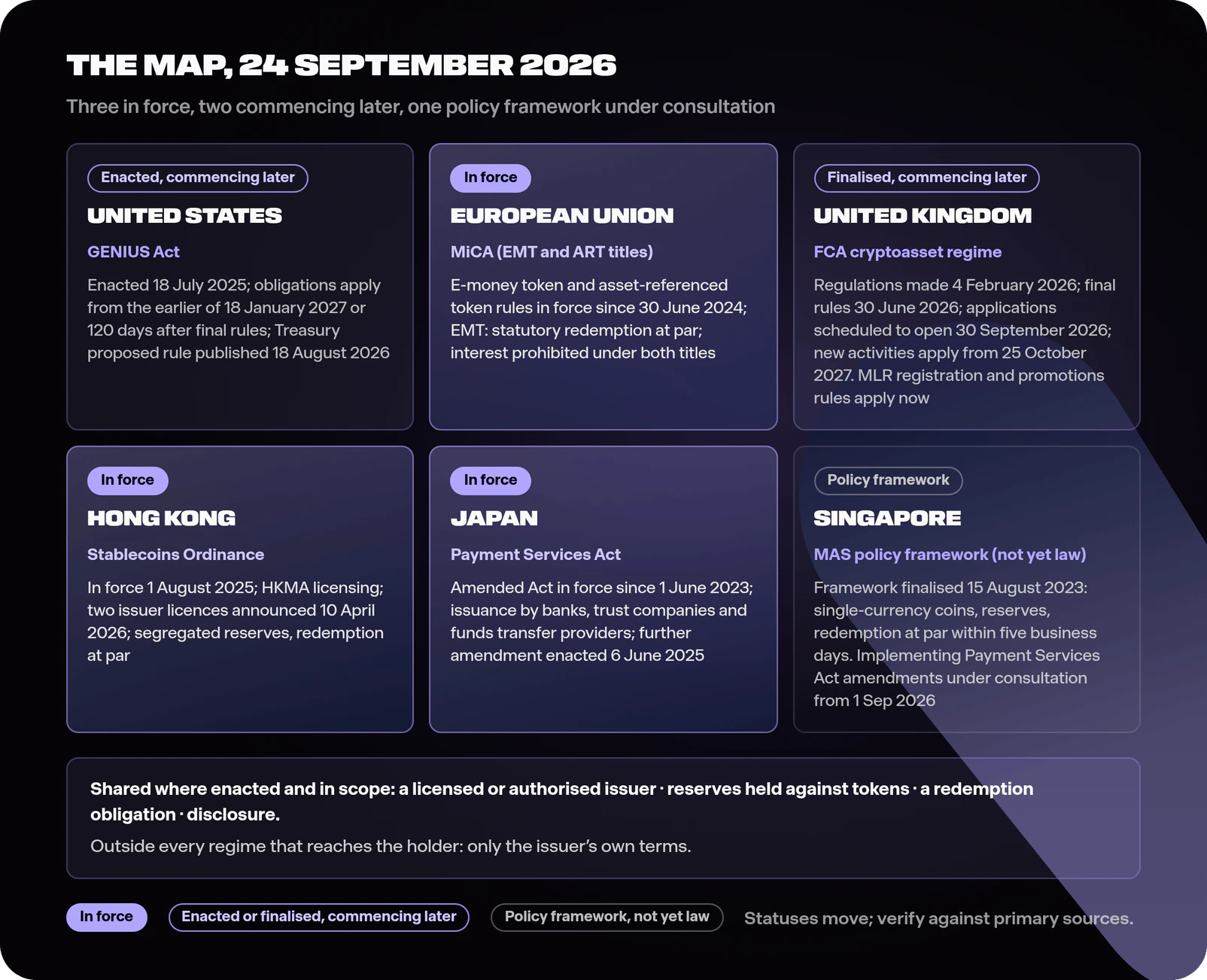
The six jurisdictions stand at three different stages on 24 September 2026. Three have stablecoin rules in force: the EU (MiCA), Hong Kong (the Stablecoins Ordinance) and Japan (the amended Payment Services Act). Two have enacted or finalised rules with a later commencement: the United States (the GENIUS Act) and the United Kingdom (the FCA's cryptoasset regime). Singapore has a finalised policy framework, and the legislation that would make it binding is under consultation. The frameworks share, where enacted and in scope, four requirements: an issuer licensed or authorised by a named supervisor, reserves held against the tokens in issue, some redemption obligation, and disclosure. The content differs in ways that decide a holder's actual position: which assets qualify as reserves and where they must sit; whether redemption is a statutory right of every holder or an issuer policy for approved customers; how fast redemption must be paid; whether interest may be paid on the token; how tokens from foreign issuers are treated; and, most basically, whether the rule is in force yet. The table below states those differences by jurisdiction, and the sections that follow explain each one.
Status by jurisdiction, 24 September 2026
| Jurisdiction | Instrument | Regulated activity and entity | Supervisor | Status and effective date |
|---|---|---|---|---|
| United States | GENIUS Act (Public Law 119-27) | Issuing a payment stablecoin; permitted issuers are bank subsidiaries, federally qualified non-bank issuers, and state-qualified issuers with up to $10bn outstanding | OCC, FDIC, Federal Reserve, state regulators; Treasury for foreign-issuer comparability | Enacted, commencing later. Enacted 18 July 2025; applies from the earlier of 18 January 2027 or 120 days after final regulations; Treasury proposed rule published 18 August 2026 |
| European Union | MiCA (Regulation (EU) 2023/1114), Titles III and IV | Offering to the public or seeking admission to trading of e-money tokens (issuers authorised as credit institutions or e-money institutions, or others with the issuer's written consent, Article 48) and of asset-referenced tokens (issuers authorised under Article 21, or credit institutions complying with Article 17, Article 16) | National competent authorities; EBA for significant tokens | In force. Titles III and IV applied from 30 June 2024; CASP rules from 30 December 2024 |
| United Kingdom | FSMA 2000 (Cryptoassets) Regulations 2026; FCA PS26/10, PS26/11, PS26/12 | Issuing a qualifying stablecoin in the UK; safeguarding qualifying cryptoassets | FCA; Bank of England for systemic stablecoins recognised by HM Treasury | Enacted, commencing later. Regulations made 4 February 2026; final rules published 30 June 2026; applications scheduled to open 30 September 2026; the application window for firms relying on the savings provisions is scheduled to close 28 February 2027; new regulated activities apply from 25 October 2027 (FCA PS26/18). MLR registration and the financial promotions regime already apply to cryptoasset firms |
| Hong Kong | Stablecoins Ordinance (Cap. 656) | Issuing a fiat-referenced stablecoin in Hong Kong, or a Hong Kong dollar-referenced stablecoin anywhere; licensed issuers only | HKMA | In force. Commenced 1 August 2025; HKMA announced two issuer licences on 10 April 2026 |
| Japan | Payment Services Act, as amended in 2022 and 2025 | Issuing digital-money-type stablecoins (banks, funds transfer service providers, trust companies); intermediating them (registered electronic payment instrument exchange service providers) | JFSA | In force. 2022 amendment in force from 1 June 2023; further amendment enacted 6 June 2025 |
| Singapore | MAS single-currency stablecoin framework; Payment Services Act 2019 amendments | Would cover, once implemented (not yet law): issuing a single-currency stablecoin pegged to SGD or a G10 currency in Singapore | MAS | Policy framework, not yet law. Framework finalised 15 August 2023; implementing Payment Services Act amendments under consultation from 1 September 2026 |
The United States: what does the GENIUS Act require, and when?
Schnelle Antwort
The GENIUS Act, enacted on 18 July 2025, is the US federal law on payment stablecoins. It confines issuance to permitted issuers, requires reserves of at least one-to-one in a defined list of assets, monthly reserve reports examined by a registered public accounting firm, annual audited statements for issuers above $50bn, and bars issuers from paying holders interest or yield solely for holding, using or retaining the token. None of these obligations applies yet: the Act takes effect on the earlier of 18 January 2027 or 120 days after the primary federal regulators issue final regulations, and the Treasury published a proposed rule on 18 August 2026.
Who may issue. The Act creates the category of "permitted payment stablecoin issuer": subsidiaries of insured depository institutions, federally qualified non-bank issuers supervised by the OCC, and state-qualified issuers supervised under a state regime, with the state pathway limited to issuers with no more than $10bn in consolidated outstanding issuance (GENIUS Act, section 4(c)). Foreign issuers may serve the US market where the Treasury determines that their home regime is comparable and they can comply with lawful US orders (sections 3(b)(2) and 18).
Reserves. Permitted reserves are listed in section 4(a)(1)(A): US coins and currency, demand deposits at insured depository institutions, Treasury bills and other Treasury obligations with a remaining maturity of 93 days or less, overnight repurchase and reverse repurchase agreements collateralised by Treasuries, government money-market fund shares, and tokenised forms of the same. Deposits and repo keep an issuer exposed to banking counterparties, which is the channel the USDC episode demonstrated.
Redemption and disclosure. Issuers must establish and publicly disclose a redemption policy providing for timely redemption, and must publish the monthly composition of reserves on their website, examined by a registered public accounting firm and certified by the chief executive and chief financial officer (section 4(a)(1) and 4(a)(3)). Issuers with more than $50bn outstanding must also publish annual audited financial statements (section 4(a)(10)). The redemption obligation is a policy the issuer must publish and follow; the Act does not give every secondary-market holder a statutory right to redeem with the issuer, and in practice direct redemption runs through approved customers while everyone else trades on exchanges (Federal Reserve, FEDS Notes, 23 February 2024).
Interest, insurance and insolvency. No permitted or foreign issuer may pay the holder of a payment stablecoin any form of interest or yield solely in connection with holding, using or retaining it (section 4(a)(11)). Section 4(e) states that payment stablecoins are not backed by the full faith and credit of the United States, not guaranteed by the US Government, and not subject to FDIC deposit insurance or National Credit Union Administration share insurance. In an issuer insolvency, holders' claims on the reserve rank ahead of other creditors (section 11).
Effective date. Section 20 sets the effective date at the earlier of 18 months after enactment, which is 18 January 2027, or 120 days after the primary federal regulators issue final implementing regulations. The Treasury's proposed rule on issuance, offer and sale was published in the Federal Register on 18 August 2026, with comments due by 19 October 2026 (Federal Register, 18 August 2026). A separate deadline runs from enactment: from 18 July 2028, three years after enactment, digital asset service providers may not offer or sell a payment stablecoin in the United States unless it is issued by a permitted issuer (section 3(b)(1)). Until the Act takes effect, its obligations on issuers do not apply, and a description of a token as "regulated under GENIUS" should be read with that in mind.
What the Act provides for holders, once it applies. A defined reserve floor, monthly examined disclosure, a published redemption policy, priority for holders' claims on the reserves in an issuer insolvency (section 11), and an issuer that a federal or state supervisor can reach. It provides no interest from the issuer and no deposit insurance, and its requirements do not reach issuers outside its scope.
The European Union: how does MiCA treat e-money tokens and asset-referenced tokens?
Schnelle Antwort
MiCA's stablecoin titles have applied since 30 June 2024 and create two separate regimes. E-money tokens (Title IV) reference a single official currency and may be offered to the public or admitted to trading in the EU only by issuers authorised as credit institutions or e-money institutions, or by others with the issuer's written consent; MiCA gives holders a claim against the issuer and requires redemption at par, at any time and free of charge. Asset-referenced tokens (Title III) reference baskets or other assets and need their own authorisation, with a redemption right at market value or in the referenced assets. Interest to holders is prohibited under both titles. A token referencing the US dollar alone is an EMT under MiCA's definition (Article 3(1)(7)), so the EMT rules apply when it is offered to the public or admitted to trading in the EU.
E-money tokens. Under Article 48(1), only the issuer of an EMT may offer it to the public or seek its admission to trading in the EU, and only if the issuer is authorised as a credit institution or an e-money institution and has notified and published a crypto-asset white paper; other persons may do so with the issuer's written consent. Article 49 states that holders have a claim against the issuer and requires the issuer to redeem, at the holder's request, at par value, at any time and without a fee. That redemption obligation is set in the Regulation itself, whereas the GENIUS Act requires issuers to publish and follow a redemption policy. Article 54(a), in force, requires at least 30 percent of the funds received to be deposited in separate accounts at credit institutions, with the remainder invested in secure, low-risk assets in the same currency (ESMA, MiCA Article 54). For significant EMTs issued by e-money institutions, Article 58(1)(a) applies the reserve and liquidity rules written for asset-referenced tokens (Articles 36 to 38 and Article 45(1) to (4)); Article 45(7)(b) requires the EBA's liquidity standards for significant tokens to set a minimum deposit share of no less than 60 percent in each referenced currency (ESMA, MiCA Articles 45 and 58). Those EBA liquidity standards were still a final draft submitted to the European Commission, not yet adopted, on 24 September 2026 (EBA, liquidity RTS page, viewed 24 September 2026). The deposit rule supports supervision and reproduces the bank-exposure channel the USDC episode demonstrated. Before an EMT is offered, the issuer must notify its crypto-asset white paper to its competent authority at least 20 working days before publication, and MiCA says competent authorities "shall not require prior approval" of it (Article 51(11)); an ART white paper, by contrast, is approved as part of the issuer's authorisation (Articles 17 and 21). Article 50 prohibits issuers, and crypto-asset service providers when providing services related to EMTs, from granting interest or any benefit related to the length of time the token is held (Regulation (EU) 2023/1114).
Asset-referenced tokens. Under Article 16(1), an ART may be offered to the public or admitted to trading in the EU only by its issuer, authorised under Article 21 or, for a credit institution, complying with Article 17, and Article 36 requires a reserve of assets. Article 39 requires a permanent redemption right, paid either in funds at the market value of the referenced assets or by delivery of those assets. Article 40 prohibits interest. The ART regime is the one a multi-currency or commodity-referenced token would fall under; it is not the regime that governs a dollar token.
Enforcement of the perimeter. On 17 January 2025 ESMA, welcoming the European Commission's Q&A guidance on Titles III and IV, stated its expectation that crypto-asset service providers would restrict their services for ARTs and EMTs that do not comply with MiCA, with the restrictions expected to be completed by the end of January 2025 and services on a "sell only" basis possible until the end of the first quarter of 2025 (ESMA, 17 January 2025). The statement names no token; its effect fell on tokens whose issuers had not obtained authorisation, while tokens from authorised EMT issuers could still be offered. On 21 March 2025 BaFin prohibited Ethena GmbH from continuing to offer its USDe token to the public, instructed it to have the reserve assets frozen by the custodians and appointed a special representative to monitor compliance. BaFin cited "serious shortcomings in the authorisation procedure" and said it had "sufficient grounds to suspect" that Ethena GmbH was offering securities to the public in Germany without the required prospectus, a suspicion stated by the regulator (BaFin, 21 March 2025). BaFin's notice of 15 April 2025 reports that Ethena GmbH withdrew its authorisation application on 3 April 2025 and that on 14 April 2025 BaFin ordered the winding-up of its USDe business, with USDe tokens to be redeemed under a plan approved by BaFin (BaFin, 15 April 2025). Neither notice refers to MiCA's interest prohibition.
What MiCA provides for holders. For an EMT from an authorised issuer: a claim against the issuer with redemption at par (Article 49), at least 30 percent of funds received deposited at credit institutions (Article 54), an authorised issuer, and supervision by national competent authorities (the EBA for significant tokens). MiCA bars issuers and service providers from granting interest (Articles 40 and 50), and ESMA's January 2025 statement addressed EU service providers' services for tokens that do not comply with MiCA.
The United Kingdom: what do the final rules require, and when do they apply?
Schnelle Antwort
The UK's stablecoin rules are final, and the new regulated activities they create do not apply until 25 October 2027. The Financial Services and Markets Act 2000 (Cryptoassets) Regulations 2026 were made on 4 February 2026 and bring issuing a qualifying stablecoin and safeguarding cryptoassets into the FCA's perimeter; the FCA published its final policy statements, including PS26/10 on stablecoin issuance, on 30 June 2026; and the FCA says applications for authorisation will open on 30 September 2026. Cryptoasset firms already face two existing sets of rules: registration with the FCA under the Money Laundering Regulations, and the cryptoasset financial promotions regime. The FCA says stablecoins recognised by HM Treasury as systemic will be regulated jointly with the Bank of England (FCA, 30 June 2026).
What was published. On 30 June 2026 the FCA published five policy statements: PS26/9 (admissions, disclosures and market abuse), PS26/10 (stablecoin issuance), PS26/11 (regulated cryptoasset activities, including custody), PS26/12 (prudential requirements) and PS26/13 (application of the FCA Handbook) (FCA, cryptoasset regime policy statements, 30 June 2026). PS26/18, perimeter guidance on when cryptoasset activities need FCA authorisation, followed on 16 September 2026 (FCA, PS26/18).
What PS26/10 requires of a UK issuer. A qualifying stablecoin must be backed one-to-one by a pool of backing assets held on statutory trust for tokenholders, with separate trusts per token so that the assets are protected from the issuer's general creditors in an insolvency. Backing must be in a single currency; permitted assets include on-demand deposits, short-term government debt, public-debt constant net asset value money-market funds and repurchase agreements, with a minimum on-demand deposit share and a core backing requirement tied to the issuer's own redemption history. On a redemption request, a payment order to an account in the holder's name must be placed by the end of the next business day, with the clock starting once anti-money-laundering checks are complete. Issuers may not pass interest or income from the backing assets to holders (FCA, PS26/10, June 2026).
Dates. The regulations were made on 4 February 2026. The FCA says firms will be able to apply for authorisation or vary existing permissions from 7am on 30 September 2026 (FCA, new cryptoasset regime page, viewed 24 September 2026), and that for a firm wishing to rely on the savings provisions the application window is scheduled to close on 28 February 2027 (FCA, cryptoasset regime policy statements, 30 June 2026). PS26/18 states that the Regulations will introduce the new regulated activities from 25 October 2027 and that anyone wishing to carry on those activities by way of business in the UK will need authorisation, unless a relevant exemption or the savings or transitional run-off provisions apply (FCA, PS26/18, 16 September 2026). The FCA's regime page describes 25 October 2027 as the date the regime is expected to come into force.
What already applies before 25 October 2027. The FCA has supervised UK cryptoasset businesses for anti-money-laundering purposes since 10 January 2020, and until the new regime starts, the FCA says, "firms must continue to comply with the requirement to be registered with us under the MLRs" (FCA, registration under the MLRs ahead of the new FSMA regime). Since 8 October 2023, cryptoasset firms marketing to UK consumers, including firms based overseas, have had to comply with the UK financial promotions regime (FCA, cryptoasset marketing to UK consumers). What does not yet apply are the new FSMA activities themselves, including the PS26/10 requirements on issuing a qualifying stablecoin, so a token described as "UK-regulated" before 25 October 2027 is not yet subject to UK stablecoin issuance rules.
What the UK rules provide for holders from 25 October 2027. For a qualifying stablecoin issued in the UK, PS26/10 provides for backing assets held on trust, a next-business-day redemption standard and an FCA-authorised issuer, with Bank of England involvement for tokens recognised as systemic. The rules provide no interest from the issuer and do not reach tokens issued outside the UK perimeter unless a specific rule applies to them.
Asia: what do Hong Kong, Japan and Singapore require?
Schnelle Antwort
Hong Kong's Stablecoins Ordinance has been in force since 1 August 2025 and requires an HKMA licence to issue a fiat-referenced stablecoin in Hong Kong or a Hong Kong dollar-referenced stablecoin anywhere; only stablecoins issued by HKMA-licensed issuers may be offered to retail investors in Hong Kong, and the HKMA announced two issuer licences on 10 April 2026. Japan's amended Payment Services Act has been in force since 1 June 2023 and confines issuance to banks, funds transfer service providers and trust companies, with intermediaries registered separately. Singapore's MAS finalised a single-currency stablecoin framework on 15 August 2023, and the legislation to implement it went out for consultation on 1 September 2026. Three licence-first designs: two in force, and one finalised policy framework that is not yet binding law.
Hong Kong. The Stablecoins Ordinance (Cap. 656) passed on 21 May 2025 and commenced on 1 August 2025. A licence is required to issue a fiat-referenced stablecoin in Hong Kong, or to issue anywhere a stablecoin that purports to maintain a stable value by reference to the Hong Kong dollar. Licensees must manage reserves with proper segregation, operate a robust stabilisation mechanism, process holders' redemption requests at par value on reasonable conditions, and meet anti-money-laundering, disclosure, audit and fitness requirements; only a stablecoin issued by a licensed issuer may be offered to a retail investor (Hong Kong Government, 21 May 2025 and 29 July 2025). The HKMA received 36 applications during the initial application period (LCQ6, 10 June 2026). On 10 April 2026 the HKMA announced that it had granted stablecoin issuer licences to Anchorpoint Financial Limited and The Hongkong and Shanghai Banking Corporation Limited, with both to complete preparatory work before launch; the HKMA says its Register of Licensed Stablecoin Issuers contains the latest list of licensees (HKMA, 10 April 2026). A 27 May 2026 HKMA circular lets registered institutions offer dealing and advisory services in stablecoins from HKMA-licensed issuers to retail clients without the knowledge tests and exposure limits that apply to other virtual assets, and states that those relaxations do not apply to unlicensed stablecoins (HKMA circular, 27 May 2026).
Japan. The 2022 amendment to the Payment Services Act, in force from 1 June 2023, defines fiat-linked, par-redeemable tokens as "electronic payment instruments" and confines their issuance to banks (as deposits), funds transfer service providers (with obligations secured by deposits, guarantees or safe assets) and trust companies (holding the trust assets as bank deposits). Intermediaries that buy, sell or exchange these tokens must register as electronic payment instrument exchange service providers and may not handle tokens without clear rules on the transfer of rights and user protection (JFSA, Payment Services Act framework; JFSA Weekly Review No. 540, June 2023). The JFSA register lists two such providers as of 27 August 2026: SBI VC Trade Co., Ltd. (No. 00001), registered 4 March 2025, listed for USDC, RLUSD and JPYSC, and Coincheck, Inc. (No. 00002), registered 27 August 2026, listed for USDC (JFSA register of electronic payment instrument exchange service providers, 27 August 2026). A further amendment to the Act was enacted on 6 June 2025, with implementing notices out for consultation in January 2026 (JFSA Weekly Review No. 673, February 2026); this guide does not describe its content because the implementing rules were not final at the review date.
Singapore. MAS finalised its stablecoin framework as policy on 15 August 2023. Once the implementing legislation is enacted and commences, MAS's proposed framework would cover single-currency stablecoins pegged to the Singapore dollar or a G10 currency and issued in Singapore. As MAS described it, the framework would set requirements for reserves (composition, valuation, custody and audit), minimum base capital and liquid assets, redemption at par within five business days of a request, and disclosure of the stabilisation mechanism, holder rights and reserve audit results, and MAS said only issuers meeting all requirements would be able to have their tokens labelled "MAS-regulated stablecoins" (MAS, 15 August 2023). The framework's requirements become binding law only through amendments to the Payment Services Act 2019, and MAS opened consultation on those amendments on 1 September 2026 (MAS, 1 September 2026). Until they are enacted and commenced, "MAS-regulated stablecoin" describes a policy framework, and the stablecoin-specific requirements are not yet binding law.
What the Asian regimes provide for holders. In Hong Kong, for a token from a licensed issuer, the Ordinance's requirements on segregated reserves, redemption at par on reasonable conditions and HKMA supervision apply now. In Japan, issuance is confined to banks, trust companies and funds transfer service providers under JFSA supervision, and intermediaries must register, under rules in force now. In Singapore, the stablecoin-specific requirements are not binding law until the Payment Services Act amendments are enacted and commence.
What does none of this cover?
Schnelle Antwort
Tokens from issuers outside every regime that reaches the holder, and holders in jurisdictions without a regime. In those cases a holder's position rests on the issuer's own terms and the law that governs them, which may be a foreign law with disputes heard abroad.
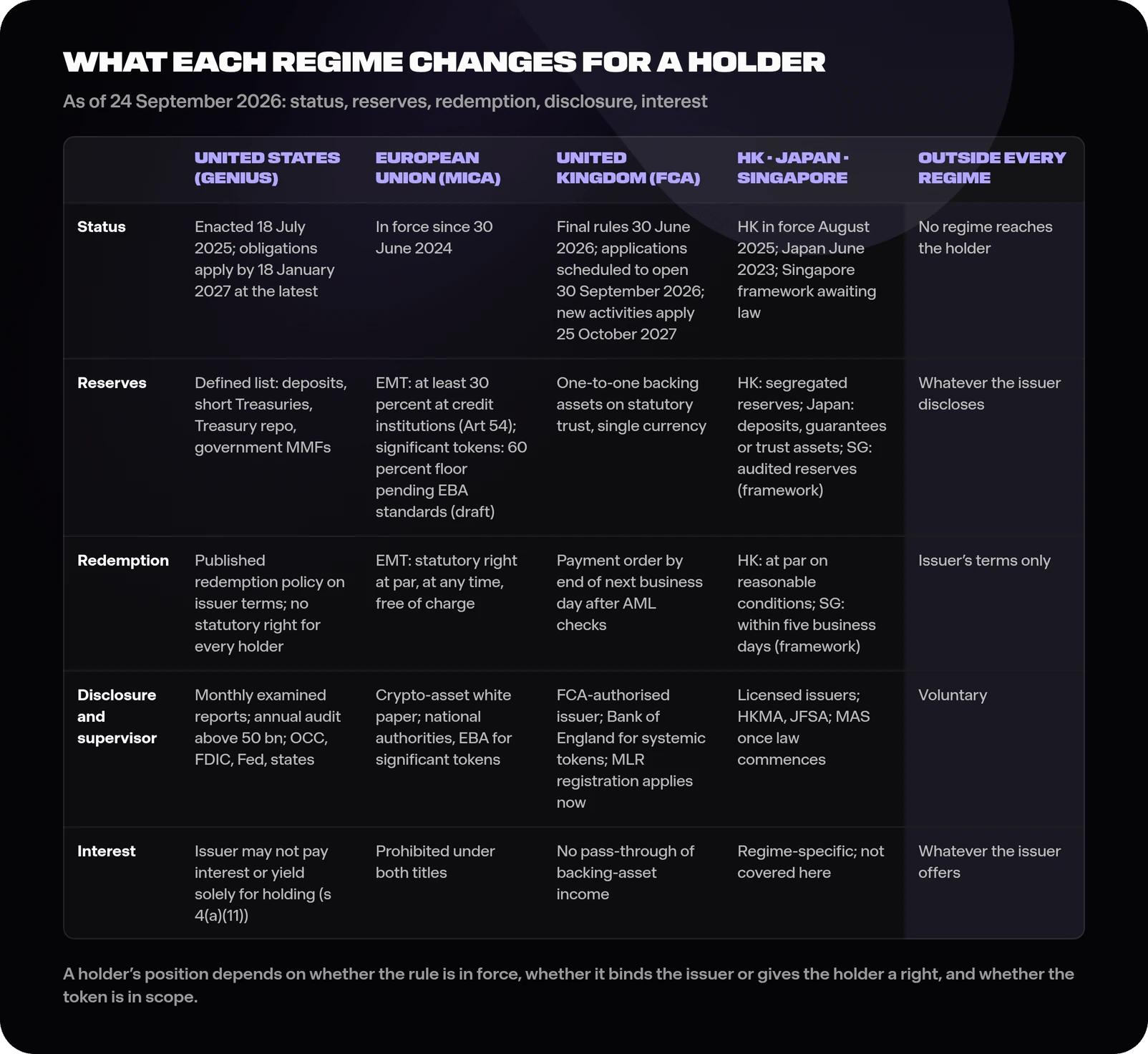
Each regime described here binds issuers that fall within its scope: issuing in the territory, issuing a token referenced to its currency, or serving its users. Many dollar stablecoins in circulation are issued by companies outside the EU and the UK, and the GENIUS Act's obligations do not yet apply to any issuer. Three questions therefore decide where a holder stands with any token: which regime, if any, the issuer is authorised or licensed under; whether that regime is in force; and whether the holder is a direct customer with a redemption relationship or a secondary-market holder relying on exchanges. The comparison of named stablecoins sets out the legal entity and redemption eligibility for each, and the guide to using stablecoins more safely covers the operational risks of holding. Other jurisdictions have enacted or are drafting regimes; this guide does not cover them.
Frequently asked questions
Does regulation make my stablecoin safe?
No regime makes a token risk-free. Where a regime applies to the issuer and reaches the holder, it sets requirements: reserves, a redemption obligation, disclosure and a supervisor. It does not insure holders (section 4(e) of the GENIUS Act states that payment stablecoins are not subject to FDIC deposit insurance), remove bank and custodian risk (USDC's March 2023 depeg happened when part of an issuer's reserves was held at Silicon Valley Bank, a US bank that regulators took control of), or reach tokens issued outside the regime.
May a stablecoin issuer pay holders interest under these regimes?
Under MiCA, issuers and crypto-asset service providers may not grant interest on e-money tokens (Article 50) or asset-referenced tokens (Article 40). Under the GENIUS Act, once it applies, issuers may not pay holders interest or yield solely for holding, using or retaining the token (section 4(a)(11)); the prohibition is written for issuers. Under the UK rules, from 25 October 2027, issuers may not pass income from backing assets to holders (FCA, PS26/10). Yields marketed on stablecoins typically come from lending or platform activity, with their own risks and regulatory questions, explained in the guide to how crypto rewards arise.
Why were some dollar stablecoins removed from EU venues?
Because MiCA allows an EMT to be offered to the public or admitted to trading in the EU only where its issuer is authorised as a credit institution or e-money institution (Article 48(1)), and ESMA's statement of 17 January 2025 set out its expectation that service providers would restrict services for tokens that do not comply with MiCA. The removals follow from the regime's perimeter and make no finding about any token's reserves; the statement concerns services by EU crypto-asset service providers and does not govern trading outside the EU.
Does MiCA apply to a stablecoin issued outside the EU?
It applies when a token is offered to the public or admitted to trading within the EU. Article 48(1) bars anyone from offering an e-money token to the public, or seeking its admission to trading, within the EU unless that person is the issuer, is authorised as a credit institution or e-money institution, and has notified and published a crypto-asset white paper under Article 51; other persons may make the offer with the issuer's written consent. MiCA does not govern a token's circulation outside the EU, and ESMA's January 2025 statement addressed EU service providers' services for tokens that do not comply with MiCA (ESMA, 17 January 2025).
Is the GENIUS Act in effect yet?
It is enacted law, and its obligations on issuers do not apply yet. Section 20 sets the effective date at the earlier of 18 January 2027 or 120 days after the primary federal regulators issue final implementing regulations. Worked through: 120 days before 18 January 2027 was 20 September 2026, so final regulations issued after that date cannot bring the effective date earlier than 18 January 2027. The Treasury's proposed rule of 18 August 2026 has a comment period running to 19 October 2026 (Federal Register, 18 August 2026). A later date also runs from enactment: from 18 July 2028, section 3(b)(1) makes it unlawful for a digital asset service provider to offer or sell a payment stablecoin to a person in the United States unless a permitted payment stablecoin issuer issued it.
What protections apply if my country has no stablecoin law?
The regimes in this guide bind issuers and service providers within their own scope. A holder in a country with no stablecoin law therefore relies on the issuer's published terms, where eligibility for direct redemption, its conditions, and the law and courts for disputes are stated, and on whichever regime, if any, the issuer is authorised or licensed under. Under most major issuers' terms, direct redemption runs through the issuer's approved customers, and other holders buy and sell on secondary markets (Federal Reserve, FEDS Notes, 23 February 2024); where a law gives holders their own redemption claim, as MiCA Article 49 does for e-money tokens in its scope, that right applies on top of the issuer's terms. Public registers show authorisation status on a given date: the JFSA publishes its list of registered electronic payment instrument exchange service providers, and the HKMA says its Register of Licensed Stablecoin Issuers contains the latest list of licensees (HKMA, 10 April 2026).
Sources and further reading
Primary sources for this guide, checked on 23 and 24 September 2026.
- GENIUS Act, Public Law 119-27. US Government Publishing Office, 18 July 2025. https://www.govinfo.gov/content/pkg/PLAW-119publ27/html/PLAW-119publ27.htm (accessed 23 September 2026)
- GENIUS Act Regulations on Payment Stablecoin Issuance, Offer, and Sale (proposed rule). US Department of the Treasury, Federal Register, 18 August 2026. https://www.federalregister.gov/documents/2026/08/18/2026-16796/genius-act-regulations-on-payment-stablecoin-issuance-offer-and-sale (accessed 23 September 2026)
- Regulation (EU) 2023/1114 on markets in crypto-assets (MiCA). EUR-Lex, 31 May 2023. https://eur-lex.europa.eu/legal-content/EN/TXT/HTML/?uri=CELEX:32023R1114 (accessed 23 September 2026)
- MiCA interactive single rulebook. ESMA, ongoing. https://www.esma.europa.eu/publications-and-data/interactive-single-rulebook/mica (accessed 23 September 2026)
- MiCA Article 45: Specific additional obligations for issuers of significant asset-referenced tokens. ESMA interactive single rulebook. https://www.esma.europa.eu/publications-and-data/interactive-single-rulebook/mica/article-45-specific-additional-obligations (accessed 24 September 2026)
- MiCA Article 48: Requirements for the offer to the public or admission to trading of e-money tokens. ESMA interactive single rulebook. https://www.esma.europa.eu/publications-and-data/interactive-single-rulebook/mica/article-48-requirements-offer-public-or (accessed 24 September 2026)
- MiCA Article 51: Content and form of the crypto-asset white paper for e-money tokens. ESMA interactive single rulebook. https://www.esma.europa.eu/publications-and-data/interactive-single-rulebook/mica/article-51-content-and-form-crypto-asset (accessed 24 September 2026)
- MiCA Article 54: Investment of funds received in exchange for e-money tokens. ESMA interactive single rulebook. https://www.esma.europa.eu/publications-and-data/interactive-single-rulebook/mica/article-54-investment-funds-received (accessed 24 September 2026)
- MiCA Article 58: Specific additional obligations for issuers of significant e-money tokens. ESMA interactive single rulebook. https://www.esma.europa.eu/publications-and-data/interactive-single-rulebook/mica/article-58-specific-additional-obligations (accessed 24 September 2026)
- Regulatory technical standards further specifying liquidity requirements of the reserve of assets under MiCAR. EBA, status as shown 24 September 2026. https://www.eba.europa.eu/regulatory-technical-standards-further-specifying-liquidity-requirements-reserve-assets-under-micar (accessed 24 September 2026)
- Statement on the provision of certain crypto-asset services in relation to non-MiCA compliant ARTs and EMTs. ESMA, 17 January 2025. https://www.esma.europa.eu/sites/default/files/2025-01/ESMA75-223375936-6099_Statement_on_stablecoins.pdf (accessed 23 September 2026)
- Ethena GmbH: BaFin prohibits new business with USDe token. BaFin, 21 March 2025. https://www.bafin.de/SharedDocs/Veroeffentlichungen/EN/Verbrauchermitteilung/weitere/2025/meldung_2025_03_21_Ethena_GmbH_en.html (accessed 23 September 2026)
- Ethena GmbH: BaFin orders winding-up of USDe business. BaFin, 15 April 2025. https://www.bafin.de/SharedDocs/Veroeffentlichungen/EN/Verbrauchermitteilung/weitere/2025/meldung_2025_04_15_Ethena_GmbH_en.html (accessed 24 September 2026)
- MiCA Article 16: Authorisation. ESMA interactive single rulebook. https://www.esma.europa.eu/publications-and-data/interactive-single-rulebook/mica/article-16-authorisation (accessed 24 September 2026)
- Overview of our cryptoassets regime policy statements. FCA, 30 June 2026. https://www.fca.org.uk/publications/policy-statements/cryptoasset-regime (accessed 23 September 2026)
- PS26/10: Stablecoin issuance. FCA, June 2026. https://www.fca.org.uk/publication/policy/ps26-10.pdf (accessed 23 September 2026)
- PS26/18: Cryptoasset perimeter guidance. FCA, 16 September 2026. https://www.fca.org.uk/publications/policy-statements/ps26-18-cryptoasset-perimeter-guidance (accessed 23 September 2026)
- The new UK cryptoasset regime. FCA, updated 2026. https://www.fca.org.uk/firms/new-regime-cryptoasset-regulation (accessed 24 September 2026)
- Cryptoasset firms: registration under the MLRs ahead of the new FSMA regime. FCA, 2026. https://www.fca.org.uk/firms/new-regime-cryptoasset-regulation/registration-under-mlrs-ahead-new-fsma-regime (accessed 24 September 2026)
- Cryptoassets: marketing to UK consumers. FCA. https://www.fca.org.uk/firms/cryptoassets/marketing-uk-consumers (accessed 24 September 2026)
- CP25/14: Stablecoin issuance and cryptoasset custody. FCA, 28 May 2025. https://www.fca.org.uk/publications/consultation-papers/cp25-14-stablecoin-issuance-cryptoasset-custody (accessed 23 September 2026)
- Government welcomes passage of Stablecoins Bill. Hong Kong SAR Government, 21 May 2025. https://www.info.gov.hk/gia/general/202505/21/P2025052100374.htm (accessed 23 September 2026)
- Implementation of regulatory regime for stablecoin issuers. HKMA via Hong Kong SAR Government, 29 July 2025. https://www.info.gov.hk/gia/general/202507/29/P2025072900703.htm (accessed 23 September 2026)
- Granting of stablecoin issuer licences. HKMA via Hong Kong SAR Government, 10 April 2026. https://www.info.gov.hk/gia/general/202604/10/P2026041000471.htm (accessed 23 September 2026)
- LCQ6: Development and regulation of stablecoins. Hong Kong SAR Government, 10 June 2026. https://www.info.gov.hk/gia/general/202606/10/P2026061000429.htm (accessed 23 September 2026)
- Circular on virtual asset-related activities in relation to Relevant Stablecoins. HKMA, 27 May 2026. https://brdr.hkma.gov.hk/eng/doc-ldg/docId/getPdf/20260527-2-EN/20260527-2-EN.pdf (accessed 23 September 2026)
- Regulatory framework for stablecoins under the Payment Services Act. JFSA. https://www.fsa.go.jp/inter/etc/20220914-2/02.pdf (accessed 23 September 2026)
- FSA Weekly Review No. 540. JFSA, 8 June 2023. https://www.fsa.go.jp/en/newsletter/weekly2023/540.html (accessed 23 September 2026)
- FSA Weekly Review No. 673. JFSA, 3 February 2026. https://www.fsa.go.jp/en/newsletter/weekly2026/673.html (accessed 23 September 2026)
- List of registered Electronic Payment Instrument Exchange Service Providers. JFSA, 27 August 2026. https://www.fsa.go.jp/en/regulated/licensed/denshikessaisyudan.pdf (accessed 23 September 2026)
- MAS Finalises Stablecoin Regulatory Framework. Monetary Authority of Singapore, 15 August 2023. https://www.mas.gov.sg/news/media-releases/2023/mas-finalises-stablecoin-regulatory-framework (accessed 23 September 2026)
- MAS Consults on Legislative Amendments to Implement Stablecoin Regulatory Framework. Monetary Authority of Singapore, 1 September 2026. https://www.mas.gov.sg/news/media-releases/2026/mas-consults-on-legislative-amendments-to-implement-stablecoin-regulatory-framework (accessed 23 September 2026)
- Stablecoins in 2025: Developments and Financial Stability Implications. Federal Reserve Board, FEDS Notes, 8 April 2026. https://www.federalreserve.gov/econres/notes/feds-notes/stablecoins-in-2025-developments-and-financial-stability-implications-20260408.html (accessed 23 September 2026)
- Primary and Secondary Markets for Stablecoins. Federal Reserve Board, FEDS Notes, 23 February 2024. https://www.federalreserve.gov/econres/notes/feds-notes/primary-and-secondary-markets-for-stablecoins-20240223.html (accessed 23 September 2026)
Kurzes Quiz: Hat es geklebt?
Ein paar Fragen zur Überprüfung der Grundlagen sind gelandet. Es folgen Antworten mit Erläuterungen und niemand außer Ihrem zukünftigen Portfolio bewertet Sie.


Sie haben ein Quiz zu „How Are Stablecoins Regulated Around the World?“ abgeschlossen! Teilen Sie Ihren Erfolg in den sozialen Medien.
 War das hilfreich?