
TL;DR
- Because some participants can convert the token into a dollar, or its equivalent, at or near par, so any other market price is a trading opportunity for them, and their trades pull the price back. For a fiat-backed token, below par they buy on the exchange and redeem with the issuer; above par, they mint with the issuer and sell on the exchange. The conversion right is the anchor, and arbitrage is the rope.
- Under the issuer terms of the large fiat-backed tokens, verified direct customers of the issuer, usually at institutional size, subject to fees, minimums and the settlement hours of the banking system; holders without an account commonly sell on an exchange at the exchange price. Where the law gives holders a redemption claim, as MiCA Article 49 does for in-scope EU e-money tokens, any holder can request redemption at par without a fee, subject to the issuer's identity checks and published conditions. Where holders depend on others' redemption, the peg reaches them indirectly, through the arbitrage of the people who can redeem; that arbitrage supports the market price and gives those holders no right or route to redeem themselves.
- Reserves that exist, can be turned into cash quickly, and are shown to exist by an independent party. The weaker any of those three, the less the arbitrage trade is worth taking, and the wider the band the price can drift in before anyone steps in.
- By replacing the issuer's redemption desk with contracts that lock more crypto than they issue, with access rules that differ by protocol. In Sky's vaults, which issue DAI and USDS, a vault owner repays their own debt to unlock their own collateral, and a holder without a vault sells on the market or uses a swap module; in Liquity's LUSD (version 1), any holder can redeem coins for a dollar's worth of ETH, minus a fee. In both, a liquidation engine is designed to keep the collateral worth more than the coins it backs, and the costs and failure points differ from the fiat-backed case.
In einem Block
A stablecoin peg holds a token near its reference price through routes to convert it at or near par. Approved customers redeem under issuer terms, any holder of an in-scope EU e-money token can by law, vault owners repay their own debt, and some contracts let any holder redeem or swap. A price off par invites a trade until the gap is below its cost.
Why does a token with no built-in price trade close to one dollar?
Schnelle Antwort
Because some participants can convert the token into a dollar, or its equivalent, at or near par, so any other market price is a trading opportunity for them, and their trades pull the price back. For a fiat-backed token, below par they buy on the exchange and redeem with the issuer; above par, they mint with the issuer and sell on the exchange. The conversion right is the anchor, and arbitrage is the rope.
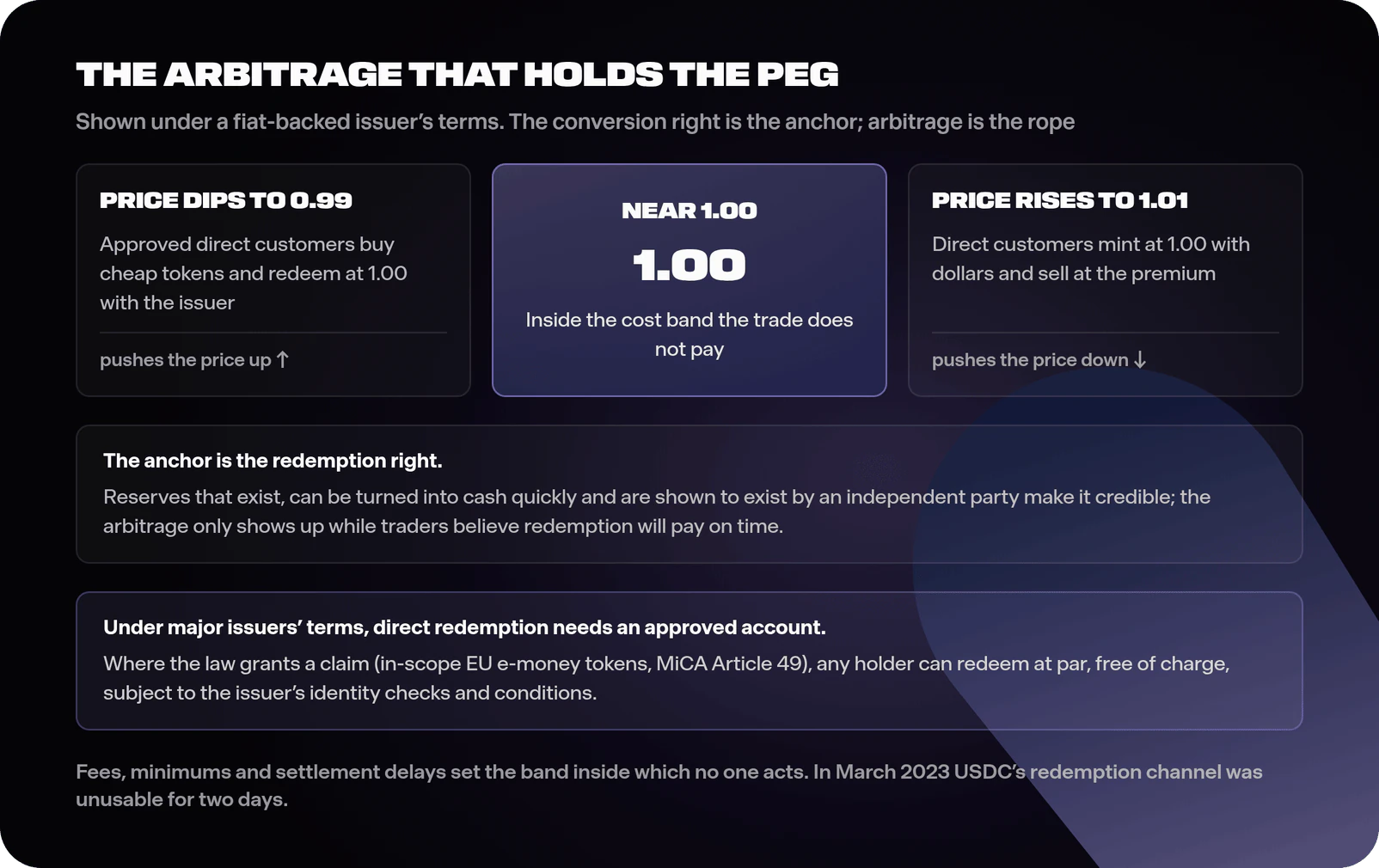
Nothing in a stablecoin's contract sets its market price. Exchanges quote it like any other asset, and it moves by fractions of a cent all day. What stops the movement from turning into a drift is that some participants can exchange the token for a dollar with the issuer. Suppose an issuer redeems each token for one dollar and the token dips to 0.99 on some exchange. A direct customer buys tokens at 0.99, sends them to the issuer, receives 1.00 per token, and keeps the difference minus costs; the buying pushes the exchange price back up. The same logic runs in reverse: at 1.01, the customer deposits dollars, receives tokens at 1.00, sells them at 1.01, and the selling pushes the price down. The Federal Reserve describes this directly: direct customers of the issuer "can engage in arbitrage trading, profiting off differences between the primary exchange rate and the exchange rate on secondary markets to maintain the peg" (Federal Reserve, FEDS Notes, 23 February 2024).
The trade is not free and it is not instant. The arbitrageur pays exchange fees and network fees, may pay the issuer a redemption fee, ties up capital while the redemption settles, and takes the risk that the token falls further or that the issuer delays payment before the dollars arrive. Those costs define a band: inside it, no one bothers, and the price wanders; at its edges, the trade pays and the price gets pulled back. How wide the band is, and whether anyone is standing at its edges in a crisis, depends on who can redeem and on what terms. That is the next section.
Who can actually redeem, and what does it cost?
Schnelle Antwort
Under the issuer terms of the large fiat-backed tokens, verified direct customers of the issuer, usually at institutional size, subject to fees, minimums and the settlement hours of the banking system; holders without an account commonly sell on an exchange at the exchange price. Where the law gives holders a redemption claim, as MiCA Article 49 does for in-scope EU e-money tokens, any holder can request redemption at par without a fee, subject to the issuer's identity checks and published conditions. Where holders depend on others' redemption, the peg reaches them indirectly, through the arbitrage of the people who can redeem; that arbitrage supports the market price and gives those holders no right or route to redeem themselves.
Primary market versus secondary market
The Federal Reserve draws the line plainly: the primary market is where the issuer creates and destroys tokens against dollars, and, for the tokens the note describes, access to it is limited to the issuer's own onboarded customers; "most retail users instead purchase their stablecoins from intermediaries and can buy and sell them on secondary markets" (Federal Reserve, FEDS Notes, 23 February 2024). The two markets have different prices. The primary rate is one dollar by contract. The secondary rate is whatever the last trade on that exchange was. The peg is the observation that the second stays near the first, and the reason is the arbitrage described above. For a holder on the secondary market, that arbitrage is no substitute for redemption access. It works only while the participants who can redeem choose to trade, and a holder without an account can exit only at the price the market offers at the time; if the arbitrage is constrained, as it was over the March 2023 weekend described below, the gap falls on the holders who cannot redeem.
The following summary uses each issuer's published terms as of 23 September 2026. It describes who may redeem with the issuer; it is not a comparison of the tokens, which belongs to the comparison of the biggest stablecoins.
| Token | Direct customer (primary market) | Secondary-market holder |
|---|---|---|
| USDC | Only holders of a Circle Mint account, opened through an application process, can redeem with Circle; Circle commits to redeem 1 USDC for 1 USD "subject to these Terms, applicable law, and any fees where applicable", and redemption is conditional on account standing and on no regulator, law-enforcement or court action restricting it (Circle, USDC Terms, accessed 23 September 2026). | Sells on an exchange or through an intermediary at the market price; no claim on Circle until a Circle Mint account is opened. |
| USDT | Verification fee of 150 USD in Tether tokens; minimum acquisition or redemption amount 100,000 USD; redemption fee the greater of 1,000 USD or 0.1 percent (Tether, Fees page, accessed 23 September 2026). | Sells on an exchange at the market price; under Tether's published minimum, balances below 100,000 USD cannot be redeemed directly with Tether. |
Issuer terms are issuer statements and can change; the figures above are what the pages said on the day of review. Where an issuer issues a token in the EU as an e-money token under MiCA, holders of that token also have the statutory claim described below, whatever the issuer's general terms say.
Fees, minimums and delays
Three frictions matter for the peg. Fees and minimums set the smallest gap worth closing: a redemption fee of 0.1 percent means the trade does not pay until the token is more than a tenth of a cent below par, before exchange and network costs. Settlement sets the speed: redemption pays out in dollars through the banking system, so it runs on banking days and hours, and a redemption requested on a Friday evening may not be funded until Monday. Liquidity sets the ceiling: an issuer can only pay redemptions as fast as it can turn reserves into cash, which is the subject of the next section.
All three showed up together in March 2023. Circle announced on 10 March that it had been unable to wire out about 3.3 billion dollars of USDC reserves, out of around 40 billion, from Silicon Valley Bank; on 11 March it stated that USDC "issuance and redemption is constrained by the working hours of the U.S. banking system" and would resume when banks opened on Monday. Over that weekend USDC traded at lows under 90 cents on secondary markets (Federal Reserve, FEDS Notes, 23 February 2024). The redemption promise had not been withdrawn. Redemption could not settle until banks reopened, so the arbitrage that normally pulls the price back was constrained, and uncertainty about the reserves held at the failed bank moved the secondary price.
What the law adds
Two regimes write conditions into the redemption right for issuers in their scope. In the EU, the Markets in Crypto-Assets Regulation (Regulation (EU) 2023/1114, MiCA), whose e-money token rules have applied since 30 June 2024, gives any holder of an in-scope e-money token a claim against the issuer, requires the issuer to redeem "at any time and at par value" on a holder's request, and provides that redemption "shall not be subject to a fee" (MiCA Article 49(2), 49(4), 49(6), via the ESMA rulebook); these obligations bind the issuer, which must state its redemption conditions in its white paper (Article 49(5)), and a holder still goes through the issuer's identity checks before being paid. In the United States, the GENIUS Act (Public Law 119-27), enacted 18 July 2025, requires a permitted payment stablecoin issuer to publish a redemption policy with "clear and conspicuous procedures for timely redemption", must disclose all purchase and redemption fees with at least seven days' notice of changes, and may impose discretionary redemption limits only where a regulator permits (GENIUS Act, Public Law 119-27, section 4(a)(1)(B)). Those obligations are not yet in force: they take effect on the earlier of 18 January 2027 or 120 days after the primary federal regulators issue final implementing regulations, and proposed rules were published on 18 August 2026. Under MiCA the redemption right attaches to holding an in-scope e-money token; the GENIUS Act requires a published redemption policy and does not give every secondary-market holder a statutory right to redeem with the issuer. Neither regime changes the hours of the banking system. The guide to stablecoin regulation around the world covers scope and dates by jurisdiction.
What makes the redemption promise credible?
Schnelle Antwort
Reserves that exist, can be turned into cash quickly, and are shown to exist by an independent party. The weaker any of those three, the less the arbitrage trade is worth taking, and the wider the band the price can drift in before anyone steps in.
A redemption right is only as good as the issuer's ability to honour it on demand, which comes down to the reserve's composition, liquidity and verification. Composition: cash, bank deposits and short-dated government paper can meet redemptions at short notice, while longer bonds, loans or riskier assets may have to be sold at a loss in a rush, which is exactly when redemptions spike. The Federal Reserve's April 2026 assessment gives the shape of the difference among the two largest tokens: USDC backed in full by higher-quality liquid assets, and USDT with reserves of about 1.04 times its coins in circulation, of which about 0.74 times were in the higher-quality categories of Treasuries, Treasury-backed repurchase agreements and bank deposits (Federal Reserve, FEDS Notes, 8 April 2026). Liquidity in the plain sense follows from composition and from where the assets sit: a reserve held at a bank that fails is not available until the bank's depositors are made whole, which is what the March 2023 weekend demonstrated. Verification: issuers publish attestations, third-party snapshots of reserves on a date, and some have moved to audited annual financial statements; what each kind of document does and does not prove is set out in the guide to proof of reserves and the failure-modes guide.
The GENIUS Act writes composition into US law for permitted payment stablecoin issuers, from its effective date: reserves of at least one dollar per token, held in listed assets such as currency, insured demand deposits, Treasury bills of 93 days or less, overnight Treasury repurchase agreements and government money-market funds, with monthly reports examined by a registered public accounting firm (GENIUS Act, sections 4(a)(1)(A) and 4(a)(3)). In the EU, MiCA sets reserve rules for issuers of asset-referenced tokens (Article 36) and investment rules for issuers of e-money tokens, which must deposit at least 30 percent of funds received in separate accounts at credit institutions (Article 54(a)); both have applied since 30 June 2024, alongside the redemption right described above. For a first reader the point is the same either way: the arbitrage that holds the peg only shows up while traders believe redemption will pay on time, and every line of a reserve disclosure is evidence for or against that belief. Put together, a peg's strength depends on four conditions at once: who has access to the issuer's redemption route and on what terms, how much liquidity the token has on the markets where it trades, the quality and accessibility of the reserves or collateral, and market confidence that redemption will be honoured. A weakness in any one of them can widen the band, even when the others look sound.
How do crypto-backed coins hold a peg without an issuer?
Schnelle Antwort
By replacing the issuer's redemption desk with contracts that lock more crypto than they issue, with access rules that differ by protocol. In Sky's vaults, which issue DAI and USDS, a vault owner repays their own debt to unlock their own collateral, and a holder without a vault sells on the market or uses a swap module; in Liquity's LUSD (version 1), any holder can redeem coins for a dollar's worth of ETH, minus a fee. In both, a liquidation engine is designed to keep the collateral worth more than the coins it backs, and the costs and failure points differ from the fiat-backed case.
Sky: vault owners repay their own debt
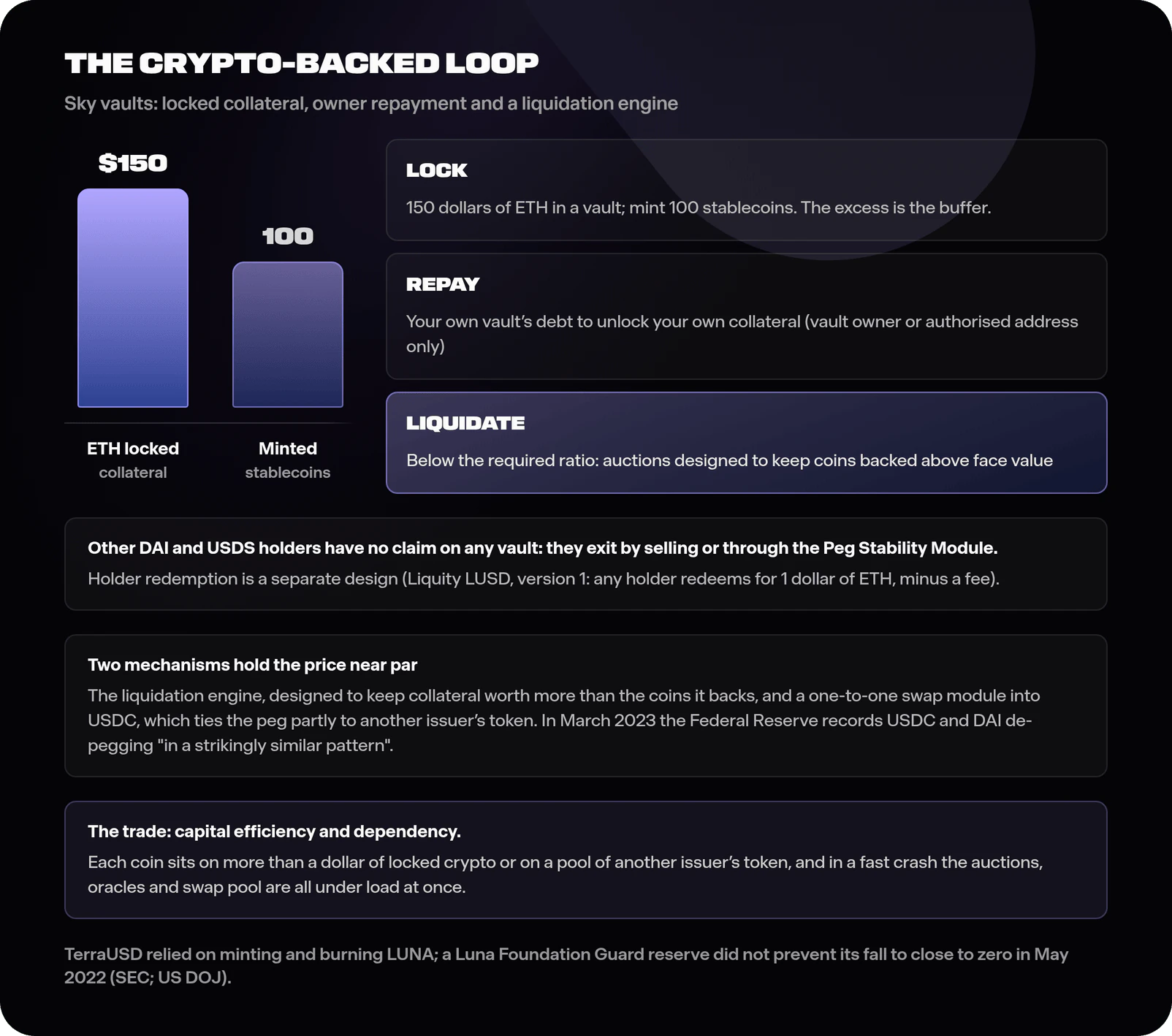
In the Sky protocol, which issues DAI and its successor USDS, coins come out of vault contracts. A user locks, say, 150 dollars of ETH in a vault and mints 100 stablecoins against it; the excess is the buffer that absorbs ETH's price swings. Repaying that vault's debt unlocks that vault's collateral, and the right to do so belongs to the vault's owner and any addresses the owner has authorised (Sky Protocol developer documentation, CDP Manager, accessed 24 September 2026). Opening a vault needs no place on an approved customer list; the Federal Reserve notes that for DAI "any Ethereum user" can access issuance directly (Federal Reserve, FEDS Notes, 23 February 2024). An ordinary DAI or USDS holder who has not opened a vault gains no claim on any vault's collateral by holding the coin: that holder's routes to a dollar are selling on the market or using the Peg Stability Module described below. The frictions differ from the fiat-backed case: there is no identity check or banking-hours constraint in the contract, and in their place a network fee on every step and a smart contract whose code, and the parameters governance sets in it, fix the terms.
Liquity LUSD: a redemption right for any holder
Liquity's LUSD (version 1) is built with a holder redemption route. Its documentation states that "Users can redeem their LUSD for ETH at any time" at face value, so one LUSD returns one dollar's worth of ETH, less a fee of (baseRate + 0.5 percent) times the ETH drawn; redemptions are taken from the lowest-collateralised positions, called Troves, first, whose debt and collateral are reduced by the amount redeemed (Liquity documentation, LUSD Redemptions, accessed 24 September 2026). When LUSD trades far enough below one dollar to cover that fee, any holder or arbitrageur can buy it and redeem it, and that buying pulls the market price back up. The terms are the protocol's own, set in its code and documentation, and other crypto-backed designs do not necessarily offer the same right.
How Sky holds the price near par
For Sky, two mechanisms hold the price near par. The first is the liquidation engine. If a vault's collateral falls below the required ratio, the protocol seizes it and auctions it for stablecoins to cover the debt, using a Dutch auction whose price declines over time until a buyer takes it, with a penalty added to the debt (a `chop` of 1.13 on 1,000 of debt means 1,130 must be raised at auction) and with circuit breakers and debt ceilings that limit how much can be liquidated at once (Sky Protocol developer documentation, Collateral Liquidation, accessed 23 September 2026). That machinery is designed to keep the coins backed by more than their face value through a crash, and it is covered in the guide to DeFi lending and liquidations. The second mechanism is a direct swap. Sky's Peg Stability Module lets anyone exchange DAI or USDS for USDC at one-to-one with no slippage, from a pool of pre-minted tokens; the documentation states that fees are currently not activated on those routes and could change (Sky Protocol developer documentation, LitePSM, accessed 23 September 2026). That swap ties the peg partly to the value of another stablecoin. For March 2023 the Federal Reserve records that "USDC and DAI de-pegged in a strikingly similar pattern, reaching lows of under 90 cents", and observes that "the fact that some portion of Dai is collateralized by USDC ties the market for Dai more directly to changes in USDC's market" (Federal Reserve, FEDS Notes, 23 February 2024). The peg module is a plausible channel for that co-movement, since a coin that can be swapped one-to-one for USDC takes on doubts about USDC. That reading is our inference from the Fed note and the Sky documentation; neither document establishes it as the single cause of DAI's fall.
The trade is capital efficiency and dependency: in Sky's design each coin sits on more than a dollar of locked crypto or on a pool of another issuer's token, and in a fast crash the auctions, the price oracles that trigger them and the swap pool are all under load at the same time. The failure-modes guide records how each has strained.
How do synthetic dollars hold a peg, and how do algorithmic designs differ?
Schnelle Antwort
A synthetic dollar holds a crypto asset plus an offsetting short so the pair's value stays roughly flat, and only whitelisted counterparties can mint or redeem; an algorithmic coin such as TerraUSD relied on minting and burning a paired token, LUNA, and a reserve later held by the Luna Foundation Guard did not prevent its fall to close to zero in May 2022 (US Attorney's Office, SDNY, 11 December 2025; SEC, 16 February 2023). They are separate models: a synthetic dollar is backed by crypto assets and hedge positions the protocol holds, while an algorithmic coin's peg rested on a supply rule against its own paired token. Synthetic dollars remain in use with their own risks. A coin whose peg rests on its own paired token would not meet the GENIUS Act's rule of at least one dollar of listed reserve assets per token for permitted payment stablecoin issuers in its scope (GENIUS Act, section 4(a)(1)(A)).
Synthetic dollars
The synthetic model, with USDe as the prominent example, rests on a hedge in place of a cash reserve. According to Ethena's documentation, the protocol holds an asset such as ETH or a staked-ETH token and shorts the same asset in perpetual futures, so the position's dollar value nets to roughly flat whatever the price does; USDe is described by its issuer as "a synthetic dollar, backed with crypto assets and corresponding short futures positions" (Ethena documentation, accessed 23 September 2026). The peg mechanism looks like the fiat-backed one on the surface, buy below par and redeem at par, mint at par and sell above, with the difference that direct minting and redemption are limited to "authorized, whitelisted users" who have passed the protocol's verification; Ethena also says it keeps a small share of backing in stablecoins to fund immediate redemptions (Ethena documentation, Peg Arbitrage Mechanism and Overview, accessed 23 September 2026). These are the issuer's descriptions of its own design, and the composition of the backing on any given day is an issuer assertion. Everyone else trades on exchanges, as with a fiat-backed token.
The distinct risk is the cost of the hedge. The short position earns funding when funding rates are positive and pays it when they are negative; the protocol's own documentation says negative funding is "a feature, rather than a bug of the system", that a reserve fund "will step in" when combined revenue turns negative, and that historical negative-funding streaks have been short (Ethena documentation, Funding Risk, accessed 23 September 2026). Those are issuer statements about the design; how the reserve fund would perform through a long negative-funding period is something the documentation describes in advance and cannot demonstrate.
Venue pricing is a separate matter from the peg. On 10 October 2025, Binance reported that USDe, along with wBETH and BNSOL, depegged on its platform between 21:36 and 22:16 UTC and later compensated Futures, Margin and Loan users who were liquidated in that window; the notice gives no root cause (Binance, support announcement, October 2025). One exchange's order book falling away from par is a pricing and margin event on that venue. Whether the token's backing or redemption mechanism was affected is a separate question that a venue notice does not answer either way, and any statement Ethena made about its backing that day is an issuer assertion. The guide to oracle risk draws that distinction.
Algorithmic coins
The algorithmic model put a paired token at the centre of the peg. According to the US Attorney's Office for the Southern District of New York, Terraform's promotional materials claimed that "one UST could always be exchanged for $1 worth of LUNA", and the reverse (US Attorney's Office, SDNY, 11 December 2025). Below par, holders could burn UST for newly minted LUNA; above par, they could burn LUNA to mint UST. From early 2022 the design also had an outside reserve. Kwon publicly announced the creation of the Luna Foundation Guard (LFG) in or about January 2022, and the office's account describes it as "deploying billions of dollars' worth of financial reserves to defend UST's peg" (same source). Neither held in May 2022. Redemptions through the swap minted LUNA in rapidly growing quantities, its price collapsed, and the LFG reserve did not restore the peg; the SEC's account is that UST "depegged from the U.S. dollar, and the price of it and its sister tokens plummeted to close to zero" (SEC press release, 16 February 2023, announcing a civil complaint against Terraform Labs and Do Kwon).
The system was also less autonomous than it was presented to be. In the same release, the US Attorney's Office states that Kwon controlled the LFG while describing it as independent and misappropriated hundreds of millions of dollars in assets from it, and that when UST fell below 92 cents in or about May 2021, its recovery followed purchases of UST by a high-frequency trading firm under an agreement with Kwon, while Kwon publicly credited the Terra protocol with restoring the peg (US Attorney's Office, SDNY, 11 December 2025). The SEC complaint's allegations were later tested in court: on 5 April 2024 a federal jury found Terraform and Kwon liable for securities fraud, and in June 2024 they agreed to a final judgment including about 4.5 billion dollars in payments (SEC, press release 2024-73, 13 June 2024). Separately, Kwon pleaded guilty on 12 August 2025 in the US District Court for the Southern District of New York to one count of conspiracy to commit commodities, securities and wire fraud and one count of wire fraud, and on 11 December 2025 he was sentenced to 15 years in prison; the office puts the investor losses from the collapse of UST and LUNA at "over $40 billion" (US Attorney's Office, Southern District of New York, 12 August 2025 and 11 December 2025). The first reader's takeaway is that a peg resting on confidence in a paired token can break even with a reserve set aside to defend it. The failure-modes guide walks the spiral in detail.
Frequently asked questions
Can an ordinary holder redeem a stablecoin for a dollar directly?
Under the issuer terms of the large fiat-backed tokens, direct redemption is limited to onboarded customers of the issuer: holders of a Circle Mint account for USDC, or verified customers meeting Tether's 100,000 dollar minimum for USDT (issuer terms, accessed 23 September 2026). Holders without such an account usually sell on an exchange at the exchange price. The law can give a direct route: in the EU, MiCA Article 49 gives any holder of an in-scope e-money token a claim against the issuer and redemption at par, at any time and free of charge, applying since 30 June 2024, subject to the issuer's identity checks and the redemption conditions in its white paper; the regulation guide covers which tokens are in scope. For Sky's DAI and USDS, anyone can open a vault without an account, but repaying debt unlocks only the collateral in a vault the person owns or is authorised to manage; a holder without a vault sells on the market or uses the Peg Stability Module (Sky Protocol developer documentation). Liquity's LUSD (version 1) works differently: any holder can redeem LUSD for a dollar's worth of ETH, minus a fee (Liquity documentation, LUSD Redemptions).
Why do stablecoins trade at 0.999 or 1.001 rather than exactly 1.000?
Because arbitrage has costs: issuer fees, exchange fees, network fees, redemption minimums and the time it takes for a redemption to settle through a bank. Those who can redeem only act when the gap exceeds those costs, so the price drifts inside a narrow band around par and is pulled back at the band's edges.
What is the difference between a depeg and a dip?
Scale and cause. A dip is the ordinary band. A depeg is a break large enough to signal doubt that the conversion channel will pay, such as USDC under 90 cents when its redemptions could not settle over a banking weekend in March 2023, or UST going to close to zero in May 2022 when confidence in its paired token collapsed and the Luna Foundation Guard's reserve did not restore the peg (SEC, 16 February 2023; US Attorney's Office, SDNY, 11 December 2025). The failure-modes guide sorts depegs into the recoverable reserve shock and the terminal reflexive collapse.
How do the risks of crypto-backed and fiat-backed stablecoins differ?
They sit in different places, and neither set is smaller in general. A fiat-backed coin depends on its issuer, the banks and custodians that hold its reserves, and the customers or holders entitled to redeem; a bank problem outside banking hours can constrain the redemption route, as USDC's weekend in March 2023 showed. A crypto-backed coin depends on contract code, price oracles, liquidation auctions that must clear during a crash, the collateral's own volatility and, where a swap module holds another issuer's token, on that token as well: the Federal Reserve records that DAI de-pegged in a "strikingly similar pattern" to USDC that same weekend (Federal Reserve, FEDS Notes, 23 February 2024). A crypto-backed coin's collateral is visible on-chain at any time, and it needs more than a dollar of locked value per coin. The comparison of the biggest stablecoins sets named tokens side by side on one date.
Does regulation guarantee the peg?
No. Laws such as the EU's MiCA and, from its effective date, the US GENIUS Act require reserves, redemption terms and disclosure for issuers in their scope, which strengthens the promise's credibility without removing the risks of banks, custodians and markets. USDC's reserves were partly caught in a bank failure in March 2023, and a rule on reserve composition does not change the hours in which banks settle payments.
Sources and further reading
Sources for this guide, checked on 23 September 2026. Issuer and protocol documentation records what the issuer or protocol states; it is labelled as such in the text.
- Primary and Secondary Markets for Stablecoins. Federal Reserve Board, FEDS Notes, 23 February 2024. https://www.federalreserve.gov/econres/notes/feds-notes/primary-and-secondary-markets-for-stablecoins-20240223.html (accessed 23 September 2026)
- Stablecoins in 2025: Developments and Financial Stability Implications. Federal Reserve Board, FEDS Notes, 8 April 2026. https://www.federalreserve.gov/econres/notes/feds-notes/stablecoins-in-2025-developments-and-financial-stability-implications-20260408.html (accessed 23 September 2026)
- GENIUS Act, Public Law 119-27. US Government Publishing Office, 18 July 2025. https://www.govinfo.gov/content/pkg/PLAW-119publ27/html/PLAW-119publ27.htm (accessed 23 September 2026)
- MiCA Article 49, Issuance and redeemability of e-money tokens. ESMA Interactive Single Rulebook, Regulation (EU) 2023/1114. https://www.esma.europa.eu/publications-and-data/interactive-single-rulebook/mica/article-49-issuance-and-redeemability-e (accessed 23 September 2026)
- MiCA Article 54, Investment of funds received in exchange for e-money tokens. ESMA Interactive Single Rulebook, Regulation (EU) 2023/1114. https://www.esma.europa.eu/publications-and-data/interactive-single-rulebook/mica/article-54-investment-funds-received (accessed 24 September 2026)
- USDC Terms. Circle Internet Group, current version. https://www.circle.com/legal/usdc-terms (accessed 23 September 2026)
- Fees. Tether, current version. https://tether.to/en/fees/ (accessed 23 September 2026)
- CDP Manager. Sky Protocol developer documentation, current version. https://developers.skyeco.com/protocol/vaults/cdp-manager/ (accessed 24 September 2026)
- LUSD Redemptions. Liquity documentation (Liquity v1 FAQ), current version. https://docs.liquity.org/liquity-v1/faq/lusd-redemptions (accessed 24 September 2026)
- Collateral Liquidation. Sky Protocol developer documentation, current version. https://developers.skyeco.com/protocol/vaults/collateral-liquidation/ (accessed 23 September 2026)
- LitePSM. Sky Protocol developer documentation, current version. https://developers.skyeco.com/protocol/liquidity/litepsm/ (accessed 23 September 2026)
- USDe overview. Ethena Labs documentation, current version. https://docs.ethena.fi/ (accessed 23 September 2026)
- Peg Arbitrage Mechanism. Ethena Labs documentation, current version. https://docs.ethena.fi/protocol-overview/peg-arbitrage-mechanism.md (accessed 23 September 2026)
- Funding Risk. Ethena Labs documentation, current version. https://docs.ethena.fi/protocol-overview/risks/funding-risk.md (accessed 23 September 2026)
- SEC Charges Crypto Asset Trading Platform Terraform Labs and Founder Do Kwon with Defrauding Investors (announcement of a civil complaint; for the outcome see the SEC and US Attorney releases below). US Securities and Exchange Commission, press release 2023-32, 16 February 2023. https://www.sec.gov/newsroom/press-releases/2023-32 (accessed 23 September 2026)
- Terraform and Kwon to Pay $4.5 Billion Following Fraud Verdict. US Securities and Exchange Commission, press release 2024-73, 13 June 2024. https://www.sec.gov/newsroom/press-releases/2024-73 (accessed 24 September 2026)
- Do Kwon Pleads Guilty To Fraud. US Attorney's Office, Southern District of New York, 12 August 2025. https://www.justice.gov/usao-sdny/pr/do-kwon-pleads-guilty-fraud (accessed 24 September 2026)
- Crypto-Enabled Fraudster Sentenced For Orchestrating $40 Billion Fraud (sentencing of Do Kwon). US Attorney's Office, Southern District of New York, 11 December 2025. https://www.justice.gov/usao-sdny/pr/crypto-enabled-fraudster-sentenced-orchestrating-40-billion-fraud (accessed 24 September 2026)
- Binance Resolves USDE, BNSOL and WBETH Depeg Issue and Compensates Affected Users. Binance, support announcement, October 2025. https://www.binance.com/en/support/announcement/detail/0989d6c7f32545bfb019e3249eaabc3f (accessed 23 September 2026)
Kurzes Quiz: Hat es geklebt?
Ein paar Fragen zur Überprüfung der Grundlagen sind gelandet. Es folgen Antworten mit Erläuterungen und niemand außer Ihrem zukünftigen Portfolio bewertet Sie.


Sie haben ein Quiz zu „How Do Stablecoins Keep Their Peg?“ abgeschlossen! Teilen Sie Ihren Erfolg in den sozialen Medien.
 War das hilfreich?