
TL;DR
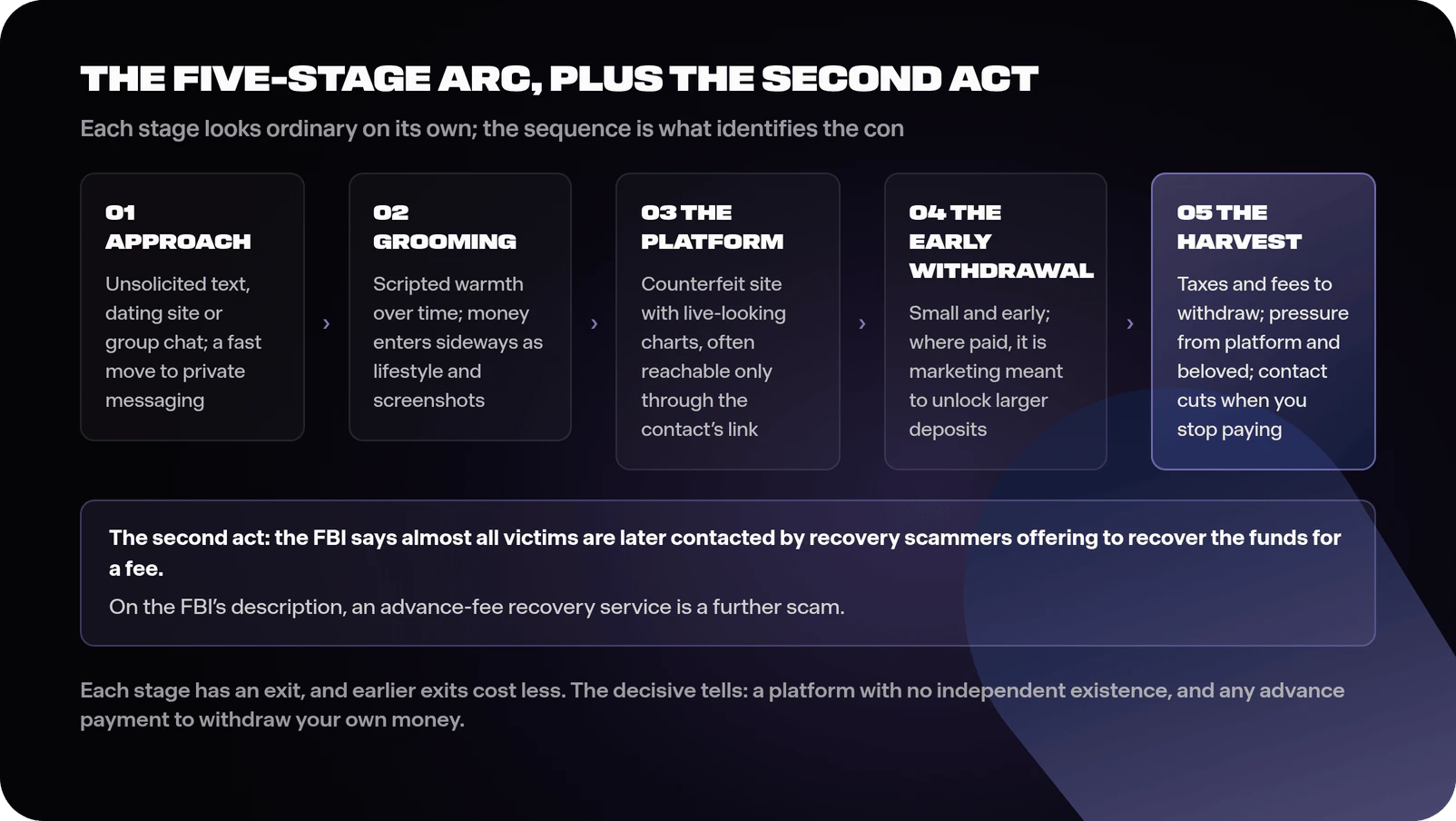
- An unsolicited but plausible contact, a fast move to private messaging, and a period of warm, patient, unhurried relationship-building in which money is barely mentioned. The investment comes later, and its absence early is part of the design.
- A counterfeit trading site or app, often only reachable through the contact's link, where deposits are real and balances are fabricated. In many documented cases an early, small withdrawal is paid deliberately, because it is cheap proof that the platform "works"; the stages after it are designed to block withdrawal.
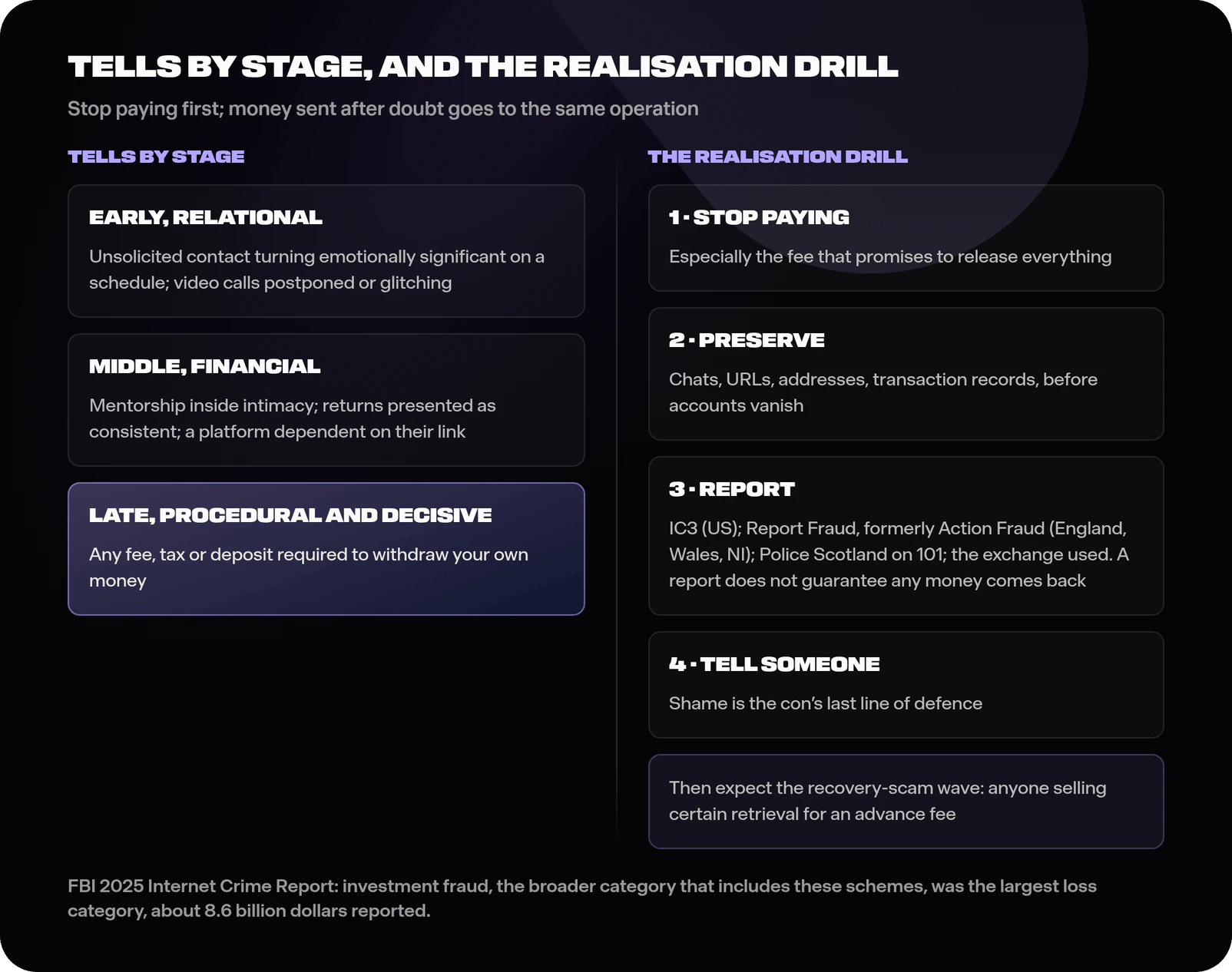
- Stage-matched tells: unsolicited warmth migrating to private channels; mentorship arriving inside intimacy; a platform with no independent existence; withdrawals gated by advance fees; and urgency that ramps when you pull back. On realising, at any stage: stop paying, preserve everything, report, and expect the recovery-scam wave.
In einem Block
A relationship investment scam is investment fraud that begins with a relationship. A scammer, usually making contact out of the blue online, builds trust and then steers the person into depositing money, often crypto, on a counterfeit trading platform. It shows invented gains and may pay out a small early withdrawal.
How does the approach and grooming stage actually work?
Schnelle Antwort
An unsolicited but plausible contact, a fast move to private messaging, and a period of warm, patient, unhurried relationship-building in which money is barely mentioned. The investment comes later, and its absence early is part of the design.
The first message arrives dressed as an accident or a coincidence. The FBI lists the usual channels as social media, texting, dating sites, WhatsApp and Telegram groups, online searches and online advertisements, and gives "Hey, do you have WhatsApp, let's talk there" as a characteristic early line (FBI, Cryptocurrency Investment Fraud). Its 2022 public service announcement describes fraudsters "either spoofing long lost contacts known to the victim or posing as a potential friend or romantic partner" who "often spend time gaining the victim's confidence and trust" (FBI IC3, PSA I-100322, 3 October 2022). The profiles are polished and increasingly AI-assisted: the FBI warns of scammers "using deepfake technology" or hiring real people to speak with targets on the phone, and UNODC reported a 600 percent increase in mentions of deepfake-related content targeting criminal groups in Southeast Asia, across the online platforms it monitored, in the first half of 2024 (FBI, Cryptocurrency Investment Fraud; UNODC, 7 October 2024). The conversation moves off the original platform to an encrypted messenger, out of reach of the dating app's moderation, and then it does something counterintuitive: it takes its time.
The grooming period is the con's real investment, and its warmth is professional. Daily good-morning messages, life stories, photos of meals and gyms and travel, questions about your family and your work and, gently, your finances. The FBI names "excessive flattery" and "empathizing with, and often suffering from, similar life events as the victim" as standard tactics (FBI, Cryptocurrency Investment Fraud). How long this lasts varies by case; the agency descriptions give no fixed number of weeks, and this guide does not put a figure on it. The operators themselves are frequently victims too. The UN Human Rights Office estimated in August 2023 that at least 120,000 people across Myanmar and around 100,000 in Cambodia "may be held in situations where they are forced to carry out online scams", naming "romance-investment scams and crypto fraud" among the activities, and its February 2026 report documented torture, detention and sexual abuse inside the compounds (OHCHR, 29 August 2023; OHCHR, 20 February 2026). That industrial detail explains both the scale and the scripts' uniformity.
Money enters sideways, as lifestyle first: mention of trading successes, screenshots of gains, an uncle or mentor with a system, reluctance to share it that melts under your curiosity. The FTC's June 2024 alert puts it plainly: "They want to help you invest your money in the crypto markets, or they say they can teach you how to do it" (FTC, 10 June 2024). By the time the platform link arrives, it arrives as a favour between intimates, which is the purpose of everything that came before.
What is the fake platform, and why might an early withdrawal pay?
Schnelle Antwort
A counterfeit trading site or app, often only reachable through the contact's link, where deposits are real and balances are fabricated. In many documented cases an early, small withdrawal is paid deliberately, because it is cheap proof that the platform "works"; the stages after it are designed to block withdrawal.
The platforms are the con's stagecraft and they are good: live-looking charts, customer support, account tiers, two-factor login, and a domain name that, in the FBI's words, "closely mimics, or 'spoofs', a legitimate site" (FBI, Cryptocurrency Investment Fraud). The FBI's 2022 PSA says the fake sites and apps "allow the victims to track their investments and give the impression they are growing exponentially" (FBI IC3, PSA I-100322, 3 October 2022). The tell is distribution: this platform arrives only through your contact, and searching for it independently finds nothing, or finds warnings. The FBI's 2022 PSA advises looking out for "domain names that impersonate legitimate financial institutions, especially cryptocurrency exchanges" (FBI IC3, PSA I-100322, 3 October 2022). Deposits move as crypto to addresses the operation controls, at which point, as the guide to sending and receiving crypto explains, the transfer generally cannot be reversed by the sender; the dashboard number that then grows so beautifully is a figure in the operators' database.
The early withdrawal. The FBI says it is common in the early stages for scammers to allow victims to withdraw the original deposit and the "earnings" on top, and that "this is meant to trick victims and to reassure them that the platform is legitimate" (FBI, Cryptocurrency Investment Fraud). The FBI's word is "common", and the FTC's description allows for operations that pay out nothing at all: on a fake site "you won't be able to withdraw your money at all, or only if you pay high fees" (FTC, What To Know About Cryptocurrency and Scams, May 2022). Where an early withdrawal is paid, its function is marketing, and its cost to the operation is small beside the deposits it is meant to unlock. A small payout therefore proves little. A substantial withdrawal that completes to a wallet you control, with no new fee attached, is a more demanding test, though it too shows only that one transfer went through. The FBI's 2022 PSA reported individual losses ranging "from tens of thousands to millions of dollars"; across all complaint types, the average reported loss in the 2025 Internet Crime Report was 20,699 dollars, and complainants aged 60 and over reported an average of 38,500 dollars (FBI IC3, PSA I-100322, 3 October 2022; FBI IC3, 2025 Internet Crime Report).
The harvest. When a meaningful withdrawal is requested, the platform discovers taxes, unlock fees and compliance deposits, each payable in advance, each unlocking nothing, each calibrated against what the victim appears able to pay. The FBI describes the moment: "Once the victim is ready to withdraw all their earnings, they will find their account frozen and an arbitrary requirement will arise, usually in the form of paying 'taxes' or 'fees' to unlock their funds" (FBI, Cryptocurrency Investment Fraud). The FBI's June 2026 PSA adds a newer variant: when banks block transfers, scammers tell victims their accounts have been "flagged" and send couriers to collect cash in person for the supposed fees or fines, then repeat the demand (FBI IC3, PSA I-061526, 15 June 2026). Pressure arrives from both the platform and the beloved contact, the sunk costs argue for one more fee, and the con ends when the victim stops paying, at which point contact cuts and the operation's next department, covered below, takes the file.
What are the tells at each stage, and what do you do on realising?
Schnelle Antwort
Stage-matched tells: unsolicited warmth migrating to private channels; mentorship arriving inside intimacy; a platform with no independent existence; withdrawals gated by advance fees; and urgency that ramps when you pull back. On realising, at any stage: stop paying, preserve everything, report, and expect the recovery-scam wave.
The early tells are relational: contact you did not seek that becomes emotionally significant on a schedule, video calls that keep being postponed or glitch oddly when they happen (the guide to AI voice clones and deepfake scams covers these), and life details that fail small cross-checks. The middle tells are financial: investment mentorship from someone you have never met, returns presented as consistent in the way the guide to guaranteed returns as a red flag teaches you to question, and the platform's dependence on their link. The FTC compresses the middle stage into one rule: "Never mix online dating and investment advice" (FTC, May 2022). The late tells are procedural and decisive: a fee, tax or deposit required to withdraw your own money is the harvest running. The FBI's guidance on that demand is unusually direct: "we strongly recommend that you do not pay them" (FBI, Cryptocurrency Investment Fraud).
Realisation has a drill, and its order matters. Stop paying first, including and especially the fee that promises to release everything; money sent after doubt sets in goes to the same operation as the deposits before it. Preserve everything second: chat logs, platform URLs, deposit addresses and transaction records, per the evidence list in how to respond if your crypto is hacked or stolen, before accounts vanish. Report third: in the US to IC3, which the FTC lists alongside itself, the CFTC, the SEC and the cryptocurrency exchange used as places to report crypto fraud (FTC, May 2022); in England, Wales and Northern Ireland to Report Fraud, which has replaced Action Fraud (reportfraud.police.uk or 0300 123 2040; City of London Police, December 2025); in Scotland to Police Scotland on 101; elsewhere to the local police or national reporting service. A report does not guarantee that any money comes back, and tracing outcomes are the exception, but reports are how the interventions that do happen begin: according to the FBI, its Operation Level Up, launched in January 2024, had by December 2025 contacted 8,103 people it identified as current victims, 77 percent of whom did not know they were being scammed, and the FBI estimated 511 million dollars in prevented losses (FBI, Operation Level Up). And tell someone fourth, because shame is the con's last line of defence. These operations are industrial and their scripts are professional; the FBI's 2025 data books about 8.6 billion dollars of reported investment-fraud losses from people who were targeted, alone and human.
The epilogue requires its own warning. The FBI states that "almost all victims, after they lost their money, are contacted by scammers conducting recovery fraud schemes". Those schemes, it says, involve scammers "impersonating law enforcement, private companies, and/or law firms" who claim they can recover the lost funds for a fee, and the page adds that "the FBI will never ask for money" (FBI, Cryptocurrency Investment Fraud). A useful working rule follows: treat an unprompted contact that knows your case details and promises certain recovery for an advance fee as the same fraud returning for a second payment.
Frequently asked questions
Could I really fall for a relationship investment scam if I would never send money to a stranger?
By the time money moves, the contact no longer feels like a stranger: the victims described by the FBI and FTC sent money to someone they had been talking to regularly over time, and in some cases into an account they had already withdrawn from. The grooming stage exists to answer exactly that objection, which is why this guide teaches the arc. The FBI's own outreach found that 77 percent of the victims it contacted did not know they were being scammed (FBI, Operation Level Up, figures as of December 2025).
Are the scammers behind relationship investment scams real people or AI?
Sometimes a real operator, frequently trafficked and scripted; increasingly assisted or replaced by AI for photos, video calls and fluency (FBI, Cryptocurrency Investment Fraud; UNODC, 7 October 2024). The FBI notes that even a real person on the other end "could be part of a scam", so whether the person exists settles little. The arc is the more useful test: an investment platform reachable only through one contact's private link is a tell whoever sends it.
Does a successful withdrawal prove a crypto platform is legitimate?
No. The FBI says it is common in the early stages for scammers to let victims withdraw the original deposit and the "earnings" as well, and that this "is meant to trick victims and to reassure them that the platform is legitimate" (FBI, Cryptocurrency Investment Fraud). A hypothetical shows the arithmetic: an operation that pays out a 500-dollar test withdrawal and then receives a 20,000-dollar deposit has spent 2.5 percent of what the test unlocked. A completed withdrawal shows only that one transfer went through. The checks that mean more sit outside the platform: whether an opportunity offered by a stranger or long-lost contact can be verified independently, whether the domain imitates a known exchange, and whether the app's legitimacy can be verified at all (FBI IC3, PSA I-100322, 3 October 2022).
Can the money lost to a relationship investment scam be recovered?
No one can promise recovery. The FBI states that paying the scammers' fees "will not result in you recovering your funds" (FBI, Cryptocurrency Investment Fraud). In the United States, federal prosecutors bring civil forfeiture actions against traced scam proceeds; the US Attorney's Office for the District of Columbia describes their purpose as including "to recover assets that may be used to compensate victims" where federal law authorises it, and notes that the details in such a complaint are allegations (US Attorney's Office for the District of Columbia, 16 July 2024). That process runs through the courts and can take years. An advance-fee recovery service is, on the FBI's description, a further scam, so paying one adds a second loss to the first (FBI, Cryptocurrency Investment Fraud).
How can I help a friend who may be caught in a relationship investment scam?
A confrontation over the contact they care about tends to push people to defend it, so aim at procedure instead: ask what happened the last time they asked to withdraw a substantial sum, and whether a new fee or tax appeared; show them the FBI's description of the scheme; and be the person they can tell without shame when doubt lands. Affinity keeps victims in; being safe to talk to is the counter-affinity.
Sources and further reading
Primary sources for this guide, last checked 23 September to 7 October 2026.
- 2025 Internet Crime Report. FBI Internet Crime Complaint Center (IC3), 2026. https://www.ic3.gov/AnnualReport/Reports/2025_IC3Report.pdf (accessed 23 September 2026)
- Cryptocurrency Investment Fraud (victim services resource: scheme description, early withdrawals, fees to unlock funds, recovery fraud). FBI, undated page. https://www.fbi.gov/how-we-can-help-you/victim-services/national-crimes-and-victim-resources/cryptocurrency-investment-fraud (accessed 24 September 2026)
- Operation Level Up. FBI, figures as of December 2025. https://www.fbi.gov/how-we-can-help-you/victim-services/national-crimes-and-victim-resources/operation-level-up (accessed 23 September 2026)
- Cryptocurrency Investment Schemes, PSA I-100322. FBI IC3, 3 October 2022. https://www.ic3.gov/PSA/2022/psa221003 (accessed 24 September 2026)
- Scammers Use Couriers to Collect Cash in Cryptocurrency Investment Scams, PSA I-061526. FBI IC3, 15 June 2026. https://www.ic3.gov/PSA/2026/PSA260615 (accessed 24 September 2026)
- FinCEN Alert on Prevalent Virtual Currency Investment Scam Commonly Known as "Pig Butchering", FIN-2023-Alert005. Financial Crimes Enforcement Network (US Treasury), 8 September 2023. https://www.fincen.gov/sites/default/files/shared/FinCEN_Alert_Pig_Butchering_FINAL_508c.pdf (accessed 24 September 2026)
- FinCEN Reminds Financial Institutions of Its Resources on Identifying Potential Relationship Investment Scams (#DatingorDefrauding statement). Financial Crimes Enforcement Network (US Treasury), 13 February 2026. https://www.fincen.gov/news/news-releases/dating-or-defrauding-2026 (accessed 7 October 2026)
- What To Know About Cryptocurrency and Scams. Federal Trade Commission, May 2022. https://consumer.ftc.gov/articles/what-know-about-cryptocurrency-scams (accessed 23 September 2026)
- What to do if your online love interest offers to teach you how to invest your money. Federal Trade Commission consumer alert, 10 June 2024. https://consumer.ftc.gov/consumer-alerts/2024/06/what-do-if-your-online-love-interest-offers-teach-you-how-invest-your-money (accessed 23 September 2026)
- Hundreds of thousands trafficked to work as online scammers in SE Asia, says UN report. UN Human Rights Office (OHCHR), 29 August 2023. https://www.ohchr.org/en/press-releases/2023/08/hundreds-thousands-trafficked-work-online-scammers-se-asia-says-un-report (accessed 24 September 2026)
- UN report details grave abuses against those trafficked into scam centres. UN Human Rights Office (OHCHR), 20 February 2026. https://www.ohchr.org/en/press-releases/2026/02/un-report-details-grave-abuses-against-those-trafficked-scam-centres (accessed 24 September 2026)
- Report Fraud service goes live with full public launch in January 2026. City of London Police, December 2025. https://www.cityoflondon.police.uk/news/city-of-london/news/2025/december/report-fraud-service-goes-live-with-full-public-launch-in-january-2026/ (accessed 24 September 2026)
- U.S. files Civil Forfeiture Action to Recover Cryptocurrency Worth $2.5 Million for Victims of Pig Butchering Scheme. US Attorney's Office for the District of Columbia, 16 July 2024. https://justice.gov/usao-dc/pr/us-files-civil-forfeiture-action-recover-cryptocurrency-worth-25-million-victims-pig (accessed 24 September 2026)
- Billion-dollar cyberfraud industry expands in Southeast Asia as criminals adopt new technologies. UNODC, 7 October 2024. https://www.unodc.org/roseap/en/2024/10/cyberfraud-industry-expands-southeast-asia/story.html (accessed 24 September 2026)
Kurzes Quiz: Hat es geklebt?
Ein paar Fragen zur Überprüfung der Grundlagen sind gelandet. Es folgen Antworten mit Erläuterungen und niemand außer Ihrem zukünftigen Portfolio bewertet Sie.


Sie haben ein Quiz zu „Pig Butchering: How Long-Con Crypto Scams Build Trust“ abgeschlossen! Teilen Sie Ihren Erfolg in den sozialen Medien.
 War das hilfreich?