
TL;DR
- A token that moves on a blockchain but is designed to stay close to a fixed reference value, typically one dollar, so that crypto's rails can carry money without crypto's price swings. It exists because traders, remitters and applications needed a unit that holds value between the moments of use.
- Fiat-backed coins are issued against cash and short-term government paper held by a company; crypto-backed coins lock more crypto than they issue in contracts that liquidate collateral that falls too far; synthetic and algorithmic designs hold the reference with hedges or supply rules. A common heuristic places each at a different point of a trade-off among stability, capital efficiency and decentralisation; it is a way of thinking about designs and does not predict outcomes.
- In every design you own a transferable token; what differs is what supports its value, the contract and governance risks attached, and who can redeem it directly. Fiat-backed issuers' terms usually limit direct redemption to approved customers; DAI and USDS holders have no claim on any vault and exit by selling or swapping; Ethena's terms let only whitelisted Mint Users redeem USDe. In none of these do you own a reserve dollar, and the token's stability is exactly as strong as what stands behind it.
- Four questions: what backs it and how well is that demonstrated, who can redeem directly and how fast, which chain's version you are holding, and which legal regime, if any, the issuer answers to. Answered in that order, they place any instrument in a day's reading.
In einem Block
A stablecoin is a blockchain token that aims to hold a steady value, usually one US dollar, by resting on issuer-held reserves, surplus crypto locked in contracts, hedged positions or supply rules. Its holder owns the token; the right to redeem it is separate.
What is a stablecoin, and why does it exist?
Schnelle Antwort
A token that moves on a blockchain but is designed to stay close to a fixed reference value, typically one dollar, so that crypto's rails can carry money without crypto's price swings. It exists because traders, remitters and applications needed a unit that holds value between the moments of use.
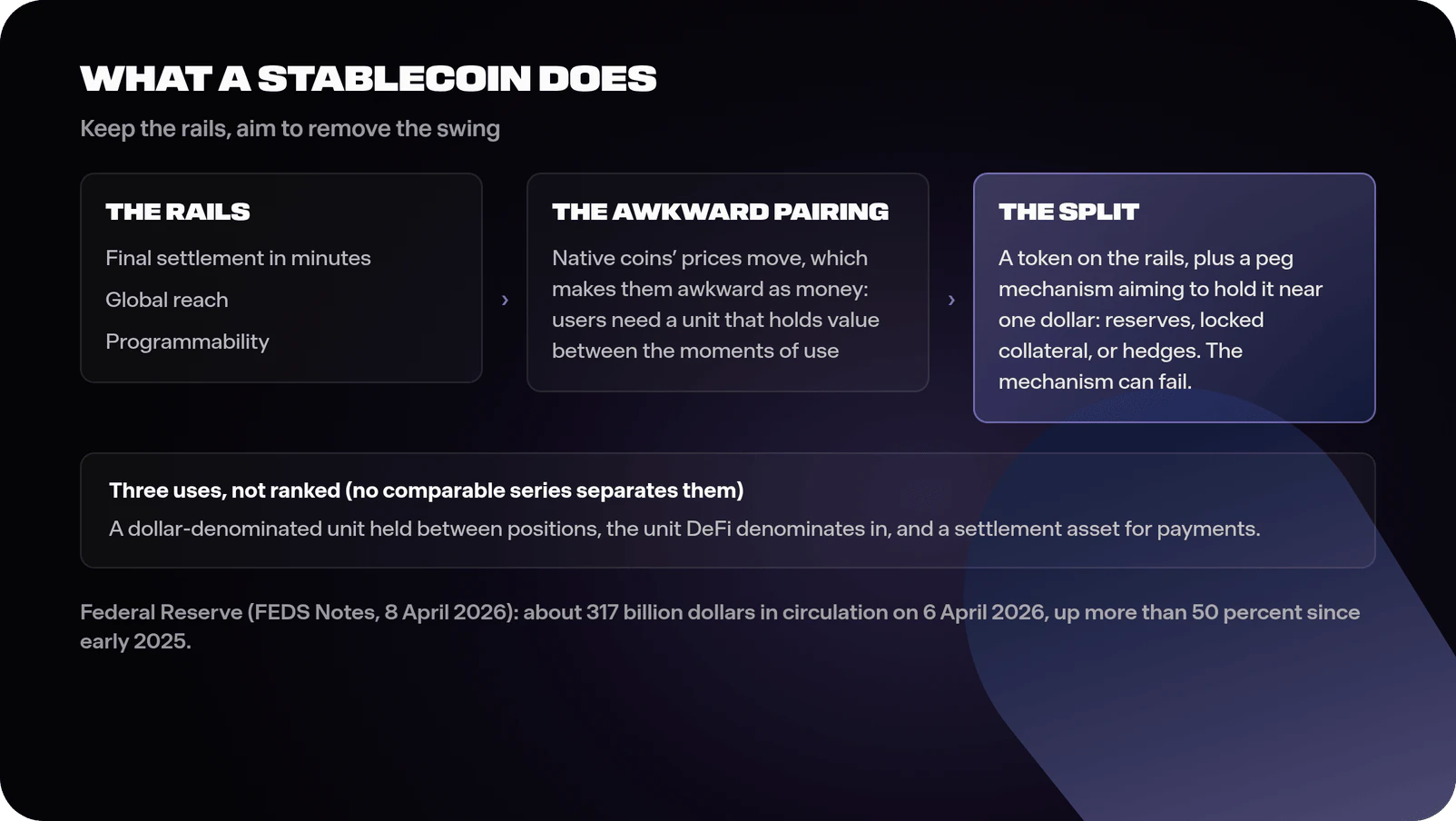
The properties that make a blockchain useful for money, final settlement in minutes, global reach, programmability, come paired with one that makes its native coins awkward as money: their price moves. Stablecoins split the pair. The token lives on-chain with the rails' properties, as the guide to how blockchains differ maps them, while a mechanism off-chain or in-contract holds its price near the reference currency.
Stablecoins have at least three uses, and this guide does not rank them, because no published series measures them against each other on a comparable basis. On exchanges, a stablecoin is a dollar-denominated unit to hold between positions without leaving the venue. In DeFi, it is the unit that lending markets and liquidity pools denominate in, as the DeFi guide explains. In payments, it is a settlement asset for transfers and for the payment firms and card networks now building on it; the stablecoin adoption report measures that use with dated data and defined denominators, and explains why the official activity series combine all uses. The Federal Reserve's April 2026 note puts the category at about 317 billion dollars on 6 April 2026, up more than 50 percent since early 2025, and reports that retail-sized wallets (holdings under 1,000 dollars) increased substantially in 2025 (Federal Reserve, FEDS Notes, 8 April 2026). Wallets are not people: one person can hold many, and one custodial wallet can hold many people's balances.
What are the three kinds, and how does each hold its peg?
Schnelle Antwort
Fiat-backed coins are issued against cash and short-term government paper held by a company; crypto-backed coins lock more crypto than they issue in contracts that liquidate collateral that falls too far; synthetic and algorithmic designs hold the reference with hedges or supply rules. A common heuristic places each at a different point of a trade-off among stability, capital efficiency and decentralisation; it is a way of thinking about designs and does not predict outcomes.
In the fiat-backed model the issuer holds reserves, typically cash, bank deposits, Treasury bills and repurchase agreements, mints one token per dollar received from an approved customer, and undertakes to redeem at par on its terms. USDT and USDC are the reference examples, and the Federal Reserve's February 2024 note calls USDT "the largest stablecoin on the market" (Federal Reserve, FEDS Notes, 23 February 2024). The comparison of the biggest stablecoins sets out each named token's reserves, evidence and redemption terms on a single date, and the Federal Reserve's April 2026 note assesses their reserve quality (Federal Reserve, FEDS Notes, 8 April 2026). The model is capital-efficient, and its price stability depends on the banks and custodians that hold the reserves: in March 2023 USDC traded below 90 cents for about three days after Circle said it could not wire out 3.3 billion dollars of its roughly 40 billion dollars of reserves held at a failed bank (Federal Reserve, FEDS Notes, 23 February 2024).
Crypto-backed coins replace the issuer's balance sheet with contracts: a vault owner locks volatile crypto worth more than the coins they generate, and repays their own debt to unlock their own collateral (Sky, Vat documentation), while liquidation machinery, described in the guide to DeFi lending and liquidations, sells collateral that falls too far. DAI and USDS, both issued through the Sky protocol's contracts, are the reference examples; Sky's own risk disclosure states that USDS "may be under- or inadequately collateralised and can be subject to de-pegging, runs, or a sudden loss of value" (Sky, User Risks). The model is verifiable on-chain and capital-inefficient by design, since every dollar of stablecoin sits on more than a dollar of locked collateral.
Synthetic and algorithmic designs hold the reference without full reserves. A synthetic dollar such as USDe is, in its issuer's words, "backed with crypto assets and corresponding short futures positions", so that the combination's value stays roughly flat (Ethena, documentation). An algorithmic design adjusts supply against a paired token. That second design's flagship, TerraUSD, relied on minting and burning against its sister token LUNA, and it "depegged from the U.S. dollar, and the price of it and its sister tokens plummeted to close to zero" in May 2022 (SEC, press release, 16 February 2023). An outside reserve did not prevent the collapse: the US Department of Justice describes the Luna Foundation Guard as tasked with deploying "billions of dollars' worth of financial reserves to defend UST's peg" (US Department of Justice, press release, 11 December 2025). The guide to stablecoin failure modes anatomises the spiral. Synthetic dollars carry their own risks, including funding rates that can turn against the hedge. The anatomy of the October 2025 liquidation cascade and the oracle risk guide cover an episode on 10 October 2025 in which, according to Binance's notice, USDe, wBETH and BNSOL depegged on Binance between 21:36 and 22:16 UTC and Binance compensated affected Futures, Margin and Loan users who held those tokens as collateral; the notice gives no root cause (Binance, announcement, 11 October 2025).
| Fiat-backed | Crypto-backed | Synthetic or algorithmic | |
|---|---|---|---|
| Reference examples | USDT, USDC | USDS, DAI | USDe (synthetic); TerraUSD (algorithmic, failed 2022) |
| What the holder owns | A transferable token | A transferable token | A transferable token |
| What supports its value | Issuer reserves, with redemption at par for approved customers | Crypto that vault owners lock above the value of the coins they generate, with automated liquidations | Crypto plus offsetting short positions (USDe); minting and burning against LUNA, with an outside reserve fund that did not prevent collapse (TerraUSD) |
| Who can redeem directly | Approved customers, on the issuer's terms; in the EU, MiCA gives e-money token holders a claim against the issuer | No holder claim on any vault: a vault owner repays their own debt to unlock their own collateral; other holders sell, or swap for USDC through the Peg Stability Module at a fixed rate and fee | USDe: only whitelisted Mint Users (KYC-checked, not US persons); other holders have no right to redeem with the issuer |
| Contract and governance risks | Circle's and Tether's terms reserve the right to freeze tokens and block addresses | Governance can change collateral, liquidation and swap-module parameters | Issuer terms; funding rates and the venues holding the hedge |
| Where it is strong | Price stability while reserves stay accessible, capital efficiency, scale | On-chain verifiability, open access to opening a vault | Capital efficiency |
| Where it breaks | Banks, custodians, redemption gating | Collateral crashes, liquidation failure | Funding reversals; reflexive spirals |
| Regulatory posture (September 2026) | The model written into the US GENIUS Act's payment-stablecoin rules (enacted 18 July 2025, not yet in effect) and MiCA's e-money token title (EU, applying since 30 June 2024) | Treatment varies by regime and design | Supply-rule designs hold no reserve of the kind GENIUS section 4(a)(1) requires of permitted issuers (at least 1 to 1) |
What do you actually hold when you own one?
Schnelle Antwort
In every design you own a transferable token; what differs is what supports its value, the contract and governance risks attached, and who can redeem it directly. Fiat-backed issuers' terms usually limit direct redemption to approved customers; DAI and USDS holders have no claim on any vault and exit by selling or swapping; Ethena's terms let only whitelisted Mint Users redeem USDe. In none of these do you own a reserve dollar, and the token's stability is exactly as strong as what stands behind it.
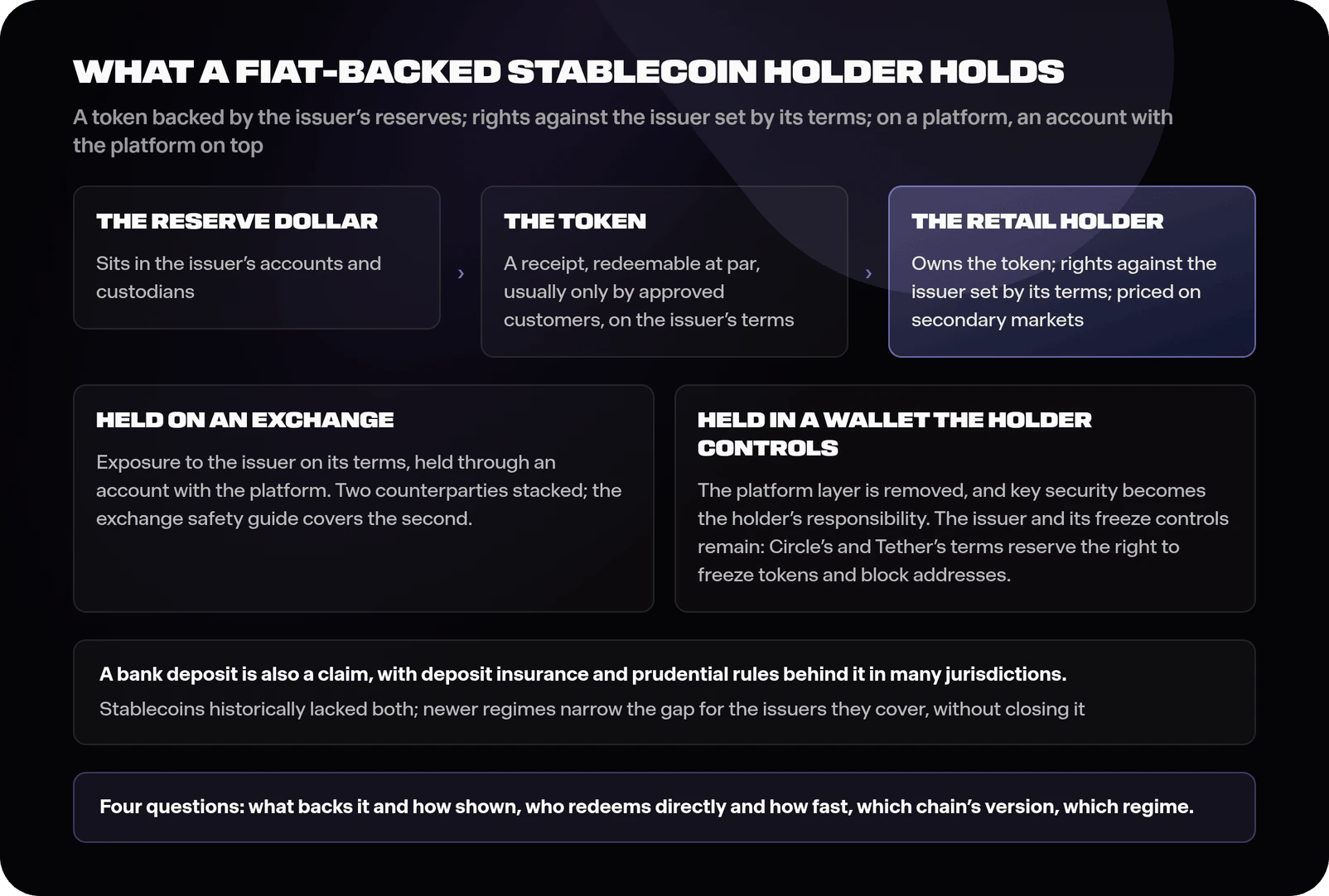
The distinction is the pillar's core and the reason the guide to whether crypto exchanges are safe is this guide's nearest neighbour. A dollar in a bank is a claim on the bank, protected in many jurisdictions by deposit insurance and prudential rules. A fiat-backed stablecoin is a token whose holder's rights against the issuer, if any, depend on the issuer's terms, the entity you contracted with (if any) and the law of its jurisdiction; before MiCA's stablecoin titles (Regulation (EU) 2023/1114, Titles III and IV) applied on 30 June 2024 and the GENIUS Act (Public Law 119-27) was enacted on 18 July 2025, little law in the EU or the United States was specific to the product. The reserve dollar sits in the issuer's accounts; the token is the receipt.
Legal claim, redemption claim and market value
For a fiat-backed token, three things that are often run together need to be kept apart. The legal claim is whether, and against whom, a holder has an enforceable right: it depends on the issuer's terms, the entity the holder contracted with (if any) and the law of its jurisdiction, and in the EU, MiCA Article 49 gives e-money token holders a claim against the issuer. The redemption claim is the practical ability to hand the token to the issuer and receive dollars at par: under the major issuers' terms it is open to approved or verified customers, subject to minimums and fees, as the next section sets out. The market value is the price at which the token trades on exchanges and other secondary markets, which arbitrage tends to hold near par and which has fallen below par under stress, as USDC's did in March 2023. The three can diverge: a token can trade below par while the issuer's redemption terms are unchanged, and a holder without direct redemption access depends on the market price to exit, whatever claim the law gives them.
Direct customer versus secondary-market holder
Redemption at par is the mechanism that keeps the receipt close to the dollar, and the guide to how stablecoins keep their peg explains how, and how imperfectly, arbitrage transmits that to market prices. What matters for this guide is who can use the mechanism. The Federal Reserve distinguishes a primary market, where approved customers mint and redeem with the issuer, from a secondary market, where everyone else buys and sells on exchanges: "only direct customers of Circle (cleared through an application process) have access to the primary market for USDC, and those customers tend to be businesses such as crypto-asset exchanges, financial technology companies, and institutional traders", and, as of that 2024 note, Tether's primary market carried "a reported minimum of $100,000 of USDT per mint on-chain" (Federal Reserve, FEDS Notes, 23 February 2024). Circle's terms state that only holders with a Circle Mint account can redeem USDC directly with Circle (Circle, USDC Terms, 12 December 2025); Tether's terms require redeemers to be verified customers and reserve minimum amounts and fees (Tether, Terms of Service). Under those terms, a retail holder holds a token that a direct customer could redeem at par, and relies on exchanges and arbitrage to keep its market price there. In a stressed market that price can go, and has gone, below par. EU law adds a different route for e-money tokens: MiCA Article 49 provides that holders "shall have a claim against the issuers" and that the issuer shall redeem "at any time and at par value" on a holder's request (Regulation (EU) 2023/1114, applying since 30 June 2024). The guide to how stablecoins are regulated around the world sets out how that obligation applies and to which issuers.
Crypto-backed and synthetic tokens separate ownership from redemption in other ways. For DAI, "any Ethereum user can access the smart contracts issuing the token" (Federal Reserve, FEDS Notes, 23 February 2024), and that access means opening a vault: in Sky's contracts a vault owner locks collateral, draws DAI as debt, and repays that debt to free their own collateral (Sky, Vat and CDP Manager documentation). Someone who bought DAI or USDS on the market owns the token and has no claim on any vault's collateral. Their exits are selling on the market or, where it is available, swapping through the protocol's Peg Stability Module, which Sky says lets users trade "USDS or DAI with other stablecoins like USDC" at "fixed exchange ratios and fees", with the fees adjustable by governance (Sky, LitePSM documentation). Some crypto-backed designs do give holders an express right: Liquity's documentation says "Users can redeem their LUSD for ETH at any time", at face value minus a fee, drawing first on the lowest-collateralised positions (Liquity, LUSD redemptions). For USDe, Ethena's terms allow minting and redemption with Ethena BVI only by Mint Users, who must pass KYC and AML checks and be whitelisted, and exclude users in the United States; "If you are a Holding User, you do not have a right to redeem USDe with Ethena BVI". The same terms say USDe "does not represent a claim, participation interest, economic right" associated with Ethena BVI, and that holders are not entitled to returns earned on its reserves (Ethena, USDe Terms and Conditions, August 2025). Crypto and short positions support USDe's value; an ordinary holder owns the token and relies on the market to sell it.
Two consequences follow for holders. First, issuer diligence is stablecoin diligence: reserve composition, attestation versus audit, redemption terms and legal domicile, the list the comparison guide applies instrument by instrument. Second, custody diligence is unchanged: a fiat-backed stablecoin on an exchange is exposure to the issuer on its terms, held through an account with the exchange, two counterparties stacked, and a stablecoin in your own wallet removes the second while leaving the first. Self-custody also does not remove issuer controls: Circle's and Tether's terms both reserve the right to freeze tokens and block addresses (Circle, USDC Terms; Tether, Terms of Service). Self-custody moves the job of protecting keys and checking addresses to the holder, with no platform to reverse a mistake, so each arrangement carries its own risks. The guide to using stablecoins more safely turns this into practice.
How do you evaluate a stablecoin?
Schnelle Antwort
Four questions: what backs it and how well is that demonstrated, who can redeem directly and how fast, which chain's version you are holding, and which legal regime, if any, the issuer answers to. Answered in that order, they place any instrument in a day's reading.
Backing and demonstration come first. Reserve composition matters because cash and short Treasuries meet redemptions while longer or riskier holdings falter in a run; an attestation is a point-in-time snapshot and an audit is an examination of financial statements, and neither by itself proves each day's token backing; and reserves concentrated at one custodian carry that custodian's risk. The failure-modes guide sets out this evidence gradient in full. Redemption comes second: who may redeem directly, at what minimums, on what timeline, and what history says about the channel under stress. The chain question applies the multichain rule: Circle's multichain page, as observed on 24 September 2026, says USDC "is natively supported across 38 blockchain networks", including Ethereum, Solana and Base (Circle, Multi-chain USDC), and each is a separate deployment that inherits its chain's properties on top of the issuer's. The count changes as Circle adds or retires networks. The regime question, handled in the guide to how stablecoins are regulated around the world, decides what stands behind the token in law: in the United States, the GENIUS Act requires permitted payment stablecoin issuers to "maintain identifiable reserves" on "an at least 1 to 1 basis" and to publish a redemption policy (Public Law 119-27, section 4(a)(1)); it was enacted on 18 July 2025 and its obligations apply from the earlier of 18 January 2027 or 120 days after final implementing regulations, which Treasury proposed on 18 August 2026 (Federal Register, 18 August 2026). In the European Union, MiCA (Regulation (EU) 2023/1114) sets separate regimes for issuers of e-money tokens and of asset-referenced tokens, applying since 30 June 2024 (ESMA, MiCA rulebook, Titles III and IV). Whether those rules yet apply to a given issuer depends on the jurisdiction and the effective dates.
Where does the risk actually live?
Schnelle Antwort
In what stands behind the token (issuer reserves, contract collateral or a hedge), in the chain and platform you hold it through, and in the regime that does or does not stand behind it. Depegs are the visible symptom; the failure-modes guide anatomises them, and the use-safely guide turns the risk map into habits.
Two cases from the record show the range. USDC in March 2023 was a reserve and counterparty shock: about 8 percent of reserves were stuck at a failed bank, the market price fell below 90 cents, and it recovered over about three days after Circle, according to the Federal Reserve note, announced that redemptions would resume on Monday 13 March (Federal Reserve, FEDS Notes, 23 February 2024). The depeg played out on the secondary market as a question of access to part of the reserves and of confidence. TerraUSD in May 2022 was a reflexive collapse in which the defence mechanism destroyed the asset meant to support it, the Luna Foundation Guard's outside reserve did not prevent it, and there was no recovery (SEC, press release, 16 February 2023; US Department of Justice, press release, 11 December 2025). Each teaches the same reading: the token's stability is a property of everything around it, and the holder's protection is knowing what that is.
Frequently asked questions
Is a stablecoin the same as a dollar?
No. A fiat-backed stablecoin is a token issued by a company that holds dollars, redeemable directly, under the major issuers' terms, only by approved customers; a bank deposit is also a claim, with deposit insurance and prudential regulation behind it that stablecoins have historically lacked. The newer regimes narrow the gap for the issuers they cover without closing it. In the United States, the GENIUS Act (enacted 18 July 2025, obligations not yet in effect) provides that a payment stablecoin shall not be "subject to deposit insurance by the Federal Deposit Insurance Corporation" and makes it unlawful to represent otherwise (Public Law 119-27, section 4(e)). In the EU, MiCA gives e-money token holders a claim against the issuer and redemption at par (Regulation (EU) 2023/1114, Article 49). DAI and USDS holders have no claim on any Sky vault, and Ethena's terms say USDe is not a claim on its issuer (Ethena, USDe Terms and Conditions).
Can a stablecoin go to zero?
An algorithmic one did: TerraUSD's price fell to close to zero in May 2022 (SEC, press release, 16 February 2023). A fiat-backed coin can break its peg and recover, as USDC did in March 2023; the catastrophic path for that design runs through issuer insolvency or frozen reserves, which is why backing and legal regime sit among the evaluation's four questions. Sky's own disclosure says USDS can lose value "potentially to zero" (Sky, User Risks).
Is one type of stablecoin safer than another?
The academy ranks none, because the answer depends on which risk is meant. Each design concentrates risk in a different place: fiat-backed coins in banks, custodians and issuer terms; crypto-backed coins in collateral prices and liquidation machinery; synthetic dollars in hedges and funding rates. A design that reduces one risk, such as dependence on a bank, can carry more of another, such as exposure to collateral prices. The comparison guide sets named instruments side by side on one date, and March 2023 shows that even a fully reserved token can trade below par.
Why does the same stablecoin exist on many chains?
Issuers deploy separate versions where demand is, each a distinct contract on a distinct ledger meant to be worth the same; Circle's page listed 38 networks for USDC when observed on 24 September 2026 (Circle, Multi-chain USDC). Moving between them is a real cross-chain transaction, and sending on the wrong network can lose funds, as the guide to sending and receiving crypto explains.
Do stablecoins pay interest?
Issuers generally keep the reserve yield. In the United States the GENIUS Act provides that no permitted payment stablecoin issuer or foreign payment stablecoin issuer "shall pay the holder of any payment stablecoin any form of interest or yield" (Public Law 119-27, section 4(a)(11)); that obligation applies once the Act takes effect, on the earlier of 18 January 2027 or 120 days after final implementing regulations. In the EU, MiCA has provided since 30 June 2024 that "issuers of e-money tokens shall not grant interest in relation to e-money tokens", and extends the ban to crypto-asset service providers providing services related to e-money tokens (Regulation (EU) 2023/1114, Article 50; Article 40 does the same for asset-referenced tokens). Yields that some platforms advertise on stablecoin balances come from lending or other platform activity, each with its own risks, which the guide to where crypto rewards come from explains.
Sources and further reading
- Stablecoins in 2025: Developments and Financial Stability Implications. Federal Reserve Board, FEDS Notes, 8 April 2026. https://www.federalreserve.gov/econres/notes/feds-notes/stablecoins-in-2025-developments-and-financial-stability-implications-20260408.html (accessed 23 September 2026)
- Primary and Secondary Markets for Stablecoins. Federal Reserve Board, FEDS Notes, 23 February 2024. https://www.federalreserve.gov/econres/notes/feds-notes/primary-and-secondary-markets-for-stablecoins-20240223.html (accessed 23 September 2026)
- GENIUS Act, Public Law 119-27. US Government Publishing Office, enacted 18 July 2025. https://www.govinfo.gov/content/pkg/PLAW-119publ27/html/PLAW-119publ27.htm (accessed 23 September 2026)
- GENIUS Act Regulations on Payment Stablecoin Issuance, Offer, and Sale (proposed rule). Department of the Treasury, Federal Register, 18 August 2026. https://www.federalregister.gov/documents/2026/08/18/2026-16796/genius-act-regulations-on-payment-stablecoin-issuance-offer-and-sale (accessed 23 September 2026)
- MiCA interactive single rulebook (Titles III and IV). ESMA, undated. https://www.esma.europa.eu/publications-and-data/interactive-single-rulebook/mica (accessed 23 September 2026)
- MiCA Article 49, Issuance and redeemability of e-money tokens. ESMA, undated. https://www.esma.europa.eu/publications-and-data/interactive-single-rulebook/mica/article-49-issuance-and-redeemability-e (accessed 24 September 2026)
- MiCA Article 50, Prohibition of granting interest. ESMA, undated. https://www.esma.europa.eu/publications-and-data/interactive-single-rulebook/mica/article-50-prohibition-granting-interest (accessed 23 September 2026)
- USDC Terms. Circle, 12 December 2025. https://www.circle.com/legal/usdc-terms (accessed 23 September 2026)
- Multi-chain USDC. Circle, undated. https://www.circle.com/multi-chain-usdc (accessed 23 September 2026)
- Resolution of USDE, BNSOL, and WBETH Price Depeg and Risk Control Enhancements. Binance, announcement, 11 October 2025. https://www.binance.com/en/support/announcement/detail/0989d6c7f32545bfb019e3249eaabc3f (accessed 24 September 2026)
- Terms of Service. Tether, undated. https://tether.to/en/legal/ (accessed 23 September 2026)
- SEC Charges Crypto Asset Trading Platform Terraform Labs and its Founder. US Securities and Exchange Commission, press release, 16 February 2023. https://www.sec.gov/newsroom/press-releases/2023-32 (accessed 23 September 2026)
- User Risks. Sky, undated. https://docs.sky.money/user-risks (accessed 23 September 2026)
- Ethena documentation. Ethena, undated. https://docs.ethena.fi/ (accessed 23 September 2026)
- USDe Terms and Conditions. Ethena, last updated August 2025. https://docs.ethena.fi/resources/usde-terms-and-conditions (accessed 24 September 2026)
- Vat (Core Accounting). Sky Protocol Docs, undated. https://developers.skyeco.com/protocol/core/vat/ (accessed 24 September 2026)
- CDP Manager. Sky Protocol Docs, undated. https://developers.skyeco.com/protocol/vaults/cdp-manager/ (accessed 24 September 2026)
- LitePSM. Sky Protocol Docs, undated. https://developers.skyeco.com/guides/psm/litepsm/ (accessed 24 September 2026)
- LUSD Redemptions (Liquity v1 FAQ). Liquity, undated. https://docs.liquity.org/liquity-v1/faq/lusd-redemptions (accessed 24 September 2026)
- Crypto-Enabled Fraudster Sentenced For Orchestrating $40 Billion Fraud. US Attorney's Office, Southern District of New York, press release, 11 December 2025. https://www.justice.gov/usao-sdny/pr/crypto-enabled-fraudster-sentenced-orchestrating-40-billion-fraud (accessed 24 September 2026)
- Stablecoins and safe asset prices (Working Paper 1270). Bank for International Settlements, 28 May 2025. https://www.bis.org/publ/work1270.pdf (accessed 23 September 2026)
Kurzes Quiz: Hat es geklebt?
Ein paar Fragen zur Überprüfung der Grundlagen sind gelandet. Es folgen Antworten mit Erläuterungen und niemand außer Ihrem zukünftigen Portfolio bewertet Sie.


Sie haben ein Quiz zu „What Is a Stablecoin? The Complete Guide“ abgeschlossen! Teilen Sie Ihren Erfolg in den sozialen Medien.
 War das hilfreich?