
TL;DR
- Because nobody controls future market returns, so a promise of a fixed, high return with no risk is either backed by a specific contract and payer you can identify, or it is being paid from somewhere the operator is not describing. The SEC puts this sign first on its list of Ponzi red flags, and this section explains the arithmetic behind it.
- Three different things. BlockFi agreed to a settled SEC order on registration and disclosure before it failed, without admitting or denying the findings; Celsius's founder pleaded guilty to commodities and securities fraud, and the SEC and FTC brought their own civil cases; Voyager and its former chief executive agreed to settle FTC charges over deposit-insurance claims that the FTC alleged were false. None of those records finds a Ponzi scheme. This section sets out the record with each item's status; the next gives this guide's editorial reading of it.
- This section is editorial analysis, and it does not suggest that Celsius, Voyager or BlockFi ran a Ponzi scheme. The three products were legally different and the records on them are different; the common thread this guide draws from those records is that each firm paired yield language with safety language that its business, as the records describe it, did not support.
- Returns that are too smooth for the risk claimed, mechanisms explained in vocabulary with no arithmetic behind them, withdrawal friction that grows, and rewards for recruiting that outrun the claimed business. They repeat because the psychology they use is stable: the wish for return without variance, and deference to confidence.
1つのブロックで
A guaranteed-return offer is an investment pitch promising a fixed, above-market return with little or no claimed risk. The SEC lists "high returns with little or no risk" first among its Ponzi scheme warning signs.
Why is a guarantee itself the red flag?
簡単な回答
Because nobody controls future market returns, so a promise of a fixed, high return with no risk is either backed by a specific contract and payer you can identify, or it is being paid from somewhere the operator is not describing. The SEC puts this sign first on its list of Ponzi red flags, and this section explains the arithmetic behind it.
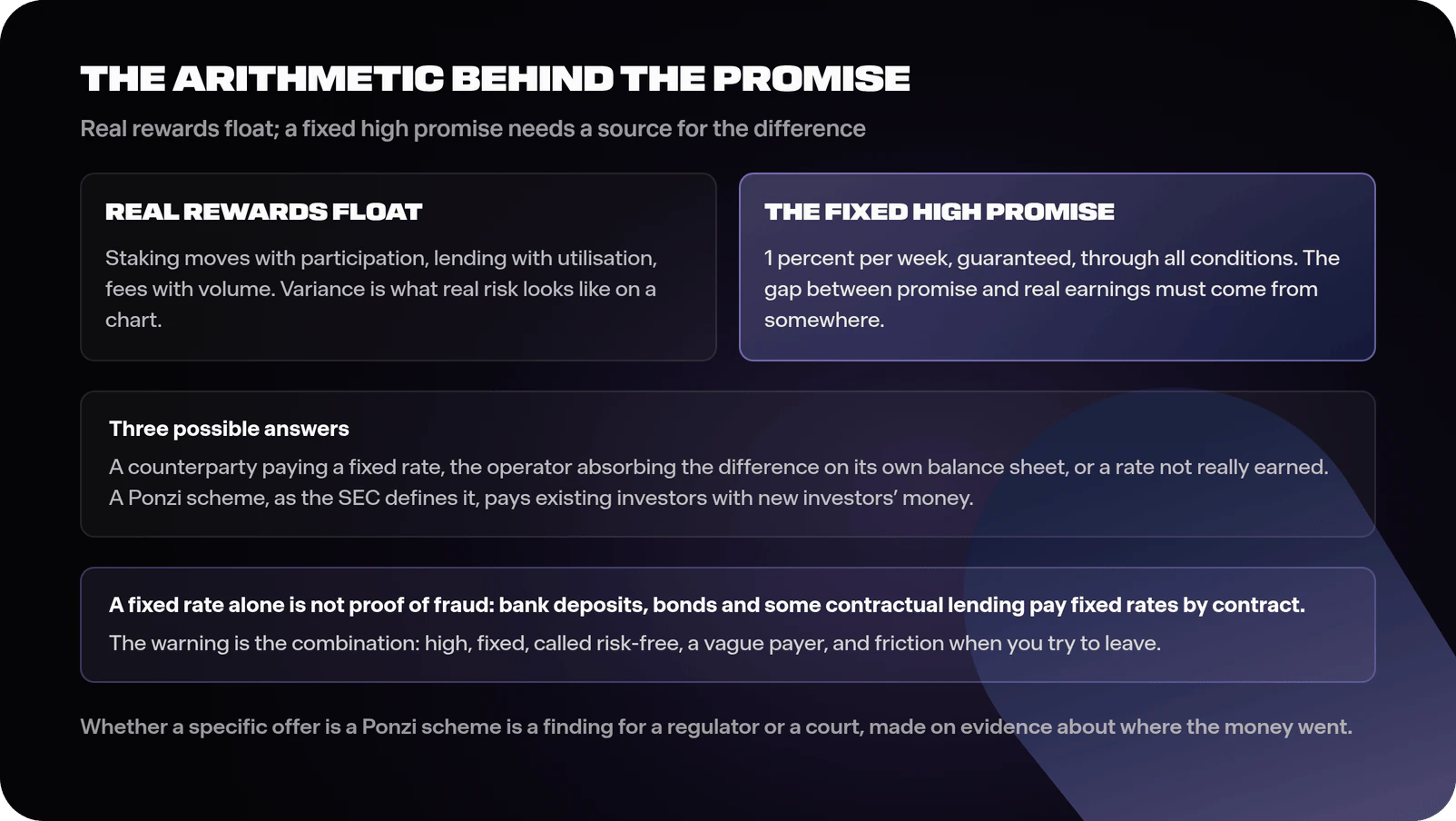
Crypto rewards generally come from protocol issuance, borrowers and trading fees, and each of these moves with conditions. Staking rewards move with participation, lending rates move with utilisation, and fee income moves with volume. An offer of a fixed 1 percent per week is therefore claiming one of three things: that it has found a counterparty who pays a fixed rate regardless of conditions, that it is absorbing the fluctuation on its own balance sheet indefinitely without charging for it, or that the rate is not really being earned at all. The SEC's 2013 investor alert on Ponzi schemes using virtual currencies cited SEC v. Shavers, in which investors were allegedly promised up to 7 percent interest per week (SEC Office of Investor Education and Advocacy, Investor Alert, 23 July 2013). That case is an example of the third explanation: a federal court in Texas entered final judgment against Trendon Shavers and, according to the SEC, found that he had used new investors' bitcoins to pay purported returns and diverted investors' bitcoins for his personal use (SEC, Litigation Release No. 23090, 18 September 2014). He separately pleaded guilty to one count of securities fraud on 21 September 2015 and was sentenced to 18 months in prison (US Attorney's Office, SDNY, 21 July 2016).
What a Ponzi scheme is, and what it is not
The SEC defines a Ponzi scheme as "an investment fraud that pays existing investors with funds collected from new investors" (SEC, Investor.gov, Ponzi scheme). The organisers typically do not invest the money; they use inflows to pay earlier investors and keep some for themselves. The structure fails when new money slows or when many investors ask to withdraw at once. The SEC's published warning signs are high returns with little or no risk, overly consistent returns, unregistered investments, unlicensed sellers, secretive or complex strategies, problems with paperwork, and difficulty receiving payments.
The word is used loosely, and precision matters here. A fixed rate is not by itself evidence of a Ponzi scheme. A bank deposit pays a fixed rate because prudential rules, capital and, in many jurisdictions, deposit insurance stand behind it. A bond pays a fixed coupon because a named borrower has contracted to pay it. A lending platform can pay a fixed rate for a period if its own borrowers pay more and the platform absorbs the difference. In each of these ordinary cases the rate sits close to what the underlying activity earns, the risk is disclosed, and the payer can be named. The question is whether the rate, the risk description and the identity of the payer fit together. When a rate is high, the risk is described as low or absent, and the payer is a vocabulary word with no named counterparty behind it, the SEC's list has been matched on its first three items. Whether a specific offer is in fact a Ponzi scheme is a finding for a regulator or a court, made on evidence about where the money actually went.
The crypto packaging changes the vocabulary and one operational detail. Transfers that are hard to reverse once confirmed and cross-border structures mean that collapse tends to arrive as a withdrawal freeze announced online, and that operators are often beyond the reach of most victims' recovery. The academy's scams guide covers the retail versions, including fake platforms, and the pig butchering guide covers the relationship-led pipelines that graft this promise onto romance and job fraud. This guide focuses on the licensed-looking version, because it can look credible to cautious savers who would dismiss an obvious scam.
What did regulators and courts actually find about Celsius, Voyager and BlockFi?
簡単な回答
Three different things. BlockFi agreed to a settled SEC order on registration and disclosure before it failed, without admitting or denying the findings; Celsius's founder pleaded guilty to commodities and securities fraud, and the SEC and FTC brought their own civil cases; Voyager and its former chief executive agreed to settle FTC charges over deposit-insurance claims that the FTC alleged were false. None of those records finds a Ponzi scheme. This section sets out the record with each item's status; the next gives this guide's editorial reading of it.
BlockFi
On 14 February 2022 the SEC announced that BlockFi Lending LLC had agreed to pay a 50 million dollar penalty to the SEC and a further 50 million dollars to 32 states to settle charges that its BlockFi Interest Accounts were unregistered securities, that the firm had operated as an unregistered investment company, and that it had made a false and misleading statement on its website for more than two years about the level of risk in its loan portfolio. The order describes the accounts as paying variable monthly interest, records that about 572,000 investors held roughly 10.4 billion dollars in them as of December 2021, and finds that the firm's claim that institutional loans were "typically" over-collateralised was untrue: only 16 to 24 percent of those loans were over-collateralised in the periods examined (SEC, press release 2022-26 and Order, Securities Act Release No. 11029, 14 February 2022). The SEC's press release describes the misstatement finding as a violation of the antifraud provisions of the Securities Act; neither the release nor the order describes the accounts as a Ponzi scheme, and BlockFi agreed to the order without admitting or denying the SEC's findings. BlockFi and nine affiliates filed for Chapter 11 in the District of New Jersey on 28 November 2022, case 22-19361 (Kroll, BlockFi restructuring docket).
Celsius
Celsius halted customer withdrawals on 12 June 2022, when about 400,000 retail customers had roughly 4.7 billion dollars of crypto assets on the platform, and filed for bankruptcy on 13 July 2022 (US Attorney's Office, SDNY, 8 May 2025). On 13 July 2023 the SEC filed a civil complaint against Celsius Network Limited and founder Alex Mashinsky alleging the offer of unregistered securities through the Earn Interest Program, false and misleading statements to investors, and manipulation of the price of the CEL token; announcing the charges, the SEC's enforcement director said that behind the scenes the company "operated a failing business model and took significant risks with investors' crypto assets" (SEC, press release 2023-133, 13 July 2023). The same day the FTC announced a settlement with the bankrupt company, carrying a 4.7 billion dollar judgment suspended so that remaining assets could go to customers, and filed a complaint against three former executives. The FTC alleged that Celsius had told customers their deposits were safe and always available, that a 750 million dollar insurance policy covered deposits and that they could earn rewards of up to 18 percent a year, while the company routinely made unsecured loans totalling 1.2 billion dollars as of April 2022 (FTC, press release, 13 July 2023). On 3 December 2024 Mashinsky pleaded guilty to one count of commodities fraud and one count of securities fraud. The prosecutors' announcement describes two schemes, misleading customers about core aspects of Celsius, including its profitability and the nature of the investments it made with customer funds, and manipulating the price of CEL; it also states that Celsius billed itself as "the safest place for your crypto" and used customer deposits to fund purchases of CEL to support its price without telling customers (US Attorney's Office, SDNY, 3 December 2024). On 8 May 2025 he was sentenced to 12 years in prison (US Attorney's Office, SDNY, 8 May 2025). On 20 July 2026 the FTC announced that Mashinsky and co-founders Shlomi Daniel Leon and Hanoch Goldstein had agreed to stipulated orders, filed in the US District Court for the Southern District of New York, to pay a total of 16.5 million dollars to resolve its charges and to accept bans on marketing certain products; the FTC notes that such orders take legal effect when approved and signed by the judge (FTC, press release, 20 July 2026).
Voyager
Voyager halted withdrawals on 1 July 2022 and its entities filed for bankruptcy on 5 July 2022 (FTC complaint against Voyager Digital, paragraphs 3 and 4). On 12 October 2023 the FTC announced a settlement with the bankrupt company, a 1.65 billion dollar judgment suspended so that assets could be returned through the bankruptcy, and charges against former chief executive Stephen Ehrlich; the FTC's complaint alleged that Voyager told customers "YOUR USD IS FDIC INSURED" and that deposits were safe, when Voyager was not a bank and crypto assets held there had no FDIC protection (FTC, press release, 12 October 2023). On 27 June 2025 the FTC announced that Ehrlich had agreed to a proposed stipulated order, filed in the US District Court for the Southern District of New York, to resolve its charges with a 2.8 million dollar payment and a ban on marketing or selling retail crypto products (FTC, press release, 27 June 2025). Voyager's own release of 27 June 2022 says its operating subsidiary had issued a notice of default to the hedge fund Three Arrows Capital for failure to make required payments on a loan of 15,250 BTC and 350 million USDC, and that the platform was still fulfilling withdrawals at that date (Voyager Digital, press release, 27 June 2022). Withdrawals were halted four days later. The FTC documents do not address that loan.
What is this guide's own reading of those cases?
簡単な回答
This section is editorial analysis, and it does not suggest that Celsius, Voyager or BlockFi ran a Ponzi scheme. The three products were legally different and the records on them are different; the common thread this guide draws from those records is that each firm paired yield language with safety language that its business, as the records describe it, did not support.
The three firms did not sell an identical promise. BlockFi's interest accounts paid variable rates, and the SEC's settled order turned on registration and a misstatement about collateral. Celsius paid weekly "rewards" and, according to federal prosecutors, billed itself as the safest place for customers' crypto; its founder's guilty plea covered misleading customers about the business and manipulating the CEL token, as the prosecutors' announcement describes the two schemes. Voyager's case, as the FTC brought it, centred on the allegation that customers were falsely told their US dollar balances were FDIC insured. Anyone who says "they were all Ponzi schemes" is overstating the record, and anyone who says "they were regulated companies, so the products were sound" is ignoring it.
In this guide's reading, what the cases share is instructive precisely because it is narrower than a Ponzi allegation. Each firm took retail deposits with language that borrowed from banking (interest, insurance, safety), and each placed customer assets in lending or market activity with risks of its own. At BlockFi, the SEC's settled order found that institutional loans were far less often over-collateralised than its website said. At Celsius, the FTC alleged routine unsecured lending, and federal prosecutors described undisclosed purchases of CEL with customer deposits. At Voyager, the company's own release reported a large loan to a single borrower, Three Arrows Capital, which Voyager said it had declared in default four days before it halted withdrawals. Celsius and Voyager halted withdrawals within three weeks of each other in mid-2022, BlockFi filed for bankruptcy that November, and customers of all three became creditors in bankruptcy proceedings. At the advertised rates, up to 18 percent a year at Celsius according to the FTC, a year's interest was a fraction of the principal that the freeze locked in place.
Two further editorial points follow. First, some warnings were public before the freezes: the SEC's BlockFi order was published about four months before Celsius halted withdrawals, and the advertised rates were public and could be compared with what the underlying lending markets paid. Reading such signals is a skill this guide tries to teach; trusting logos is the habit it tries to unlearn. Second, as a general point about yield products, harm to depositors does not depend on proven dishonesty. A promise funded by risky activity can fail whatever its operator's intentions, and a depositor's place in a creditor queue is set by the account terms and the insolvency process. This guide draws no conclusion about the state of mind of anyone at the three firms beyond what the records cited above state. Recovery percentages differ by estate, claim class and the price date used for valuation; the Exchange Failure Index covers that accounting.
What are the tells, and why do they repeat?
簡単な回答
Returns that are too smooth for the risk claimed, mechanisms explained in vocabulary with no arithmetic behind them, withdrawal friction that grows, and rewards for recruiting that outrun the claimed business. They repeat because the psychology they use is stable: the wish for return without variance, and deference to confidence.
The tells in this section describe Ponzi-type and fake-platform schemes in general, mapped to the SEC's published list; they are not a description of Celsius, Voyager or BlockFi.
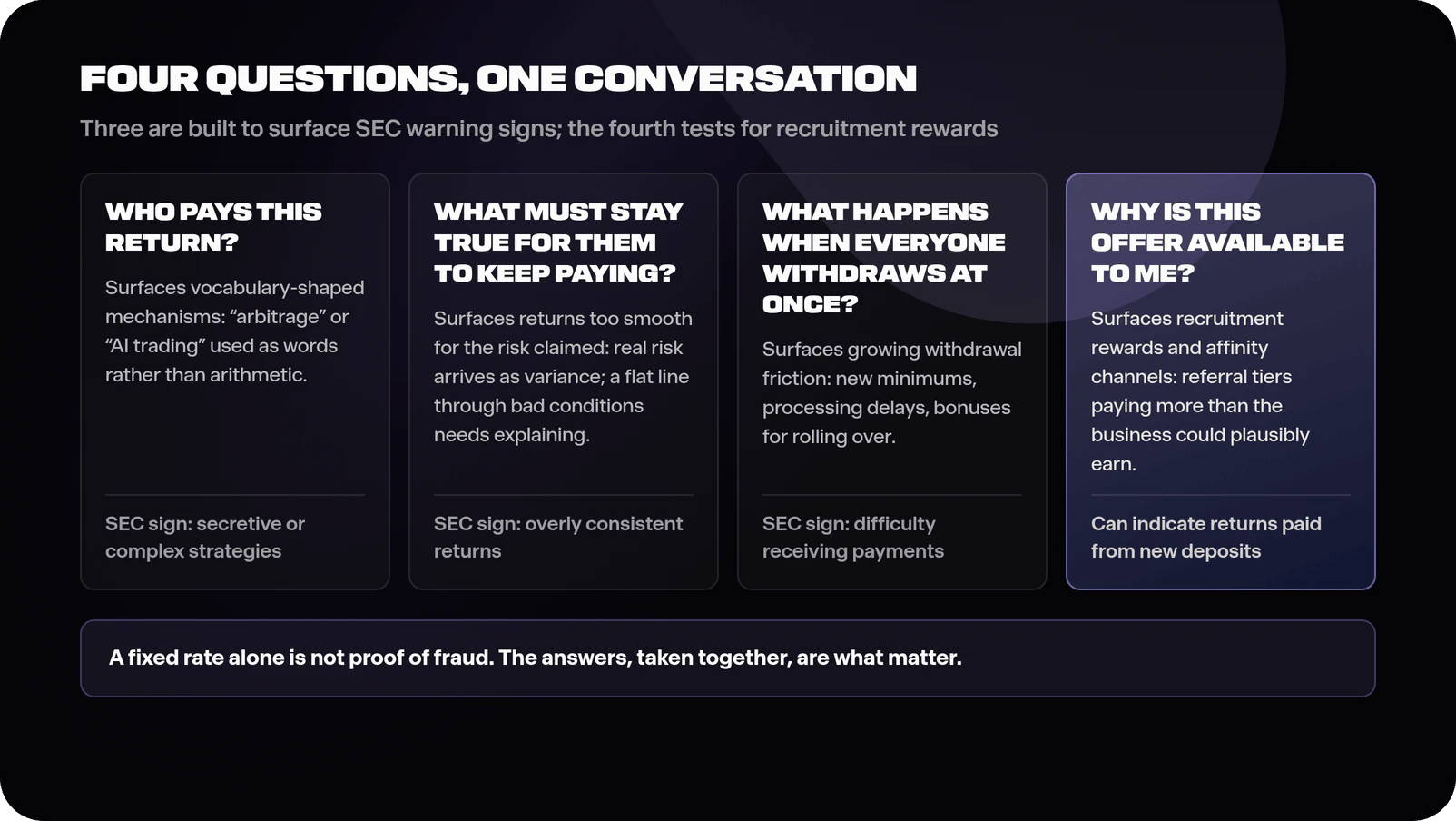
Each tell has its reason, and each maps onto the SEC's published list. Overly consistent returns, the flat line through conditions that hurt everyone else, are the SEC's second warning sign, because real risk arrives as variance and a fabricated dashboard does not (SEC, Investor.gov, Ponzi scheme). Vocabulary-shaped mechanisms, "arbitrage", "AI trading" or "liquidity mining" used as incantations, correspond to the SEC's secretive or complex strategies; the test is whether the mechanism survives one round of arithmetic aloud, at the claimed scale. Withdrawal friction that grows, new minimums, processing delays, bonuses for rolling over, corresponds to difficulty receiving payments, and it can be among the last signals before a freeze. Recruitment rewards that outrun the business, referral tiers paying better than the underlying activity could plausibly earn, can indicate a scheme whose real revenue is depositors. The FBI's 2025 report adds the retail version of the friction tell: victims shown fake profits and then charged "taxes and fees" when they try to withdraw (FBI IC3, 2025 Internet Crime Report).
The psychology deserves one plain paragraph, because contempt for victims is both wrong and protective camouflage. These offers are built for reasonable people: early withdrawals may process instantly, because financing them is the marketing budget; the community is warm, because affinity is the channel; the reward lands monthly, until it is the reason you moved the rest. The defence is procedural, which is why this guide ends in questions that anyone, including a stranger to the scheme, can ask.
What do you do with a live suspicion?
簡単な回答
Fraud-response guidance generally runs in this order: no further deposits, a quiet check of whether withdrawals still work, documentation, and a report to the relevant authority whatever the check shows. The order matters, and the response guide carries the full drill; this section is the yield-specific addendum.
Pausing new deposits costs nothing, and it is an easy step to skip, because a scheme's whole interface argues for one more deposit. A quiet withdrawal check, an ordinary-sized redemption made without announcement, reads a signal that a dashboard cannot fake: whether money actually comes out, at the speed and size it used to. Documentation (statements, addresses, correspondence and marketing claims) is cheap to gather while access exists and can matter in any later complaint or proceeding. Reporting routes include IC3 in the United States, which the FTC lists alongside itself, the CFTC and the SEC as places to report crypto fraud (FTC, consumer advice on cryptocurrency scams); in England, Wales and Northern Ireland, Report Fraud, which has replaced Action Fraud (reportfraud.police.uk or 0300 123 2040; City of London Police, December 2025); in Scotland, Police Scotland on 101; and elsewhere the local police or national reporting service. A report does not guarantee that any money comes back, although reports feed the investigations from which asset freezes and prosecutions can follow. Offers to recover lost funds in return for an upfront fee are a known follow-on scam: the FTC describes recovery offers that require payment first as scams and says government agencies and legitimate organisations never ask for money to help get a refund (FTC, consumer advice on refund and recovery scams). The social step, telling the person who made the introduction, is often the hardest, and it can break the affinity chains through which these schemes spread.
Frequently asked questions
Is every fixed crypto yield a fraud?
No. A fixed rate can rest on a contract with an identifiable payer, and jurisdiction and structure decide what stands behind it. A high rate is not proof of fraud on its own either: lending to riskier borrowers or exposure to volatile markets can pay more because more can be lost, provided that risk is disclosed. Regulators flag the combination of high, fixed and described as guaranteed or risk-free, because no operator controls future market returns. The further a rate sits above what the underlying activity earns, the more of the gap needs an explanation that survives arithmetic, and whether an offer is actually a Ponzi scheme is a finding that depends on where the money went.
Weren't Celsius and BlockFi regulated companies with real offices?
They were operating businesses with offices and marketing departments, and the SEC's BlockFi order shows a regulator acting on the product months before any freeze. A licence or registration is a fact to check on the relevant public register on a given date, and it covers named activities only: the SEC's settled order found that BlockFi's interest accounts were securities that had not been registered, a finding BlockFi neither admitted nor denied (SEC, 14 February 2022). Offices and logos establish that a company exists; they say nothing about whether its promise adds up, which is why this guide's questions target the promise.
Was Celsius a Ponzi scheme? What about Voyager and BlockFi?
None of the court or regulator records cited in this guide makes that finding for any of the three, and this guide does not use the word for them. A Ponzi finding rests on evidence about where the money went. In SEC v. Shavers, for example, the SEC reported that the court found new investors' bitcoins had been used to pay purported returns to earlier ones (SEC, Litigation Release No. 23090, 18 September 2014). The records on the three firms are of other kinds: a settled SEC order on registration and a loan-risk statement (BlockFi, February 2022, without admission or denial), a founder's guilty plea to commodities fraud and securities fraud (Celsius, December 2024), and settlements of FTC charges over deposit-insurance claims (Voyager, October 2023 and June 2025). A settlement without admission is also a different thing from a court's finding after a contested trial.
What did customers actually get back?
Outcomes vary by estate and claim class, arrive over years, can come as crypto, cash or, in some plans, equity, and depend on the price date each plan uses to value claims. The Exchange Failure Index sets out that accounting from the estate records, and this guide does not repeat recovery figures.
How is this different from a bank paying fixed interest?
In many jurisdictions, deposit insurance, prudential regulation, capital requirements and a lender of last resort stand behind bank deposits, and the fixed rate reflects that. A crypto reward account is typically a contractual arrangement with a company, and its terms and the applicable law decide what stands behind it; the FTC's Voyager complaint turned on its allegation that customers were falsely told their dollar balances were FDIC insured, when crypto assets held at Voyager had no FDIC protection (FTC, 12 October 2023).
Someone I trust is receiving payouts from one of these right now. What do I say?
Three points tend to help in that conversation: withdrawals working today are consistent with the early phase of a scheme, when paying early exits is part of the marketing; the four questions cost nothing to ask; and a quiet withdrawal check gives an answer that marketing cannot supply. Affinity is the channel these schemes travel, and a calm conversation can interrupt it.
Sources and further reading
Primary and reference sources for this guide, checked on 23 September 2026.
- Ponzi Scheme (definition and red flags). US Securities and Exchange Commission, Investor.gov, undated. https://www.investor.gov/protect-your-investments/fraud/types-fraud/ponzi-scheme (accessed 23 September 2026)
- Investor Alert: Ponzi Schemes Using Virtual Currencies. SEC Office of Investor Education and Advocacy, 23 July 2013. https://www.investor.gov/introduction-investing/general-resources/news-alerts/alerts-bulletins/investor-alerts/investor-7 (accessed 23 September 2026)
- What To Know About Cryptocurrency and Scams. US Federal Trade Commission, consumer advice, undated. https://consumer.ftc.gov/articles/what-know-about-cryptocurrency-and-scams (accessed 23 September 2026)
- 2025 Internet Crime Report. FBI Internet Crime Complaint Center, 2026. https://www.ic3.gov/AnnualReport/Reports/2025_IC3Report.pdf (accessed 23 September 2026)
- BlockFi Agrees to Pay $100 Million in Penalties and Pursue Registration of its Crypto Lending Product. US Securities and Exchange Commission, press release 2022-26, 14 February 2022. https://www.sec.gov/newsroom/press-releases/2022-26 (accessed 23 September 2026)
- In the Matter of BlockFi Lending LLC, Order Instituting Cease-and-Desist Proceedings, Securities Act Release No. 11029. US Securities and Exchange Commission, 14 February 2022. https://www.sec.gov/litigation/admin/2022/33-11029.pdf (accessed 23 September 2026)
- BlockFi Inc., et al., Chapter 11 case 22-19361, District of New Jersey, petition date 28 November 2022. Kroll restructuring administration docket. https://restructuring.ra.kroll.com/blockfi/ (accessed 23 September 2026)
- SEC Charges Crypto Lending Platform Celsius Network and Founder Alex Mashinsky. US Securities and Exchange Commission, press release 2023-133, 13 July 2023. https://www.sec.gov/newsroom/press-releases/2023-133 (accessed 23 September 2026)
- FTC Reaches Settlement with Crypto Platform Celsius Network; Charges Former Executives. US Federal Trade Commission, 13 July 2023. https://www.ftc.gov/news-events/news/press-releases/2023/07/ftc-reaches-settlement-crypto-platform-celsius-network-charges-former-executives-duping-consumers (accessed 23 September 2026)
- Celsius Founder and Former CEO Alexander Mashinsky Pleads Guilty. US Attorney's Office, Southern District of New York, 3 December 2024. https://www.justice.gov/usao-sdny/pr/celsius-founder-and-former-ceo-alexander-mashinsky-pleads-guilty-multi-billion-dollar (accessed 23 September 2026)
- Founder of Celsius Sentenced to 12 Years for Fraud and Market Manipulation. US Attorney's Office, Southern District of New York, 8 May 2025. https://www.justice.gov/usao-sdny/pr/founder-celsius-sentenced-12-years-fraud-and-market-manipulation (accessed 23 September 2026)
- Founders of Celsius Network Ordered to Pay $16.5 Million to Resolve FTC Charges. US Federal Trade Commission, 20 July 2026. https://www.ftc.gov/news-events/news/press-releases/2026/07/founders-celsius-network-ordered-pay-165-million-resolve-ftc-charges (accessed 23 September 2026)
- FTC Reaches Settlement with Crypto Company Voyager Digital; Charges Former Executive with Falsely Claiming Consumers' Deposits Were Insured by FDIC. US Federal Trade Commission, 12 October 2023. https://www.ftc.gov/news-events/news/press-releases/2023/10/ftc-reaches-settlement-crypto-company-voyager-digital-charges-former-executive-falsely-claiming (accessed 23 September 2026)
- Trendon T. Shavers and Bitcoin Savings and Trust, Litigation Release No. 23090. US Securities and Exchange Commission, 18 September 2014. https://www.sec.gov/enforcement-litigation/litigation-releases/lr-23090 (accessed 24 September 2026)
- Texas Man Sentenced For Operating Bitcoin Ponzi Scheme. US Attorney's Office, Southern District of New York, 21 July 2016. https://www.justice.gov/usao-sdny/pr/texas-man-sentenced-operating-bitcoin-ponzi-scheme (accessed 24 September 2026)
- Refund and Recovery Scams. US Federal Trade Commission, consumer advice, undated. https://consumer.ftc.gov/articles/refund-and-recovery-scams (accessed 24 September 2026)
- Report Fraud service goes live with full public launch in January 2026. City of London Police, December 2025. https://www.cityoflondon.police.uk/news/city-of-london/news/2025/december/report-fraud-service-goes-live-with-full-public-launch-in-january-2026/ (accessed 24 September 2026)
- Voyager Digital Provides Market Update. Voyager Digital Ltd., press release (issuer statement), 27 June 2022. https://www.prnewswire.com/news-releases/voyager-digital-provides-market-update-301575492.html (accessed 24 September 2026)
- FTC v. Voyager Digital, LLC, et al., Complaint. US Federal Trade Commission, filed October 2023. https://www.ftc.gov/system/files/ftc_gov/pdf/voyager_complaint_filed.pdf (accessed 23 September 2026)
- Former CEO of Voyager Digital Agrees to Ban and $2.8 Million Payment to Resolve FTC Charges. US Federal Trade Commission, 27 June 2025. https://www.ftc.gov/news-events/news/press-releases/2025/06/former-ceo-voyager-digital-agrees-ban-28-million-payment-resolve-ftc-charges (accessed 23 September 2026)
簡単なクイズ: 定着しましたか?
基本的な事項を確認するためのいくつかの質問がありました。解説付きの解答が続きますが、あなたの将来のポートフォリオを除いて誰もあなたを採点しません。


「Guaranteed Returns: The Biggest Red Flag in Crypto」のクイズを完了しました!成果をソーシャルメディアで共有しましょう。
 これは役に立ちましたか?