
TL;DR
- You commit the network's coin behind a validator, the validator proposes and votes on blocks, and the protocol pays rewards to the stake that took part. Your choices are the route in: run a validator or delegate to one from your own wallet (native staking), hold a liquid staking token, or stake through an exchange or other custodial provider.
- From new issuance and transaction fees, distributed by protocol formulas that depend on how much of the supply is staked and how the validator performs. The rate is a moving output of those formulas, which is why a single advertised percentage is only a snapshot.
- They differ enough that Ethereum's rules cannot be transplanted to other chains, and each network can change them through upgrades or governance. As documented when the sources were checked on 24 September 2026, Ethereum slashes double-signing with a correlation penalty and runs activation and exit queues; Solana currently has no in-protocol slashing and phases stake in and out over epochs; Cosmos SDK chains slash both double-signing and downtime with a set unbonding period; Cardano leaves delegated ada spendable at any time.
- A liquid staking token adds a contract, a governance process and a market price between you and the protocol; exchange staking adds the platform's balance sheet and the legal treatment of its service in each jurisdiction where it operates. Neither is part of the protocol, and the protocol does not know either exists.
1つのブロックで
Staking is a form of participation in a proof-of-stake network that commits the network's own coin behind a validator, directly or through an intermediary, so that the stake helps propose and confirm blocks. The protocol pays participating stake a share of issuance and unburned transaction fees, in that coin, at a rate its formulas set.
How does staking work from a holder's side?
簡単な回答
You commit the network's coin behind a validator, the validator proposes and votes on blocks, and the protocol pays rewards to the stake that took part. Your choices are the route in: run a validator or delegate to one from your own wallet (native staking), hold a liquid staking token, or stake through an exchange or other custodial provider.
Proof-of-stake networks select validators to propose and attest to blocks in proportion to stake. Honest participation receives staking rewards; missed duties cost some reward on most networks; provable misbehaviour, chiefly signing two conflicting blocks or votes, can destroy part of the stake on networks that implement slashing. Rewards arrive in the network's own coin. How much, how quickly, and what can be lost are all set by each protocol's rules, which the next two sections take network by network.
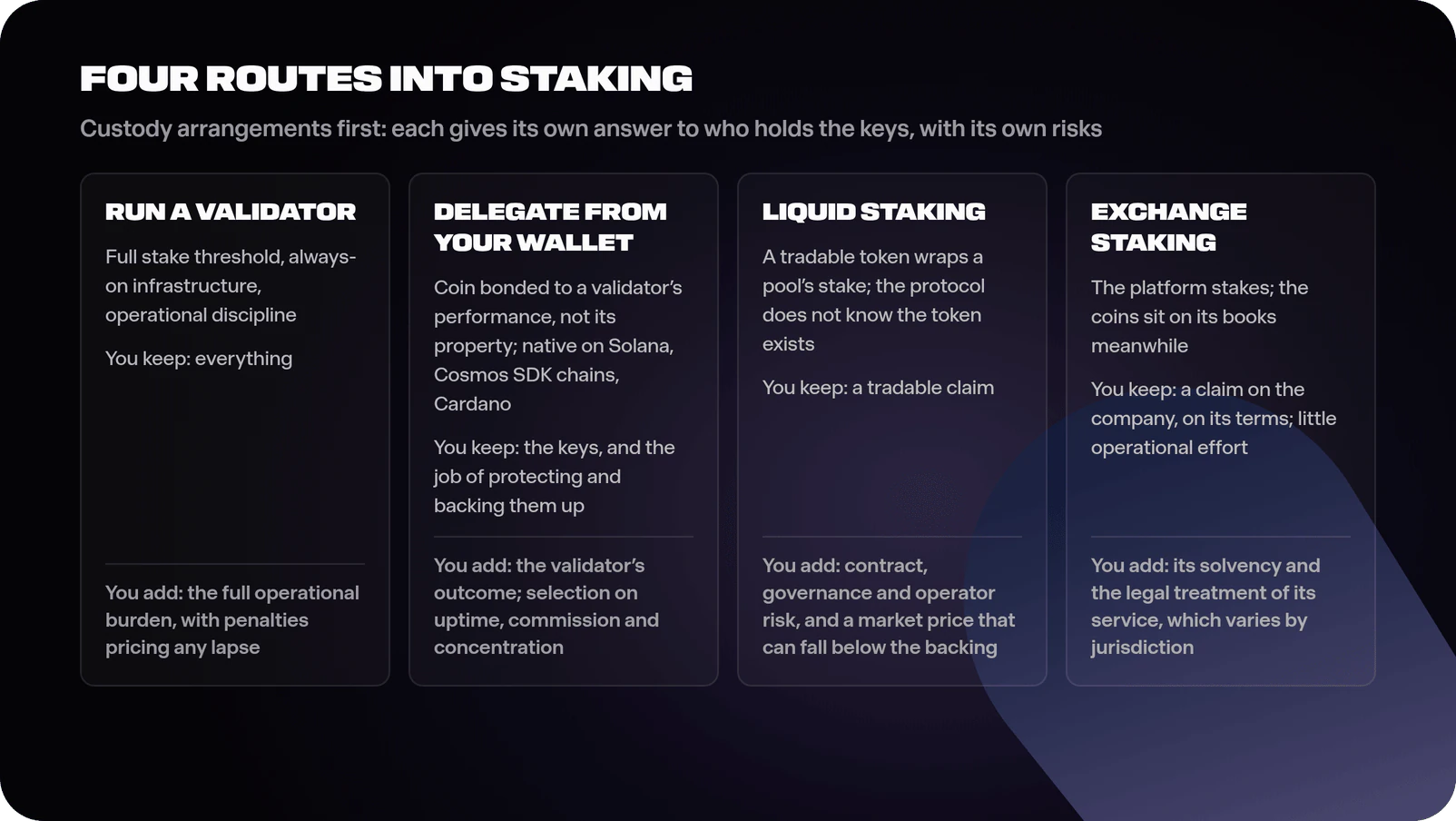
The four routes differ in what you keep. Ethereum's own documentation groups them as home (solo) staking, delegated staking to a node operator, liquid and pooled staking, and centralised exchanges, describing the exchange route as needing minimal oversight or effort from the holder while carrying the highest trust assumptions (ethereum.org, Staking). Running a validator keeps everything and demands everything: the full stake threshold, always-on infrastructure, and the operational discipline whose absence is what penalties price. Delegating from your own wallet, the native pattern on Solana, Cosmos SDK chains and Cardano, keeps the keys with the holder, and with them the job of protecting and backing up those keys: the coin is bonded to a validator's performance without becoming the validator's property, and validator selection, on uptime, commission and concentration, is the decision that matters. Liquid staking wraps a stake in a tradable token, adding a contract layer and a market price to the risk ledger. Exchange staking is a button in a platform's app: the coins sit on the platform's books, and the arrangement belongs to the counterparty risks covered in the guide to whether crypto exchanges are safe.
Who controls the coins, and who bears which loss. In native staking, solo or delegated, the coins stay under authorities held by the holder's own keys (on Solana, the stake and withdraw authorities; on Cardano, ada that stays spendable in the holder's wallet), and on chains that implement slashing a penalty falls on the stake bonded to the validator, so the holder bears it directly; there is no platform counterparty, and the delegator's exposure is to the chosen operator. In liquid staking the holder deposits coins into a pool's contracts and receives a token; the contracts and the pool's operators control the staked coins, a penalty on the pool's validators reduces the backing, and how that loss is shared among token holders depends on the pool's own rules. In exchange or other custodial provider staking the provider holds the coins and the keys and chooses the validators; whether it absorbs a slashing loss or passes it on, and what the customer recovers if the provider fails, depend on its terms, the entity and the jurisdiction. Nothing in this guide describes a Bron service; where any platform offers staking, the entity that provides the staking service and its terms determine who controls the coins and who bears these losses.
Where do staking rewards come from, and what sets their size?
簡単な回答
From new issuance and transaction fees, distributed by protocol formulas that depend on how much of the supply is staked and how the validator performs. The rate is a moving output of those formulas, which is why a single advertised percentage is only a snapshot.
On Ethereum, validators are paid for proposing blocks, including unburnt transaction fees, and for attesting regularly to the state of the network (ethereum.org, Staking). The base reward per validator is proportional to its effective balance and inversely proportional to the square root of the number of validators, so total issuance rises as more validators join while the reward per validator falls (ethereum.org, Rewards and penalties). Missing the source and target votes of an attestation costs what those votes would have earned (ethereum.org, Rewards and penalties). When checked on 24 September 2026, the staking page on ethereum.org displayed a "current APR" of 2.5 percent, with no stated calculation method or as-of date for the figure; it is quoted here only as that dated observation, and the rate changes with participation.
On Solana, delegators receive staking rewards in proportion to their stake behind a validator that votes correctly: the documentation describes validators accumulating vote credits and stakers accruing points equal to vote credits multiplied by stake, with the validator's commission taken as a percentage of rewards (Anza, Stake delegation and rewards; Solana, Staking). On Cardano, ada delegated in one epoch is snapshotted at the start of the next, active the epoch after, and rewards for that epoch are calculated and paid two epochs later, roughly 15 to 20 days after the first delegation and every epoch thereafter, provided the pool produces blocks (cardano.org, Stake pool delegation). Cosmos SDK chains distribute block rewards and fees to bonded stake through the distribution module, less each validator's commission (Cosmos SDK, Staking module).
Two sizing points follow. First, because rewards are paid in the coin, a positive staking rate is a token-denominated figure and says nothing about the fiat value of the position; the coin's price can move more in a week than the reward pays in a year. Second, issuance paid to stakers raises their share of the total supply relative to holders who do not stake, which is a change in share and says nothing about value. Staking pays no more than the protocol issues and fees provide, so a product quoting multiples of the native rate is adding other mechanisms, with other risks, that its terms would need to describe.
How do slashing, lockups and withdrawals differ by network?
簡単な回答
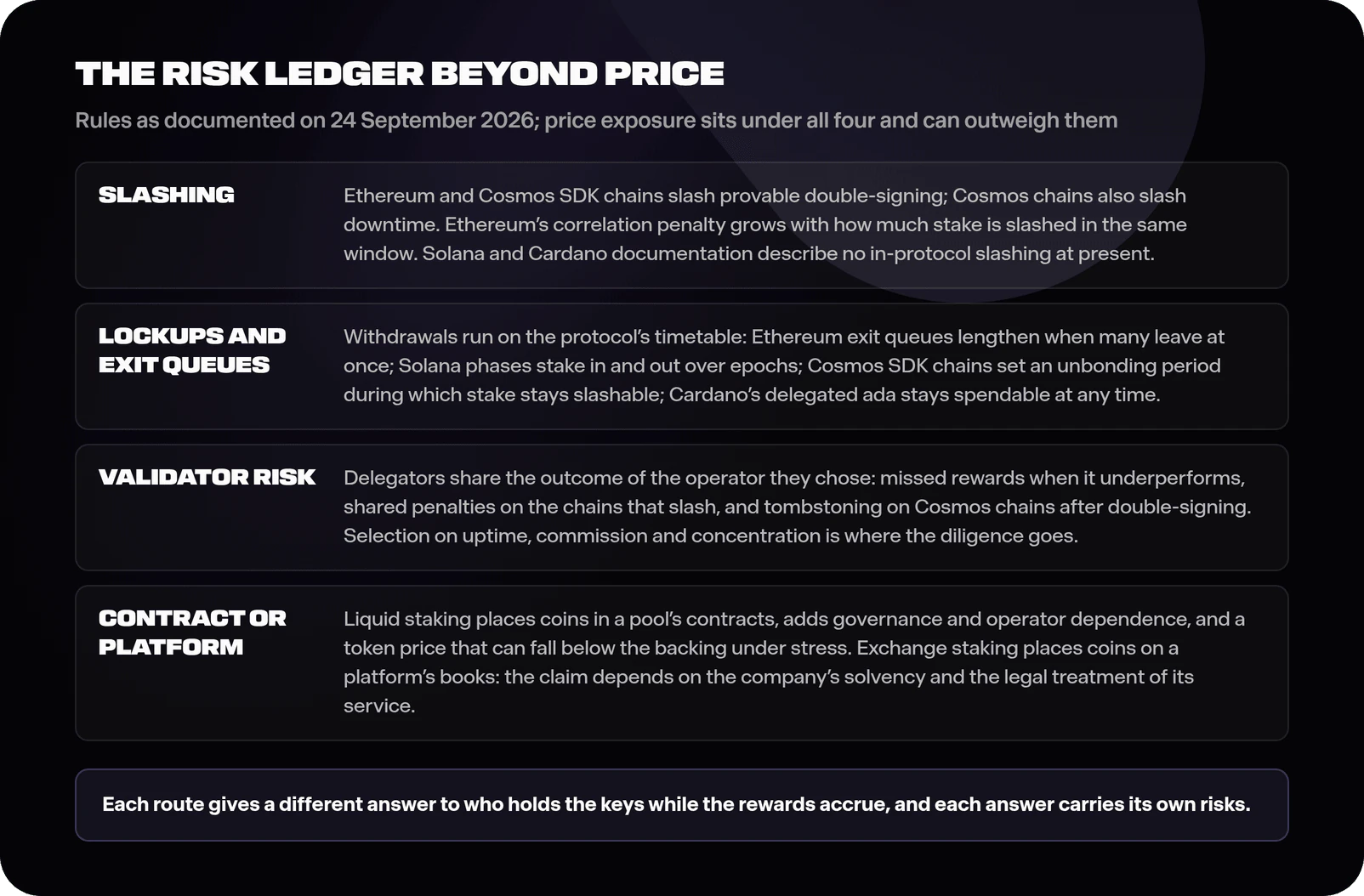
They differ enough that Ethereum's rules cannot be transplanted to other chains, and each network can change them through upgrades or governance. As documented when the sources were checked on 24 September 2026, Ethereum slashes double-signing with a correlation penalty and runs activation and exit queues; Solana currently has no in-protocol slashing and phases stake in and out over epochs; Cosmos SDK chains slash both double-signing and downtime with a set unbonding period; Cardano leaves delegated ada spendable at any time.
Ethereum
A validator needs at least 32 ETH and joins an activation queue that limits how fast new validators enter; since the Pectra upgrade, a validator with compounding (0x02) withdrawal credentials can hold an effective balance of up to 2,048 ETH (ethereum.org, Staking; Proof-of-stake; Withdrawal credentials). Slashable offences are proposing multiple blocks in a single slot and submitting contradictory attestations. The penalty runs in stages: an initial penalty of 1/4096 of effective balance, up to 0.5 ETH (about 0.0078 ETH for a 32 ETH validator), minor daily penalties while the validator sits inactive, a correlation penalty around day 18 whose size scales with the total stake of all validators slashed in the same window, and ejection around day 36. For a lone slashed validator the correlation penalty is under 0.1 percent of stake; in a mass slashing event it can reach the whole stake (ethereum.org, Proof-of-stake; Rewards and penalties). That design is why concentration of many validators on one operator or one client is treated as a network-level risk. A separate inactivity leak bleeds stake from validators who stop voting if the chain fails to finalise for more than four epochs.
Withdrawals were enabled by the Shanghai/Capella upgrade on 12 April 2023, and how rewards leave a validator depends on its withdrawal credential type (ethereum.org, Withdrawals; Withdrawal credentials). A validator still on the original 0x00 credentials cannot receive any withdrawals until it updates them to 0x01 (and, if wanted, from 0x01 to 0x02). On 0x01 credentials, any balance above 32 ETH is swept automatically to the withdrawal address, so rewards above 32 ETH do not compound. On 0x02 compounding credentials, introduced with Pectra, rewards compound up to a maximum effective balance of 2,048 ETH; partial withdrawals below that level must be requested manually, and automatic sweeps apply only to balance above 2,048 ETH (ethereum.org, Withdrawal credentials). Whatever the credential type, a full exit places the validator in an exit process whose duration depends on how many others are exiting at the same time, followed by a withdrawal delay (ethereum.org, Withdrawals). Holders in pooled or liquid arrangements do not interact with these queues directly (the pool's operators do), which is why their exposure is to the pool's contracts and operators, covered below.
Solana
Solana's staking documentation states that there is no in-protocol implementation of slashing at present, while noting that slashing may be introduced in future (Solana, Staking). Delegated stake does not become effective immediately. A delegation or deactivation takes several epochs to complete, with a fraction becoming active or inactive at each epoch boundary, and the exact duration depends on what other network participants are doing (Solana, Stake accounts). The stake program caps how much of total network stake can warm up or cool down in one epoch: Anza's documentation gives the cap as 25 percent per epoch, while the current stake program source code defines that original 25 percent rate alongside a lower 9 percent rate that applies once a network feature is activated, so the cap in force on a given date should be read from the network's feature status (Anza, Stake delegation and rewards; Solana stake program source). Stake that is cooling down continues to accrue staking rewards and remains exposed to any penalty the protocol applies. The practical consequence is that entry and exit take at least one epoch boundary, and longer when many holders move at once. Validators charge a commission on rewards, and the stake account stays under the stake and withdraw authorities held by the holder's keys throughout (Solana, Stake accounts).
Cosmos SDK chains
Chains built on the Cosmos SDK (the Cosmos Hub and many others) use a slashing module that penalises two things: double-signing, and failing to sign enough blocks in a window (Cosmos SDK, Slashing module). A validator that misses too many blocks is automatically jailed, potentially slashed and unbonded, and may send a transaction to rejoin after a jail period; a validator caught double-signing is tombstoned, meaning it cannot unjail and can only return as a new validator with different keys, so its delegators stop receiving staking rewards from it until they unbond or redelegate. The module's documented example parameters are a 5 percent slash for double-signing and a 1 percent slash for downtime, with a 100-block signed-blocks window and a 50 percent minimum; each chain sets its own values, so the figures for a specific network must be read from that network's own parameters rather than these examples. Delegators who unbond must wait the chain's unbonding period, which each chain sets for itself (the SDK documentation's example value is three days), and during that period their tokens remain slashable for offences the validator committed while the tokens were bonded (Cosmos SDK, Staking module). Bonded tokens can be redelegated to another validator instantly, but until the redelegation matures they remain slashable for infractions the original validator committed before it began (Cosmos SDK, Staking module).
Cardano
Cardano's model differs from the three above. Delegated ada stays in the holder's wallet and remains spendable at any time; there is no lock-up, and the holder can switch pools at will (cardano.org, Stake pool delegation). The documentation for delegation and stake pools describes no slashing penalty and no mechanism by which delegated ada is destroyed; the cost of a poorly run pool is missed rewards, since rewards depend on the pool producing blocks. Rewards follow the epoch timetable set out above.
What do liquid staking and exchange staking add to the risk?
簡単な回答
A liquid staking token adds a contract, a governance process and a market price between you and the protocol; exchange staking adds the platform's balance sheet and the legal treatment of its service in each jurisdiction where it operates. Neither is part of the protocol, and the protocol does not know either exists.
Liquid staking tokens
A liquid staking token (LST) represents a claim on staked coins and the rewards they generate, issued by a pool that runs validators on holders' behalf. Ethereum's documentation is direct on the distinction: the protocol pays rewards to validators and does not know the token exists, so holding an LST is not the same as staking (ethereum.org, Pooled staking). The added risks it lists are smart contract risk, since the coins are held by contracts that could contain bugs or be exploited; the dependence on the pool's contracts, governance and operators working correctly; and the possibility that the token's secondary-market price falls below the value of the coins backing it during market stress or thin liquidity. A holder who needs to exit during such a period faces the choice between selling at a discount and waiting for the pool's own redemption process, which in turn depends on the underlying network's exit timetable. The same page notes that some pools concentrate stake with their chosen node operators, and that large amounts of staked ETH under the control of a few organisations create conditions for censorship, value extraction and single points of failure (ethereum.org, Pooled staking). Concentration also matters for slashing, because Ethereum's correlation penalty grows with the total stake slashed in the same window. The questions in the guide to what a smart contract is about who can upgrade a contract and who holds its admin keys apply in full.
Exchange staking
When an exchange stakes on a customer's behalf, the coins are on the platform's books and the platform decides what share of protocol rewards to pass through. The customer's claim is against the company, on the terms its user agreement sets, so what the customer can recover depends on the company's solvency as well as on the protocol's rules; the guide to exchange safety and the Exchange Failure Index cover how such claims have fared in insolvencies. There is also a legal dimension that varies by jurisdiction. In the United States, on 9 February 2023 the SEC announced a settled enforcement action against Payward Ventures, Inc. and Payward Trading Ltd., together operating Kraken. The SEC's complaint, filed in the US District Court for the Northern District of California (case 3:23-cv-00588), alleged that their staking-as-a-service programme was an unregistered offer and sale of securities under Section 5 of the Securities Act of 1933. Without admitting or denying the allegations, the two companies consented to a final judgment, subject to court approval, and agreed to pay $30 million in disgorgement, prejudgment interest and civil penalties and to cease offering or selling securities through crypto asset staking services or staking programmes (SEC press release 2023-25, 9 February 2023; SEC Litigation Release 25637). The SEC's notice of covered action for the case gives 13 February 2023 as the date of the qualifying judgment (SEC, Notice of Covered Action 2023-052). A consent judgment of this kind records what the parties agreed and contains no court finding on whether staking programmes in general are securities. On 29 May 2025 the SEC's Division of Corporation Finance published a staff statement expressing the view that certain protocol staking activities in the United States (self or solo staking, self-custodial staking directly with a third party, and custodial arrangements in which a custodian stakes assets it holds for their owners) do not involve the offer and sale of securities within the meaning of Section 2(a)(1) of the Securities Act of 1933. It states that it does not address liquid staking, restaking or liquid restaking. The statement says it represents the staff's views, is not a rule, regulation, guidance or statement of the Commission, which has neither approved nor disapproved it, and has no legal force or effect (SEC Division of Corporation Finance, 29 May 2025). Treatment elsewhere depends on each jurisdiction's rules for the entity and the activity, and the academy's guide to how stablecoins are regulated around the world, though written for stablecoins, shows how such rules are organised by jurisdiction, entity, activity and effective date.
Frequently asked questions
Can I lose my entire stake?
Through slashing alone, on Ethereum, only in a mass slashing event where a large share of all validators is slashed at once; a lone slashed validator loses well under 1 percent of stake plus the initial and daily penalties before ejection (ethereum.org, Proof-of-stake). On Cosmos SDK chains the loss is the chain's configured fraction. Solana and Cardano documentation describe no in-protocol slashing at present. Losses of the whole position arise instead from the coin's price, from a failed exchange, or from a broken liquid staking contract.
What do I still risk when delegating from my own wallet?
The keys stay with the holder, which removes the platform's balance sheet from the picture and leaves the protection and backup of those keys with the holder. What remains is the protocol's own rules: the chosen validator's performance and, on chains that implement it, its slashing; the unbonding or cool-down timetable; and price. Delegation is where staking meets the questions in who holds your crypto, and validator selection is where the diligence goes.
Why do advertised staking rates differ so much between chains?
Because each protocol sets its own issuance and reward formula, and on some chains the rate moves with participation: on Ethereum the base reward per validator falls as the number of validators rises (ethereum.org, Rewards and penalties). Some chains show a high rate because their issuance is high, so part of the reward is the dilution the holder would otherwise have suffered, handed back. Comparing rates across chains without netting issuance, and without reading each chain's penalty and unbonding terms, gives a misleading picture.
Are staking rewards taxed?
Tax treatment of staking rewards differs by jurisdiction. The questions a tax authority's rules typically answer are whether and when a reward counts as income, at what value, and how a later sale or exchange of the rewarded coins is treated, and those rules change over time. Records of the date, amount and value of each reward at receipt are the raw material for any of these assessments. Professional advice applies.
What is restaking?
Restaking reuses already-staked assets to secure additional applications. Ethereum's documentation describes it as built by third parties on top of Ethereum and outside protocol staking: each application adds its own slashing conditions, withdrawals can face additional delays, and its additional rewards do not come from the Ethereum protocol (ethereum.org, Staking). The SEC staff statement of 29 May 2025 on protocol staking states that it does not address restaking (SEC Division of Corporation Finance, 29 May 2025). The guide to where crypto rewards come from sets out how to trace who pays any such additional reward.
Sources and further reading
Primary and reference sources for this guide. All URLs were checked on 23 September 2026; the protocol documentation and SEC pages were rechecked on 24 September 2026, when the SEC case records and the ethereum.org restaking note were also fetched.
- Staking with Ethereum (staking options and their trust assumptions, 32 ETH minimum, 2,048 ETH maximum effective balance, rewards, withdrawals, displayed current APR, restaking note). ethereum.org, undated, observed 24 September 2026. https://ethereum.org/en/staking/ (accessed 24 September 2026)
- Withdrawal credentials: 0x00 credentials receive no withdrawals until updated; 0x01 automatic sweep of balance above 32 ETH; 0x02 compounding up to a 2,048 ETH maximum effective balance, manual partial withdrawals and sweeps only above 2,048 ETH. ethereum.org developer documentation, last updated 22 January 2026. https://ethereum.org/developers/docs/consensus-mechanisms/pos/withdrawal-credentials/ (accessed 24 September 2026)
- Proof-of-stake (PoS): slashing offences, penalty stages, correlation penalty, inactivity leak, activation queue. ethereum.org, undated developer documentation. https://ethereum.org/en/developers/docs/consensus-mechanisms/pos/ (accessed 24 September 2026)
- Proof-of-stake rewards and penalties: base reward formula, attestation penalties, slashing schedule. ethereum.org, undated developer documentation. https://ethereum.org/en/developers/docs/consensus-mechanisms/pos/rewards-and-penalties/ (accessed 24 September 2026)
- Staking withdrawals: Shanghai/Capella, 12 April 2023; partial withdrawals and full exits. ethereum.org, undated. https://ethereum.org/en/staking/withdrawals/ (accessed 24 September 2026)
- Pooled staking and liquid staking tokens: what an LST represents, contract and price risk. ethereum.org, undated. https://ethereum.org/en/staking/pools/ (accessed 24 September 2026)
- Staking on Solana: delegation, commission, statement that there is no in-protocol slashing currently. Solana documentation, undated. https://solana.com/docs/references/staking (accessed 24 September 2026)
- Stake delegation and rewards: warm-up and cool-down, 25 percent per epoch warm-up rate, vote credits and points. Anza (Agave validator client documentation), undated. https://docs.anza.xyz/consensus/stake-delegation-and-rewards (accessed 24 September 2026)
- Stake accounts: stake and withdraw authorities, activation and deactivation over epoch boundaries. Solana documentation, undated. https://solana.com/docs/references/staking/stake-accounts (accessed 24 September 2026)
- Stake program warm-up and cool-down rates (original 25 percent and 9 percent after feature activation). solana-program/stake source code, warmup_cooldown_allowance.rs, main branch. https://github.com/solana-program/stake/blob/main/interface/src/warmup_cooldown_allowance.rs (accessed 24 September 2026)
- Slashing module: double-sign and downtime penalties, jailing, tombstoning, example parameters. Cosmos SDK documentation, undated. https://docs.cosmos.network/main/build/modules/slashing (accessed 24 September 2026)
- Staking module: delegation, unbonding time, redelegation, slashability during unbonding. Cosmos SDK documentation, undated. https://docs.cosmos.network/main/build/modules/staking (accessed 24 September 2026)
- Stake pool delegation: ada stays spendable, no lock-up, epoch reward timetable. cardano.org, undated. https://cardano.org/stake-pool-delegation/ (accessed 24 September 2026)
- Delegation. Cardano documentation, undated. https://docs.cardano.org/about-cardano/learn/delegation (accessed 24 September 2026)
- Kraken to Discontinue Unregistered Offer and Sale of Crypto Asset Staking-As-A-Service Program and Pay $30 Million to Settle SEC Charges. US Securities and Exchange Commission, press release 2023-25, 9 February 2023. https://www.sec.gov/newsroom/press-releases/2023-25 (accessed 24 September 2026)
- Litigation Release No. 25637, Payward Ventures, Inc. (d/b/a Kraken) and Payward Trading, Ltd. (d/b/a Kraken), US District Court for the Northern District of California, No. 3:23-cv-00588. US Securities and Exchange Commission, 13 February 2023. https://www.sec.gov/enforcement-litigation/litigation-releases/lr-25637 (accessed 24 September 2026)
- Notice of Covered Action 2023-052, SEC v. Payward Ventures, Inc. (d/b/a Kraken) and Payward Trading, Ltd. (date of qualifying judgment or order 13 February 2023). US Securities and Exchange Commission, 27 April 2023. https://www.sec.gov/enforcement-litigation/whistleblower-program/notice-covered-actions/award-claim-2023-052 (accessed 24 September 2026)
- Statement on Certain Protocol Staking Activities. US SEC Division of Corporation Finance, staff statement, 29 May 2025. https://www.sec.gov/newsroom/speeches-statements/statement-certain-protocol-staking-activities-052925 (accessed 24 September 2026)
簡単なクイズ: 定着しましたか?
基本的な事項を確認するためのいくつかの質問がありました。解説付きの解答が続きますが、あなたの将来のポートフォリオを除いて誰もあなたを採点しません。


「What Is Staking, and What Are Its Risks?」のクイズを完了しました!成果をソーシャルメディアで共有しましょう。
 これは役に立ちましたか?