
TL;DR
- A trading venue combined, in the dominant retail model, with a custodian: it matches orders and holds the assets, so your balance is an entry in its books backed by coins in wallets it controls. What that entry is in law depends on the account terms, the entity you contract with and its jurisdiction. The same design provides the convenience and creates the counterparty exposure.
- It depends on the account terms and the jurisdiction of the entity you contract with, and the answer has ranged from assets held for customers outside the company's property to a transfer of title that left customers as unsecured creditors. The documents that decide this are readable by non-lawyers at the level that matters.
- Custody structure, segregation, jurisdiction and solvency transparency: where the coins are, whose property they are, which rules apply, and what evidence reaches you. Each is checkable at a useful level from public materials, and together they describe the risk you carry.
- Keeping assets on a platform provides liquidity, convenience and account recovery and carries counterparty exposure; withdrawing to self-custody replaces that counterparty exposure with different operational and security risks, plus fees and slower access to trading. Neither is free of risk, and how the two compare differs with how a platform is used and how much key management a person can take on; this guide does not rank them.
ในบล็อกเดียว
A custodial crypto exchange is a company that matches trades and holds customers' crypto-assets in wallets it controls, recording balances in its own ledger. Whether a balance is the customer's property or a debt the company owes depends on the account agreement and the law governing the contracting entity, and it is usually tested only if the company fails.
What is an exchange, in the terms that matter?
ตอบด่วน
A trading venue combined, in the dominant retail model, with a custodian: it matches orders and holds the assets, so your balance is an entry in its books backed by coins in wallets it controls. What that entry is in law depends on the account terms, the entity you contract with and its jurisdiction. The same design provides the convenience and creates the counterparty exposure.
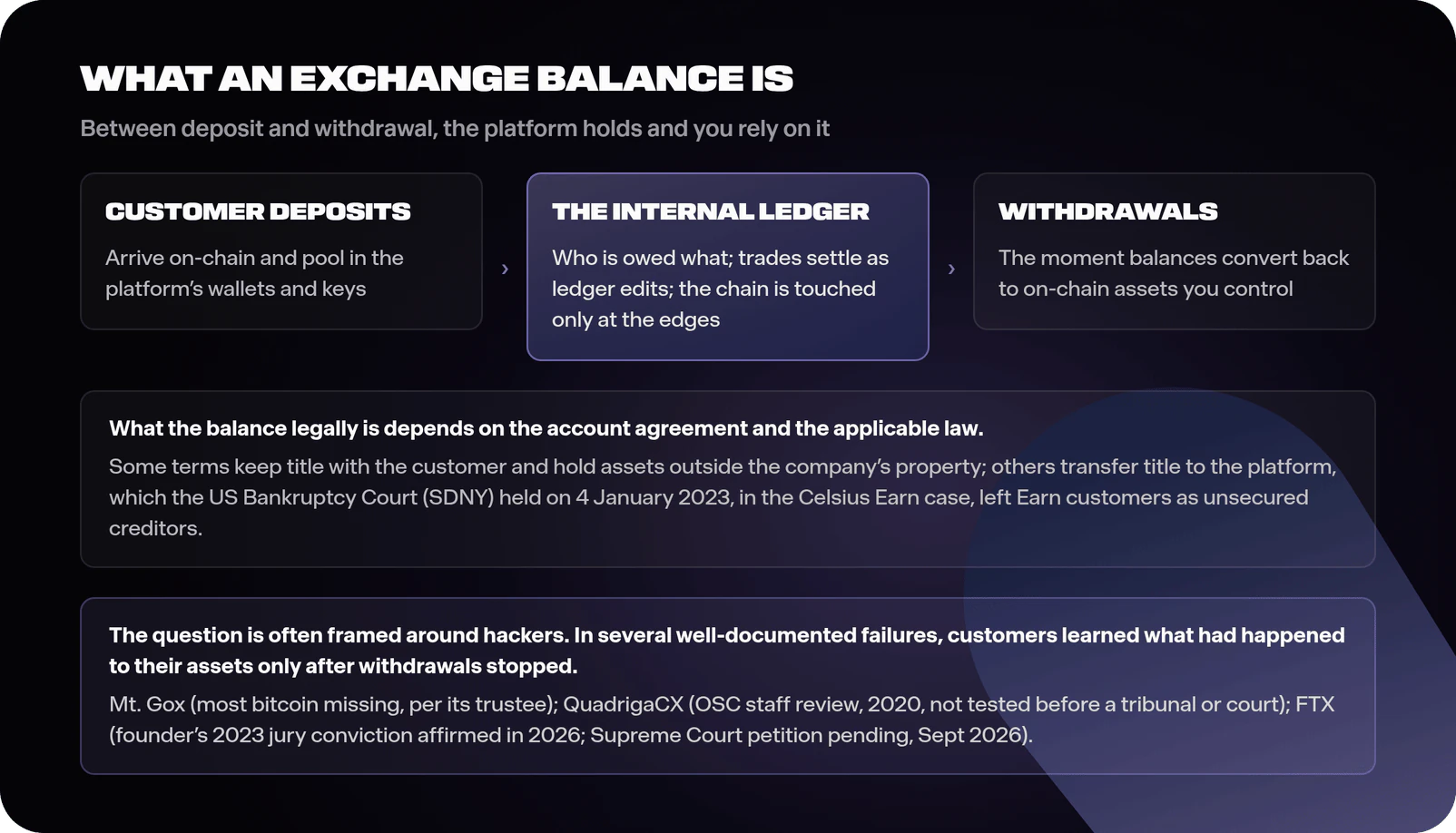
The custody guides' distinction lands here with full weight. On-chain, per the wallet guide, holding means keys; an exchange balance involves no keys of yours. The platform pools customer assets in wallets it controls, runs an internal ledger of who is owed what, and settles your trades by editing that ledger, touching the chain only on deposit and withdrawal. This is what makes exchanges fast and liquid, and it is also what makes them counterparties: between deposit and withdrawal, the platform holds and you rely on it.
What you rely on is a legal question with more than one answer, and the next section reads the documents that answer it. One boundary clarifies the whole subject first: none of this describes trading through self-custody, where decentralised venues, per the DeFi guide, swap assets without holding them and carry contract and oracle risk in place of a custodian's counterparty risk. Comparing those two sets of risks starts with a clear picture of the custodial exchange.
What is your balance, legally: property or a debt?
ตอบด่วน
It depends on the account terms and the jurisdiction of the entity you contract with, and the answer has ranged from assets held for customers outside the company's property to a transfer of title that left customers as unsecured creditors. The documents that decide this are readable by non-lawyers at the level that matters.
Terms that transfer title. The clearest documented case is Celsius. Its Terms of Use (version 8) stated that customers "grant Celsius all right and title to such Eligible Digital Assets, including ownership rights", with the right to "pledge, re-pledge, hypothecate, rehypothecate, sell, lend, or otherwise transfer or use" them. In a memorandum opinion dated 4 January 2023, the US Bankruptcy Court for the Southern District of New York held that assets deposited in Earn accounts became Celsius's property on deposit and so property of the bankruptcy estate, leaving Earn customers as unsecured creditors, despite the agreement's frequent use of the word "loan" (In re Celsius Network LLC, Case No. 22-10964 (MG), Memorandum Opinion, 4 January 2023). The ruling concerned Earn accounts under those terms and US bankruptcy law. In that case the balance was treated as an unsecured claim against the company, and its value in the failure depended on what the estate could pay; terms worded differently, a different entity or a different jurisdiction can produce a different result.
Terms that keep title with the customer. Other agreements say the opposite. Coinbase's US user agreement (section 2.7, last updated 22 July 2026) states that title to supported digital assets "shall at all times remain with you and shall not transfer to Coinbase", that assets held for customer wallets "are not property of Coinbase, and are not subject to claims of Coinbase's creditors", and that Coinbase may hold customer assets in shared blockchain addresses it controls. Two qualifications apply. This is a platform's statement of its own terms, quoted here as such and never as a court's finding; how any set of terms performs in an actual insolvency depends on the applicable law, on whether operations matched the words, and on a court. And the same section allocates the risk of loss of assets in the customer's wallet to the customer, so retained title is a statement about property in insolvency, and no statement about theft, error or operational failure. Coinbase is cited as an example of retained-title wording, and this guide makes no assessment of the platform.
Regulation that overrides or fills the contract. In the EU, MiCA (Regulation (EU) 2023/1114) requires crypto-asset service providers that hold clients' crypto-assets to make adequate arrangements to safeguard clients' ownership rights, "especially in the event of the crypto-asset service provider's insolvency", and to prevent use of clients' crypto-assets for their own account (MiCA Article 70(1)). Providers offering custody must keep custodied crypto-assets legally segregated from their own estate, in accordance with applicable law, so that the provider's creditors have no recourse to them, in particular in insolvency, and must also keep them operationally segregated (MiCA Article 75(7)). These duties bind providers authorised under MiCA and have applied since 30 December 2024. Providers already operating under national law before that date could continue without MiCA authorisation for a transitional period that ended no later than 1 July 2026, or earlier where a member state shortened it (MiCA Article 143(3); ESMA, MiCA rulebook). In the UK, the FCA published final policy statements on 30 June 2026; PS26/11 applies safeguarding requirements under CASS 17 to client cryptoassets, with adjustments for cryptoasset custody, and the FCA's summary says the protections cover ownership rights, record-keeping, reconciliation and private key management. These rules are due to bind firms authorised under the Financial Services and Markets Act 2000 (Cryptoassets) Regulations 2026 when the regime commences on 25 October 2027 (FCA, PS26/11, paragraph 1.3, and cryptoasset regime page, 30 June 2026). Some UK obligations already apply before then: the FCA states that until the new regime starts, cryptoasset firms must continue to be registered with it under the Money Laundering Regulations, and the cryptoasset financial promotions rules have applied since 8 October 2023 (FCA); neither of these is a safeguarding regime. Where one of these regimes applies to the entity an account is held with, its segregation duties apply alongside the account terms; where none applies, the terms and the insolvency law of the entity's home jurisdiction are left to decide.
Three things shape the answer for any account: the custody clause in the agreement of the specific entity the account sits with, whether its words retain the customer's title or transfer it, and the regime, if any, that applies to that entity; in a dispute, a court applying the relevant law decides. An app's wording ("your assets", "your balance") describes the interface; the clause, the regime and the applicable law set the legal position.
What are the four dimensions of counterparty assessment?
ตอบด่วน
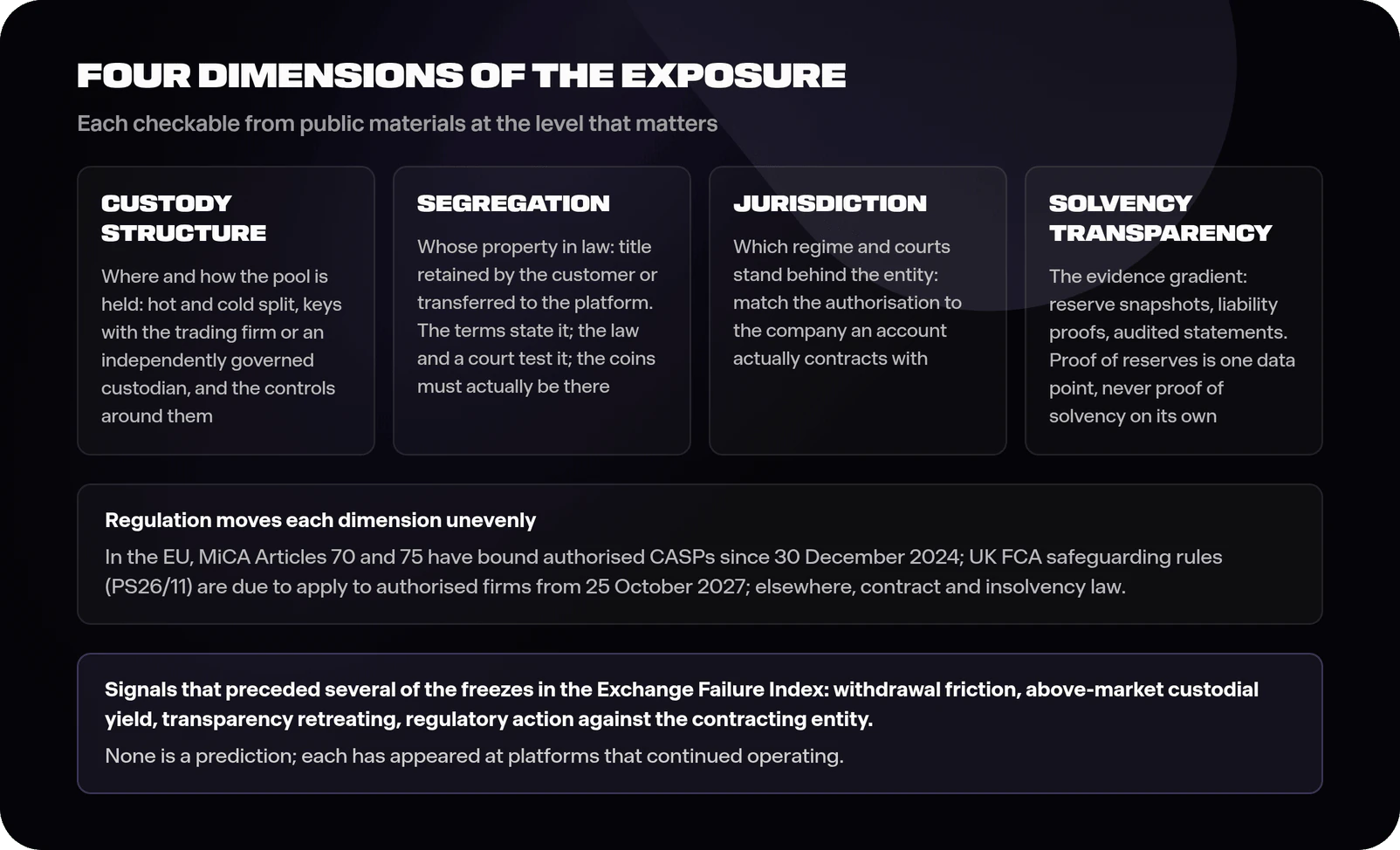
Custody structure, segregation, jurisdiction and solvency transparency: where the coins are, whose property they are, which rules apply, and what evidence reaches you. Each is checkable at a useful level from public materials, and together they describe the risk you carry.
Custody structure asks where and how the platform holds the pool: the split between hot and cold storage, whether keys sit with the trading company or a separately governed custodian, and what operational controls, of the kind the institutional custody guide details, stand around them. Some venues publish an outline of it. Custody by a separately governed third party takes the keys out of the trading firm's hands, and the custodian then becomes a further counterparty with its own controls, insolvency position and failure modes. FTX shows what control concentrated in a trading firm can allow: the US Department of Justice states that FTX's founder, Samuel Bankman-Fried, "directed co-conspirators to alter FTX's computer code to allow Alameda to withdraw effectively unlimited amounts of cryptocurrency from the exchange" (US DOJ, 28 March 2024). A jury convicted him on seven counts, including wire fraud, on 2 November 2023; the US Court of Appeals for the Second Circuit affirmed the judgment on 12 June 2026, and his petition to the US Supreme Court, filed on 10 September 2026, was pending on 24 September 2026 (US DOJ, 2 November 2023; US Supreme Court docket 26-349).
Segregation asks the property question of the previous section, and adds an operational test: even where the words say assets are held for customers, the coins have to actually be there, in wallets reconciled against the ledger, and never lent or traded by the platform. QuadrigaCX illustrates the gap between terms and operations. A 2020 review by staff of the Ontario Securities Commission concluded that the platform's downfall "resulted from a fraud committed by" its co-founder and chief executive, Gerald Cotten. According to the staff review, he opened accounts under aliases, credited himself with fictitious balances that he traded with clients, and traded client assets on external platforms without authorisation, and management gave false assurances about how assets were stored. The OSC states that these are staff findings and views, not findings of fact by an OSC hearing panel, and that they have not been tested before its tribunal or a court; Cotten died in December 2018 (OSC, QuadrigaCX report, 2020). Segregation is a legal and operational fact to check against the terms, any authorisation conditions and independent reporting, never an assumption the interface earns.
Jurisdiction asks which rules and courts stand behind the first two dimensions. MiCA's CASP regime imposes the EU segregation and custody duties described above on authorised providers; the UK regime is due to apply its safeguarding rules from 25 October 2027; and for venues organised outside such regimes, or serving users cross-border without local authorisation, more rests on the governing law and forum named in the agreement and on the insolvency law of the entity's home jurisdiction, alongside any consumer rules of the user's own country that apply. Whether a particular firm holds an authorisation is shown on the relevant regulator's public register on the day it is checked. The practical check is matching the authorisation to the user: the entity an account actually contracts with, and the regime that entity answers to for that customer, which multi-entity groups make worth a few minutes of reading. The regulatory guide covers the stablecoin side of these regimes.
Solvency transparency asks what evidence flows between you and the balance sheet. Proof of reserves is one data point within this dimension: a reserve snapshot shows assets a set of keys controlled at one moment, and only beside a matching liability commitment at the same entity and time, reconciled against the platform's books to show it is complete, does it say anything about whether assets cover what customers are owed. Neither shows off-chain debts, pledged assets or beneficial ownership, so proof of reserves is evidence of disclosure direction and never proof of solvency. Audited financial statements at the contracting entity are a stronger class of evidence, and the gap between the two is the gap between a snapshot and assurance. The proof-of-reserves guide gives the schemes and their limits in full.
What are the trade-offs between leaving assets on an exchange and withdrawing them?
ตอบด่วน
Keeping assets on a platform provides liquidity, convenience and account recovery and carries counterparty exposure; withdrawing to self-custody replaces that counterparty exposure with different operational and security risks, plus fees and slower access to trading. Neither is free of risk, and how the two compare differs with how a platform is used and how much key management a person can take on; this guide does not rank them.
What staying on the platform provides. Instant trading and conversion without on-chain settlement or network fees; no keys to generate, back up or protect; password and 2FA reset through support if you lose access; and, where the regime provides it, statutory segregation. The account security guide covers the account-side risks that come with that convenience.
What staying on the platform costs. Exposure to every dimension above: the platform's custody controls, its actual segregation practice, its home law, and its solvency. If withdrawals stop, the balance is whatever the terms and the estate make it, and the timescale is the insolvency process's, which in the Mt. Gox case ran from a 2014 bankruptcy to first distributions in July 2024, with the repayment deadline since extended to 31 October 2026 (Mt. Gox rehabilitation trustee, rehabilitation plan and notice of 27 October 2025). The Exchange Failure Index records what each estate returned, by class and date; this guide gives no recovery percentages.
What withdrawing provides and costs. Removing assets to a wallet you control replaces exposure to the platform's balance sheet with the operational and security risks of self-custody that the wallet security guide covers: loss of backups, phishing, address poisoning, signing mistakes, device compromise. These risks fall on the holder, and no custody arrangement removes them entirely. Each withdrawal also costs a network fee, may be subject to platform limits and identity checks, and puts a settlement delay between you and the next trade. The weighting differs with trading frequency, holding period and capacity to manage keys, and self-custody does not suit every holder.
Patterns documented before past failures. The Index describes signals that preceded several of the withdrawal freezes it records: withdrawal friction, such as new delays, pauses or "technical issues"; above-market yield paid on custodial balances, which the guaranteed-returns guide explains as compensation for risks the platform takes with customer assets; transparency retreating, such as lapsed attestations or reported banking troubles; and regulatory action against the entity you contract with. Several of the failures in the Exchange Failure Index, including Mt. Gox, Celsius, BlockFi, QuadrigaCX and FTX, showed one or more of these signals before the freeze. None of these signals is a prediction, each has appeared at platforms that continued operating, and a past pattern does not show that a future failure will look the same. They are recorded here as history, and this guide does not present any of them as a reason to deposit, keep or withdraw assets.
Rehearsal. One consideration applies to either arrangement. A withdrawal route that has never been used at routine size is untested, in the same way the backup guide treats a backup that has never been restored.
Frequently asked questions
Does regulation reduce the counterparty risk of a crypto exchange?
Regulation sets minimum duties on the dimensions it reaches, such as segregation, custody standards, capital and reporting. MiCA's custody and segregation rules bind crypto-asset service providers authorised in the EU and have applied since 30 December 2024 (MiCA Articles 70 and 75), and the UK's safeguarding rules for client cryptoassets are due to apply to authorised firms from 25 October 2027 (FCA, PS26/11). Those duties do not remove counterparty risk, do not guarantee that losses are made good, and do not reach a group entity outside the regime. A worked example: a group may hold an EU authorisation for one subsidiary while a customer's agreement names an affiliate incorporated elsewhere, and the EU duties attach only if the named entity is the authorised one. Whether a firm is authorised is shown on the regulator's public register, such as the MiCA register published by ESMA or the FCA's Financial Services Register, on the day it is checked.
Does an exchange's size reduce its counterparty risk?
Longevity and scale are evidence of operational competence and of incidents survived, and the record cautions against letting them settle the question alone: Mt. Gox and FTX were both prominent venues when they failed. Size says something about custody operations and little about segregation or solvency transparency, the dimensions at issue in the FTX case, where a jury convicted the founder of fraud and conspiracy offences in November 2023 (US DOJ, 2 November 2023; conviction affirmed by the Second Circuit on 12 June 2026, Supreme Court petition pending on 24 September 2026).
What happens to my crypto if an exchange goes bankrupt?
Outcomes depend on the account agreement, on whether the assets were actually held as the agreement says, and on the insolvency law that applies to the entity. In the Celsius case, terms that transferred title left Earn customers as unsecured creditors of the estate (US Bankruptcy Court SDNY, 4 January 2023). Where terms state that title stays with customers, whether they hold a property claim on identifiable assets is for the applicable law and, if disputed, a court. Distributions follow the insolvency process's timetable and are settled by claim class, which the Exchange Failure Index records with sources. Claims run through the court-supervised process and the estate's official channels; the FBI has warned that firms offering to recover lost crypto for an upfront fee commonly take the fee and either stop responding or ask for more (IC3, 11 August 2023). The custody clause can be read at account opening, and once withdrawals stop it already governs the outcome.
Does proof of reserves mean an exchange is solvent?
On its own, no. A worked example shows why: a platform publishes addresses holding 100,000 BTC. The same snapshot would appear whether customers are owed 90,000 BTC or 120,000 BTC, and whether or not some of those coins are pledged to a lender. Only a liability commitment for the same entity at the same moment, reconciled against the platform's books so that its completeness is checked, plus visibility of off-chain debts and pledges, closes that gap; a customer's Merkle inclusion proof shows only that one balance was counted (Buterin, 19 November 2022). The US Public Company Accounting Oversight Board warned investors on 8 March 2023 that proof-of-reserve engagements are not audits, do not cover a crypto entity's liabilities, and give no assurance that assets were not later lent or made unavailable to customers (PCAOB, Investor Advisory, 8 March 2023). The proof-of-reserves guide covers the schemes in detail.
How do the risks of a decentralised exchange compare with a centralised one?
A decentralised exchange carries a different set of risks. No company holds the assets, and the contract, oracle and user-error risks described in the DeFi guide apply instead. A centralised exchange concentrates risk in one counterparty; a decentralised one places it in code, price feeds and the user's own signing. The comparison is between those two sets of risks for a given use, and this guide does not rank them.
Sources and further reading
Primary sources for this guide, verified on 23 and 24 September 2026.
- Memorandum Opinion and Order Regarding Ownership of Earn Account Assets, In re Celsius Network LLC, Case No. 22-10964 (MG). US Bankruptcy Court, Southern District of New York, 4 January 2023. https://www.nysb.uscourts.gov/sites/default/files/opinions/312902_1822_opinion.pdf (accessed 23 September 2026)
- Coinbase User Agreement (United States), section 2.7 Digital Asset Custody and Title. Coinbase, last updated 22 July 2026. Platform statement of its own terms. https://www.coinbase.com/legal/user_agreement/united_states (accessed 23 September 2026)
- MiCA Article 70, Safekeeping of clients' crypto-assets and funds. ESMA interactive single rulebook, Regulation (EU) 2023/1114. https://www.esma.europa.eu/publications-and-data/interactive-single-rulebook/mica/article-70-safekeeping-clients-crypto-assets (accessed 23 September 2026)
- MiCA Article 75, Providing custody and administration of crypto-assets on behalf of clients. ESMA interactive single rulebook, Regulation (EU) 2023/1114. https://www.esma.europa.eu/publications-and-data/interactive-single-rulebook/mica/article-75-providing-custody-and (accessed 23 September 2026)
- MiCA interactive single rulebook (application dates). ESMA. https://www.esma.europa.eu/publications-and-data/interactive-single-rulebook/mica (accessed 23 September 2026)
- MiCA Article 143, Transitional measures (paragraph 3). ESMA interactive single rulebook, Regulation (EU) 2023/1114. https://www.esma.europa.eu/publications-and-data/interactive-single-rulebook/mica/article-143-transitional-measures (accessed 24 September 2026)
- The UK cryptoasset regime: final policy statements PS26/9 to PS26/13 and commencement timetable. FCA, 30 June 2026. https://www.fca.org.uk/publications/policy-statements/cryptoasset-regime (accessed 23 September 2026)
- PS26/11: Crypto Regime, Regulated Cryptoasset Activities (paragraph 1.3, safeguarding under CASS 17). FCA, June 2026. https://www.fca.org.uk/publication/policy/ps26-11.pdf (accessed 24 September 2026)
- Registration under the MLRs ahead of the new FSMA regime. FCA. https://www.fca.org.uk/firms/new-regime-cryptoasset-regulation/registration-under-mlrs-ahead-new-fsma-regime (accessed 24 September 2026)
- Cryptoasset financial promotions: marketing to UK consumers. FCA. https://www.fca.org.uk/firms/cryptoassets/marketing-uk-consumers (accessed 24 September 2026)
- Samuel Bankman-Fried Sentenced to 25 Years in Prison. US Department of Justice, US Attorney's Office SDNY, 28 March 2024. https://www.justice.gov/usao-sdny/pr/samuel-bankman-fried-sentenced-25-years-prison (accessed 23 September 2026)
- Statement of US Attorney Damian Williams on the conviction of Samuel Bankman-Fried. US Department of Justice, US Attorney's Office SDNY, 2 November 2023. https://www.justice.gov/usao-sdny/pr/statement-us-attorney-damian-williams-conviction-samuel-bankman-fried (accessed 24 September 2026)
- Docket No. 26-349, Samuel Bankman-Fried v. United States (petition for a writ of certiorari filed 10 September 2026; lower court: US Court of Appeals for the Second Circuit, No. 24-961, decision 12 June 2026). Supreme Court of the United States. https://www.supremecourt.gov/search.aspx?filename=/docket/docketfiles/html/public/26-349.html (accessed 24 September 2026)
- United States v. Bankman-Fried, No. 24-961, opinion affirming the judgment. US Court of Appeals for the Second Circuit, 12 June 2026 (as reproduced by Justia). https://law.justia.com/cases/federal/appellate-courts/ca2/24-961/24-961-2026-06-12.html (accessed 24 September 2026)
- QuadrigaCX: A Review by Staff of the Ontario Securities Commission. Ontario Securities Commission, June 2020. https://www.osc.gov.on.ca/quadrigacxreport/ (accessed 23 September 2026)
- Investor Advisory: Exercise Caution With Third-Party Verification/Proof of Reserve Reports. Public Company Accounting Oversight Board, 8 March 2023. https://pcaobus.org/resources/information-for-investors/investor-advisories/investor-advisory-exercise-caution-with-third-party-verification-proof-of-reserve-reports (accessed 24 September 2026)
- Having a safe CEX: proof of solvency and beyond. Vitalik Buterin, 19 November 2022. https://vitalik.eth.limo/general/2022/11/19/proof_of_solvency.html (accessed 24 September 2026)
- Increase in Companies Falsely Claiming an Ability to Recover Funds Lost in Cryptocurrency Investment Scams. FBI Internet Crime Complaint Center (IC3), public service announcement, 11 August 2023. https://www.ic3.gov/PSA/2023/psa230811 (accessed 24 September 2026)
- Mt. Gox rehabilitation plan (sections 4.2.2 and 4.7.2). Mt. Gox rehabilitation trustee. https://www.mtgox.com/d/04y7ivbnz5gw.pdf (accessed 23 September 2026)
- Notice of change of repayment deadlines. Mt. Gox rehabilitation trustee, 27 October 2025. https://www.mtgox.com/img/pdf/20251027_1cc36334-e8b2-4fe4-8135-97d9a149e4f7_announcement_en.pdf (accessed 24 September 2026)
แบบทดสอบด่วน: มันติดไหม?
คำถามสองสามข้อเพื่อตรวจสอบพื้นฐานที่มาถึง คำตอบพร้อมคำอธิบายจะตามมา และไม่มีใครให้คะแนนคุณนอกจากผลงานในอนาคตของคุณ


คุณทำแบบทดสอบเรื่อง “Are Crypto Exchanges Safe? Assessing Counterparty Risk” เสร็จแล้ว! แชร์ความสำเร็จของคุณบนโซเชียลมีเดีย
 ข้อมูลนี้มีประโยชน์ไหม