
TL;DR
- From three documented mechanisms: proof-of-stake networks paying issuance and a share of fees to validators, borrowers paying interest to lenders, and traders paying swap fees to liquidity providers. Only the first is paid by the protocol itself; in the other two a contract sets the terms and other users pay. Each of these rewards is variable, is paid in a token whose price can fall, and carries a loss mechanism of its own.
- Four types that carry different risks: protocol rewards paid under a network's consensus rules, lending interest and swap fees paid by other users through a contract, promotional incentives distributed by a project, and issuer or counterparty promises (contractual rewards) at a rate a company sets, fixed or variable. The type tells you what has to remain true for the reward to continue, and what you are actually holding while it accrues.
- Principal, through price, slashing, contract exploits or counterparty failure; access, through lockups and exit queues; and the rate itself, which can fall at any time. Rewards are token-denominated; the fiat outcome is decided by the token's price over the period, and it can be negative while the dashboard shows a gain.
- That rewards promised by a company on custodial deposits are claims against that company, and that when Celsius and Voyager froze customer access in 2022 and BlockFi filed for bankruptcy later that year, customers' claims moved into bankruptcy proceedings. The three cases have different legal findings and should not be described as one identical scheme.
ในบล็อกเดียว
A crypto reward is a token payment with an identifiable source: a protocol paying for network security, borrowers paying interest, traders paying swap fees, a project distributing promotional tokens, or a company promising a rate it sets.
Where do crypto rewards come from?
ตอบด่วน
From three documented mechanisms: proof-of-stake networks paying issuance and a share of fees to validators, borrowers paying interest to lenders, and traders paying swap fees to liquidity providers. Only the first is paid by the protocol itself; in the other two a contract sets the terms and other users pay. Each of these rewards is variable, is paid in a token whose price can fall, and carries a loss mechanism of its own.
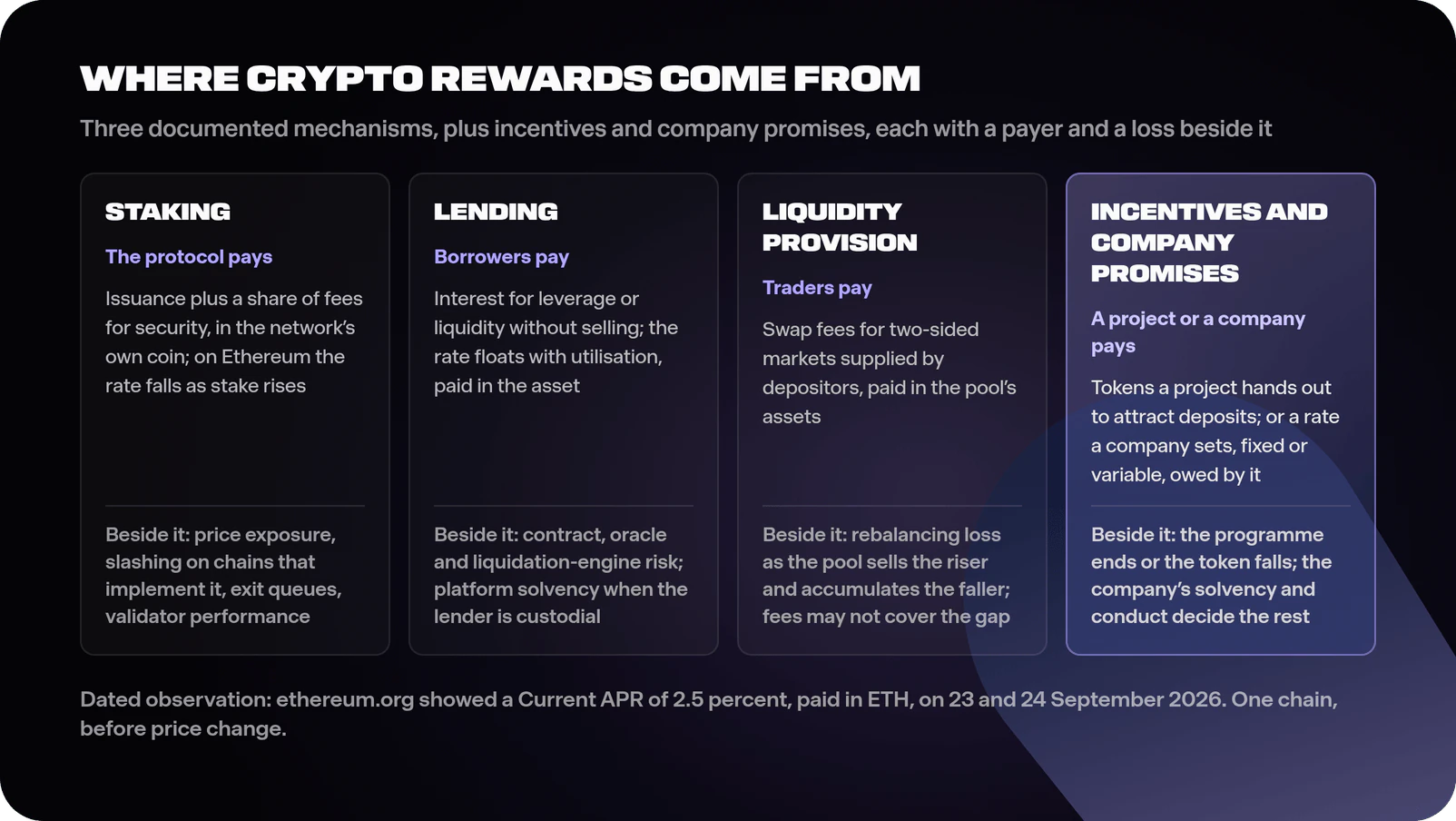
Staking: the network's security payment. Proof-of-stake chains pay validators for running the software that batches transactions into blocks and checks other validators' work. On Ethereum the reward is calculated from a base reward proportional to a validator's effective balance and inversely proportional to the square root of total staked balance, so more stake in the system means a lower rate per validator (ethereum.org, proof-of-stake rewards and penalties). Delegators and pool participants share that payment after fees. The reward is paid in the network's own coin, and the same documentation describes the penalties: missed attestations forfeit the reward that would have been earned, and provable misbehaviour such as signing two conflicting blocks destroys part of the stake and forces the validator out (ethereum.org, rewards and penalties). Exits are queued; the time to leave depends on how many validators are exiting at once (ethereum.org, staking withdrawals). When observed on 23 and 24 September 2026, the ethereum.org staking page displayed a "Current APR" of 2.5 percent, paid in ETH. It is quoted here only to illustrate the mechanism: a variable figure in ETH terms, before any operator fees, penalties or change in ETH's price, for one chain on those dates, and other networks set issuance, slashing and unbonding rules of their own; the staking guide covers those differences.
Lending: interest from borrowers. Public on-chain lending markets such as Compound match lenders to overcollateralised borrowers through contracts, and the rate is a function of utilisation, the share of supplied assets currently borrowed. Permissioned on-chain pools, such as Maple's institutional pools, work differently: they admit vetted participants, underwrite borrowers and may lend with less collateral (Maple documentation, Lending). Compound's documentation describes supply and borrow rates that rise with utilisation, with a "kink" above which they rise more steeply (Compound III documentation, interest rates). The payer is a borrower who wants leverage or liquidity without selling, and in Compound III the interest accrues in the supplied base asset (Compound III documentation, interest rates). When borrowing demand falls the rate falls with it, and the position is exposed to the lending contract, the oracle that prices collateral and the liquidation engine, all covered in the lending guide. Custodial lending, where a company takes your assets onto its own balance sheet and pays you a rate, is a different arrangement and is treated separately below.
Liquidity provision: swap fees from traders. Automated market-makers pay depositors a share of trading fees for supplying both sides of a market. In Uniswap v3, swap fees are distributed pro rata to all in-range liquidity at the time of a swap, at pool fee tiers of 0.01, 0.05, 0.3 or 1 percent (Uniswap documentation, fees). The payer is each trader who swaps in the pool. The cost is structural: a constant-product pool rebalances against the provider as prices move, selling the asset that rises and accumulating the one that falls, so the withdrawn position can be worth less than simply holding the two assets, before fees. Whether fee income covers that gap depends on trading volume and how far prices moved, and it is not guaranteed to do so in any period.
What kinds of reward are there, and why does the type matter?
ตอบด่วน
Four types that carry different risks: protocol rewards paid under a network's consensus rules, lending interest and swap fees paid by other users through a contract, promotional incentives distributed by a project, and issuer or counterparty promises (contractual rewards) at a rate a company sets, fixed or variable. The type tells you what has to remain true for the reward to continue, and what you are actually holding while it accrues.
Protocol rewards are the staking payments above: issuance and fee shares that a network's consensus rules pay to validators. The rate is set by a formula and by total stake, nobody promises it, and the rules themselves can change through network upgrades. Lending interest and swap fees are paid by other users, borrowers and traders, through a contract that sets the rate from utilisation or from the pool's fee tier; the contract routes these payments and does not fund them, so they fall when borrowing demand or trading volume falls. In both categories the rate can fall to near zero when the inputs change, and what you hold is your own asset, exposed to the mechanism's specific losses. Here the payer is a protocol rule or another user acting under one; in the two categories below it is a decision by a project or a company.
Promotional incentives are tokens a project distributes to attract deposits or usage, commonly called liquidity mining or yield farming. Where the token is new and the distribution schedule is front-loaded, the headline rate at launch can be high; that rate reflects the emission schedule and the token's price at that moment, and both can fall quickly. The reward is paid in the project's own token, its value depends on that token finding buyers, and it ends when the programme ends or the token's price falls. Some projects have used incentives to bootstrap activity that later paid its own way through fees; others ended when the emissions stopped. Nothing about the launch rate tells you which case you are in, and the rate is not a claim about sustainable profit.
Issuer and counterparty promises (contractual rewards at fixed or company-set rates) are promises by a company: deposit with us and we will pay a percentage we set. The rate can be fixed or can change at the company's discretion; BlockFi's interest accounts carried "the company's promise to provide a variable monthly interest payment" (SEC press release 2022-26, 14 February 2022). What defines the category is that the company owes the reward and decides what to do with the assets, so your reward depends on its solvency and its conduct. Where the terms transfer your assets to the company, the arrangement works as a loan to it, and what you recover if it fails depends on those terms and on how a court classifies the claim. In the United States, in a settled order that BlockFi Lending LLC consented to without admitting or denying the findings, the SEC found that BlockFi's interest accounts were securities under the Securities Act of 1933 because investors lent crypto assets to BlockFi in exchange for promised interest, and that BlockFi had misstated how much of its institutional lending was overcollateralised (SEC order 33-11029, 14 February 2022). A fixed rate is not by itself evidence of fraud; regulated fixed-income products exist in ordinary finance. In crypto as elsewhere, a contractual reward is a claim against the promising entity, and the section on 2022 below shows how such claims were resolved when three such entities failed.
The type matters because the risks differ in kind. A protocol reward, lending interest or fee income can shrink, and the contract holding the principal can fail; a promotional token can go to zero; a contractual claim can be frozen and then settled in bankruptcy on terms set by the estate. Putting all four on a single "yield" scale hides those differences.
What can be lost, and how does it compare to the reward?
ตอบด่วน
Principal, through price, slashing, contract exploits or counterparty failure; access, through lockups and exit queues; and the rate itself, which can fall at any time. Rewards are token-denominated; the fiat outcome is decided by the token's price over the period, and it can be negative while the dashboard shows a gain.
Price exposure and the denominator. In the three mechanisms above the reward is paid in the asset at risk: staking rewards in the staked coin (ethereum.org, rewards and penalties), lending interest in the supplied asset (Compound III documentation, interest rates), and swap fees in the pool's tokens (in Uniswap v2 the fee "is added to reserves" and paid out when providers withdraw; Uniswap v2 documentation, how Uniswap works). The reward and the price change therefore multiply. In a hypothetical example, a holder who receives a 5 percent reward in a token over a year in which the token fell 40 percent ends with 1.05 multiplied by 0.60, or 63 percent of the starting fiat value, a 37 percent loss. Taking the observed 2.5 percent Ethereum rate purely as an illustration, the same reward on a coin that fell 20 percent leaves 82 percent. The reward is real in token terms; in both examples the price change decides whether the fiat result is a gain or a loss. Stablecoin-denominated rewards change this term and add the issuer and depeg risks covered in the guide to stablecoin failure modes.
Slashing and penalties. On Ethereum, a slashed 32 ETH validator loses an initial amount of about 0.0078 ETH, is forcibly exited over a 36-day period, and pays a further correlation penalty at the midpoint that scales with how much other stake was slashed around the same time, so coordinated or widespread failures cost more (ethereum.org, rewards and penalties). Ordinary downtime costs the missed reward rather than the stake. Other networks apply different rules, and whether and how delegators share a validator's penalties depends on the network and the staking arrangement; the staking guide has the network-by-network detail.
Liquidity and lockups. Staked assets cannot be sold until the exit is processed, and the exit queue lengthens when many validators leave at once (ethereum.org, staking withdrawals). Lending positions can be withdrawn only if the pool has unborrowed liquidity; at very high utilisation, lenders queue behind borrowers' repayments. Custodial products can suspend withdrawals under their own terms, as Celsius and Voyager did in June and July 2022 (see the 2022 cases below).
Smart-contract risk. On-chain lending and liquidity positions live inside contracts. A flaw, a compromised admin key or a manipulated oracle can drain a pool regardless of how sound the reward mechanism was. The academy's guide to smart-contract risk and audits and the oracle guide cover the failure modes; the point here is that the reward is paid by the mechanism and the principal is held by the code.
Counterparty risk. When a platform holds your assets while generating the reward, a central question is what its customers recover if it fails, which depends on the account terms and on how a court classifies their claims. Court and agency records for three 2022 cases follow below.
Rate variability. A variable reward can fall without notice: staking rates fall as more stake enters, lending rates fall as borrowing demand falls, fee income falls with volume, and promotional programmes end. A rate observed on one day is a data point, and the reward statement that quotes it should be read as "at that moment, in that token, before losses."
What do the 2022 custodial cases show?
ตอบด่วน
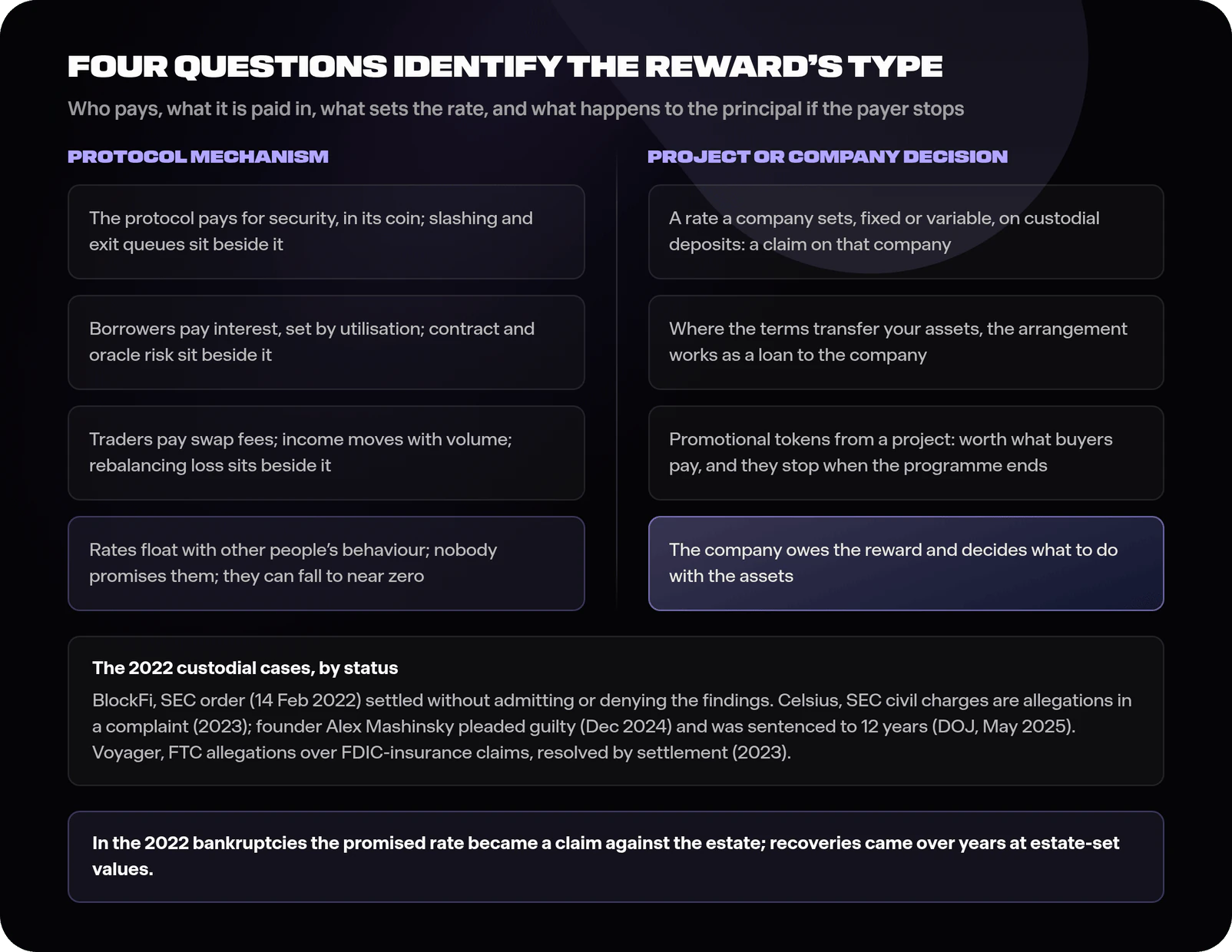
That rewards promised by a company on custodial deposits are claims against that company, and that when Celsius and Voyager froze customer access in 2022 and BlockFi filed for bankruptcy later that year, customers' claims moved into bankruptcy proceedings. The three cases have different legal findings and should not be described as one identical scheme.
BlockFi. On 14 February 2022 the SEC ordered BlockFi Lending LLC to pay a $50m penalty, with BlockFi agreeing to pay a further $50m to 32 states. In the settled order, which BlockFi Lending LLC consented to without admitting or denying the findings, the SEC found that BlockFi Interest Accounts, through which investors lent crypto assets in exchange for variable monthly interest, were securities offered without registration under the Securities Act of 1933, that BlockFi had also breached the registration provisions of the Investment Company Act of 1940, and that BlockFi had made a materially false statement on its website from March 2019 to August 2021 that its institutional loans were "typically" overcollateralised when only about 24 percent in 2019, 16 percent in 2020 and 17 percent to mid-2021 were (SEC order 33-11029 and press release 2022-26, 14 February 2022). BlockFi Inc. and eight affiliates, including BlockFi Lending LLC, filed for Chapter 11 in the US Bankruptcy Court for the District of New Jersey on 28 November 2022 (Case No. 22-19361, per the court's claims and noticing agent, Kroll); the Exchange Failure Index carries the estate record.
Celsius. Celsius halted customer withdrawals on 12 June 2022 and filed for bankruptcy on 13 July 2022; according to the US Attorney's Office, customers then had $4.7bn in inaccessible assets on the platform (US Attorney's Office SDNY, 8 May 2025). In July 2023 the SEC filed a complaint alleging that Celsius and its founder, Alexander Mashinsky, violated the registration and anti-fraud provisions of the Securities Act of 1933 and the anti-fraud provisions of the Securities Exchange Act of 1934, in connection with the Earn Interest Program and the CEL token; Celsius consented to the relief requested, including a permanent injunction, and the SEC's civil claims against Mashinsky are allegations set out in that complaint (SEC press release 2023-133, 13 July 2023). In the separate criminal case, Mashinsky pleaded guilty to commodities fraud and securities fraud on 3 December 2024 and was sentenced on 8 May 2025 to 12 years in prison. The US Attorney's Office said that Celsius marketed itself as the "safest place for your crypto" and that Mashinsky used customer assets "to place risky bets" (US Attorney's Office SDNY, 8 May 2025). The guilty plea is a criminal conviction of Mashinsky personally; the SEC's claims against Celsius the company were resolved by its consent to the relief sought, and this guide does not describe them as a court finding of fraud against the company.
Voyager. Voyager froze customer access and filed for bankruptcy in July 2022. According to the FTC, its chief executive had written to customers in June 2022 that their funds were "as safe with us as at a bank", about two weeks before access was frozen. In a complaint filed on 12 October 2023 the FTC alleged that Voyager had falsely marketed "YOUR USD IS FDIC INSURED" when it was not a bank and customers' crypto had no FDIC protection. Voyager agreed to settle; the settlement imposed a $1.65bn judgment, suspended so that assets could be returned through the bankruptcy, and permanently bars Voyager and its affiliates from offering products for depositing, exchanging, investing or withdrawing assets (FTC, 12 October 2023). These are FTC allegations about deceptive insurance claims, resolved by settlement; they are not a fraud conviction and should not be conflated with the Celsius plea.
What the three records share is the structure: retail customers deposited assets against a promised rate, the company decided how those assets were deployed, and when the company entered bankruptcy the promised rate was replaced by a claim against the estate. Recoveries were paid over years, partly in kind and partly in cash, at values set by the estates; the Exchange Failure Index tracks the recovery figures by estate and date. Protocol-mechanism rewards do not pass through a company's balance sheet in this way. That difference concerns where the payer sits, and holders of those positions remained exposed to the price falls of 2022 and to the contract and slashing risks described above.
Frequently asked questions
Do crypto rewards translate into money in your own currency?
The mechanisms in this guide do pay rewards, in tokens. Whether that becomes money in a holder's own currency depends on the token's price over the period, and the result can be negative. A break-even calculation shows how narrow the margin is: a 2.5 percent reward paid in a token offsets a price fall of only about 2.4 percent (1 divided by 1.025 is about 0.976), so any larger fall leaves the holder below the starting fiat value, before fees, penalties or tax. Tax treatment of rewards differs by jurisdiction, and professional advice applies to individual cases. This academy does not say whether anyone should seek rewards.
How does staking's risk differ from other reward types?
This guide does not rank risk. Staking's payer and penalties are written into the protocol's own documentation. Staking from one's own wallet removes a platform from the chain of payment, and in exchange places key management, validator choice and operator fees on the holder. It still carries price exposure that can exceed the reward (in the worked example above, a 20 percent price fall against a 2.5 percent reward), plus slashing, exit queues and dependence on validator performance, and custodial staking adds the platform's solvency. The staking guide explains the rules network by network.
Are high rewards on new protocols always scams?
No. Promotional incentives are a documented way of bootstrapping activity. A launch rate set by a distribution schedule lasts as long as that schedule, it is paid in a token whose price depends on later buyers, and the fraud warning signs in the guaranteed-returns guide apply to the offer's disclosures as well as to the rate.
Is a fixed rate on its own a warning sign?
A fixed rate tells you the reward is a contractual promise by a company rather than a protocol mechanism, which makes it a claim on that company's solvency and conduct. That is a different kind of risk from a protocol reward, and on its own it does not establish fraud. The guaranteed-returns guide separates the regulatory and court findings in the 2022 cases from the general pattern.
Why do rewards get quoted in percent if the token can fall?
Because the mechanism pays in tokens and has no view of the token's fiat price, so its rate is a token-denominated growth rate. The fiat outcome requires a second number, the token's price change, and the two multiply. Two rates quoted in different tokens measure growth in different units, and comparing them says nothing about the fiat result until each is combined with its token's price change.
Sources and further reading
- Staking with Ethereum. ethereum.org, undated (page displayed "Current APR" 2.5 percent, observed 23 and 24 September 2026). https://ethereum.org/en/staking/ (accessed 24 September 2026)
- Proof-of-stake rewards and penalties. ethereum.org developer documentation, undated. https://ethereum.org/en/developers/docs/consensus-mechanisms/pos/rewards-and-penalties/ (accessed 23 September 2026)
- Staking withdrawals. ethereum.org, undated. https://ethereum.org/en/staking/withdrawals/ (accessed 23 September 2026)
- Interest rates. Compound III documentation, undated. https://docs.compound.finance/interest-rates/ (accessed 23 September 2026)
- Lending, Maple Institutional for Lenders. Maple, undated. https://docs.maple.finance/maple-institutional-for-lenders/lending (accessed 24 September 2026)
- EIP-1559: Fee market change for ETH 1.0 chain. Ethereum Improvement Proposals, 2019. https://eips.ethereum.org/EIPS/eip-1559 (accessed 24 September 2026)
- Fees. Uniswap protocol documentation, undated. https://docs.uniswap.org/concepts/protocol/fees (accessed 23 September 2026)
- How Uniswap works (constant product formula and LP shares). Uniswap v2 documentation, undated. https://docs.uniswap.org/contracts/v2/concepts/protocol-overview/how-uniswap-works (accessed 23 September 2026)
- In the Matter of BlockFi Lending LLC, Order Instituting Cease-and-Desist Proceedings, Release No. 33-11029. US Securities and Exchange Commission, 14 February 2022. https://www.sec.gov/litigation/admin/2022/33-11029.pdf (accessed 23 September 2026)
- BlockFi Agrees to Pay $100 Million in Penalties and Pursue Registration of its Crypto Lending Product. US Securities and Exchange Commission, press release 2022-26, 14 February 2022. https://www.sec.gov/newsroom/press-releases/2022-26 (accessed 23 September 2026)
- BlockFi Inc., et al., Case No. 22-19361 (Bankr. D.N.J.), case information (petition date 28 November 2022). Kroll Restructuring Administration, claims and noticing agent. https://restructuring.ra.kroll.com/blockfi/ (accessed 24 September 2026)
- SEC Charges Celsius Network and Founder Alex Mashinsky. US Securities and Exchange Commission, press release 2023-133, 13 July 2023. https://www.sec.gov/newsroom/press-releases/2023-133 (accessed 23 September 2026)
- Founder of Celsius Sentenced to 12 Years for Fraud and Market Manipulation. US Attorney's Office, Southern District of New York, 8 May 2025. https://www.justice.gov/usao-sdny/pr/founder-celsius-sentenced-12-years-fraud-and-market-manipulation (accessed 23 September 2026)
- FTC Reaches Settlement with Crypto Company Voyager Digital; Charges Former Executive with Falsely Claiming Consumers' Deposits Were Insured by FDIC. Federal Trade Commission, 12 October 2023. https://www.ftc.gov/news-events/news/press-releases/2023/10/ftc-reaches-settlement-crypto-company-voyager-digital-charges-former-executive-falsely-claiming (accessed 23 September 2026)
- 2025 Internet Crime Report. FBI Internet Crime Complaint Center, 2026. Context for the scale of investment fraud (about $8.6bn reported) and crypto-related losses (about $11bn); it does not break out yield-product losses. https://www.ic3.gov/AnnualReport/Reports/2025_IC3Report.pdf (accessed 23 September 2026)
แบบทดสอบด่วน: มันติดไหม?
คำถามสองสามข้อเพื่อตรวจสอบพื้นฐานที่มาถึง คำตอบพร้อมคำอธิบายจะตามมา และไม่มีใครให้คะแนนคุณนอกจากผลงานในอนาคตของคุณ


คุณทำแบบทดสอบเรื่อง “Where Crypto Rewards Come From, and What Risks They Carry” เสร็จแล้ว! แชร์ความสำเร็จของคุณบนโซเชียลมีเดีย
 ข้อมูลนี้มีประโยชน์ไหม