
TL;DR
- Six failure modes recur, and each has its own trigger and its own point of breakage: reserve and counterparty failure, liquidity and redemption-access dislocation, oracle and venue-pricing effects, collateral and liquidation failure, funding and hedge failure, and reflexive algorithmic collapse. One episode can involve more than one mode. Each token named in the matrix is a dated case study of a mechanism; its inclusion implies no judgement of the token's quality or safety today.
- A stablecoin holds its value because of its redemption channel, the quality of its reserve or collateral, and the confidence of its holders. Nothing in the token's code fixes its market price. When any of those three weakens under pressure, the peg breaks.
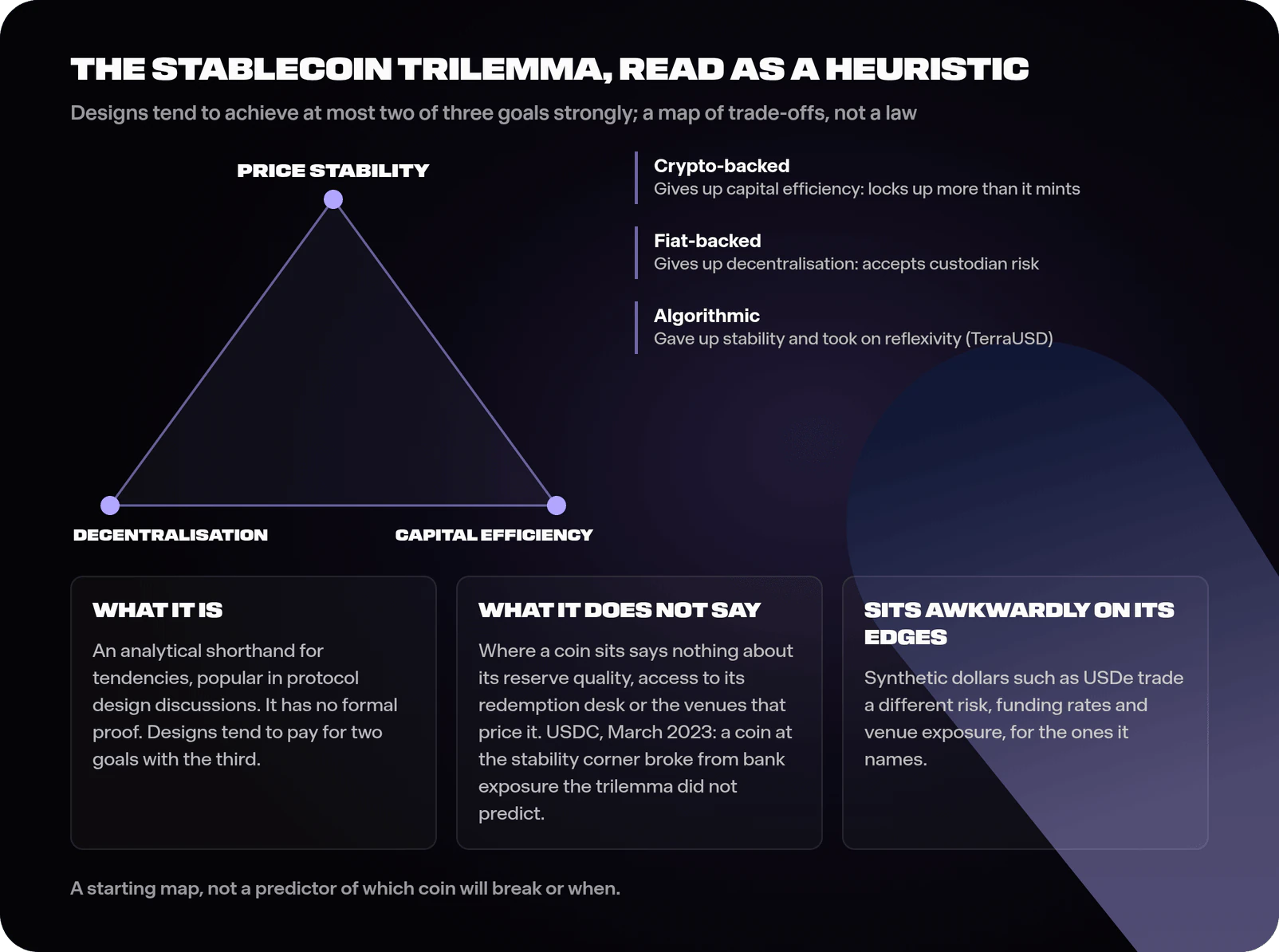
- The stablecoin trilemma is a heuristic that says a design tends to achieve at most two of three goals strongly: price stability, capital efficiency and decentralisation. It is a useful map of trade-offs. It is not a law, and it does not by itself predict which coin will break or when.
- Four models: fiat-backed (USDT, USDC, PYUSD, USDP), crypto-backed (USDS, LUSD), algorithmic (the failed TerraUSD) and synthetic or hybrid (USDe, Frax). Each sits at a different point of the trilemma and each breaks somewhere different: at the bank, at the liquidation engine, inside its own supply mechanism, or in the funding market and the venues that price it.
en una cuadra
A stablecoin failure mode is a pattern of breakdown that stops a token being turned back into its reference value. A fiat-backed coin can break when the path to its reserves freezes through a bank failure, gated redemption or weekend closure. An algorithmic coin can break when its own defence mechanism destroys its backing.
Failure modes at a glance: what triggers each, and what can a holder check?
Respuesta rápida
Six failure modes recur, and each has its own trigger and its own point of breakage: reserve and counterparty failure, liquidity and redemption-access dislocation, oracle and venue-pricing effects, collateral and liquidation failure, funding and hedge failure, and reflexive algorithmic collapse. One episode can involve more than one mode. Each token named in the matrix is a dated case study of a mechanism; its inclusion implies no judgement of the token's quality or safety today.
The matrix summarises facts set out and sourced in the sections that follow; the two archetypes and the venue-pricing variant examined later map onto its rows.
| Failure mode | Trigger | What breaks | Example in this guide (dated) | What holders could check |
|---|---|---|---|---|
| Reserve and counterparty failure | A bank or custodian holding part of the reserve fails, or reserve assets lose value | Confidence that every token is backed and reachable | USDC, 10 to 13 March 2023: $3.3bn of reserves, about 8 percent, at Silicon Valley Bank; low of about $0.86; recovered after depositors were protected on 12 March | Reserve composition and custodians in issuer disclosures; the assurance type and its as-of date |
| Liquidity and redemption-access dislocation | Redemption is closed, gated or slow, or market depth thins, while reserves still exist | The arbitrage that ties the market price to par | USDC, same weekend: primary-market operations suspended until redemptions resumed on 13 March 2023; strain spread to DAI through its Peg Stability Module and to GUSD (about $0.96) and USDP (about $0.91) | Who can redeem directly, on what terms and in what hours; whether a swap module ties the coin to another issuer's token |
| Oracle and venue-pricing effects | A price feed or a venue's internal index departs from wider markets | Collateral valuations and liquidations that act on that price | USDe, wBETH and BNSOL on Binance, 10 October 2025, 21:36 to 22:16 UTC; Binance compensated affected users and gave no root cause | Which price a venue or protocol uses to value the token, and how its oracle is designed |
| Collateral and liquidation failure (crypto-backed) | Collateral prices fall faster than liquidation auctions clear | The overcollateralisation buffer behind each coin | No dated episode examined in this guide; the failure surface of designs such as Sky's and Liquity's | Collateral ratios against liquidation thresholds, and whether auctions are clearing, on-chain |
| Funding and hedge failure (synthetic) | Perpetual funding turns negative for a sustained period | The cost of carrying the hedge, then any insurance fund, then full collateralisation | No dated episode examined in this guide; UXD's risk disclosures (accessed 23 September 2026) named the risk | Funding rates, and the issuer's disclosures on reserve funds and custodians |
| Reflexive (algorithmic) collapse | Large exits push the coin below par, and redemptions mint more of the paired token | The paired token's value, and with it the backing | TerraUSD, May 2022: fell to close to zero; the Luna Foundation Guard's reserve did not prevent it | Whether the backing depends on a token the same system issues, and how that token's supply moves |
What makes a stablecoin stable?
Respuesta rápida
A stablecoin holds its value because of its redemption channel, the quality of its reserve or collateral, and the confidence of its holders. Nothing in the token's code fixes its market price. When any of those three weakens under pressure, the peg breaks.
A stablecoin is a token engineered to hold a constant value while living on a volatile blockchain. The central observation for any serious analysis is that the stability is not inside the token. It sits in the redemption channel that lets an eligible holder exchange the token for its reference value, in the reserve or collateral standing behind that promise, and in the market's confidence that both will hold when tested. Every design is an attempt to make that promise credible at scale, and to keep it credible when the market turns hostile.
The interesting questions are therefore never about how a coin behaves at par on a calm day. They are about what defends the peg under redemption pressure and what breaks it. Two facts shape everything that follows. First, under their own terms most fiat-backed issuers redeem directly only for approved customers, typically exchanges, payment firms and institutional traders, so other holders commonly depend on secondary markets (Federal Reserve, FEDS Notes, 23 February 2024). Second, the reserves behind USDT and USDC differ in composition, according to the Federal Reserve: as of early 2026 it described USDC as fully backed by higher-quality liquid assets and USDT as backed about 1.04 times over in total with about 0.74 times in higher-quality assets (Federal Reserve, FEDS Notes, 8 April 2026). Those two facts, access and quality, decide how each design behaves in a run.
What is the stablecoin trilemma, and how far does it go?
Respuesta rápida
The stablecoin trilemma is a heuristic that says a design tends to achieve at most two of three goals strongly: price stability, capital efficiency and decentralisation. It is a useful map of trade-offs. It is not a law, and it does not by itself predict which coin will break or when.
Each goal pulls against the others. Strong stability tends to demand full or excess collateral, which sacrifices capital efficiency. Pushing capital efficiency toward or below one-to-one backing introduces stability risk. Decentralisation removes the central issuer that makes fiat backing administratively simple. The framework is a helpful way to see why fiat-backed coins accept custodian risk, why crypto-backed coins lock up more than they mint, and why algorithmic designs took on reflexivity.
Two cautions apply. The trilemma is a description of tendencies, and it has no formal proof; designs such as delta-neutral synthetic dollars sit awkwardly on its edges because they trade a different risk (funding rates and venue exposure) for the ones the triangle names. And where a coin sits on the triangle says something about the kind of stress it is exposed to, without saying anything about the quality of its reserve, the access to its redemption desk or the venues that price it. The USDC episode of March 2023 happened to a coin at the stability corner of the triangle; the trilemma did not predict it, and bank exposure did. Treat the triangle as a starting map, and the sections that follow as the terrain.
Which stablecoin models exist, and where does each one break?
Respuesta rápida
Four models: fiat-backed (USDT, USDC, PYUSD, USDP), crypto-backed (USDS, LUSD), algorithmic (the failed TerraUSD) and synthetic or hybrid (USDe, Frax). Each sits at a different point of the trilemma and each breaks somewhere different: at the bank, at the liquidation engine, inside its own supply mechanism, or in the funding market and the venues that price it.
The pillar guide defines each type of stablecoin at introductory level; here the concern is the failure surface of each. The table maps the four before each is examined in turn.
| Model | Examples in this guide | How it holds the peg | Main failure surface |
|---|---|---|---|
| Fiat-backed | USDT, USDC, PYUSD, USDP | Cash, bank deposits and short-term government paper held against a one-to-one claim; direct redemption for approved customers | Banking and custodian exposure; redemption gating; reserve quality |
| Crypto-backed | USDS (Sky), LUSD (Liquity) | Overcollateralised crypto locked in on-chain vaults with automated liquidation; Sky adds a Peg Stability Module, and Liquity gives any LUSD holder a redemption right | Collateral crash outrunning liquidations; oracle failure |
| Algorithmic | TerraUSD (failed) | Supply expansion and contraction against a paired volatile token; from 2022 also a reserve held by the Luna Foundation Guard | Reflexive collapse when confidence in the paired token fails |
| Synthetic or hybrid | USDe (Ethena), Frax | Hedged positions, or partial reserves plus a stabilising mechanism | Sustained negative funding; venue and counterparty exposure; design complexity |
Fiat-backed. Fiat-backed coins hold reserves of cash, bank deposits and short-dated government paper against a one-to-one claim, with redemption handled by the issuer for approved customers. Tether issues USDT, and its reserve composition and assurance history are examined in the assurance section below. Circle, the issuer of USDC, publishes monthly third-party attestation reports prepared under AICPA standards (Circle, transparency page, accessed 23 September 2026); the March 2023 episode tested that model severely. PayPal USD (PYUSD) is issued by Paxos, which states that reserves are held in US dollar deposits, Treasuries and cash equivalents (Paxos, PYUSD page, accessed 23 September 2026), and Paxos also issues USDP. These coins are capital-efficient and stable in the ordinary case, and they import the risk profile of their custodians and banking rails. Their failure modes are off-chain: banking counterparty exposure, reserve opacity, custodial concentration and redemption gating. Continuity also depends on the issuing entity keeping its standing with its supervisor: in February 2023 the New York Department of Financial Services ordered Paxos to cease minting the Binance-branded BUSD, and the token was wound down (NYDFS, press release, 6 August 2025, describing the February 2023 order).
Crypto-backed. Sky, the protocol formerly called MakerDAO, is the canonical example. It issues USDS, with legacy DAI upgradeable one-for-one, against collateral held in vaults: a vault owner locks collateral and generates the stablecoin as a debt, and repays that debt to unlock the same collateral (Sky Protocol developer documentation, CDP Manager, accessed 24 September 2026). When a vault falls below its required collateral ratio the protocol seizes the collateral and sells it through Dutch auctions that settle instantly on a falling price curve, with circuit breakers that can pause liquidations (Sky Protocol developer documentation, collateral liquidation, accessed 23 September 2026). Liquity's LUSD takes the decentralised approach further: a minimum collateral ratio of 110 percent, a right for any LUSD holder to redeem LUSD for ETH at face value minus a fee, which acts as the peg floor, and immutable, non-upgradeable contracts (Liquity documentation, accessed 23 and 24 September 2026). The trust question here shifts away from an accountant's report and toward the smart contracts, the liquidation engine and the oracle feeds, all of which are observable on-chain. The capital-efficiency cost is explicit and accepted as the price of verifiability. The failure surface is a collateral crash that outruns the auctions, or an oracle that feeds the wrong price; the guide to how price feeds break covers the second in detail.
Algorithmic. The defining example is TerraUSD (UST), whose 2022 collapse is dissected below, with Basis Cash and Empty Set Dollar as earlier, smaller experiments in the same lineage, and Ampleforth as a rebasing variant that adjusts holder balances directly rather than holding a hard peg. These designs sit at the capital-efficiency extreme of the trilemma and are reflexive by construction: the mechanism meant to defend the peg depends on confidence in the very system whose peg is in doubt. Terra later added an external reserve beside that mechanism, and the failure section below explains why it did not hold.
Synthetic or hybrid. The newer architecture is the delta-neutral synthetic dollar, of which Ethena's USDe is the prominent example. Its core position holds a crypto asset together with an offsetting short in perpetual futures so that the portfolio's price sensitivity nets to roughly zero, and the protocol describes distributing funding earned on that hedge to users who stake USDe; Ethena's current documentation describes a broader backing portfolio that also includes lending and tokenised traditional assets, shifted between strategies under governance review (Ethena documentation, accessed 23 September 2026). Ethena's USDe terms state that USDe itself "does not represent a claim, participation interest, economic right" or similar right against the issuing entity, and that holders are not entitled to interest or other returns earned on the reserves (Ethena, USDe terms and conditions, accessed 24 September 2026). The hedge is designed to offset a price decline in the backing, and it depends on perpetual funding staying favourable: when funding turns persistently negative, holding the short becomes a direct cost. The earlier Solana-based UXD protocol listed exactly this in its own risk disclosures, warning that funding negative for long enough to deplete its insurance fund would leave holders undercollateralised (UXD Protocol documentation, risks, accessed 23 September 2026). USDe was also one of three tokens that Binance says depegged on its platform in October 2025, an episode described in the failure section that concerned how one venue priced the token; Binance's notice gives no root cause. The fractional model once associated with Frax, holding part reserves and stabilising the remainder algorithmically, was the hybrid midpoint; in February 2023 Frax governance voted to raise its target collateral ratio to 100 percent and retire the algorithmic component (Frax governance, FIP-188, February 2023), a move that tracks the broader market shift this guide closes on.
How is a stablecoin peg defended, and who can actually redeem?
Respuesta rápida
A peg is defended by arbitrage against a credible redemption right, and that right is usually available only to approved direct customers. The primary channel is redemption at par with the issuer, or with the protocol itself in the few designs, such as Liquity's, that give every holder an express redemption right; the secondary channel is open-market trading, which rests on the belief that the primary channel will hold.
A stablecoin trades around par because arbitrage makes deviation profitable to close. Two channels do the work, and the distinction between them is where most analytical errors live. The peg guide explains the loop for first readers; the point here is what the loop quietly depends on.
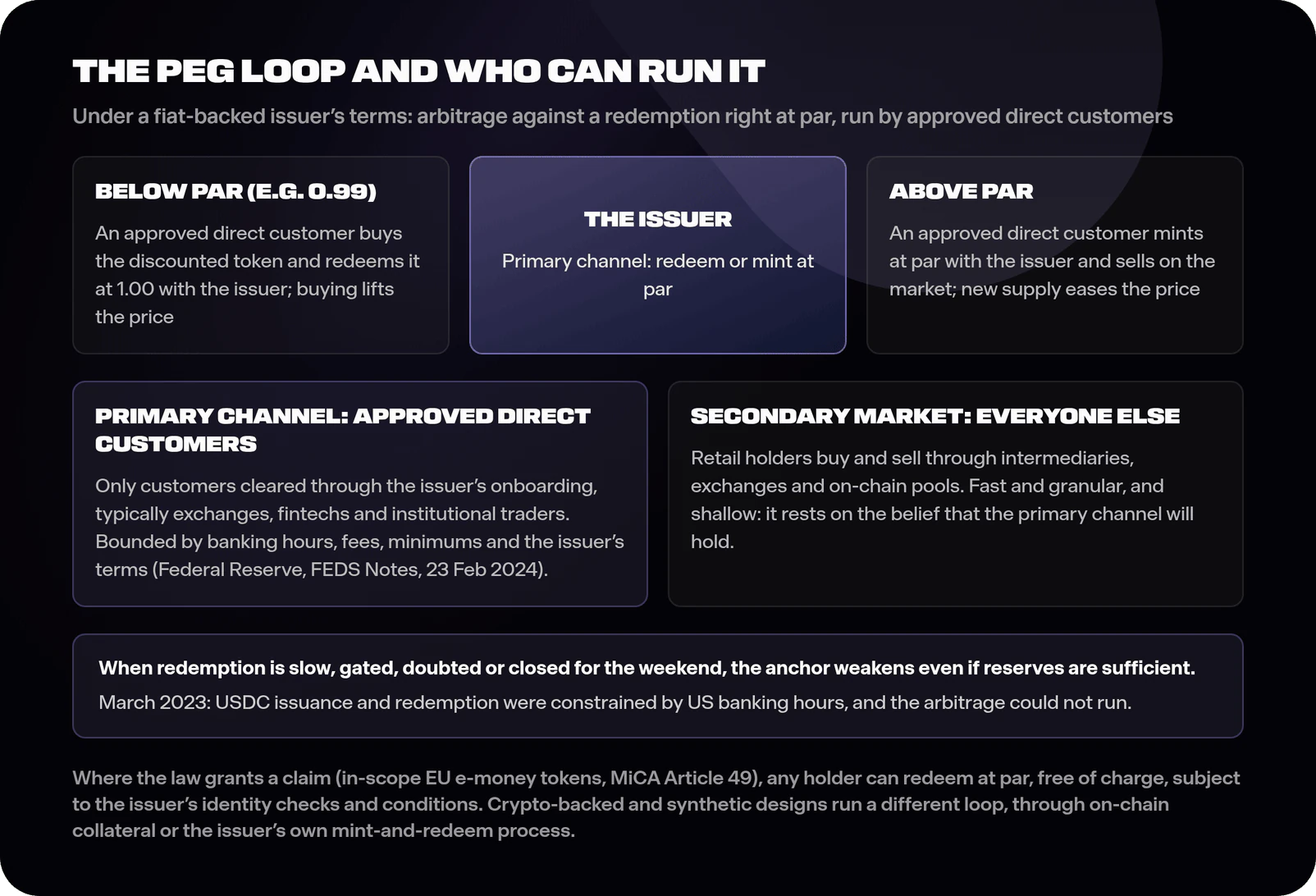
The primary channel is redemption. A credible right to redeem one token for one unit of the reference asset, at par and on demand, is the backstop that anchors everything. If the token trades at 0.99 and an eligible holder can redeem it for 1.00, buying the discounted token and redeeming it is a profitable trade, and that buying pressure restores the peg. The strength of a peg is, in large part, the strength and accessibility of this redemption right. For fiat-backed coins under the major issuers' terms the right is narrower than the word "redeemable" suggests (MiCA's claim for holders of in-scope EU e-money tokens, set out below, is the main statutory exception): only direct customers cleared through the issuer's onboarding, typically exchanges, fintechs and institutional traders, have access to the primary market, and retail holders buy and sell through intermediaries and secondary markets instead (Federal Reserve, FEDS Notes, 23 February 2024). Redemption is also bounded by banking hours, fees, minimums and the issuer's terms. When redemption is slow, gated, doubted or simply closed for the weekend, the anchor weakens even if the reserves are genuinely sufficient. The March 2023 USDC episode is the demonstration: Circle stated that issuance and redemption were constrained by US banking hours, primary-market minting stayed depressed through the weekend, and the arbitrage that would normally have closed the gap was constrained while uncertainty about the reserves moved the price (Federal Reserve, FEDS Notes, 23 February 2024).
The secondary channel is the open market. On exchanges and in on-chain pools, traders close smaller deviations continuously. This channel is fast and granular, and it is also shallow, because it rests entirely on the belief that the primary channel will hold. Once the market doubts redemption, secondary arbitrageurs withdraw, liquidity thins, and a deviation the secondary channel would normally absorb is allowed to widen.
Crypto-backed and synthetic designs run different loops, and who can use them depends on the protocol. Three mechanisms need to be kept apart. The first is a vault owner's repayment. In Sky's design a vault owner locks collateral, generates DAI or USDS as a debt, and repays that debt to unlock their own collateral; an ordinary DAI or USDS holder has no claim on any vault (Sky Protocol developer documentation, CDP Manager, accessed 24 September 2026). A holder who wants to exit sells on the market or, where it is available, swaps through the Peg Stability Module, which exchanges DAI or USDS for other stablecoins such as USDC at fixed ratios and governance-set fees (Sky Protocol developer documentation, LitePSM, accessed 24 September 2026). The second is a third party's liquidation: when a vault falls below its required collateral ratio, the auction process described above sells its collateral to cover the debt, so the peg also relies on liquidations clearing underwater vaults faster than they accumulate (Sky Protocol developer documentation, collateral liquidation, accessed 23 September 2026). The third is an express holder redemption right, and Liquity's LUSD is the example: any LUSD holder can redeem LUSD for ETH at face value minus a fee of (baseRate + 0.5 percent) of the ETH drawn, taken from the lowest-collateralised positions first, and that right sets the price floor (Liquity documentation, LUSD redemptions, accessed 24 September 2026). Synthetic dollars follow the issuer's own terms. For USDe, only whitelisted Mint Users who have passed KYC and AML checks may mint or redeem with Ethena's issuing entity, users in the United States are not eligible, and the terms state: "If you are a Holding User, you do not have a right to redeem USDe with Ethena BVI" (Ethena, USDe terms and conditions, accessed 24 September 2026). That redemption path also depends on the exchanges and custodians where the hedge is held. The mechanisms are different, and so are the ways they can jam.
Attestation or audit: what does reserve assurance actually prove?
Respuesta rápida
Reserve assurance is a gradient, and each rung answers a different question. A point-in-time attestation reports on reserves at one moment; a monthly examination checks a disclosure for a month; a financial-statement audit gives an opinion on an entity's accounts for a year. None of them proves that every token was backed on every day between reports.
For any reserve-backed model, the central task is judging whether the reserves are real, sufficient, liquid and accessible, and this is harder than it sounds because of what standard disclosures omit. The common shorthand, "attestation equals weak, audit equals strong", is an oversimplification in both directions.
An attestation is not one thing. Tether's recurring reserve reports, for example, are issued by BDO under ISAE 3000 (Revised) as reasonable-assurance engagements on the reserves report as of a single date; the March 2026 opinion states that the reporting date is limited to a point in time as of 31 March 2026 and that no assurance is given at any other date (BDO, ISAE 3000R opinion on Tether International, 31 March 2026). Circle's monthly USDC reports are prepared under AICPA attestation standards and state that the value of reserves exceeded USDC in circulation on the dates tested (Circle, transparency page, accessed 23 September 2026). Reasonable assurance on a defined subject is stronger than the "photo of the vault" caricature, and it still says nothing about the day after.
A financial-statement audit examines the issuer's accounts over a period, testing internal controls and checking compliance with an accounting framework. It gives an opinion on the entity's financial statements as a whole. It is not designed to confirm that each token in circulation was backed on each day, and the auditor's opinion covers the year-end balance sheet and the year's results rather than the intraday reserve position. That is why some legislation now asks for both. The US GENIUS Act (Public Law 119-27, enacted 18 July 2025, with the conditional effective date described in the regulation section) requires each permitted payment stablecoin issuer to publish the monthly composition of its reserves (section 4(a)(1)(C)), to have that monthly report examined by a registered public accounting firm (section 4(a)(3)(A)) and to submit monthly certifications by its chief executive and chief financial officer, with criminal penalties for a knowingly false certification (section 4(a)(3)(B) and (C)); issuers with more than $50bn outstanding that are not SEC reporting companies must also produce audited annual financial statements (section 4(a)(10)(A)).
Tether's trajectory illustrates the gradient. USDT historically relied on point-in-time attestations rather than a financial-statement audit. In a settlement announced on 23 February 2021, the New York Attorney General stated that its investigation had found that, starting no later than mid-2017, Tether had no access to banking anywhere in the world and for periods of time held no reserves to back tethers in circulation, and that its claims of full dollar backing at all times were untrue; under the settlement agreement Bitfinex and Tether neither admitted nor denied those findings, paid an $18.5m penalty and agreed to quarterly public disclosures of the assets backing tethers (New York Attorney General, press release and settlement agreement, February 2021). On 24 March 2026 Tether announced that it had engaged a Big Four firm for what it described as its first full financial-statement audit (Tether, 24 March 2026). On 13 August 2026 Tether announced that KPMG U.S. had completed an audit of Tether International, S.A. de C.V.'s financial statements for the year ended 31 December 2025, issuing an unqualified opinion, and reported that reserves exceeded liabilities by about $6.8bn as of that date (Tether, 13 August 2026). Three qualifications matter. This is an issuer announcement about annual financial statements; the opinion document itself was not located for this guide, so the announcement is reported as Tether's own statement. It is separate from the recurring BDO reserve attestations, which continue to report at points in time. And an unqualified opinion on 2025 year-end accounts does not by itself establish day-to-day token backing during 2026, which is the question a holder in a run actually cares about. Set beside it, the Federal Reserve's independent reading as of early 2026 was that USDT held about 1.04 times reserves in total with about 0.74 times in higher-quality liquid assets, against full higher-quality backing for USDC (Federal Reserve, FEDS Notes, 8 April 2026).
The analytical point is that reserve quality lives on a gradient defined by the assurance standard and its scope, the frequency of reporting, the composition of the assets and the concentration of custodians, never on a simple binary of backed versus unbacked. Composition determines behaviour under stress: reserves in cash and short Treasuries can meet redemptions quickly, while longer or less liquid holdings can falter in a run. Custodian concentration is its own risk, since a one-to-one reserve is only as available as the banks and custodians holding it, and the next section shows a minority share at one failed bank breaking a peg for a weekend.
How do stablecoins fail? The two archetypes and a third variant
Respuesta rápida
A reserve and counterparty shock, like USDC falling to about $0.86 in March 2023, can recover once the path to the reserves reopens; a reflexive algorithmic collapse, like TerraUSD in May 2022, proved terminal because its defence mechanism destroyed its own backing, and the external reserve held by the Luna Foundation Guard did not prevent it. A third variant, venue mispricing, showed up in October 2025, when Binance recorded USDe depegging on its own platform for about 40 minutes and compensated liquidated users, while Ethena's founder said the discrepancy was confined to that venue.
Stablecoin failures sort into two distinct patterns, with a newer variant that shares features of neither. The mechanisms inside them stay distinct even when one episode combines them: a reserve or counterparty failure concerns whether the backing exists and can be reached, a liquidity dislocation concerns whether redemption and market depth are available when holders want to leave, an oracle or venue-pricing effect concerns the price a system acts on, and a reflexive failure concerns a defence mechanism that consumes its own backing. The named tokens below are case studies of those mechanisms at a date. The first is a reserve and counterparty shock, in which a fully reserved coin breaks because the path to its reserves freezes. The second is a reflexive collapse, in which the peg-defence mechanism destroys the asset meant to back the coin. The figure summarises both, and the venue-pricing variant follows.
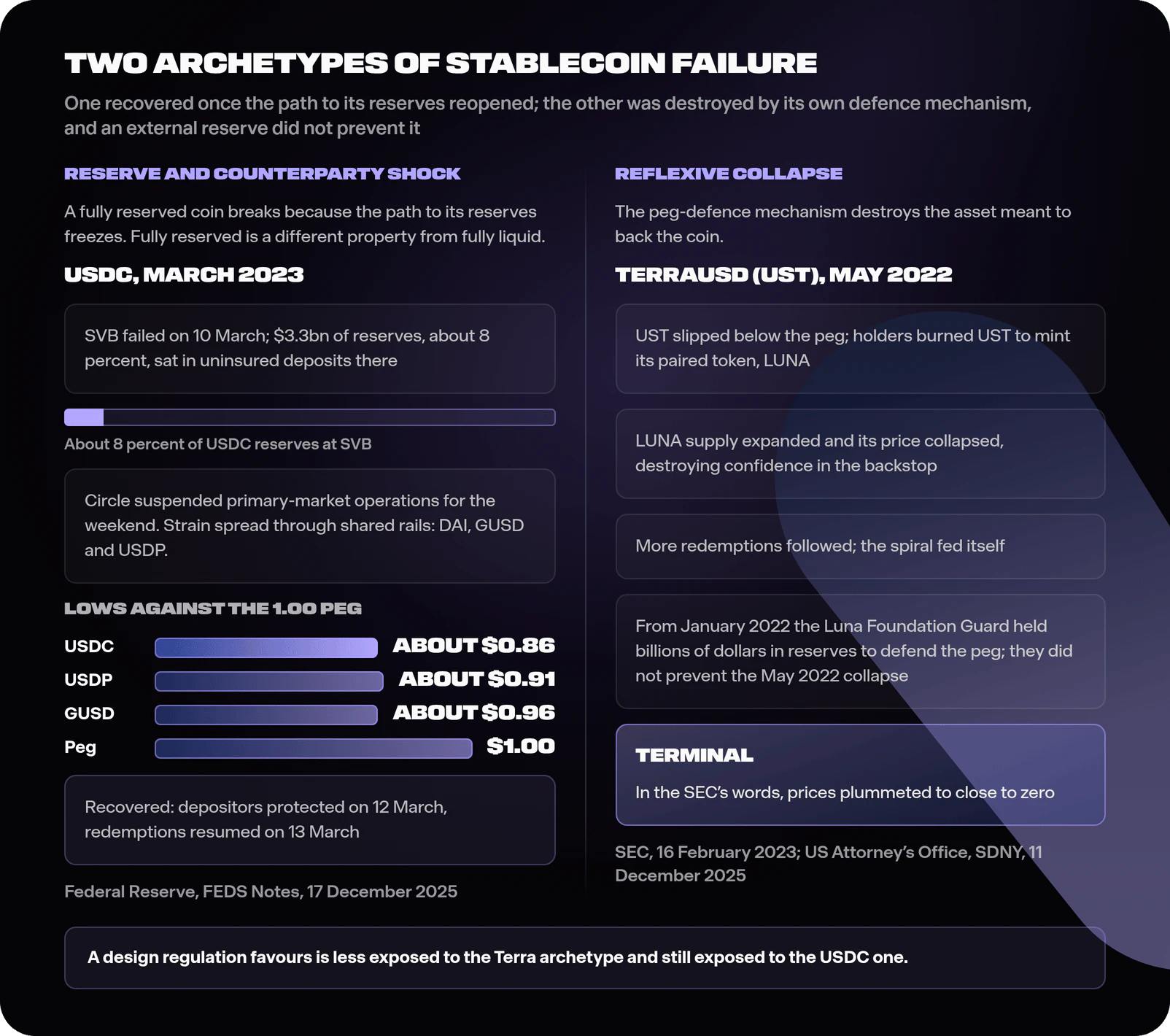
Archetype one: the reserve and counterparty shock (USDC, March 2023). The USDC episode is the clean example of how a fully reserved, fiat-backed coin can still break, and why such a depeg can be a confidence and liquidity event with no insolvency behind it. When Silicon Valley Bank failed on 10 March 2023, Circle disclosed that $3.3bn of USDC reserves, about 8 percent of the total, sat in uninsured deposits at the bank (Federal Reserve, FEDS Notes, 17 December 2025). The reserves were genuine and the exposure was a fraction of the total, yet after Circle suspended primary-market operations for the weekend USDC fell to about $0.86 at its low (Federal Reserve, FEDS Notes, 17 December 2025). The doubt spread through on-chain plumbing: DAI, which at the time leaned heavily on USDC through its Peg Stability Module, took in roughly $1bn of USDC a day as holders used it as an escape valve, and the strain reached other coins accepted by similar modules, with GUSD trading to about $0.96 and USDP to about $0.91 (Federal Reserve, FEDS Notes, 17 December 2025). The price recovered sharply after the Federal Reserve, Treasury and FDIC announced full protection for SVB depositors on the evening of 12 March, and returned to par once Circle resumed redemptions on Monday 13 March (Federal Reserve, FEDS Notes, 17 December 2025). The lesson is that a fiat-backed coin inherits the fragility of the banking system it sits on, that fully reserved is a different property from fully liquid, and that contagion runs wherever coins and protocols share rails or hold one another as collateral.
Archetype two: the reflexive collapse (TerraUSD, May 2022). TerraUSD is the canonical algorithmic failure and the clearest demonstration of how reflexivity can prove fatal. UST held its peg through a mint-and-burn arbitrage with its paired token LUNA: a holder could exchange one dollar of UST for one dollar of newly minted LUNA, and the reverse. That core mechanism relied on LUNA. An external reserve came later: the Luna Foundation Guard (LFG), whose creation Kwon announced in or about January 2022, was, in the words of the US Attorney's Office, "tasked with deploying billions of dollars' worth of financial reserves to defend UST's peg" (US Attorney's Office, SDNY, 11 December 2025). That reserve did not prevent the collapse in May 2022. The system was also less autonomous than it was presented: in announcing Kwon's sentence, the US Attorney's Office stated that Kwon controlled both the LFG and Terraform while claiming the LFG was independent, that he misappropriated hundreds of millions of dollars in assets from the LFG, and that when UST lost its peg in May 2021 the peg was restored only after a trading firm bought millions of dollars of UST under an agreement with Kwon, while Kwon publicly credited the Terra protocol itself (US Attorney's Office, SDNY, 11 December 2025). Demand for UST rested largely on the Anchor protocol; the SEC's complaint of 16 February 2023 alleged that Terraform Labs and its then chief executive, Do Kwon, marketed UST as "yield-bearing" and advertised it as paying as much as 20 percent interest through Anchor (SEC, press release 2023-32, 16 February 2023). When large holders exited and UST slipped below the peg, the arbitrage did exactly what it was designed to do, and that was the problem. Holders burned UST to mint LUNA, LUNA's supply expanded, its price collapsed, and the collapse destroyed confidence in LUNA's ability to backstop UST, which drove still more redemptions. The spiral ran until, in the SEC's words, "the price of it and its sister tokens plummeted to close to zero", a collapse the SEC said "devastated both retail and institutional investors" (SEC, press release 2023-32, 16 February 2023). The complaint's allegations have since been tested in court: on 5 April 2024 a federal jury found Terraform and Kwon liable for securities fraud, and in June 2024 they consented to a final judgment that included about $4.5bn in payments (SEC, press release 2024-73, 13 June 2024). Separately, Kwon pleaded guilty on 12 August 2025 in the US District Court for the Southern District of New York to one count of conspiracy to commit commodities, securities and wire fraud and one count of wire fraud, and on 11 December 2025 he was sentenced to 15 years in prison; the US Attorney's Office put investor losses at over $40bn (US Attorney's Office, Southern District of New York, 12 August 2025 and 11 December 2025). The structural lesson is that endogenous collateral offers little protection in the scenario that matters most, because the asset meant to absorb selling pressure loses value in proportion to the pressure it is meant to absorb, and in Terra's case an external reserve of billions of dollars did not stop the spiral once it began.
A modern variant: venue pricing and the October 2025 USDe episode. A third, subtler failure surfaced on 10 October 2025, during the market-wide sell-off covered in the anatomy of the October 2025 liquidation cascade. Binance's own notice states that USDe, wBETH and BNSOL depegged on Binance between 21:36 and 22:16 UTC on 10 October, and that affected Futures, Margin and Loan users would be compensated for the difference between the market price at 00:00 UTC on 11 October and their liquidation price, plus liquidation fees. The same notice says Binance would add redemption prices to the index weighting for the three tokens, set a minimum price threshold for USDe and review its risk-control parameters more often. It gives no root cause and no market-wide total (Binance, announcement, 11 October 2025). Ethena's side of the story comes from its founder: as reported by CoinDesk, the founder said the price discrepancy was confined to a single venue that referenced its own order book instead of the deepest pool of liquidity (CoinDesk, 13 October 2025, citing Ethena's founder). That is an issuer assertion beside an exchange's acknowledgement. This guide has not located an original issuer statement or attestation covering USDe's supply or backing during the episode, and so states neither. Read together, the two accounts are consistent with a venue-pricing problem, in which a token valued inside one exchange's margin system partly by reference to that exchange's own market can, when liquidity there thins during a sell-off, trigger forced liquidations of positions that used it as collateral. That reading is this guide's inference from the two parties' statements; neither account is a regulatory or independent finding. The general lesson is that a stablecoin's risk surface includes how third-party venues classify and price it, a subject the guide to oracle risk and price feeds covers in depth.
How is stablecoin regulation reshaping the design space?
Respuesta rápida
Regulation is converging on fully reserved, Treasury-heavy designs with statutory redemption rights, frequent assurance and a ban on issuer-paid interest. The US GENIUS Act is enacted with a conditional effective date, the US CLARITY Act failed a Senate cloture vote on 15 September 2026, the EU's MiCA stablecoin titles have applied since 30 June 2024, and the UK's new regime is expected to start on 25 October 2027.
The guide to how stablecoins are regulated around the world sets out each jurisdiction by activity, entity and effective date. This section covers only what the rules do to the design space, and precision about the status of each matters because they sit at very different stages.
The GENIUS Act (United States, enacted, not yet fully effective). Signed into law on 18 July 2025 as Public Law 119-27, the GENIUS Act is a US federal statute written specifically for payment stablecoins. It binds permitted payment stablecoin issuers and becomes effective on the earlier of 18 months after enactment (18 January 2027) or 120 days after the primary federal regulators issue final implementing regulations; implementing rules are at the proposal stage, including the Treasury Department's proposed rule on payment stablecoin issuance, offer and sale, published in the Federal Register on 18 August 2026 (GENIUS Act, Public Law 119-27; Federal Register, 91 FR 53368, 18 August 2026). It requires identifiable reserves on an at least one-to-one basis, and its list of permissible reserves is broader than the shorthand of cash and Treasury bills: coins and currency and balances at Federal Reserve Banks, demand deposits at insured depository institutions, Treasury securities with 93 days or less to maturity, overnight repurchase and reverse repurchase agreements backed by Treasuries, shares of registered government money-market funds, other similarly liquid federal government-issued assets approved by the regulator, and tokenised versions of eligible assets (GENIUS Act, section 4(a)(1)(A)). By permitting repurchase agreements and tying reserves to bank deposits, it does not isolate issuers from banking-sector fragility. On assurance it sets the dual regime described above: monthly reserve reports examined by a registered public accounting firm with executive certifications (section 4(a)(3)), plus audited annual financial statements for issuers above $50bn outstanding that are not SEC reporting companies (section 4(a)(10)). Section 4(a)(11) bars permitted and foreign payment stablecoin issuers from paying holders "any form of interest or yield" solely in connection with holding, using or retaining the stablecoin (GENIUS Act, Public Law 119-27).
The CLARITY Act (United States, proposed). The Digital Asset Market Clarity Act, H.R. 3633, is sometimes described as enacted law sitting beside GENIUS. It is not. It passed the House in July 2025 and was reported by the Senate Banking Committee, with the reported version dated 1 June 2026 (GovInfo, H.R. 3633 reported in Senate). On 15 September 2026 the Senate rejected cloture on the motion to proceed by 49 votes to 50, short of the 60 required, so the bill did not reach the floor (US Senate, roll call vote 234, 15 September 2026). Its subject also differs from reserves: as drafted, it is a market-structure bill that would divide jurisdiction between the SEC and the CFTC for non-stablecoin assets and leaves stablecoin reserve standards to GENIUS. Any account of its yield provisions describes a bill text that may still change.
MiCA (European Union, in force). The EU's Markets in Crypto-Assets Regulation (Regulation (EU) 2023/1114) binds issuers and crypto-asset service providers operating in the EU. It splits stablecoins into e-money tokens (Title IV), which reference a single official currency, and asset-referenced tokens (Title III), which reference baskets or other assets; both titles have applied since 30 June 2024, with the rules for crypto-asset service providers applying from 30 December 2024 (ESMA, MiCA interactive rulebook, Article 149). For e-money tokens, a token may be offered to the public in the EU only if its issuer is authorised as a credit institution or electronic money institution, with other offerors needing the issuer's written consent (Article 48(1)), and the issuer must redeem on a holder's request "at any time and at par value" (Article 49(4)), and may not charge a fee for that redemption (Article 49(6)). For asset-referenced tokens, the issuer must be authorised (Articles 16 and 21, with a separate route for credit institutions under Article 17), must hold a reserve of assets (Article 36) and must keep custody policies ensuring those assets are unencumbered and readily accessible for redemptions (Article 37). The white-paper rules differ by token type. An issuer of e-money tokens must notify its white paper to its competent authority at least 20 working days before publication, and competent authorities "shall not require prior approval" (MiCA, Article 51(11)); the white paper for an asset-referenced token is approved as part of the issuer's authorisation (MiCA, Articles 17 and 21).
MiCA's own text also sets floors for bank deposits. Article 54(a) requires e-money token issuers to deposit "at least 30 %" of the funds received in separate accounts at credit institutions, and that rule applies now (MiCA, Article 54). For asset-referenced tokens, Article 36(4) says the minimum deposit share that the EBA's liquidity standards must set cannot be lower than 30 percent of the amount referenced in each official currency, and Article 45(7)(b) raises that floor to 60 percent for significant asset-referenced tokens (MiCA, Articles 36 and 45). Article 58(1)(a) applies the significant-token reserve and liquidity rules (Articles 36, 37 and 38 and Article 45(1) to (4)) to e-money institutions that issue significant e-money tokens (MiCA, Article 58). The EBA's regulatory technical standards that turn these floors into detailed liquidity requirements were, as shown on the EBA's page on 24 September 2026, a final draft submitted to the European Commission and not yet adopted (EBA, liquidity RTS page, accessed 24 September 2026); the exact percentages in that draft may change before adoption. On yield, MiCA prohibits issuers and crypto-asset service providers from granting interest in relation to e-money tokens, and it treats any remuneration or benefit linked to the length of time a token is held as interest (MiCA, Article 50); Article 40 makes the same rule for asset-referenced tokens. Enforcement has reached synthetic designs in two separate steps. On 21 March 2025 Germany's financial supervisor, BaFin, prohibited Ethena GmbH from continuing to offer its USDe token to the public and instructed the company to have the corresponding reserve of assets frozen by the custodians. BaFin's notice cited "serious shortcomings in the authorisation procedure" and said it had sufficient grounds to suspect that securities were being offered to the public in Germany without the required prospectus; BaFin presented that second point as a suspicion (BaFin, 21 March 2025). In a notice dated 15 April 2025, BaFin said that Ethena GmbH had withdrawn its authorisation application on 3 April 2025, that on 14 April it had ordered the company to wind up its business that required authorisation, and that its review had identified serious deficiencies in the company's business organisation and infringements of MiCA requirements (BaFin, 15 April 2025). The grounds BaFin gave in both notices concern authorisation, organisation and MiCA compliance; neither notice cites the interest ban.
The United Kingdom (final rules, later application). The legal basis is the Financial Services and Markets Act 2000 (Cryptoassets) Regulations 2026, made on 4 February 2026, which create new regulated cryptoasset activities for firms carrying them on in the UK. On 30 June 2026 the FCA published its final cryptoasset policy statements, PS26/9 to PS26/13, including PS26/10 on stablecoin issuance, with the new regime expected to start on 25 October 2027 (FCA, cryptoasset regime page, accessed 23 September 2026). The FCA says applications for authorisation under FSMA will open on 30 September 2026 (FCA, new regime page, accessed 24 September 2026). The new FSMA activities, such as issuing a qualifying stablecoin, do not yet apply, while existing obligations do: the FCA says that until the new FSMA regime starts, firms must continue to comply with the requirement to be registered with it under the Money Laundering Regulations, and its cryptoasset financial promotions rules have applied since 8 October 2023 (FCA, MLR registration page and cryptoasset marketing page, accessed 24 September 2026).
The consequence is convergence. Regulation favours the fully reserved, Treasury-heavy model with redemption rights and frequent third-party assurance, and it penalises opacity, custodial concentration and unrestricted reserve reuse. It is hostile to uncollateralised algorithmic designs and to yield-bearing structures that resemble unregistered deposits. Crypto-backed and hybrid designs keep a role where verifiable, censorship-resistant collateral is the priority, and they now operate beside a regulated mainstream that increasingly resembles tokenised money-market exposure with a statutory redemption right. One irony deserves naming: by steering reserves toward commercial-bank deposits, both MiCA's deposit minimums and GENIUS's permitted-reserve list push issuers toward the custodial concentration that produced the USDC episode in the first place. A design that regulation favours is less exposed to the Terra archetype, because its backing does not depend on a token the same system issues, and remains exposed to the USDC archetype; that is a description of where the residual risk sits, and no design is free of it.
The table contrasts the frameworks on the points that matter most for design.
| Framework | Jurisdiction | Status (24 September 2026) | Stance on issuer-paid interest | Source |
|---|---|---|---|---|
| GENIUS Act | United States | Enacted 18 July 2025; effective on the earlier of 18 January 2027 or 120 days after final rules (Treasury proposed rule 18 August 2026) | Once effective, bars permitted and foreign payment stablecoin issuers from paying holders interest or yield solely for holding, using or retaining the coin (s. 4(a)(11)) | Public Law 119-27 |
| CLARITY Act (H.R. 3633) | United States | Passed House July 2025; reported by Senate committee (version dated 1 June 2026); Senate cloture rejected 49 to 50 on 15 September 2026 | Market-structure bill; provisions may change | US Senate roll call vote 234 |
| MiCA | European Union | Titles III and IV applied from 30 June 2024; CASP rules from 30 December 2024 | Prohibits issuers and CASPs from granting interest on EMTs (Art. 50) and ARTs (Art. 40) | ESMA MiCA rulebook |
| UK regime | United Kingdom | Final rules published 30 June 2026 (PS26/10 stablecoin issuance); authorisation applications scheduled to open 30 September 2026; regime expected to start 25 October 2027 | See PS26/10 | FCA cryptoasset regime pages |
Frequently asked questions
Is an attestation the same as an audit for a stablecoin?
No. They are different engagements, and each report states its own limits in a few places worth reading: the "as of" date, the standard used, the level of assurance (limited or reasonable) and the subject matter. Tether's BDO report, for example, is a reasonable-assurance engagement under ISAE 3000 (Revised) on a reserves report as of 31 March 2026, and it gives no assurance for any other date (BDO, 31 March 2026). Tether's announcement of 13 August 2026 concerns something else: an audit, which Tether says KPMG U.S. completed, of Tether International's financial statements for the year ended 31 December 2025 (Tether, 13 August 2026). A worked reading: a report dated 31 March says nothing about 1 April, and a year-end audit says nothing about the following spring. Under the GENIUS Act, once it takes effect, US permitted issuers will need monthly examined reserve reports as well (Public Law 119-27, section 4(a)(3)).
Are algorithmic stablecoins banned?
Neither the EU nor the US bans algorithmic stablecoins by name. Each sets conditions that a design relying on a paired volatile token, without a reserve of listed assets, would find hard to meet. In the EU, MiCA (Regulation (EU) 2023/1114, stablecoin titles applying since 30 June 2024) permits e-money tokens to be offered to the public only where the issuer is an authorised credit institution or electronic money institution, and requires the issuer to redeem at par on request (Articles 48 and 49); asset-referenced token issuers must hold a reserve of assets (Article 36). In the US, the GENIUS Act, once effective, requires permitted payment stablecoin issuers to hold reserves of listed assets on an at least one-to-one basis (Public Law 119-27, section 4(a)(1)(A)). Rules elsewhere differ, and the regulation guide sets them out by jurisdiction.
Do different types of stablecoin fail in different ways?
Yes, and each model has warning signs of its own that an observer can watch. For a fiat-backed coin, the early signal is usually off-chain: an issuer disclosure of exposure to a troubled bank, or a pause in minting and redemption, as with Circle's weekend in March 2023 (Federal Reserve, FEDS Notes, 17 December 2025). For a crypto-backed coin, the signals are on-chain: collateral ratios falling toward liquidation thresholds, auctions struggling to clear, or an oracle price that diverges from the market. For a synthetic dollar, the signal is funding: a long run of negative perpetual funding rates raises the cost of the hedge, the risk UXD's own disclosures named (UXD Protocol documentation). For an algorithmic coin, the signal is the paired token's supply expanding as holders redeem, the pattern TerraUSD showed in May 2022. No model is free of a failure surface; each moves the risk to a different place.
Did USDe actually depeg in October 2025?
On Binance it did: the exchange's own notice records USDe depegging there between 21:36 and 22:16 UTC on 10 October 2025 and offers compensation to liquidated users, without giving a root cause (Binance, 11 October 2025). As reported by CoinDesk, Ethena's founder said the price discrepancy was confined to that venue (CoinDesk, 13 October 2025, citing Ethena's founder). Taken together, the exchange's notice and the issuer's account are consistent with a venue-pricing problem; that reading is this guide's inference, and the guide makes no statement about USDe's supply or backing during the episode.
Does a stablecoin white paper need regulatory approval under MiCA?
It depends on the token type. An e-money token issuer notifies its white paper to its competent authority at least 20 working days before publication, and the authority may not require prior approval (MiCA, Article 51(11)). The white paper for an asset-referenced token is approved as part of the issuer's authorisation (MiCA, Articles 17 and 21). Notification of the white paper does not replace the issuer's own status: an e-money token issuer must already be authorised as a credit institution or electronic money institution (MiCA, Article 48(1)), and an asset-referenced token issuer needs authorisation under Article 21 or, for a credit institution, must follow the Article 17 procedure.
What caused the USDC depeg in March 2023?
Exposure to a failed bank, combined with closed redemption over a weekend. Circle disclosed that $3.3bn of reserves, about 8 percent, sat at Silicon Valley Bank when it failed; USDC traded down to about $0.86 before recovering after US authorities protected the bank's depositors on 12 March and Circle resumed redemptions on 13 March (Federal Reserve, FEDS Notes, 17 December 2025).
What is a stablecoin depeg?
A stablecoin depeg is a material move in the token's price away from its target, usually one dollar. It can be a brief liquidity event that recovers, as with USDC in 2023; a permanent structural collapse, as with TerraUSD in 2022; or a venue-specific mispricing, as with USDe on one exchange in 2025.
Sources
Primary and high-trust sources for this guide. Issuer and exchange statements are labelled as such in the text.
- Stablecoins in 2025: Developments and Financial Stability Implications. Federal Reserve Board, FEDS Notes, 8 April 2026. https://www.federalreserve.gov/econres/notes/feds-notes/stablecoins-in-2025-developments-and-financial-stability-implications-20260408.html (accessed 23 September 2026)
- Primary and Secondary Markets for Stablecoins. Federal Reserve Board, FEDS Notes, 23 February 2024. https://www.federalreserve.gov/econres/notes/feds-notes/primary-and-secondary-markets-for-stablecoins-20240223.html (accessed 23 September 2026)
- In the Shadow of Bank Runs: Lessons from the Silicon Valley Bank Failure and Its Impact on Stablecoins. Federal Reserve Board, FEDS Notes, 17 December 2025. https://www.federalreserve.gov/econres/notes/feds-notes/in-the-shadow-of-bank-run-lessons-from-the-silicon-valley-bank-failure-and-its-impact-on-stablecoins-20251217.html (accessed 23 September 2026)
- SEC Charges Crypto Asset Trading Platform Terraform Labs and CEO Do Kwon with Defrauding Investors (announcement of a civil complaint; for the outcome see the SEC and US Attorney releases below). US Securities and Exchange Commission, press release 2023-32, 16 February 2023. https://www.sec.gov/newsroom/press-releases/2023-32 (accessed 23 September 2026)
- Terraform and Kwon to Pay $4.5 Billion Following Fraud Verdict. US Securities and Exchange Commission, press release 2024-73, 13 June 2024. https://www.sec.gov/newsroom/press-releases/2024-73 (accessed 24 September 2026)
- Do Kwon Pleads Guilty To Fraud. US Attorney's Office, Southern District of New York, 12 August 2025. https://www.justice.gov/usao-sdny/pr/do-kwon-pleads-guilty-fraud (accessed 24 September 2026)
- Crypto-Enabled Fraudster Sentenced For Orchestrating $40 Billion Fraud (sentencing of Do Kwon). US Attorney's Office, Southern District of New York, 11 December 2025. https://www.justice.gov/usao-sdny/pr/crypto-enabled-fraudster-sentenced-orchestrating-40-billion-fraud (accessed 24 September 2026)
- Tether Completes the Largest Inaugural Financial Audit in History (issuer announcement; headline as stated by Tether). Tether, 13 August 2026. https://tether.io/news/tether-completes-the-largest-inaugural-financial-audit-in-history/ (accessed 23 September 2026)
- Tether Signs Big Four Firm to Complete First Full Audit (issuer announcement). Tether, 24 March 2026. https://tether.io/news/tether-signs-big-four-firm-to-complete-first-full-audit-setting-a-new-quality-standard-for-the-digital-asset-economy/ (accessed 23 September 2026)
- Independent Reasonable Assurance Report on the Consolidated Reserves Report of Tether International, S.A. de C.V. as of 31 March 2026 (ISAE 3000 Revised). BDO Advisory Services S.r.l., 2026. https://assets.ctfassets.net/vyse88cgwfbl/6crn1tXbl6AtWZBWucZnfg/c4ff472d70c1b48c2f689f27b54c84f5/ISAE_3000R_-_Opinion_Tether_International_Financial_Figure_31-03-2026.pdf (accessed 23 September 2026)
- Attorney General James Ends Virtual Currency Trading Platform Bitfinex's Illegal Activities in New York (settlement announcement; title as published by the Attorney General). New York Attorney General, 23 February 2021. https://ag.ny.gov/press-release/2021/attorney-general-james-ends-virtual-currency-trading-platform-bitfinexs-illegal (accessed 23 September 2026)
- Settlement Agreement between the Office of the Attorney General of the State of New York and iFinex Inc., BFXNA Inc., BFXWW Inc., Tether Holdings Limited and related entities (Bitfinex and Tether neither admit nor deny the findings). New York Attorney General, February 2021. https://ag.ny.gov/sites/default/files/2021.02.17_-_settlement_agreement_-_execution_version.b-t_signed-c2_oag_signed.pdf (accessed 24 September 2026)
- USDC Transparency and Reserve Attestations (issuer page). Circle, accessed 23 September 2026. https://www.circle.com/transparency (accessed 23 September 2026)
- PayPal USD (PYUSD) (issuer page). Paxos, accessed 23 September 2026. https://www.paxos.com/pyusd (accessed 23 September 2026)
- Superintendent Adrienne A. Harris Secures $48.5 Million Settlement with Paxos Trust Company (describes the February 2023 order to cease minting BUSD). New York Department of Financial Services, 6 August 2025. https://www.dfs.ny.gov/reports_and_publications/press_releases/pr20250806 (accessed 23 September 2026)
- Notice Regarding Paxos-Issued BUSD. New York Department of Financial Services, 2023. https://www.dfs.ny.gov/consumers/alerts/Paxos_and_Binance (accessed 23 September 2026)
- Collateral Liquidation (Liquidation 2.0). Sky Protocol developer documentation, accessed 23 September 2026. https://developers.skyeco.com/protocol/vaults/collateral-liquidation/ (accessed 23 September 2026)
- CDP Manager (vault operation: locking collateral, generating and repaying debt, freeing collateral). Sky Protocol developer documentation, accessed 24 September 2026. https://developers.skyeco.com/protocol/vaults/cdp-manager/ (accessed 24 September 2026)
- LitePSM (Peg Stability Module swaps between DAI or USDS and other stablecoins at fixed ratios and fees). Sky Protocol developer documentation, accessed 24 September 2026. https://developers.skyeco.com/guides/psm/litepsm/ (accessed 24 September 2026)
- Liquity documentation (V1 minimum collateral ratio, redemptions, immutability). Liquity, accessed 23 September 2026. https://docs.liquity.org/llms-full.txt (accessed 23 September 2026)
- LUSD Redemptions (V1 FAQ: holder redemption for ETH at face value, fee formula, lowest-collateralised troves first). Liquity, accessed 24 September 2026. https://docs.liquity.org/liquity-v1/faq/lusd-redemptions (accessed 24 September 2026)
- USDe Terms and Conditions (Mint User eligibility; Holding Users have no right to redeem; no claim or entitlement to reserve returns). Ethena, accessed 24 September 2026. https://docs.ethena.fi/resources/usde-terms-and-conditions (accessed 24 September 2026)
- Ethena Overview (protocol documentation). Ethena Labs, accessed 23 September 2026. https://docs.ethena.fi/overview/ethena-overview (accessed 23 September 2026)
- Risks (protocol documentation). UXD Protocol, accessed 23 September 2026. https://docs.uxd.fi/uxdprotocol/overview/risks (accessed 23 September 2026)
- FIP-188: Increase CR to 100%. Frax Finance governance forum, February 2023. https://gov.frax.finance/t/fip-188-increase-cr-to-100/2147 (accessed 23 September 2026)
- Binance Resolves USDE, BNSOL and WBETH Depeg Event and Compensates Affected Users (exchange notice). Binance, 11 October 2025. https://www.binance.com/en/support/announcement/detail/0989d6c7f32545bfb019e3249eaabc3f (accessed 23 September 2026)
- No, Ethena's USDe Didn't De-peg During Friday's Crash (news report of the issuer's statement; cited only for what Ethena's founder said). CoinDesk, 13 October 2025. https://www.coindesk.com/markets/2025/10/13/no-ethena-s-usde-didn-t-de-peg (accessed 23 September 2026)
- GENIUS Act, Public Law 119-27. US Government Publishing Office, 18 July 2025. https://www.govinfo.gov/content/pkg/PLAW-119publ27/html/PLAW-119publ27.htm (accessed 23 September 2026)
- GENIUS Act Regulations on Payment Stablecoin Issuance, Offer, and Sale (proposed rule). US Department of the Treasury, Federal Register 91 FR 53368, 18 August 2026. https://www.federalregister.gov/documents/2026/08/18/2026-16796/genius-act-regulations-on-payment-stablecoin-issuance-offer-and-sale (accessed 24 September 2026)
- H.R. 3633, Digital Asset Market Clarity Act, Reported in Senate. US Government Publishing Office, 1 June 2026. https://www.govinfo.gov/app/details/BILLS-119hr3633rs (accessed 23 September 2026)
- Roll Call Vote 119th Congress, 2nd Session, Vote 234: On Cloture on the Motion to Proceed to H.R. 3633. US Senate, 15 September 2026. https://www.senate.gov/legislative/LIS/roll_call_votes/vote1192/vote_119_2_00234.htm (accessed 23 September 2026)
- Markets in Crypto-Assets Regulation (MiCA), interactive single rulebook. ESMA, accessed 23 September 2026. https://www.esma.europa.eu/publications-and-data/interactive-single-rulebook/mica (accessed 23 September 2026)
- MiCA Article 48, Requirements for the offer to the public or admission to trading of e-money tokens. ESMA interactive single rulebook, accessed 24 September 2026. https://www.esma.europa.eu/publications-and-data/interactive-single-rulebook/mica/article-48-requirements-offer-public-or (accessed 24 September 2026)
- MiCA Article 49, Issuance and redeemability of e-money tokens. ESMA interactive single rulebook, accessed 24 September 2026. https://www.esma.europa.eu/publications-and-data/interactive-single-rulebook/mica/article-49-issuance-and-redeemability-e (accessed 24 September 2026)
- MiCA Article 37, Custody of reserve assets. ESMA interactive single rulebook, accessed 24 September 2026. https://www.esma.europa.eu/publications-and-data/interactive-single-rulebook/mica/article-37-custody-reserve-assets (accessed 24 September 2026)
- MiCA Article 50, Prohibition of granting interest. ESMA interactive single rulebook, accessed 23 September 2026. https://www.esma.europa.eu/publications-and-data/interactive-single-rulebook/mica/article-50-prohibition-granting-interest (accessed 23 September 2026)
- MiCA Article 51, Content and form of the crypto-asset white paper for e-money tokens. ESMA interactive single rulebook, accessed 24 September 2026. https://www.esma.europa.eu/publications-and-data/interactive-single-rulebook/mica/article-51-content-and-form-crypto-asset (accessed 24 September 2026)
- MiCA Article 54, Investment of funds received in exchange for e-money tokens. ESMA interactive single rulebook, accessed 24 September 2026. https://www.esma.europa.eu/publications-and-data/interactive-single-rulebook/mica/article-54-investment-funds-received (accessed 24 September 2026)
- MiCA Article 36, Obligation to have reserve assets. ESMA interactive single rulebook, accessed 24 September 2026. https://www.esma.europa.eu/publications-and-data/interactive-single-rulebook/mica/article-36-obligation-have-reserve-assets (accessed 24 September 2026)
- MiCA Article 45, Specific additional obligations for issuers of significant asset-referenced tokens. ESMA interactive single rulebook, accessed 24 September 2026. https://www.esma.europa.eu/publications-and-data/interactive-single-rulebook/mica/article-45-specific-additional-obligations (accessed 24 September 2026)
- MiCA Article 58, Specific additional obligations for issuers of e-money tokens. ESMA interactive single rulebook, accessed 24 September 2026. https://www.esma.europa.eu/publications-and-data/interactive-single-rulebook/mica/article-58-specific-additional-obligations (accessed 24 September 2026)
- Regulatory Technical Standards further specifying the liquidity requirements of the reserve of assets under MiCAR (status page: final draft submitted to the European Commission). European Banking Authority, final report 13 June 2024. https://www.eba.europa.eu/regulatory-technical-standards-further-specifying-liquidity-requirements-reserve-assets-under-micar (accessed 24 September 2026)
- Final Report: Draft Regulatory Technical Standards further specifying the liquidity requirements of the reserve of assets under Article 36(4) of MiCA. European Banking Authority, 13 June 2024. https://www.eba.europa.eu/sites/default/files/2024-06/580db2f3-8370-4927-baa3-0f995722b417/Final%20report_draft%20RTS%20further%20specifying%20the%20liquidity%20requirements%20Article%2036%204.pdf (accessed 23 September 2026)
- Ethena GmbH: BaFin prohibits new business with USDe token. BaFin, 21 March 2025. https://www.bafin.de/SharedDocs/Veroeffentlichungen/EN/Verbrauchermitteilung/weitere/2025/meldung_2025_03_21_Ethena_GmbH_en.html (accessed 24 September 2026)
- Ethena GmbH: BaFin orders winding-up of business in USDe tokens that required authorisation. BaFin, 15 April 2025. https://www.bafin.de/SharedDocs/Veroeffentlichungen/EN/Verbrauchermitteilung/weitere/2025/meldung_2025_04_15_Ethena_GmbH_en.html (accessed 24 September 2026)
- Cryptoasset regime: final policy statements. Financial Conduct Authority, 30 June 2026. https://www.fca.org.uk/publications/policy-statements/cryptoasset-regime (accessed 23 September 2026)
- New regime for cryptoasset regulation. Financial Conduct Authority, accessed 24 September 2026. https://www.fca.org.uk/firms/new-regime-cryptoasset-regulation (accessed 24 September 2026)
- Registration under the MLRs ahead of the new FSMA regime. Financial Conduct Authority, accessed 24 September 2026. https://www.fca.org.uk/firms/new-regime-cryptoasset-regulation/registration-under-mlrs-ahead-new-fsma-regime (accessed 24 September 2026)
- Cryptoasset financial promotions: marketing to UK consumers. Financial Conduct Authority, accessed 24 September 2026. https://www.fca.org.uk/firms/cryptoassets/marketing-uk-consumers (accessed 24 September 2026)
Prueba rápida: ¿se mantuvo?
Five quick ones to see what landed. Pick an answer, then check the key below.


¡Has completado un cuestionario sobre “Stablecoin Stability and Failure Modes”! Comparte tu logro en las redes sociales.
 ¿Fue esto útil?