
TL;DR
- Custodial crypto exchanges and platforms that held customer assets and failed to return them on demand, from 2014 to mid-2026, with a publicly documented cause, sums, legal treatment and recovery. Each entry is sourced to an insolvency filing, an estate notice, a court judgment or a regulator report, and recovery is quoted with its class, unit and date. The register is a selection of documented examples and does not estimate how often exchanges fail.
- Eight documented failures meet the method, summarised below in date order as examples, with no claim that they measure how often failures occur. Read the recovery column with the legal-treatment column: in these eight rows they track what customers received more closely than the loss column does. Each recovery percentage is a percentage of a claim valued by that estate, in its own unit and at its own valuation date: Mt. Gox values BTC claims in yen at the June 2018 rate and repays in BTC/BCH or cash; Quadriga's claims are in Canadian dollars at 15 April 2019 rates; Voyager's initial recovery is a percentage of the claim valued at 5 July 2022; FTX's are percentages of dollar values set by a court-approved conversion table; BlockFi's are percentages of allowed claims under its plan; and Cryptopia's entitlements, calculated as at 14 May 2019, are returned in coins. A higher percentage in one row therefore does not show that customers there recovered more of their coins' value than customers in another row.
- Two legal facts and one unit: whether assets were held on trust or had become the platform's property, which jurisdiction ran the process, and what the claim was denominated in and at what date. In these eight cases the loss column tracked recovery poorly; that is an observation from a selected register, and this report does not measure it statistically.
- Several of these failures were preceded by similar warning signs: withdrawal friction, fixed yields on custodial balances, published balance-sheet questions and regulatory action, visible in those cases for days to months before the freeze. The exchange pillar's list of documented pre-failure patterns is drawn from this column of the register; each pattern has also appeared at platforms that continued operating.
en una cuadra
The Exchange Failure Index is a sourced register that records eight custodial crypto platform failures from 2014 to 2022 as examples, classifying each by its initial trigger and what followed, setting out the sums, how the law treated customer claims and what customers recovered, in what form and over what time.
Method: what this register includes, and how
Respuesta rápida
Custodial crypto exchanges and platforms that held customer assets and failed to return them on demand, from 2014 to mid-2026, with a publicly documented cause, sums, legal treatment and recovery. Each entry is sourced to an insolvency filing, an estate notice, a court judgment or a regulator report, and recovery is quoted with its class, unit and date. The register is a selection of documented examples and does not estimate how often exchanges fail.
Included. An entry must meet all of the following: (1) a custodial platform held customer assets; (2) those assets were frozen, lost or misappropriated, so the platform did not return them on demand; (3) the platform entered an insolvency, liquidation, rehabilitation or criminal process; (4) the cause, the legal treatment of customer claims and the recovery are documented in public estate, court or regulator records or, where those could not be retrieved, in attributed reports of them, with any gap stated in the entry; and (5) the entry names one identifiable platform.
Excluded. DeFi protocol exploits where no custodian held the funds; stablecoin depegs; hacks that a solvent operator absorbed without an insolvency process (listed in a separate table); platforms that closed or wound down while returning customer assets on demand; combined rows for unnamed peers; and failures for which no public record of the cause and the legal process could be found for this review. Platforms meeting the inclusion criteria are not all listed: the eight entries were chosen as documented examples across triggers and jurisdictions, and the register makes no claim to be a complete list.
DeFi protocol exploits belong to the academy's risk cluster and stablecoin depegs to the stablecoin cluster. Absorbed hacks are listed in a second table because the customer outcome was decided by the company's balance sheet, with no court involved. Each entry is classified twice. The initial trigger is one of external intrusion (assets taken by outsiders), insider fraud or misappropriation (used only where a criminal court or a regulator has made a finding or published a conclusion, named in the entry with its date and current status), or balance-sheet insolvency (assets lost through the platform's business decisions). A second column records what followed, because several cases changed character: an intrusion can end in insolvency, and an insolvency can later produce a fraud conviction.
Recovery is quoted as the estate, court or regulator stated it, in its unit, for its creditor class, with the date of the notice, because a claim paid at 120 percent of a dollar value fixed at an earlier date and a claim paid in coins are different outcomes wearing similar percentages. Where an estate docket could not be retrieved for this review, the figure is marked "qualified" and the best available official notice is cited, or the figure is omitted and the gap stated. The register is a set of eight examples, selected because each has a public estate, court or regulator record: it is not a complete census or a random sample, so it supports no prevalence estimate, such as how often custodial platforms fail, what share of platforms fail or which trigger is most common across the industry. Recovery percentages are quoted in each estate's own terms, and a percentage in one row is not comparable with a percentage in another until each is read with the claim valuation behind it, as the section on what decides recovery explains.
The register, 2014 to mid-2026
Respuesta rápida
Eight documented failures meet the method, summarised below in date order as examples, with no claim that they measure how often failures occur. Read the recovery column with the legal-treatment column: in these eight rows they track what customers received more closely than the loss column does. Each recovery percentage is a percentage of a claim valued by that estate, in its own unit and at its own valuation date: Mt. Gox values BTC claims in yen at the June 2018 rate and repays in BTC/BCH or cash; Quadriga's claims are in Canadian dollars at 15 April 2019 rates; Voyager's initial recovery is a percentage of the claim valued at 5 July 2022; FTX's are percentages of dollar values set by a court-approved conversion table; BlockFi's are percentages of allowed claims under its plan; and Cryptopia's entitlements, calculated as at 14 May 2019, are returned in coins. A higher percentage in one row therefore does not show that customers there recovered more of their coins' value than customers in another row.
| Failed | Platform (jurisdiction) | Initial trigger | What followed | Scale at failure | Legal treatment of customers | Recovery (form, unit, class, timing) |
|---|---|---|---|---|---|---|
| Feb 2014 | Mt. Gox (Japan) | External intrusion: thefts from the hot wallet over years (the trustee's 2019 report notes a 2017 US indictment whose allegations include theft by hacking Mt. Gox; an allegation) | A withdrawal halt on 7 February 2014 (as reported by CoinDesk, 4 March 2014), then bankruptcy (insolvency); on 15 March 2019 the Tokyo District Court acquitted former chief executive Mark Karpelès of embezzlement and convicted him of the unauthorised creation and use of electromagnetic records, with a suspended sentence (trustee report, 1 October 2019), a conviction the Tokyo High Court upheld on 12 June 2020 (as reported by CoinDesk) | Mt. Gox's February 2014 filing reported about 750,000 customer bitcoins and 100,000 of its own missing, as reported by NBC News; the trustee held 141,686 BTC and 142,846 BCH as of 30 September 2019 (trustee report to the Tokyo District Court, 1 October 2019) | Bankruptcy 2014, claims valued at 50,058.12 yen per BTC; civil rehabilitation from 22 June 2018, BTC claims valued at 749,318.83 yen per BTC, expressly without converting them into yen claims (trustee plan, sections 2.1.2, 2.3, 4.2.2) | Repayment in BTC/BCH or cash at the creditor's election (plan, section 4.7.2); early lump-sum option of 21 percent of the valued claim, final rate capped at 23.6 percent for those who chose it (plan, sections 2.2(4), 4.3.2.2); distributions from July 2024; deadline extended to 31 October 2026 (trustee notices, 5 July 2024 and 27 October 2025) |
| Jan 2019 | Cryptopia (New Zealand) | External intrusion | Liquidation; trust finding | About NZ$30 million taken, 9 to 14 percent of holdings (High Court judgment, 8 April 2020) | High Court held that account holders' crypto was property held on trust (Ruscoe v Cryptopia, 8 April 2020) | In-specie return of coins to verified holders, entitlements calculated as at 14 May 2019: over NZ$400 million by December 2024, over NZ$487 million to 16,850 holders by December 2025, top-ups toward 100 percent planned (Grant Thornton liquidators, 14th report, 11 December 2025) |
| Feb 2019 | QuadrigaCX (Canada) | Insider fraud (conclusion of an Ontario Securities Commission staff review, June 2020, which staff state was not tested before an OSC tribunal or a court); losses were first widely attributed to assets left inaccessible by the founder's death | Bankruptcy; no enforcement proceeding, since co-founder and chief executive Gerald Cotten had died in December 2018 and Quadriga was bankrupt (OSC staff review) | Clients lost at least C$169 million; trustee identified about C$46 million (OSC staff review, 2020) | Bankruptcy; claims converted to Canadian dollars at 15 April 2019 rates, BTC at C$6,739.08 (Ontario Superior Court order, 1 March 2021) | Interim dividend of 13.09 cents per dollar of proven claim, proven claims about C$303 million, cheques from May 2023; further dividends uncertain (EY trustee notice, 12 May 2023; qualified copy) |
| Apr 2021 | Thodex (Turkey) | Insider fraud as charged: first-instance conviction of founder Faruk Fatih Özer for qualified fraud, money laundering and founding a criminal organisation by the Anadolu 9th Heavy Penal Court on 7 September 2023, not final (as reported by Anadolu Agency, Turkey's state news agency, 7 September 2023; no court record retrieved) | On 30 January 2025 the 22nd Criminal Chamber of the Istanbul Regional Court of Justice overturned the criminal-organisation conviction and returned the case to the first-instance court, where the retrial of 21 defendants began (as reported by Anadolu Agency, 30 January 2025 and 1 November 2025); Özer was found dead in his cell at a Tekirdağ high-security prison on 1 November 2025 and the Tekirdağ Chief Public Prosecutor's Office opened judicial and administrative investigations (Turkish Ministry of Justice, General Directorate of Prisons and Detention Houses, press statement, 2 November 2025); he died before the retrial ended, so no final judgment was reached against him | Loss put at about 356 million lira in the indictment of the Anadolu Chief Public Prosecutor's Office, which drew on a report by MASAK, Turkey's financial intelligence unit (as reported by Anadolu Agency, 7 September 2023) | Criminal proceedings; the first-instance court sentenced the founder to 11,196 years in September 2023 (as reported by Anadolu Agency, 7 September 2023), a verdict since partly overturned on appeal | No public creditor distribution scheme identified for this review (unsupported); a victims' lawyer said in November 2025 that compensation and asset-seizure processes were continuing (as reported by DL News) |
| Jun 2022 | Celsius (US) | Balance-sheet insolvency (withdrawal pause) | Chapter 11; founder Alex Mashinsky pleaded guilty on 3 December 2024 to commodities fraud and securities fraud and was sentenced to 12 years on 8 May 2025 (US Department of Justice, 8 May 2025) | Earn accounts held crypto with a market value of about 4.2 billion dollars as of 10 July 2022 (US Bankruptcy Court, SDNY, opinion of 4 January 2023) | Chapter 11; the court held Earn assets to be property of the estate under Celsius's Terms of Use (opinion of 4 January 2023); plan effective 31 January 2024 (Stretto case site) | Initial distribution of over 3 billion dollars in BTC, ETH and Ionic Digital shares from 31 January 2024 (Celsius release, 31 January 2024); the debtors' Notice of Effective Date sets out an illustrative Earn recovery (Celsius distribution FAQ), which could not be retrieved for this review, so no percentage is quoted; later cash distributions from litigation recoveries (Celsius release, 5 December 2024) |
| Jul 2022 | Voyager (US) | Balance-sheet insolvency; the bankruptcy court described Voyager as among the firms "adversely affected by the loan defaults of Three Arrows" (Bankruptcy Court, SDNY, decision of 11 March 2023) | Chapter 11 | Not quoted: the debtors' first-day filings were not retrieved for this review | Chapter 11 plan | Initial recovery of 35.72 percent of the claim valued at 5 July 2022, in kind for supported tokens, USDC for unsupported tokens, or dollars by cheque; later recoveries in dollars by cheque (Voyager official support notice) |
| Nov 2022 | FTX (Bahamas/US) | Insider fraud or misappropriation: founder Sam Bankman-Fried convicted by a jury on seven counts, including wire fraud, on 2 November 2023 and sentenced to 25 years on 28 March 2024; affirmed by the US Court of Appeals for the Second Circuit on 12 June 2026 (No. 24-961); petition for a writ of certiorari filed 10 September 2026, docketed 15 September 2026, response due 15 October 2026 (US Supreme Court, docket No. 26-349) | Chapter 11 (filed 11 November 2022) | The Department of Justice stated that he stole over 8 billion dollars of customers' money (US Department of Justice, 28 March 2024) | Chapter 11; digital-asset claims estimated in dollars at the fixed prices of a court-approved conversion table (order and exhibit, D.I. 7090, 7 February 2024); plan effective 3 January 2025 (Kroll case site) | Convenience claims (under 50,000 dollars) 120 percent from 18 February 2025; Dotcom customer claims 96 percent and US customer claims 100 percent cumulative after the 31 March 2026 distribution, in cash (FTX Recovery Trust releases, 2025 to 2026) |
| Nov 2022 | BlockFi (US) | Balance-sheet insolvency after FTX's collapse (BlockFi held claims against the FTX estates, per the plan administrator, 22 July 2024) | Chapter 11 | Not quoted: the debtors' first-day filings were not retrieved for this review | Chapter 11; plan effective 24 October 2023 (Kroll case site); earlier, under a settled SEC order of 14 February 2022, entered without BlockFi admitting or denying the findings, BlockFi agreed to stop offering its interest accounts to new US investors | Convenience class 50 percent up to 1,500 dollars from February 2024; plan administrator announced 100 percent recovery on allowed customer and general unsecured claims after selling its FTX claims, in kind via Coinbase (BlockFi plan administrator, 22 July 2024) |
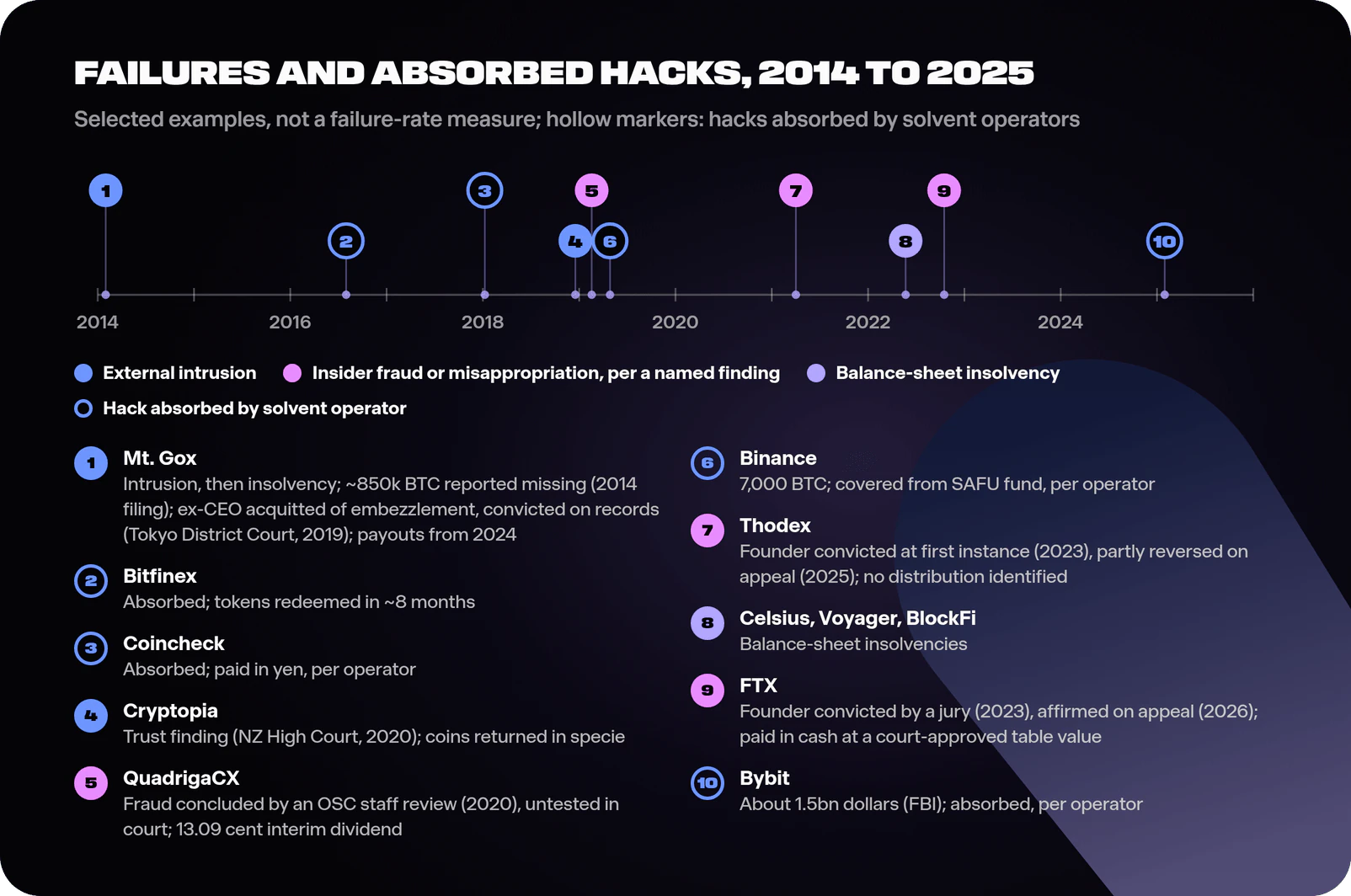
Five entries carry the register's argument. Mt. Gox shows how one failure can pass through several categories: it began with thefts from its hot wallet over years, an external intrusion that a 2017 US indictment alleges was carried out by hacking (as the trustee's 2019 report notes), and ended in bankruptcy, with a decade to first distribution and a valuation history that is easy to misstate. The 2014 bankruptcy valued BTC claims at 50,058.12 yen; the 2018 rehabilitation plan re-based them at 749,318.83 yen, about fifteen times higher, and states that this calculation does not turn cryptocurrency claims into yen claims (Mt. Gox rehabilitation trustee, plan, sections 2.1.2, 2.3, 4.2.2). Creditors could elect repayment in BTC and BCH or in cash (section 4.7.2), and the early lump-sum option paid 21 percent of the valued claim (section 2.2(4)). Three numbers must be kept apart: the coins the trustee held (141,686 BTC as of 30 September 2019, per the trustee's report to the Tokyo District Court, against about 850,000 the company reported missing in 2014, as reported by NBC News), the claim valuation (the 2018 yen rate), and the market value of a BTC distribution on the day it landed in 2024 or later, which the trustee does not fix and which depended on the price that day.
FTX is classed as insider fraud or misappropriation on the strength of a criminal conviction: a jury convicted its founder, Sam Bankman-Fried, on seven counts including wire fraud and conspiracy to commit wire fraud on 2 November 2023 (US Attorney, SDNY, 2 November 2023); he was sentenced to 25 years, and the Department of Justice stated that he stole over 8 billion dollars of customers' money (US Department of Justice, 28 March 2024). The US Court of Appeals for the Second Circuit affirmed the judgment on 12 June 2026 (United States v. Bankman-Fried, No. 24-961), and his petition for a writ of certiorari was filed with the US Supreme Court on 10 September 2026 and docketed on 15 September 2026, with the government's response due on 15 October 2026 (US Supreme Court, docket No. 26-349). Its estate pays claims as a percentage of a dollar value fixed by the prices in a court-approved conversion table (US Bankruptcy Court, District of Delaware, order and exhibit, D.I. 7090, 7 February 2024). The convenience class received 120 percent, the Dotcom customer class 96 percent and the US customer class 100 percent cumulative by the March 2026 distribution (FTX Recovery Trust, 31 March 2026). All of those percentages are of that dollar figure, so a customer whose claim was a coin position was paid in cash against the table price of that coin. The order and exhibit reviewed here do not state the date the table prices refer to, so this register does not give one.
QuadrigaCX shows how the story told at a freeze can differ from the cause assessed later. After co-founder and chief executive Gerald Cotten died in December 2018, the losses were widely attributed to crypto assets left inaccessible by his death; a June 2020 review by staff of the Ontario Securities Commission said "this was not the case" and concluded that the collapse resulted from a fraud committed by Cotten. Staff found that he had opened accounts under aliases, credited himself with fictitious balances that he traded with clients, and lost about C$28 million trading client assets on other platforms, and that new client deposits were re-routed to fund other clients' withdrawals (OSC staff review, June 2020). The report states that these are not findings of fact by an OSC hearing panel and have not been tested before the OSC tribunal or a court; no proceeding followed because Cotten had died and Quadriga was bankrupt. Celsius is the custodial-yield case the yield cluster describes. Its Earn accounts held crypto worth about 4.2 billion dollars as of 10 July 2022, and the bankruptcy court held that those assets were property of the estate because Celsius's Terms of Use transferred title to it, which put Earn depositors in the unsecured queue (US Bankruptcy Court, SDNY, opinion of 4 January 2023). Its founder, Alex Mashinsky, pleaded guilty on 3 December 2024 to commodities fraud and securities fraud and was sentenced to 12 years on 8 May 2025 (US Department of Justice, 8 May 2025), so this case began as a balance-sheet failure and later produced a fraud conviction.
Cryptopia is the counter-example for the pillar's segregation dimension: the New Zealand High Court held that account holders' coins were property held on trust, so holders were beneficiaries rather than creditors, and the liquidators returned coins in specie, entitlement by entitlement (Ruscoe v Cryptopia, 8 April 2020; Grant Thornton, 11 December 2025). It is a different world from the commingled estates, and it was set up by the platform's terms and ledger practice before the hack.
Hacks absorbed by solvent operators (not failures)
These incidents appear in most lists of exchange disasters, and they are kept out of the register above because no estate, court or liquidator decided the customer outcome. The company paid.
| Date | Platform | Loss (operator or agency statement) | How customers were treated | Source |
|---|---|---|---|---|
| Aug 2016 | Bitfinex | Losses spread across all accounts as a 36.067 percent generalised haircut, recorded as BFX tokens | BFX tokens redeemed at 1 dollar each, 100 percent, announced 3 April 2017, about eight months later | Bitfinex interim update, 6 August 2016; redemption notice, 3 April 2017 |
| Jan 2018 | Coincheck | About 526 million XEM transferred without authorisation | Holders paid in yen at 88.549 yen per XEM held at 26 January 2018, completed 12 March 2018 | Coincheck NEM FAQ (operator statement) |
| May 2019 | Binance | 7,000 BTC from a hot wallet, about 2 percent of its BTC holdings | Covered in full from the SAFU fund; deposits and withdrawals paused about a week | Binance security breach update, 8 May 2019 (operator statement) |
| Feb 2025 | Bybit | About 1.5 billion dollars in virtual assets, attributed by the FBI to North Korea | Bybit states it closed the ETH gap within 72 hours through loans and partner deposits and kept customer assets backed 1:1, per a Hacken-audited reserve report | FBI PSA, 26 February 2025; Bybit press release, February 2025 (operator statement) |
By the operators' own accounts, these four platforms absorbed thefts up to about 1.5 billion dollars (Bybit, per the FBI's figure). They do not change the arithmetic of what a customer owns while the outcome is unknown, and operator statements about backing are attributed claims, corroborated here only to the extent an agency or auditor is cited.
What actually decides what customers get back?
Respuesta rápida
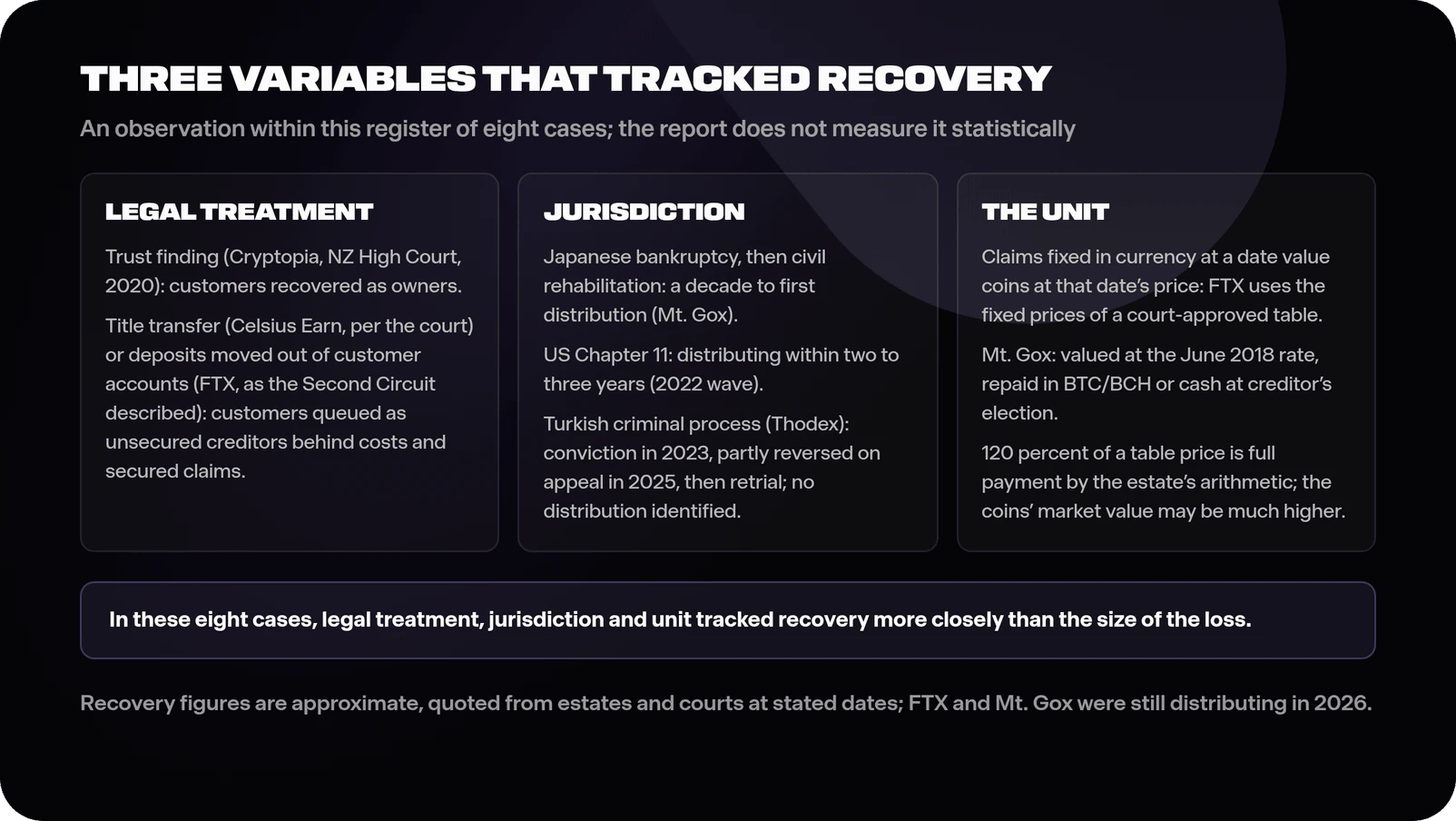
Two legal facts and one unit: whether assets were held on trust or had become the platform's property, which jurisdiction ran the process, and what the claim was denominated in and at what date. In these eight cases the loss column tracked recovery poorly; that is an observation from a selected register, and this report does not measure it statistically.
In this register, legal treatment separated outcomes most clearly, and it was set before the failure, in the account terms and the platform's actual practice. Where the terms and the ledger supported a trust, as at Cryptopia, the court treated holders as owners and the liquidators returned coins (Ruscoe v Cryptopia, 8 April 2020). Where terms transferred title, as the Celsius court found for Earn accounts, or customer deposits were moved out of customer accounts, as the Second Circuit described at FTX, where some deposits "went into Alameda's bank account instead" (opinion of 12 June 2026), customers joined the unsecured queue behind administrative costs and secured claims. The segregation dimension in the exchange safety pillar is this column turned into a diligence question, and in the EU the Markets in Crypto-Assets Regulation (Regulation (EU) 2023/1114) addresses the same point: Article 75(7), which applies from 30 December 2024 to crypto-asset service providers that hold clients' crypto-assets in custody, requires them to segregate those holdings from their own and to keep them legally segregated from the provider's estate so that the provider's creditors have no recourse to them, in particular in insolvency (ESMA, MiCA rulebook, Article 75).
Jurisdiction decided speed and form. Japanese bankruptcy and then civil rehabilitation took a decade to first distribution at Mt. Gox, with the repayment deadline now 31 October 2026 (trustee notice, 27 October 2025); the US Chapter 11 estates of 2022 reached effective dates within twelve to twenty-six months of their freezes and were distributing within two to three years; Canadian bankruptcy paid a first dividend four years after the Quadriga freeze; the Turkish criminal process produced a first-instance conviction in 2023, a partial reversal on appeal in 2025 and a retrial (as reported by Anadolu Agency), the founder died in custody on 1 November 2025 before it ended (Turkish Ministry of Justice, General Directorate of Prisons and Detention Houses, 2 November 2025), and no distribution to Thodex customers was identified for this review. The pillar's jurisdiction dimension is this column: which regime and courts stand behind the entity an account actually contracts with.
The unit is the register's quiet finding. Claims fixed in currency at a date convert a coin position into a currency claim at that date's price. FTX's estate values coin claims in dollars at the fixed prices of a court-approved conversion table (D.I. 7090), and its claims guidance tells creditors to multiply each coin quantity by the table price; Quadriga's court fixed 15 April 2019 rates, with BTC at C$6,739.08; Cryptopia calculates entitlements as at 14 May 2019 but pays them in the coins themselves. Mt. Gox is the case most often misdescribed: the plan's yen valuation uses the June 2018 rate, roughly fifteen times the 2014 bankruptcy rate, and the plan says in terms that this does not convert the claims into yen claims, so a creditor who elected BTC/BCH repayment received coins whose market value was set on the day of distribution. A customer paid 120 percent of a table price years later has been paid in full by the estate's arithmetic, while the coins' market value on the day of payment may be much higher, and the register quotes the estate's figure with its unit and date so that the two can be compared.
What preceded the failures, and what does that mean for a holder?
Respuesta rápida
Several of these failures were preceded by similar warning signs: withdrawal friction, fixed yields on custodial balances, published balance-sheet questions and regulatory action, visible in those cases for days to months before the freeze. The exchange pillar's list of documented pre-failure patterns is drawn from this column of the register; each pattern has also appeared at platforms that continued operating.
The pre-failure chapters of several entries share features. Withdrawal friction: Mt. Gox halted bitcoin withdrawals on 7 February 2014, citing a technical issue known as transaction malleability, and its site went offline on 24 February (as reported by CoinDesk, 4 March 2014); Celsius halted withdrawals in June 2022 (US Department of Justice, 8 May 2025); FTX filed for bankruptcy on 11 November 2022 because it could not meet customer withdrawal requests, nine days after the balance-sheet publication described below (US Court of Appeals, Second Circuit, 12 June 2026). Yield dependence: Celsius, Voyager and BlockFi all marketed fixed rates on custodial balances, the pattern the guide to guaranteed-return warning signs examines. Regulatory action: in a settled order of 14 February 2022, entered without BlockFi admitting or denying the findings, the SEC found that BlockFi's retail interest accounts were offered as unregistered securities, and BlockFi agreed to stop offering them to new US investors, nine months before its bankruptcy (SEC, order of 14 February 2022). Published balance-sheet questions: on 2 November 2022 a version of Alameda Research's balance sheet was published by a cryptocurrency news site, which the Second Circuit describes as "triggering widespread customer withdrawals from FTX" (opinion of 12 June 2026). A fixed rate alone is not evidence of fraud; in these three cases it accompanied a balance sheet that was lending customer assets.
For a holder, the register maps onto three questions that the exchange safety pillar describes: how much sits on a platform relative to what its functions require, whether the withdrawal path has been used at routine size, and what the account terms say about title. Platform statements about soundness are one input among several: in the Celsius case, the Department of Justice's sentencing release states that Celsius marketed itself as the "safest place for your crypto" while its founder used customer assets "to place risky bets" (US Department of Justice, 8 May 2025). The absorbed-hack table adds that a well-capitalised platform can survive a large theft; it does not change the legal character of a customer's balance while an incident is being resolved.
Each estate in this register announces its distribution channels in its own notices, listed in the sources. Failures and thefts attract follow-on fraud: the FBI has warned that companies falsely claiming to recover lost crypto charge upfront fees and then stop responding or ask for more, that private companies cannot issue seizure orders, and that suspicious contacts can be reported to the Internet Crime Complaint Center at ic3.gov or a local FBI field office (FBI IC3, PSA, 11 August 2023). Outside the US, the national police or fraud-reporting service is the equivalent route. No estate, agency or service can promise that losses will be recovered.
Frequently asked questions
Were most of these failures hacks?
Two of the eight began as external intrusions (Mt. Gox and Cryptopia), three are classed as insider fraud or misappropriation (QuadrigaCX on an Ontario Securities Commission staff review, Thodex on a first-instance conviction later partly overturned, FTX on a jury conviction affirmed on appeal) and three began as balance-sheet insolvencies (Celsius, Voyager, BlockFi). The categories overlap: Mt. Gox's hot-wallet thefts ran for years and ended in bankruptcy, and Celsius's balance-sheet failure was followed by its founder's guilty plea to fraud charges (US Department of Justice, 8 May 2025). The eight are examples and support no prevalence estimate: they cannot show how often each trigger occurs or which costs customers more across the industry, and this register makes no such ranking. The hacks that solvent operators absorbed are listed separately because the company itself paid customers and no estate was involved.
Did FTX customers really get more than they lost?
In the estate's unit, some did: the convenience class received 120 percent of claims valued at the court-approved conversion table, and larger customer classes reached 96 to 100 percent by March 2026 (FTX Recovery Trust releases). In coins, the answer depends on the market: a customer holding bitcoin at the freeze was paid cash against the fixed table price for BTC set by the court-approved conversion table (order and exhibit, D.I. 7090, 7 February 2024), whatever bitcoin traded at on the day of payment.
How were Mt. Gox claims valued, and why did it take a decade?
The 2014 bankruptcy valued BTC claims at 50,058.12 yen per coin. The civil rehabilitation that began on 22 June 2018 re-based them at 749,318.83 yen, the rate on the day before the commencement order, and the plan states that this does not convert them into yen claims; creditors chose repayment in BTC/BCH or in cash (trustee plan, sections 2.1.2, 2.3, 4.2.2, 4.7.2). The delay came from the bankruptcy, the conversion to rehabilitation so that coins could be returned in kind, litigation over the recovered coins, and creditor voting and exchange onboarding; repayments began in July 2024 and the deadline is now 31 October 2026 (trustee notices).
What made Cryptopia different?
A court finding that account holders' coins were property held on trust, so holders were beneficiaries rather than creditors (Ruscoe v Cryptopia, 8 April 2020). The platform's 2018 terms said as much, and its ledger allowed holders to be identified; the liquidators have since returned over NZ$487 million in coins (Grant Thornton, 11 December 2025).
Is this list of exchange failures kept up to date?
Each recovery figure carries the date of the estate notice it comes from, and the last-reviewed date at the top of the page records when the figures were last checked; no update schedule is promised. Several processes were still paying in 2026: the Mt. Gox trustee's repayment deadline is 31 October 2026 (trustee notice, 27 October 2025), the FTX Recovery Trust made its fourth distribution on 31 March 2026 (FTX Recovery Trust, March 2026), and the Cryptopia liquidators planned further top-ups toward full entitlements (Grant Thornton, 11 December 2025). To check a figure against the latest position, compare the date quoted here with the newest notice on the estate's own case site, listed in the sources.
Sources and further reading
Primary sources for this edition; URLs accessed 23 or 24 September 2026 as marked.
- Rehabilitation Plan (English translation). MtGox Co., Ltd. Rehabilitation Trustee, sections 2.1.2, 2.2, 2.3, 3, 4.2.2, 4.3.2.2, 4.7.2, 2021. https://www.mtgox.com/d/04y7ivbnz5gw.pdf (accessed 23 September 2026)
- Notice regarding Commencement of Repayments in Bitcoin and Bitcoin Cash. MtGox Co., Ltd. Rehabilitation Trustee, 24 June 2024. https://www.mtgox.com/img/pdf/20240624_announcement_en.pdf (accessed 23 September 2026)
- Announcement regarding repayments in Bitcoin and Bitcoin Cash made to some creditors. MtGox Co., Ltd. Rehabilitation Trustee, 5 July 2024. https://www.mtgox.com/img/pdf/20240705_01_announcement_en.pdf (accessed 23 September 2026)
- Announcement of change of repayment deadline to 31 October 2026. MtGox Co., Ltd. Rehabilitation Trustee, 27 October 2025. https://www.mtgox.com/img/pdf/20251027_1cc36334-e8b2-4fe4-8135-97d9a149e4f7_announcement_en.pdf (accessed 23 September 2026)
- Report to Tokyo District Court by Rehabilitation Trustee. MtGox Co., Ltd. Rehabilitation Trustee, 1 October 2019. https://www.mtgox.com/img/pdf/20191001_report.pdf (accessed 24 September 2026)
- Mt. Gox Works With Cops After $490M in Bitcoins Vanish. NBC News, March 2014 (news report citing Mt. Gox's filing). https://www.nbcnews.com/business/markets/mt-gox-works-cops-after-490m-bitcoins-vanish-n62346 (accessed 24 September 2026)
- The Non-Expert's Guide to the Mt. Gox Fiasco. CoinDesk, 4 March 2014 (news report citing Mt. Gox statements). https://www.coindesk.com/markets/2014/03/04/the-non-experts-guide-to-the-mt-gox-fiasco (accessed 24 September 2026)
- Japan's High Court Rejects Former Mt Gox CEO's Conviction Appeal. CoinDesk, 12 June 2020 (news report of the Tokyo High Court ruling). https://www.coindesk.com/policy/2020/06/12/japans-high-court-rejects-former-mt-gox-ceos-conviction-appeal (accessed 24 September 2026)
- Ruscoe v Cryptopia Ltd (in liquidation) [2020] NZHC 728. High Court of New Zealand, 8 April 2020. https://www.grantthornton.co.nz/globalassets/1.-member-firms/new-zealand/pdfs/cryptopia/civ-2019-409-000544---ruscoe-and-moore-v-cryptopia-limited-in-liquidation.pdf (accessed 23 September 2026)
- Liquidators' 14th Report to Shareholders and Creditors of Cryptopia Limited (in liquidation). Grant Thornton New Zealand, 11 December 2025. https://www.grantthornton.co.nz/globalassets/1.-member-firms/new-zealand/pdfs/cryptopia/14th-liquidators-report_cryptopia_dec25_final.pdf (accessed 23 September 2026)
- Cryptopia account holders receive $400m from liquidators. Grant Thornton New Zealand, 20 December 2024. https://www.grantthornton.co.nz/press/press-releases-2024/cryptopia-account-holders-receive-$400m-from-liquidators/ (accessed 23 September 2026)
- QuadrigaCX: A Review by Staff of the Ontario Securities Commission. Ontario Securities Commission, June 2020. https://www.osc.gov.on.ca/quadrigacxreport/ (accessed 23 September 2026)
- Order re claims process and conversion rates, Quadriga Fintech Solutions Corp. et al. Ontario Superior Court of Justice (Commercial List), 1 March 2021. https://documentcentre.ey.com/api/Document/download?docId=33116&language=EN (accessed 23 September 2026)
- Frequently asked questions regarding the dividend. Ernst & Young Inc. as trustee in bankruptcy of Quadriga, 2023. https://documentcentre.ey.com/api/Document/download?docId=37252&language=EN (accessed 23 September 2026)
- Notice to Creditors: Second Interim Claims Update and Notice of Dividend Distribution. Ernst & Young Inc. as trustee, 12 May 2023 (copy hosted by Miller Thomson LLP). https://millerthomson.com/wp-content/uploads/2023/05/Notice-to-Creditors-Second-Interim-Claims-Update-and-Notice-of-Dividend-Distribution-May-12-2023.pdf (accessed 23 September 2026)
- Thodex'in kurucusu Faruk Fatih Özer'in dolandırıcılık davasında karar. Anadolu Agency, 7 September 2023. https://www.aa.com.tr/tr/gundem/thodexin-kurucusu-faruk-fatih-ozerin-dolandiricilik-davasinda-karar/2986295 (accessed 23 September 2026)
- İstinaf, Thodex'in kurucusu Faruk Fatih Özer'in dolandırıcılık davasında kararını verdi. Anadolu Agency, 30 January 2025. https://www.aa.com.tr/tr/gundem/istinaf-thodexin-kurucusu-faruk-fatih-ozerin-dolandiricilik-davasinda-kararini-verdi/3467025 (accessed 23 September 2026)
- Hükümözlü Faruk Fatih Özer'in İntiharı ile İlgili İddialara İlişkin Basın Açıklaması (press statement 2025/15). Republic of Türkiye Ministry of Justice, General Directorate of Prisons and Detention Houses, 2 November 2025. https://cte.adalet.gov.tr/Home/SayfaDetay/hukumozlu-faruk-fatih-ozerin-intihari-ile-ilgili-iddialara-iliskin-basin-aciklamasi02112025081301 (accessed 24 September 2026)
- Thodex'in kurucusu Faruk Fatih Özer cezaevinde ölü bulundu. Anadolu Agency, 1 November 2025 (news report; source for the retrial of 21 defendants). https://www.aa.com.tr/tr/gundem/thodexin-kurucusu-faruk-fatih-ozer-cezaevinde-olu-bulundu/3732500 (accessed 24 September 2026)
- Crypto exchange CEO found dead in Turkish prison as victims' lawyer demands investigation. DL News, November 2025 (news report quoting a victims' lawyer). https://www.dlnews.com/articles/people-culture/turkish-thodex-crypto-exchange-founder-faruk-fatih-ozer-dead/ (accessed 24 September 2026)
- Celsius Network LLC, et al., case site (effective date 31 January 2024). Stretto. https://cases.stretto.com/celsius/ (accessed 23 September 2026)
- Memorandum Opinion and Order Regarding Ownership of Earn Account Assets, In re Celsius Network LLC, Case No. 22-10964. US Bankruptcy Court, Southern District of New York, 4 January 2023. https://www.govinfo.gov/content/pkg/USCOURTS-nysb-1_22-bk-10964/pdf/USCOURTS-nysb-1_22-bk-10964-7.pdf (accessed 24 September 2026)
- Celsius Distribution FAQ (archived). Celsius Network, 2024 (debtor statement). https://celsiusnetwork.medium.com/celsius-distribution-faq-1cdd323251ef (accessed 24 September 2026)
- Founder Of Celsius Sentenced To 12 Years For Fraud And Market Manipulation. US Department of Justice, Southern District of New York, 8 May 2025. https://www.justice.gov/usao-sdny/pr/founder-celsius-sentenced-12-years-fraud-and-market-manipulation (accessed 24 September 2026)
- Celsius Emerges from Chapter 11 and Commences Distributions of Over $3 Billion of Cryptocurrency to Creditors. Celsius Network via Business Wire, 31 January 2024. https://www.businesswire.com/news/home/20240131994097/en/Celsius-Emerges-from-Chapter-11-and-Commences-Distributions-of-Over-$3-Billion-of-Cryptocurrency-to-Creditors (accessed 23 September 2026)
- Celsius Begins Distributions of Funds Recovered Through Post Effective-Date Litigation. Celsius Network via Business Wire, 5 December 2024. https://www.businesswire.com/news/home/20241205039857/en (accessed 23 September 2026)
- Decision Regarding Approval of Disclosure Statement, Confirmation of Plan of Reorganization, and Related Matters, In re Voyager Digital Holdings, Case No. 22-10943. US Bankruptcy Court, Southern District of New York, 11 March 2023. https://www.govinfo.gov/content/pkg/USCOURTS-nysb-1_22-bk-10943/pdf/USCOURTS-nysb-1_22-bk-10943-1.pdf (accessed 24 September 2026)
- How much value was returned in the initial recovery? Voyager Digital support notice, 2023. https://support.investvoyager.com/hc/en-us/articles/16443115488667-How-much-value-was-returned-in-the-initial-recovery (accessed 23 September 2026)
- FTX Trading Ltd. case site (effective date 3 January 2025). Kroll Restructuring Administration. https://restructuring.ra.kroll.com/FTX/ (accessed 23 September 2026)
- Digital Assets Conversion Table, Exhibit 1 to Order Granting Motion of Debtors to Estimate Claims Based on Digital Assets, D.I. 7090, In re FTX Trading Ltd., Case No. 22-11068. US Bankruptcy Court, District of Delaware, 7 February 2024 (via Kroll). https://restructuring.ra.kroll.com/FTX/ExternalCall-DownloadPDF?id1=MzA1ODIxOA%3D%3D&id2=0 (accessed 24 September 2026)
- Digital Asset Estimates (claims valuation guidance: the Court entered the Order Granting Motion of Debtors to Estimate Claims Based on Digital Assets [Docket No. 7090] on 7 February 2024; claim value equals quantity times the table price). FTX support centre (estate), undated. https://support.ftx.com/hc/en-us/articles/24863020316948-Digital-Asset-Estimates (accessed 25 September 2026)
- Digital Asset Estimates. FTX support, 25 March 2024 (debtor statement). https://support.ftx.com/hc/en-us/articles/24863020316948-Digital-Asset-Estimates (accessed 24 September 2026)
- FTX Receives U.S. Bankruptcy Court Confirmation of its Plan of Reorganization. FTX via PR Newswire, 7 October 2024. https://www.prnewswire.com/news-releases/ftx-receives-us-bankruptcy-court-confirmation-of-its-plan-of-reorganization-302269152.html (accessed 23 September 2026)
- FTX Commences Initial Distributions to Convenience Class and Sets Next Distribution. FTX Recovery Trust via PR Newswire, 18 February 2025. https://www.prnewswire.com/news-releases/ftx-commences-initial-distributions-to-convenience-class-and-sets-next-distribution-302379212.html (accessed 23 September 2026)
- FTX Recovery Trust to Distribute More than $5 Billion to Creditors in Second Distribution on May 30, 2025. FTX Recovery Trust via PR Newswire, May 2025. https://www.prnewswire.com/news-releases/ftx-recovery-trust-to-distribute-more-than-5-billion-to-creditors-in-second-distribution-on-may-30-2025-302456976.html (accessed 23 September 2026)
- FTX Recovery Trust to Distribute Approximately $1.6 Billion to Creditors in Third Distribution on September 30, 2025. FTX Recovery Trust via PR Newswire, September 2025. https://www.prnewswire.com/news-releases/ftx-recovery-trust-to-distribute-approximately-1-6-billion-to-creditors-in-third-distribution-on-september-30--2025--302561856.html (accessed 23 September 2026)
- FTX Recovery Trust to Distribute Approximately $2.2 Billion to Creditors in Fourth Distribution on March 31, 2026. FTX Recovery Trust via PR Newswire, March 2026. https://www.prnewswire.com/news-releases/ftx-recovery-trust-to-distribute-approximately-2-2-billion-to-creditors-in-fourth-distribution-on-march-31--2026--302717707.html (accessed 23 September 2026)
- Samuel Bankman-Fried Sentenced to 25 Years in Prison. US Department of Justice, Southern District of New York, 28 March 2024. https://www.justice.gov/usao-sdny/pr/samuel-bankman-fried-sentenced-25-years-prison (accessed 23 September 2026)
- Statement Of U.S. Attorney Damian Williams On The Conviction Of Samuel Bankman-Fried. US Department of Justice, Southern District of New York, 2 November 2023. https://www.justice.gov/usao-sdny/pr/statement-us-attorney-damian-williams-conviction-samuel-bankman-fried (accessed 24 September 2026)
- United States v. Bankman-Fried, No. 24-961-cr. US Court of Appeals for the Second Circuit, opinion of 12 June 2026. https://ww3.ca2.uscourts.gov/decisions/OPN/24-961_opn.pdf (accessed 24 September 2026)
- Samuel Bankman-Fried, Petitioner v. United States, No. 26-349 (docket). Supreme Court of the United States, petition filed 10 September 2026, docketed 15 September 2026. https://www.supremecourt.gov/search.aspx?filename=/docket/docketfiles/html/public/26-349.html (accessed 24 September 2026)
- BlockFi Inc. case site (effective date 24 October 2023). Kroll Restructuring Administration. https://restructuring.ra.kroll.com/blockfi/ (accessed 23 September 2026)
- BlockFi Distributions. Kroll Restructuring Administration, 2024. https://cases.ra.kroll.com/BlockFiDistributions/ (accessed 23 September 2026)
- BlockFi Plan Administrator Announces Claims Sale and Full Customer Recovery. BlockFi plan administrator via PR Newswire, 22 July 2024. https://www.prnewswire.com/news-releases/blockfi-plan-administrator-announces-claims-sale-and-full-customer-recovery-302203082.html (accessed 23 September 2026)
- In the Matter of BlockFi Lending LLC, Order Instituting Cease-and-Desist Proceedings. US Securities and Exchange Commission, 14 February 2022. https://www.sec.gov/litigation/admin/2022/33-11029.pdf (accessed 23 September 2026)
- Bitfinex Interim Update. Bitfinex, 6 August 2016 (operator statement). https://blog.bitfinex.com/announcements/bitfinex-interim-update/ (accessed 23 September 2026)
- 100% Redemption of Outstanding BFX Tokens. Bitfinex, 3 April 2017 (operator statement). https://blog.bitfinex.com/announcements/100-redemption-outstanding-bfx-tokens/ (accessed 23 September 2026)
- 暗号資産NEMの不正送金に関する質問 (FAQ on the unauthorised NEM transfer). Coincheck, 2018 (operator statement). https://coincheck.com/info/faq_nem (accessed 23 September 2026)
- Binance Security Breach Update. Binance, 8 May 2019 (operator statement). https://www.binance.com/en/support/announcement/binance-security-breach-update-360028031711 (accessed 23 September 2026)
- North Korea Responsible for $1.5 Billion Bybit Hack (PSA250226). FBI Internet Crime Complaint Center, 26 February 2025. https://www.ic3.gov/PSA/2025/PSA250226 (accessed 23 September 2026)
- Increase in Companies Falsely Claiming an Ability to Recover Funds Lost in Cryptocurrency Investment Scams (PSA230811). FBI Internet Crime Complaint Center, 11 August 2023. https://www.ic3.gov/PSA/2023/psa230811 (accessed 24 September 2026)
- Fully Backed Within 72 hours: Bybit Maintains 1:1 Customer Assets Ratio in Latest Proof of Reserves Audited Report by Hacken. Bybit, February 2025 (operator statement). https://www.bybit.com/en/press/post/fully-backed-within-72-hours-bybit-maintains-1-1-customer-assets-ratio-in-latest-proof-of-reserves-audited-report-by-hacken-bltb767a9461133831f (accessed 23 September 2026)
- MiCA Article 75: Providing custody and administration of crypto-assets on behalf of clients. ESMA interactive single rulebook. https://www.esma.europa.eu/publications-and-data/interactive-single-rulebook/mica/article-75-providing-custody-and (accessed 23 September 2026)
To cite this report: Bron Academy, The Exchange Failure Index, first edition, September 2026, bron.org/academy.
Prueba rápida: ¿se mantuvo?
Llegaron algunas preguntas para comprobar los fundamentos. Siguen respuestas con explicaciones y nadie lo califica excepto su futuro portafolio.


¡Has completado un cuestionario sobre “The Exchange Failure Index”! Comparte tu logro en las redes sociales.
 ¿Fue esto útil?