TL;DR
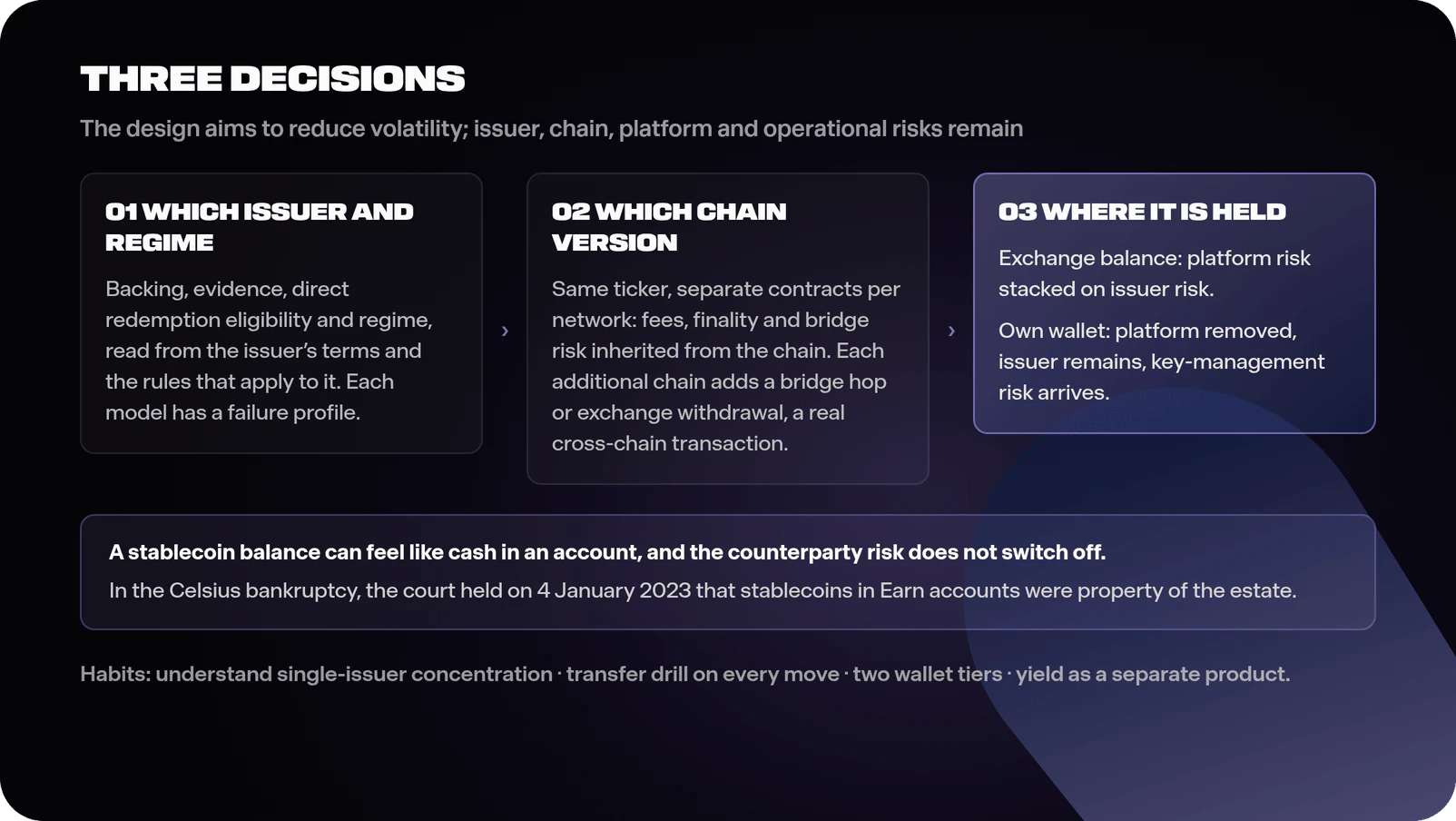
- Read the issuer's own terms for what backs the token, what evidence is published, who is eligible to redeem directly and under which regime, if any, the issuing entity is authorised or licensed, then choose the chain version deliberately, because every deployment inherits its network's fees, finality and bridge exposure. The first decision concerns issuer risk and the second network risk; both are checkable from public materials.
- An exchange balance is usually a claim on the platform, whose legal character depends on the account terms and the law that applies, and the platform's holding is in turn exposed to the issuer; your own wallet removes the platform layer, leaves the issuer's and makes key management your responsibility. What the account terms and the applicable insolvency law say about ownership decide what happens to that balance if the platform fails.
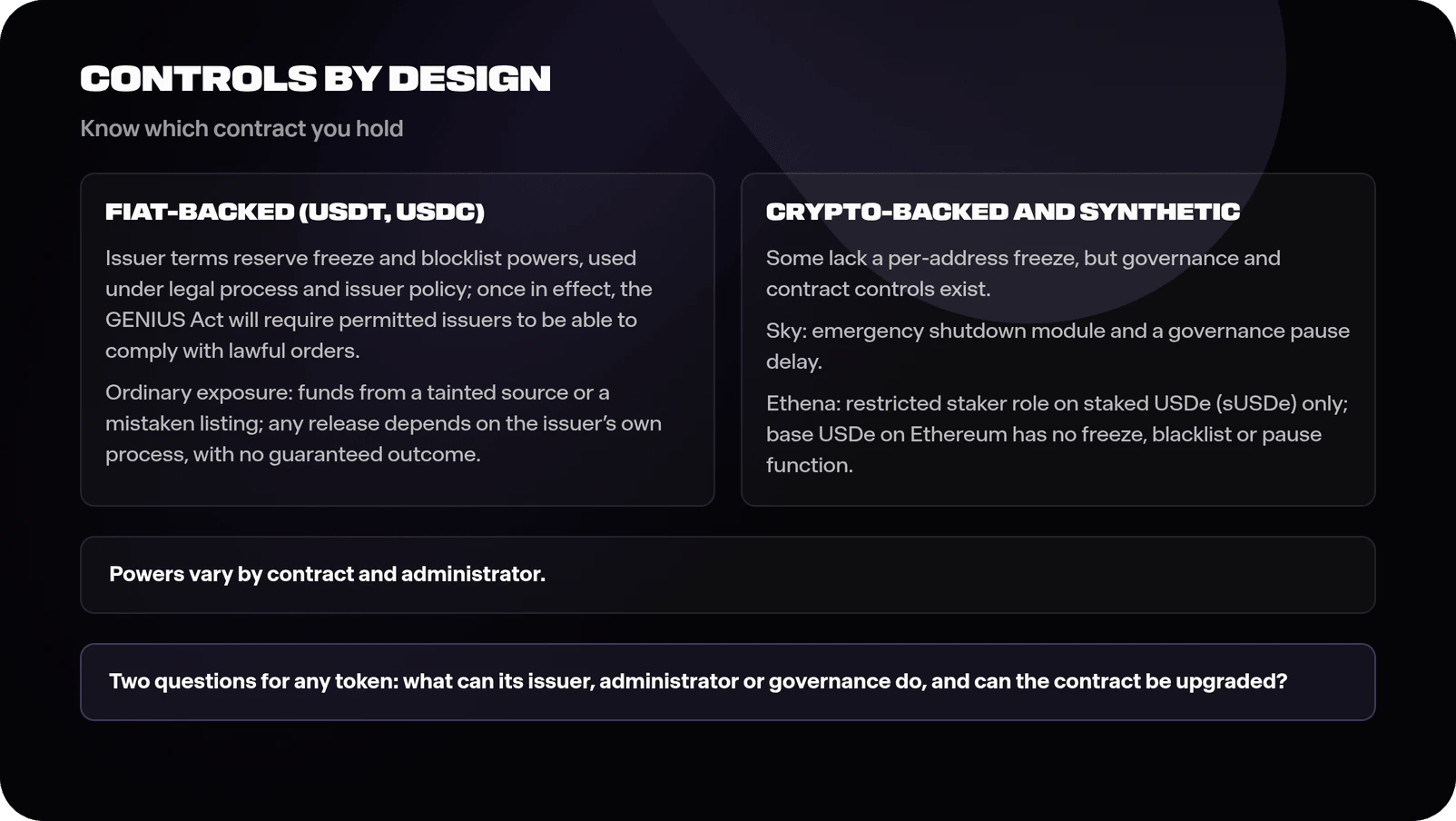
- Many stablecoin contracts include controls that can restrict what tokens do, and who holds them depends on the design: fiat-backed issuers publish freeze and blocklist powers and use them under legal process and their own policies; crypto-backed and synthetic designs have governance and contract controls of their own, which can sit on a staked version of the token and be absent from the base token. The specific powers vary by contract and administrator, so the question to ask is which contract you hold.
- Understand what single-issuer concentration means for a balance you care about, run the transfer drill on every stablecoin movement, keep the two-tier wallet structure, and read any yield offered on a stablecoin as a separate product with its own terms and risks. Four habits, three of them borrowed from guides you may already follow; each reduces a particular risk and leaves others in place.
В одном блоке
Safer stablecoin use is a set of operational practices that reduce, without removing, the risks a stablecoin keeps after its design has reduced volatility against a reference asset.
Which stablecoin, and on which chain?
Быстрый ответ
Read the issuer's own terms for what backs the token, what evidence is published, who is eligible to redeem directly and under which regime, if any, the issuing entity is authorised or licensed, then choose the chain version deliberately, because every deployment inherits its network's fees, finality and bridge exposure. The first decision concerns issuer risk and the second network risk; both are checkable from public materials.
The issuer decision
The comparison guide sets out backing, evidence, redemption and regime for the named tokens on one as-of date; this section describes how those columns bear on a holding in practice. Redemption eligibility is the point that is easiest to miss. Under the issuer terms of the large fiat-backed tokens, only approved direct customers of the issuer (typically exchanges, fintechs and institutional traders, cleared through an application process) redeem with the issuer at par, and other holders commonly buy and sell on secondary markets at whatever price those markets offer (Federal Reserve, FEDS Notes, 23 February 2024). Circle's USDC terms say the same in the issuer's own words: only Circle Mint account holders may redeem USDC directly with Circle, and a holder without such an account "may not redeem USDC with Circle unless and until" they open one (Circle, USDC terms, accessed 23 September 2026). Whether such an account is open to a given applicant depends on the issuer's onboarding criteria and the applicant's jurisdiction. Other issuers set eligibility rules in their own terms. Ethena's USDe terms, for example, limit minting and redemption with Ethena BVI Limited to whitelisted "Mint Users" who have completed KYC and AML checks, and state: "If you are a Holding User, you do not have a right to redeem USDe with Ethena BVI" (Ethena, USDe terms and conditions, last updated August 2025). DAI and USDS have no issuer redeeming for holders: they are generated by vault owners, and only a vault owner repays its own vault's debt to unlock its own collateral, so an ordinary holder has no claim on any vault (Sky, developer documentation, CDP Manager). Their holders exit by selling on a market or through Sky's LitePSM, a smart contract that swaps DAI or USDS and USDC where it is available, so that route carries smart-contract risk of its own (Sky, developer documentation, LitePSM). Outside a statutory claim such as MiCA's for e-money tokens, described below, an ordinary holder's route to dollars therefore runs through an exchange or another intermediary, with that intermediary's terms, hours, liquidity and counterparty risk attached, and with services that vary by platform and by the holder's jurisdiction.
Regime matters because it sets what the issuer must do, and for whom. In the EU, Article 49(4) of the Markets in Crypto-Assets Regulation (Regulation (EU) 2023/1114), whose e-money token rules have applied since 30 June 2024, requires the issuer of an e-money token to redeem it "at any time and at par value" at a holder's request (ESMA, MiCA interactive single rulebook, Article 49). In the US, the GENIUS Act (Public Law 119-27), enacted 18 July 2025, sets reserve, disclosure and lawful-order requirements for permitted payment stablecoin issuers; those obligations take effect on the earlier of 18 January 2027 or 120 days after final implementing regulations, so they are enacted and not yet in force. Where neither regime covers an issuer, the holder's position depends on the issuer's own terms and the law that governs them, which the issuer's disclosures describe. The regulation guide has the detail by jurisdiction, activity and effective date.
Every model has a failure profile: banking exposure for the fiat-backed model, collateral and liquidation engines (smart-contract risk) for the crypto-backed, funding rates and venue risk (counterparty risk) for the synthetic. The guide to stablecoin failure modes describes each archetype; the point here is only that the profile you are exposed to follows from the design you hold.
The chain decision
USDC on Ethereum, on Solana and on a layer 2 are three contracts on three ledgers, intended to be worth the same and different in every operational respect: fees per the network fees guide, confirmation time per the guide to how blockchains differ, and, if you ever move between them, the risk documented in why cross-chain bridges keep getting hacked. The version whose chain matches your wallet's support and your use is the one with the fewest moving parts; every additional chain adds a bridge hop or an exchange withdrawal, and each hop is a real cross-chain transaction with its own drill.
Exchange balance or your own wallet?
Быстрый ответ
An exchange balance is usually a claim on the platform, whose legal character depends on the account terms and the law that applies, and the platform's holding is in turn exposed to the issuer; your own wallet removes the platform layer, leaves the issuer's and makes key management your responsibility. What the account terms and the applicable insolvency law say about ownership decide what happens to that balance if the platform fails.
The stacking is the exchange pillar's claim chain, and the 2022 insolvencies produced a court record of it. In the Celsius bankruptcy, the US Bankruptcy Court for the Southern District of New York held on 4 January 2023 that assets deposited in Earn accounts, stablecoins included, had become Celsius's property under the account terms and were property of the bankruptcy estate; the opinion states that "stablecoins, as a type of cryptocurrency among Earn Assets, also belong to the Estates" and that account holders "have unsecured claims against the Debtors" (In re Celsius Network LLC, US Bankruptcy Court SDNY, 4 January 2023). The token's own backing did not determine that outcome. What mattered was who owned the tokens under the platform's terms, which differ by platform, account type and jurisdiction; the exchange safety pillar explains how to read them.
Withdrawing to a wallet you control retires the platform layer. The issuer's risk remains, which is why the first decision precedes this one, and the operational risks of self-custody arrive, which is why the wallet security pillar's tiering and the backup guide's design apply to a stablecoin balance exactly as to any other. The trade-off is real in both directions: a platform balance is exposed to the platform's solvency and terms, while self-custody is exposed to your own key management, and neither is the right answer for every balance or every holder.
One practical asymmetry deserves attention. A stablecoin balance can feel like cash sitting in an account, and the reasoning that might move a volatile coin into custody is easy to skip for an asset whose price is designed to stay close to its reference. The counterparty risk does not switch off. A stablecoin balance shows clearly the difference between volatility, which the design aims to reduce, and custody risk, which nothing about the design addresses.
What can an issuer or administrator do to your tokens?
Быстрый ответ
Many stablecoin contracts include controls that can restrict what tokens do, and who holds them depends on the design: fiat-backed issuers publish freeze and blocklist powers and use them under legal process and their own policies; crypto-backed and synthetic designs have governance and contract controls of their own, which can sit on a staked version of the token and be absent from the base token. The specific powers vary by contract and administrator, so the question to ask is which contract you hold.
Fiat-backed issuers
Circle's USDC terms reserve the right to block transfers of USDC to and from an address on chain and to freeze the associated USDC where Circle determines the activity may be unlawful or in breach of its terms (Circle, USDC terms, accessed 23 September 2026). Tether's terms of service, last updated 26 February 2026, state that Tether may "freeze any Tether Tokens held by you", and list "blacklisting any Digital Tokens Address which holds Tether Tokens" among the sanctions for prohibited uses (Tether, legal terms, accessed 24 September 2026). Tether also reports freezing USDT in coordination with law enforcement and sanctions authorities, and in April 2026 stated that its cooperation had resulted in more than $4.4bn frozen globally, a figure that is Tether's own and has not been independently verified for this guide (Tether, issuer announcement, 23 April 2026). Once its requirements take effect, US federal law will require this capability of permitted issuers: the GENIUS Act permits an issuer to operate only if it "has the technological capability to comply, and will comply, with the terms of any lawful order", defined to include orders to seize, freeze, burn or prevent the transfer of payment stablecoins (Public Law 119-27, sections 2 and 4). For an ordinary holder the practical exposure is specific: funds received from a tainted source, or a mistaken listing, can be caught, and any release depends on the issuer's own process as its terms describe it, with no guaranteed outcome. The guide to why exchanges ask for your ID covers how identity and screening interact with this.
Crypto-backed and synthetic designs
Some of these designs lack a per-address freeze in the fiat-backed sense. That does not put the tokens beyond anyone's control, and the absence of a freeze function says nothing about a token's backing, redemption or other risks. The Maker (now Sky) protocol behind DAI includes an Emergency Shutdown Module that governance token holders can trigger by locking tokens above a threshold, designed "to mitigate malicious governance" or "to prevent the exploitation of a critical bug", and a governance pause that delays protocol changes so "affected parties" have time to respond (Sky Protocol documentation, accessed 23 September 2026). Ethena shows why the specific contract matters. The control sits on staked USDe (sUSDe) only: the sUSDe contract defines a "FULL_RESTRICTED_STAKER_ROLE" that prevents an address from transferring, staking or unstaking sUSDe, lets a blacklist manager assign that role, and gives the admin a function that burns a restricted address's sUSDe balance and mints it to another address (Ethena Labs, StakedUSDe.sol, public repository; verified sUSDe contract on Etherscan, accessed 24 September 2026). The base USDe token contract on Ethereum, as published in the same repository and verified on Etherscan, contains no blacklist, freeze or pause function and is not an upgradeable proxy; its owner appoints the minter, and only that minter can create new USDe (Ethena Labs, USDe.sol; Etherscan, accessed 24 September 2026). A holder of USDe on Ethereum therefore faces no per-address freeze in that token contract itself, while an sUSDe holder does, and either may meet the policies of the platforms and venues that handle them. These are governance and contract controls, and the parties who hold them, the conditions for using them and the token holder's recourse differ from design to design and from contract to contract.
The academy's position is descriptive: know which contract you hold, read what its administrator, governance or issuer can do, and check for upgradeable proxies, since a control that does not exist today can be added if the contract can be upgraded (the smart contract guide explains upgradeable contracts).
What are the habits, in practice?
Быстрый ответ
Understand what single-issuer concentration means for a balance you care about, run the transfer drill on every stablecoin movement, keep the two-tier wallet structure, and read any yield offered on a stablecoin as a separate product with its own terms and risks. Four habits, three of them borrowed from guides you may already follow; each reduces a particular risk and leaves others in place.
Issuer concentration: the trade-off
A stablecoin position is a claim tied to one issuer, one reserve and one set of terms. March 2023 showed what that concentration looks like under stress: on 10 March Circle disclosed that about $3.3bn of roughly $40bn in USDC reserves was held at Silicon Valley Bank, issuance and redemption were then constrained to US banking hours over the weekend, USDC traded below 90 cents on secondary markets, and exchanges that normally offered one-for-one swaps between stablecoins paused them, so secondary-market holders could neither redeem nor easily exit (Federal Reserve, FEDS Notes, 23 February 2024). The token recovered its reference value over about three days once the affected deposits were made whole, and its market capitalisation fell by around $10bn over the month (Federal Reserve, FEDS Notes, 23 February 2024).
Some holders spread a balance across two or more issuers with different reserve profiles and domiciles; others hold one token to keep the number of terms, contracts and counterparties small. Each arrangement changes the exposure in its own way. In the March 2023 episode, a balance split between two issuers would have had only part of its value exposed to that weekend's USDC discount, provided the second token did not share the first one's exposure. Some did: the same Federal Reserve note records that DAI, which was partly collateralised by USDC, de-pegged in a strikingly similar pattern, reaching lows under 90 cents and recovering over three days (Federal Reserve, FEDS Notes, 23 February 2024). Spreading adds a second set of terms to read, a second set of controls, a second contract on each chain and possibly a second exchange relationship for on- and off-ramps; holding one token keeps those costs down and leaves the whole balance tied to one issuer's failure profile. The comparison guide gives the columns for each named token; this guide does not assess which arrangement suits any particular holder.
The transfer drill
The drill applies without modification: verified destination, explicit network on both ends, memo where required, paste-side verification, test amount, out-of-band confirmation, then the remainder, per the guide to sending and receiving crypto. Stablecoins give the wrong-network mistake plenty of room, because one ticker exists as separate contracts on many networks: Circle's developer documentation listed native USDC contract addresses on more than 30 mainnet networks when checked on 24 September 2026 (Circle, USDC contract addresses), and exchanges often offer several of them for deposit and withdrawal, with the networks supported varying by platform and, on some platforms, by the user's jurisdiction. Recovery from a wrong-network transfer depends on the chains involved, who controls the destination address and what the receiving platform supports, so the sending guide's drill is worth more before the transfer than any remedy after it.
Tiering, and yield
The tiering applies without modification: a spending balance where applications and daily use happen, per the dApps guide's approval hygiene, and a holding balance in custody that connects to nothing, per the wallet security pillar.
Yield needs its own paragraph, because it is often offered on stablecoins. This guide describes how such offers are structured and assesses none of them. Where one is offered, its availability depends on the provider and on the rules of the user's jurisdiction, and some jurisdictions restrict such products. A return offered on a stablecoin typically comes from lending, platform activity, token emissions or, in some synthetic designs, the protocol's own trading income, and each source carries the four risks in its own combination: counterparty risk, including loss of principal if a borrower or platform fails; smart-contract risk in any lending or staking contract; issuer risk in the underlying token; and network risk on the chain it runs on. Liquidity restrictions and rate variability come on top. Some regimes restrict the issuer itself: once its requirements take effect, the GENIUS Act prohibits a permitted payment stablecoin issuer from paying "any form of interest or yield" to a holder solely for holding the token (Public Law 119-27, section 4(a)(11)). Where that rule applies, a yield offer on the token comes from someone other than the issuer, under that party's terms. Where it does not, the design itself may pay: Ethena's sUSDe contract describes stakers receiving "a portion of protocol LST and perpetual yield" (Ethena Labs, StakedUSDe.sol, accessed 24 September 2026), and that return varies and carries the design's own funding, venue and contract risks. The payer question from the guide to where crypto rewards come from (who is paying this, from what, and what do they get from me) is the reading tool.
Frequently asked questions
Is holding a stablecoin safer than holding bitcoin?
They have different risk profiles. A stablecoin aims to reduce volatility relative to its reference and adds an issuer, a reserve and a set of terms and controls; bitcoin has no issuer and moves in price. The academy's guides describe each without ranking them.
Can my stablecoins be frozen?
It depends on the contract and on who administers it. Circle's terms allow it to freeze USDC where it determines activity may be unlawful or in breach of its terms, and Tether's terms state that it may "freeze any Tether Tokens held by you" (Circle, USDC terms; Tether, legal terms, both accessed 24 September 2026). A frozen balance stays at its address and cannot be moved while the freeze lasts, and nothing the holder does on the chain undoes it; any release is for the administrator to decide under its terms. Tokens received from an address later linked to crime can be caught even when the recipient knew nothing of it, which is where exchange screening comes in, as the guide to why exchanges ask for your ID explains. Crypto-backed and synthetic designs rely on governance and contract controls instead; the next answer covers how to check a specific token.
How can I check whether my stablecoin can be frozen?
Start with the issuer's terms, which for the large fiat-backed tokens state the freeze and blocklist powers in plain words. Then look at the token's verified contract on the chain's block explorer for functions with names such as blacklist, blocklist, freeze or pause, for restricted roles, and for signs of an upgradeable proxy. Check the exact token you hold: on Ethereum, Ethena's sUSDe contract has a restricted role that can block transfers, while the base USDe contract has no such function. The same ticker on another chain is a different contract and needs its own check.
Should I keep stablecoins on an exchange if their price does not move?
This guide cannot answer that for any particular holder; it can describe what each arrangement involves. A stable price leaves counterparty risk where it was. Take a platform account showing 1,000 units of a stablecoin: it typically records a claim on the platform under the account terms, and what that claim amounts to depends on those terms and on the law that applies to the platform. In the Celsius case, where the terms transferred ownership of Earn assets to the platform, the court said account holders' recovery "depends on the distributions to unsecured creditors under a confirmed chapter 11 plan", however well backed the token itself was (In re Celsius Network LLC, US Bankruptcy Court SDNY, 4 January 2023). Outcomes elsewhere depend on the terms and the insolvency law that applies. The same 1,000 units in a wallet the holder controls remain exposed to the issuer, and can be lost if the keys and backup are lost or stolen. The exchange safety pillar explains how to read account terms.
Which chain should I hold stablecoins on?
No single chain suits every holder, and this guide does not rank them. The practical test is fit: which networks the wallet supports, which networks the platform or payee on the other end accepts, and what fees and confirmation times the use involves. Consider a balance held on one network and a payment to a platform that accepts only another: the move needs a bridge or a round trip through an exchange, and each hop is a separate transfer with its own drill and its own risks. Some issuers publish the official contract address for each network (Circle's USDC contract-address page is one example), and comparing the token contract in a wallet with that list checks that a token with a familiar ticker is the issuer's own version.
What happens if I send stablecoins on the wrong network?
It depends on the chains involved, who controls the destination address and what the receiving platform supports. Some platforms can recover some wrong-network deposits under their own policies, and some transfers cannot be recovered at all. The sending guide's drill, with an explicit network on both ends and a test amount first, reduces that risk before the transfer, which is the only point at which the holder controls it. Services that contact people after a loss and promise to recover funds for an upfront fee are a known follow-on scam; the platform's own support, reached through its official website or app, is where a recovery question goes.
What happens if my stablecoin depegs?
It depends on the archetype, per the failure-modes guide. In March 2023 USDC, a fully backed token hit by a reserve shock, recovered its reference value over about three days once the affected deposits were made whole (Federal Reserve, FEDS Notes, 23 February 2024); an algorithmic design can enter a spiral that reserves fail to stop: TerraUSD collapsed in May 2022 even though the Luna Foundation Guard had been tasked with deploying "billions of dollars' worth of financial reserves to defend UST's peg" (US Department of Justice, SDNY, 11 December 2025), as the failure-modes guide describes. Those two paths gave holders very different results: a USDC holder who sold below 90 cents that weekend realised a loss at the sale price, while value lost in a spiral may not return at all. A past recovery says nothing certain about the next event, and the diligence that answers "what backs this" belongs before it.
Sources and further reading
Primary and reference sources for this guide, last reviewed 6 October 2026.
- Stablecoins in 2025: Developments and Financial Stability Implications. Federal Reserve Board, FEDS Notes, 8 April 2026. https://www.federalreserve.gov/econres/notes/feds-notes/stablecoins-in-2025-developments-and-financial-stability-implications-20260408.html (accessed 23 September 2026)
- Primary and Secondary Markets for Stablecoins. Federal Reserve Board, FEDS Notes, 23 February 2024. https://www.federalreserve.gov/econres/notes/feds-notes/primary-and-secondary-markets-for-stablecoins-20240223.html (accessed 23 September 2026)
- USDe Terms and Conditions. Ethena BVI Limited, last updated August 2025. https://docs.ethena.fi/resources/usde-terms-and-conditions (accessed 24 September 2026)
- CDP Manager (vault operation). Sky developer documentation, undated. https://developers.skyeco.com/protocol/vaults/cdp-manager/ (accessed 24 September 2026)
- LitePSM. Sky developer documentation, undated. https://developers.skyeco.com/protocol/liquidity/litepsm/ (accessed 24 September 2026)
- Crypto-Enabled Fraudster Sentenced For Orchestrating $40 Billion Fraud. US Attorney's Office, Southern District of New York, 11 December 2025. https://www.justice.gov/usao-sdny/pr/crypto-enabled-fraudster-sentenced-orchestrating-40-billion-fraud (accessed 24 September 2026)
- USDC Terms. Circle Internet Group, current version. https://www.circle.com/en/legal/usdc-terms (accessed 23 September 2026)
- Tether Supports Freeze of More Than $344 Million in USDT in Coordination with OFAC and U.S. Law Enforcement (issuer announcement). Tether, 23 April 2026. https://tether.io/news/tether-supports-freeze-of-more-than-344-million-in-usdt-in-coordination-with-ofac-and-u-s-law-enforcement/ (accessed 23 September 2026)
- GENIUS Act, Public Law 119-27. US Government Publishing Office, 18 July 2025. https://www.govinfo.gov/content/pkg/PLAW-119publ27/html/PLAW-119publ27.htm (accessed 23 September 2026)
- Markets in Crypto-Assets Regulation, interactive single rulebook. ESMA, current version. https://www.esma.europa.eu/publications-and-data/interactive-single-rulebook/mica (accessed 23 September 2026)
- In re Celsius Network LLC, Memorandum Opinion on ownership of Earn account assets. US Bankruptcy Court, Southern District of New York, 4 January 2023. https://www.courtlistener.com/opinion/9994194/celsius-network-llc/ (accessed 23 September 2026)
- Emergency Shutdown Module. Sky Protocol documentation, current version. https://developers.skyeco.com/archive/shutdown/emergency-shutdown/ (accessed 23 September 2026)
- The Pause (DSPause). Sky Protocol documentation, current version. https://developers.skyeco.com/protocol/governance/pause/ (accessed 23 September 2026)
- StakedUSDe.sol. Ethena Labs, public repository, current version. https://github.com/ethena-labs/bbp-public-assets/blob/main/contracts/contracts/StakedUSDe.sol (accessed 24 September 2026)
- USDe.sol. Ethena Labs, public repository, current version. https://github.com/ethena-labs/bbp-public-assets/blob/main/contracts/contracts/USDe.sol (accessed 24 September 2026)
- USDe token contract (0x4c9edd5852cd905f086c759e8383e09bff1e68b3), verified source. Etherscan, current version. https://etherscan.io/address/0x4c9edd5852cd905f086c759e8383e09bff1e68b3#code (accessed 24 September 2026)
- Staked USDe (sUSDe) contract StakedUSDeV2 (0x9d39a5de30e57443bff2a8307a4256c8797a3497), verified source. Etherscan, current version. https://etherscan.io/address/0x9d39a5de30e57443bff2a8307a4256c8797a3497#code (accessed 24 September 2026)
- Key addresses. Ethena Labs documentation, current version. https://docs.ethena.fi/technical-design/key-addresses (accessed 24 September 2026)
- Legal terms (Tether Tokens terms of service), last updated 26 February 2026. Tether. https://tether.to/en/legal/ (accessed 24 September 2026)
- USDC contract addresses. Circle developer documentation, current version. https://developers.circle.com/stablecoins/usdc-contract-addresses (accessed 24 September 2026)
Быстрый тест: прилипло ли оно?
Возникло несколько вопросов для проверки основ. Далее следуют ответы с пояснениями, и кроме вашего будущего портфолио никто вас не оценивает.


Вы прошли тест по теме «How to Use Stablecoins More Safely»! Поделитесь своим достижением в социальных сетях.
 Было ли это полезно?