
TL;DR
- Among the tokens whose issuer figures could be recorded on this date, USDT and USDC have the largest issuer-reported supplies by a wide margin; USDS is the crypto-collateralised successor to DAI, USDe follows a hedged synthetic design, and PYUSD, RLUSD, USDG and USD1 are fiat-backed entrants from payment, trust-company and other issuers. Sizes below are issuer-reported, each with its own as-of date, and this guide does not compute market shares from them.
- They differ on proof type, reserve composition, issuing entity and redemption terms, and their risks sit in different places. A Federal Reserve staff note of April 2026, whose authors present their own views and work from the issuers' attestation disclosures, estimated USDC fully backed by higher-quality assets and USDT reserved at about 1.04 times supply with about 0.74 times in higher-quality assets (Federal Reserve, FEDS Notes, 8 April 2026).
- DAI still exists and is being succeeded: Maker became Sky in 2024 and launched USDS, DAI converts to USDS one-to-one, and in April 2026 Binance swapped custodied DAI to USDS and removed DAI trading pairs. For a holder they are the same collateral system under two tickers, with new exchange activity now routed through USDS.
- USDe holds its value with a hedge, crypto collateral paired with short futures positions, so its risks sit in funding rates, custodians, exchanges and how venues price it; the fiat-backed entrants differ from USDT and USDC mainly in issuer identity, scale and the length of their records.
В одном блоке
A stablecoin comparison is a side-by-side reading of dollar tokens that records, for each one, what backs it, how that backing is evidenced, who can redeem directly with the issuer, which legal entity issues it and what has gone wrong before.
What is the field, as of 23 September 2026?
Быстрый ответ
Among the tokens whose issuer figures could be recorded on this date, USDT and USDC have the largest issuer-reported supplies by a wide margin; USDS is the crypto-collateralised successor to DAI, USDe follows a hedged synthetic design, and PYUSD, RLUSD, USDG and USD1 are fiat-backed entrants from payment, trust-company and other issuers. Sizes below are issuer-reported, each with its own as-of date, and this guide does not compute market shares from them.
The table records what each issuer's own pages showed when observed on 23 September 2026. Where a page could not be loaded or showed no figure, the row says so, and no number is borrowed from a tracker to fill the gap. For a market-wide total on a single date, the Federal Reserve put total stablecoin supply at about 317 billion dollars as of 6 April 2026 (Federal Reserve, FEDS Notes, 8 April 2026); that figure is five months older than the issuer figures here and is not used as a denominator for them. The stablecoin adoption report carries the market-wide series.
| Instrument | Issuer-reported size and its date | Model | Issuing legal entity | Reserve composition (issuer-stated; as observed 23 September 2026 unless another date is given) | Proof type (as stated by the issuer on 23 September 2026 unless another date is given) | Direct redemption with issuer (terms as observed 23 September 2026 unless another date is given) | Broke before? |
|---|---|---|---|---|---|---|---|
| USDT | About 183.6 bn dollars of tokens issued at 30 June 2026 (BDO attestation, published 31 July 2026); daily figure on tether.io transparency page not retrievable on 23 September 2026 | Fiat-backed | Tether International, S.A. de C.V. (the entity named in Tether's attestations); Tether announced in January 2025 that it had obtained DASP and stablecoin issuer licences in El Salvador, without naming the licensed entity or authority; register not checked by this guide | At 30 June 2026 (Q2 2026 attestation announcement, 31 July 2026): US Treasuries and repo, gold (more than 146 tonnes), bitcoin, secured loans and other assets; assets exceeded liabilities by about 4.1 bn | Quarterly attestations (BDO), latest located for 30 June 2026, published 31 July 2026; separate KPMG audit of 2025 financial statements announced 13 August 2026 | Verified customers only; minimum 100,000 dollars; redemption fee the greater of 1,000 dollars or 0.1 percent; approval at Tether's discretion | 2021 settlements with the New York Attorney General (18.5 m dollars) and the CFTC (41 m dollars, settled order) concerning past reserve representations; Tether neither admitted nor denied the findings |
| USDC | 74.6 bn dollars in circulation at 21 September 2026 (circle.com, observed 23 September 2026) | Fiat-backed | Circle affiliates; Circle Internet Financial, LLC is listed on the New York DFS register with virtual currency and money transmitter licences granted September 2015 (register checked 24 September 2026) | Majority in the Circle Reserve Fund (USDXX), an SEC-registered government money market fund holding cash, short-dated Treasuries and overnight Treasury repo; remainder as bank cash (transparency page dated 21 September 2026) | Monthly attestations (Deloitte & Touche LLP) | Circle Mint for exchanges, institutions and large businesses; Circle states it is not available to individuals or small businesses | March 2023: about 8 percent of reserves (3.3 bn dollars) at Silicon Valley Bank; traded below par over one weekend, closed after US authorities guaranteed deposits |
| USDS and DAI | 9.60 bn dollars combined USDS and DAI supply shown on sky.money, observed 23 September 2026 (no timestamp on the page; issuer-reported) | Crypto-collateralised | Sky Protocol smart contracts governed by SkyDAO; the sky.money interface is operated by Skybase International (Cayman Islands law) | Protocol collateral shown at 16.77 bn dollars against USDS obligations; composition published on the Sky financials dashboard | On-chain balances; protocol dashboards (no third-party attestation cited) | No issuer redemption, and a holder has no claim on any vault's collateral (only a vault owner repays its own debt to unlock its own collateral); any wallet can swap USDC to USDS one-to-one via the protocol's stability module, and DAI to USDS one-to-one | None in this guide's primary sources; the stability module accepts USDC one-to-one, which links the system to USDC's issuer risk |
| USDe | Not verified: Ethena's transparency dashboard was geo-restricted from our location on 23 September 2026 | Synthetic (hedged) | Ethena BVI Limited, named as issuer in Ethena's USDe terms (last updated August 2025); Ethena Labs states it is not a bank, trust company or regulated depository institution | Crypto collateral plus offsetting short futures positions, liquid stablecoins and other assets, held with off-exchange custodians (issuer description) | Issuer states weekly third-party proofs of allocation and monthly custodian attestations | Whitelisted Mint Users who have passed KYC/AML checks only (users in the United States are not eligible); the terms state other holders have no right to redeem with Ethena BVI (terms last updated August 2025, read 24 September 2026) | 10 October 2025: depegged on Binance between 21:36 and 22:16 UTC, per Binance's notice, which gives no root cause; 21 March and 14 April 2025: two BaFin orders against Ethena GmbH, which BaFin describes as immediately enforceable; its April notice states they are not yet final and that Ethena GmbH objected (see below) |
| PYUSD | Not verified on this date | Fiat-backed | Paxos Trust Company, N.A. (issuer page, which names OCC oversight; register not checked by this guide) | US dollar deposits, Treasuries and cash equivalents (issuer statement) | Monthly attestations (issuer statement) | Redemption with Paxos; retail access through PayPal and Venmo (issuer statement) | None in this guide's sources |
| RLUSD | 2,395.6 m dollars circulating at 3 September 2026 (Ripple transparency page, observed 23 September 2026) | Fiat-backed | Standard Custody & Trust Company, LLC, listed on the New York DFS register with a limited purpose trust charter granted May 2021 (register checked 24 September 2026) | Cash and cash equivalents; reserve funds 2,517.7 m dollars at the same date (issuer statement) | Monthly CPA attestations (issuer statement) | Ripple Mint interface; eligibility not specified on the page | None in this guide's sources |
| USDG | Not verified on this date | Fiat-backed | Paxos Digital Singapore Pte. Ltd. and Paxos Issuance Europe; the issuer page describes MAS supervision (major payment institution) and Finnish FSA supervision under MiCA respectively; registers not checked by this guide | Held at banking partners; "fully backed 1:1" (issuer statement) | Monthly reserve reports (issuer statement) | Redemption with Paxos (issuer statement) | None in this guide's sources |
| USD1 | Not verified on this date | Fiat-backed | World Liberty Financial (issuer page; issuing entity and custodian not identified on the page) | US cash, government money market funds and cash equivalents (issuer statement) | Monthly attestation reports (issuer statement) | Not specified on the page | None in this guide's sources |
Two cautions on reading the table. First, an issuer statement establishes what the issuer reported, and every reserve description above is exactly that; the Federal Reserve staff estimates in the next section are the only figures here from outside the issuers, and they are themselves drawn from attestation disclosures. Where a licence or charter is described, the table says whether it was checked on a regulator's register or is the issuer's own description. Second, "none in this guide's sources" means no incident was found in the primary records used here, which is a weaker claim than a clean record.
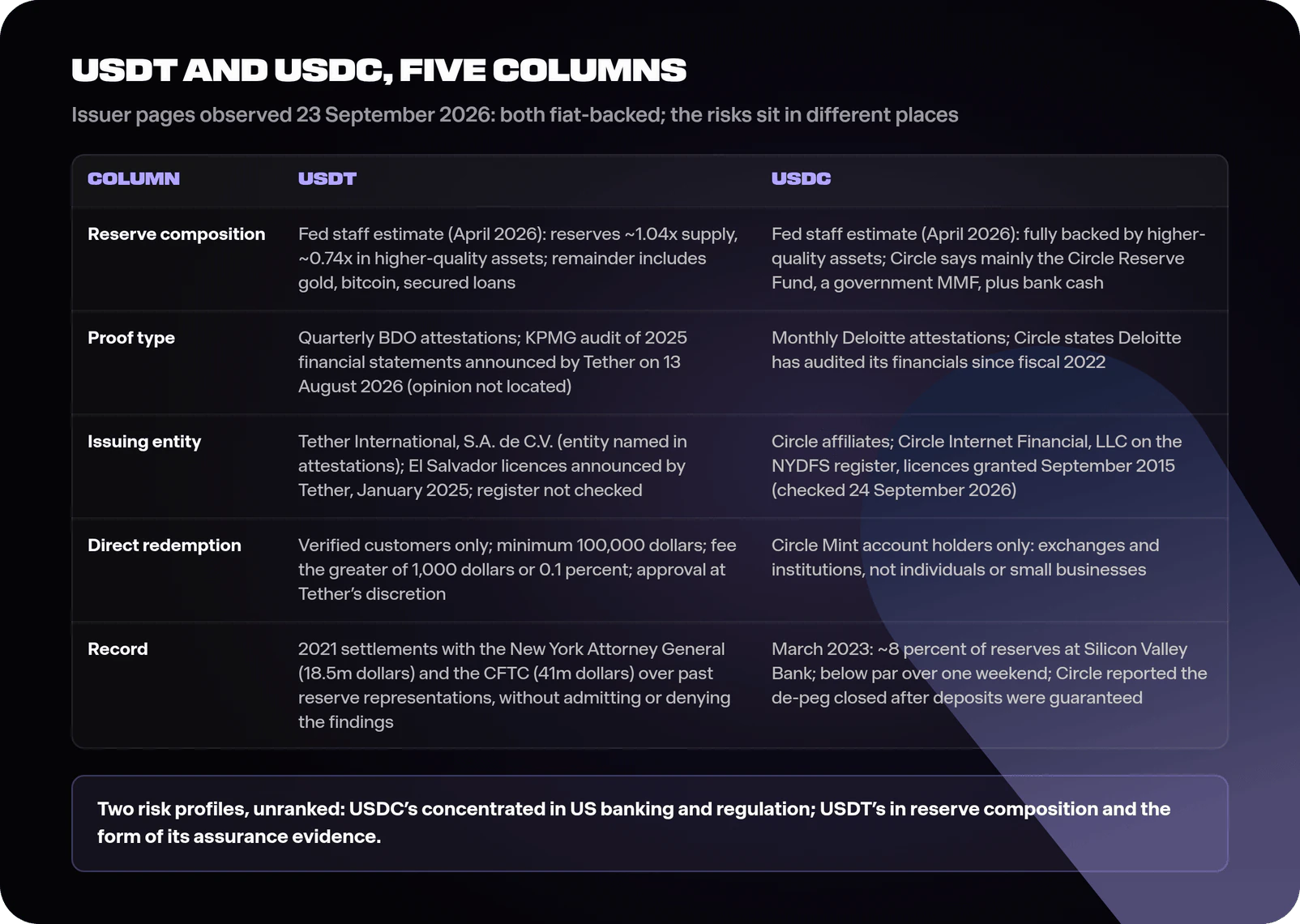
How do USDT and USDC actually differ?
Быстрый ответ
They differ on proof type, reserve composition, issuing entity and redemption terms, and their risks sit in different places. A Federal Reserve staff note of April 2026, whose authors present their own views and work from the issuers' attestation disclosures, estimated USDC fully backed by higher-quality assets and USDT reserved at about 1.04 times supply with about 0.74 times in higher-quality assets (Federal Reserve, FEDS Notes, 8 April 2026).
Reserve composition
The staff note defines higher-quality reserves as Treasuries, Treasury-backed repurchase agreements and bank deposits. On that definition the note's authors count USDC's reserves in full; Circle says most of them sit in the Circle Reserve Fund, an SEC-registered government money market fund, with the rest as bank cash (Circle, transparency page, observed 23 September 2026). In the note's estimate USDT's reserves are larger than its liabilities in total and about three-quarters higher-quality on the same definition, with the remainder in assets Tether discloses, including gold, bitcoin and secured loans. Tether's own attestation for 30 June 2026 reported total assets of about 187.75 billion dollars against liabilities of about 183.64 billion, an excess of about 4.11 billion (Tether, Q2 2026 attestation announcement, 31 July 2026). On those reported figures, that excess is the buffer against a fall in the price of the non-Treasury assets.
Proof type: attestation and audit are different things
As their pages stated on 23 September 2026, both issuers publish recurring attestations: Circle monthly by Deloitte & Touche LLP, Tether quarterly by BDO, with the latest Tether attestation located being for 30 June 2026. An attestation is a practitioner's report on management's assertions about specified balances at a point in time, under attestation standards. On 13 August 2026 Tether announced something separate: KPMG U.S. had completed an audit of the financial statements of Tether International, S.A. de C.V. for the year ended 31 December 2025 and issued an unqualified opinion, with reserves exceeding liabilities by about 6.8 billion dollars at that date (Tether, announcement, 13 August 2026). This guide treats that as an issuer announcement about annual financial statements. It is not the recurring reserve attestation, it speaks to one balance-sheet date, and it does not by itself show that tokens were fully backed on any given day since. This guide did not locate the audit opinion or the audited statements themselves, only Tether's announcement, so the audit is reported here as Tether describes it; whether the report has since been published for independent examination should be checked at the time of reading. Circle states that Deloitte has audited its financials since fiscal year 2022 (Circle, USDC page, observed 23 September 2026).
Issuing entity and its regulator
USDC is issued by Circle affiliates. Circle's transparency page states that Circle Internet Financial, LLC is licensed by the New York State Department of Financial Services as a money transmitter and for virtual currency business activity, and the DFS register lists that entity with both licences, granted in September 2015 (Circle, transparency page, observed 23 September 2026; NYDFS, virtual currency business register, checked 24 September 2026). USDT's attested entity is Tether International, S.A. de C.V. Tether announced in January 2025 that it had obtained digital asset service provider and stablecoin issuer licences in El Salvador and was completing the group's relocation there (Tether, announcement, 13 January 2025); the announcement does not name the licensed entity or the licensing authority, and this guide has not checked a Salvadoran register, so the licences are reported as Tether describes them. An issuer's domicile indicates which regulator supervises it and which courts may hear disputes, subject to the issuer's terms. It says nothing by itself about reserve quality, so this guide reads composition and proof type from the evidence.
Direct redemption
Under each issuer's terms, only approved direct customers redeem with it, and other holders rely on exchanges and arbitrage, as the Federal Reserve's note on primary and secondary stablecoin markets sets out (Federal Reserve, FEDS Notes, 23 February 2024). As observed on 23 September 2026, Circle Mint serves exchanges, institutional traders, banks and large financial institutions and, in Circle's words, is not available to individuals or small businesses. Tether serves verified customers at a minimum of 100,000 dollars per acquisition or redemption, charges the greater of 1,000 dollars or 0.1 percent to redeem, and keeps sole discretion over account approval (Tether, fees page, observed 23 September 2026). Each issuer states that it redeems at par for its direct customers; what a secondary-market holder can claim depends on the issuer's terms and on applicable law, which this guide does not assess token by token; in the EU, MiCA gives any holder of an in-scope e-money token a claim against the issuer and redemption at par (Regulation (EU) 2023/1114, Article 49). How stablecoins keep their peg covers how that arbitrage works.
Record
USDC's record entry is March 2023: Circle disclosed that about 8 percent of reserves, 3.3 billion dollars, sat at Silicon Valley Bank when it failed, the token traded below par on secondary markets over the weekend of 11 and 12 March, and Circle reported the de-peg closed after US authorities guaranteed SVB deposits (Circle, press release, 13 March 2023). USDT's record entries are regulatory settlements. In February 2021 Tether and Bitfinex settled with the New York Attorney General, agreeing to pay 18.5 million dollars in penalties and to stop trading with New Yorkers; the Attorney General's findings concerned past representations about the dollar backing of tethers, and the settlement agreement states that Bitfinex and Tether neither admit nor deny those findings (NYAG, press release, 23 February 2021; settlement agreement, February 2021). In October 2021 the CFTC issued a settled order imposing a 41 million dollar civil monetary penalty on Tether; the order finds that Tether held sufficient fiat reserves to back USDT in circulation on only 27.6 percent of days in a 26-month sample from 2016 through 2018, and records that Tether consented to it without admitting or denying the findings (CFTC, order of 15 October 2021). Both entries concern the past, and both are part of the record.
The summary is two different risk profiles, and this guide does not rank them: USDC's concentrated in the US banking and regulatory system, USDT's in the composition of its reserves and the form of its assurance evidence. How much weight either profile deserves depends on a holder's own circumstances and jurisdiction, and this guide makes no suitability judgement.
What happened to DAI, and what is USDS?
Быстрый ответ
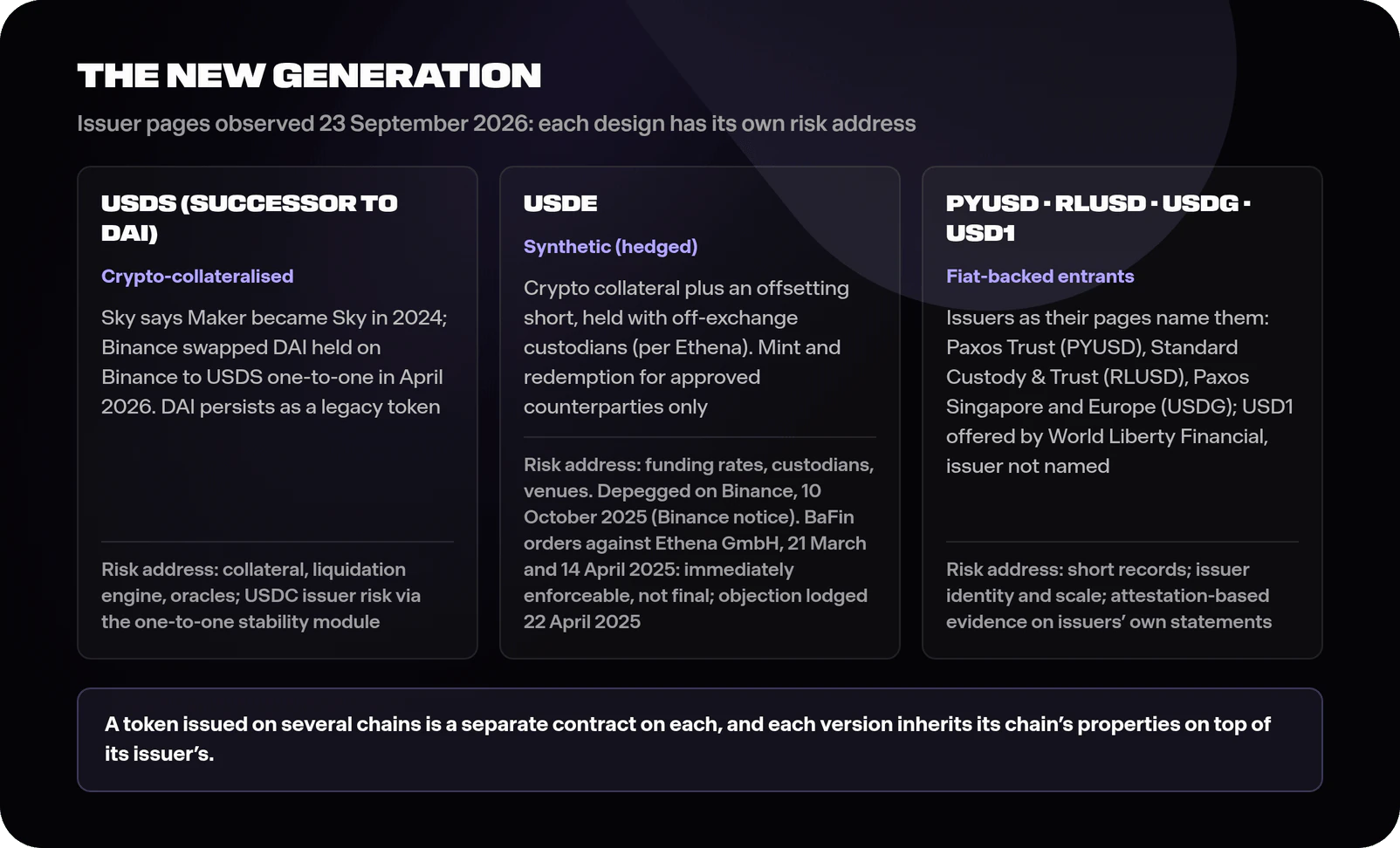
DAI still exists and is being succeeded: Maker became Sky in 2024 and launched USDS, DAI converts to USDS one-to-one, and in April 2026 Binance swapped custodied DAI to USDS and removed DAI trading pairs. For a holder they are the same collateral system under two tickers, with new exchange activity now routed through USDS.
The migration matters because guides written even a year earlier list DAI as the crypto-collateralised reference, and a reader will meet both names. The mechanics are the crypto-backed loop described in how stablecoins keep their peg: overcollateralised positions minting the stablecoin, liquidations protecting the buffer, and a stability module that exchanges USDC for USDS one-to-one with no fee in either direction (Sky, sky.money, observed 23 September 2026). Sky's site states that Maker became Sky in 2024; USDS is the flagship token, and DAI converts one-to-one. What changed in 2026 was market plumbing: Binance announced on 20 March 2026 that it would swap all DAI to USDS at one DAI to one USDS, removed DAI spot pairs on 7 April 2026 and opened USDS pairs on 9 April 2026 (Binance, announcement, 20 March 2026). This guide checked Binance's notice only and does not cover other venues' arrangements. DAI's contract remains live, so DAI persists as a legacy token.
On this observation date sky.money showed combined USDS and DAI supply of 9.60 billion dollars and collateral backing of 16.77 billion dollars, with no timestamp on the figures, so both are recorded here as issuer-reported. The evidence type is different from the fiat-backed tokens: balances and collateral are on-chain and published on the protocol's own dashboards, and no third-party attestation is cited. Redemption is also different in kind. There is no issuer with a customer list; USDS and DAI are generated by vault owners who lock collateral and draw the stablecoin against it, and only a vault owner (or an address it authorises) repays that vault's debt to unlock that vault's collateral (Sky, developer documentation, CDP Manager, accessed 24 September 2026). An ordinary USDS or DAI holder has no claim on any vault. Any wallet can interact with the contracts, and a holder exits by swapping through the stability module where it is available or selling on an exchange; there is no company to present a claim to.
The risk profile is shared by both tickers: collateral and liquidation-engine risk, oracle dependence as set out in the oracle risk guide, and exposure to other stablecoins the system accepts: the stability module swaps USDC one-to-one, so USDC's issuer and banking risk reaches USDS through that route. Sky's own risk disclosure states plainly that USDS may be under- or inadequately collateralised and may not hold its value at all times (Sky, user risks, observed 23 September 2026). Governance of collateral choices is the crypto-backed model's equivalent of an issuer's reserve policy. Those decisions are made on-chain and are publicly visible, and that visibility leaves the collateral, liquidation, oracle and governance risks above in place.
What is different about USDe and the new entrants?
Быстрый ответ
USDe holds its value with a hedge, crypto collateral paired with short futures positions, so its risks sit in funding rates, custodians, exchanges and how venues price it; the fiat-backed entrants differ from USDT and USDC mainly in issuer identity, scale and the length of their records.
USDe
USDe's design is the synthetic model described in the peg guide: crypto collateral plus offsetting short futures positions, with liquid stablecoins and other assets alongside, held with off-exchange custodians (Ethena, documentation, observed 23 September 2026). As observed on 23 September 2026, the issuer states that it publishes weekly third-party proofs of the allocation of backing assets and monthly attestations of their value at custodians; those are issuer statements, and Ethena's transparency dashboard could not be loaded from our location on the observation date, so no size is recorded here. Ethena's USDe terms limit minting and redemption with the issuer, Ethena BVI Limited, to whitelisted "Mint Users" who have completed KYC and AML checks, and state that users in the United States are not eligible; that places USDe with the fiat-backed tokens on that column even though its mechanism is different. The same terms state that "If you are a Holding User, you do not have a right to redeem USDe with Ethena BVI", and that USDe "does not represent a claim, participation interest, economic right" or similar right against Ethena BVI or its affiliates (Ethena, USDe terms and conditions, last updated August 2025). A holder outside the Mint User list therefore exits by selling on a secondary market at the market price. Ethena's own risk documentation lists funding, liquidation, custodial, exchange-failure, backing-asset and margin-collateral risks.
The record in this guide's primary sources has two strands. On 10 October 2025, USDe, wBETH and BNSOL depegged on Binance between 21:36 and 22:16 UTC, and Binance later compensated affected Futures, Margin and Loan users by formula; Binance's notice gives no root cause, no price and no market-wide total (Binance, notice, October 2025). The oracle risk guide covers how an exchange's internal pricing can diverge from other markets. Earlier, Germany's BaFin took two separate actions against Ethena GmbH. On 21 March 2025 it prohibited the company from continuing to offer USDe to the public and instructed it to have the reserve of assets frozen by the custodians, citing serious shortcomings in the authorisation procedure and grounds to suspect an offer of securities in Germany without the required prospectus (BaFin, 21 March 2025). Its notice of 15 April 2025 reports an order of 14 April 2025 requiring Ethena GmbH to wind up its business that was subject to authorisation, citing serious deficiencies in its business organisation and infringements of MiCAR; BaFin stated that this was the first time it had imposed measures under MiCAR and that secondary-market trading of USDe in the EU was no longer permissible (BaFin, 15 April 2025). BaFin describes both sets of measures as immediately enforceable; its April notice, as displayed on 24 September 2026, states that the measures are not yet final and that Ethena GmbH lodged an objection on 22 April 2025. This guide has found no later BaFin notice on the outcome of that objection. How stablecoins are regulated around the world covers the wider EU posture.
The fiat-backed entrants
The entrants are fiat-backed designs from issuers the reader may know from elsewhere. PYUSD is PayPal-branded and, according to Paxos, issued by Paxos Trust Company, N.A. under OCC oversight, with monthly attestations and retail access through PayPal and Venmo (Paxos, PYUSD page, observed 23 September 2026); this guide has not checked the OCC's records. RLUSD is issued by Standard Custody & Trust Company, LLC, which the New York DFS register lists with a limited purpose trust charter granted in May 2021 (NYDFS, register checked 24 September 2026), with monthly CPA attestations according to Ripple; its transparency page showed 2,395.6 million dollars circulating against 2,517.7 million in reserve funds at 3 September 2026 (Ripple, transparency page, observed 23 September 2026). USDG is issued by Paxos Digital Singapore Pte. Ltd., which the Global Dollar page describes as a major payment institution supervised by the Monetary Authority of Singapore, and, according to the same page, also by Paxos Issuance Europe under the supervision of the Finnish Financial Supervisory Authority and in compliance with MiCA; the page states monthly reserve reports (Global Dollar, about page, observed 23 September 2026). This guide has not checked the MAS or Finnish registers, so those statuses are reported as Paxos describes them. USD1 is offered by World Liberty Financial, which states backing in US cash, government money market funds and cash equivalents with monthly attestation reports; its page did not identify the issuing entity or custodian (World Liberty Financial, USD1 page, observed 23 September 2026).
Their differences from the leaders are scale, distribution and the regimes they were launched into. In the United States, the GENIUS Act (Public Law 119-27), enacted on 18 July 2025, sets federal requirements for issuers of payment stablecoins; it takes effect on the earlier of 18 January 2027 or 120 days after the primary federal regulators issue final implementing regulations, so on this guide's observation date its issuer obligations had not yet commenced. In the EU, the e-money token rules of MiCA (Regulation (EU) 2023/1114, Title IV), which bind issuers of e-money tokens, have applied since 30 June 2024 (ESMA, MiCA rulebook). Their evidence is attestation-based on the issuers' own statements, no incident appears in this guide's sources, and their track records are short; a short record gives less evidence of how a design behaves under stress, a point the smart contract guide makes about any young instrument.
Frequently asked questions
How do the risks of these stablecoins compare?
This guide does not rank them by safety or suitability; it sets out where each profile concentrates risk. The fully higher-quality-backed profile whose issuer group includes a New York-licensed entity concentrates risk in the US banking system and a single fund structure; the above-supply-reserved profile with a mixed composition concentrates it in the value of the non-Treasury assets and in the form of the assurance evidence; the crypto-collateralised profile in collateral, liquidation engines and oracles; the synthetic profile in funding rates, custodians and venues. This guide does not assess which profile suits any particular holder.
Is DAI still around now that USDS exists?
Yes. DAI's contract remains live, and sky.money reports USDS and DAI supply as one combined figure, 9.60 billion dollars when observed on 23 September 2026, with no timestamp on the page (Sky, sky.money). What changed in 2026 is where each ticker trades. Binance's notice of 20 March 2026 covered DAI balances held on Binance, which it would swap to USDS one-to-one, and Binance removed DAI spot pairs on 7 April 2026 (Binance, announcement, 20 March 2026). DAI held in a self-custodied wallet was outside that swap and stays DAI unless it is converted through the Sky protocol, which sky.money states converts DAI to USDS one-to-one. Other venues set their own arrangements, which this guide has not checked.
Why does the Federal Reserve assess USDT and USDC reserves differently?
The difference comes from what the reserves are made of. The April 2026 FEDS Note, a staff paper whose authors present their own views, works from the issuers' attestation disclosures and counts Treasuries, Treasury-backed repurchase agreements and bank deposits as higher-quality reserves (Federal Reserve, FEDS Notes, 8 April 2026). As a worked example, its ratios applied to 100 dollars of tokens give about 100 dollars of higher-quality reserves behind USDC, and about 104 dollars of reserves behind USDT, of which about 74 dollars are higher-quality and about 30 dollars are other assets Tether discloses, such as gold, bitcoin and secured loans. On those estimates USDT holds more total reserves per token, and a smaller share of them falls in the higher-quality category. The note does not state which attestation date its ratios use, so they may differ from Tether's 30 June 2026 figures given above.
Does the KPMG audit change USDT's evidence?
It adds a different kind of evidence. Tether says KPMG audited Tether International's financial statements for 2025 and gave an unqualified opinion; that is an annual financial-statement audit of one entity at one date. The recurring BDO attestations remain the evidence for reserves at quarter ends, the latest located being for 30 June 2026. Neither proves backing on any particular day in between. This guide found only Tether's announcement of the audit, so whether the audit report itself has been published for independent examination remains to be checked at the time of reading.
Can you redeem stablecoins directly with the issuer?
On each issuer's terms, as observed on 23 and 24 September 2026, and, for in-scope EU e-money tokens, also under MiCA Article 49, which gives any holder a claim against the issuer and redemption at par without a fee. Direct redemption of USDT is open to verified customers redeeming at least 100,000 dollars, with account approval at Tether's discretion. USDC is redeemed directly only through Circle Mint, which Circle says is not available to individuals or small businesses. USDe is minted and redeemed with Ethena BVI only by whitelisted Mint Users who have passed KYC and AML checks (users in the United States are not eligible), and Ethena's terms state that other holders have no right to redeem. The PYUSD and USDG pages name redemption with Paxos, and the RLUSD and USD1 pages observed on 23 September 2026 did not state who is eligible. USDS can be swapped for USDC by any wallet through the protocol's stability module; that is a swap, and it gives a USDS or DAI holder no claim on the collateral in any vault. Holders outside those routes exit by selling on a secondary market at the market price. Which of these routes is open to a particular holder also depends on the holder's jurisdiction and the platform used.
Is USDC on Solana the same as USDC on Ethereum?
Same issuer, same redemption terms for direct customers, different contract on a different ledger; Circle lists 38 networks with native USDC as of 16 September 2026 (Circle, USDC page). Moving between them is a real cross-chain transfer, and each version inherits its chain's properties on top of Circle's, as how blockchains differ explains. The network-matching check in how to send and receive crypto applies to every such transfer.
Sources and further reading
Primary sources for this guide, each accessed on 23 September 2026. Issuer pages are cited for what the issuer reported on that date.
- Stablecoins in 2025: Developments and Financial Stability Implications. Federal Reserve Board, FEDS Notes, 8 April 2026. https://www.federalreserve.gov/econres/notes/feds-notes/stablecoins-in-2025-developments-and-financial-stability-implications-20260408.html (accessed 23 September 2026)
- Primary and Secondary Markets for Stablecoins. Federal Reserve Board, FEDS Notes, 23 February 2024. https://www.federalreserve.gov/econres/notes/feds-notes/primary-and-secondary-markets-for-stablecoins-20240223.html (accessed 23 September 2026)
- Tether Completes the Largest Inaugural Financial Audit in History (headline as stated by Tether). Tether, 13 August 2026. https://tether.io/news/tether-completes-the-largest-inaugural-financial-audit-in-history/ (accessed 23 September 2026)
- Tether Signs Big Four Firm to Complete First Full Audit. Tether, 24 March 2026. https://tether.io/news/tether-signs-big-four-firm-to-complete-first-full-audit-setting-a-new-quality-standard-for-the-digital-asset-economy/ (accessed 23 September 2026)
- Tether Posts Strong Q2 Performance, Generates $1.5B Net Operating Profit, Maintains $4.11B Reserve Buffer (Q2 2026 attestation announcement). Tether, 31 July 2026. https://tether.io/news/tether-posts-strong-q2-performance-generates-1-5b-net-operating-profit-maintains-4-11b-reserve-buffer-and-expands-gold-holdings-to-more-than-146-tons/ (accessed 23 September 2026)
- Tether Licensed in El Salvador. Tether, 13 January 2025. https://tether.io/news/tether-licensed-in-el-salvador-strengthening-focus-on-emerging-markets-and-innovation/ (accessed 23 September 2026)
- Fees (issuance and redemption terms). Tether, undated. https://tether.to/en/fees/ (accessed 23 September 2026)
- Transparency. Tether, undated. https://tether.to/en/transparency/ (accessed 23 September 2026; balance figures are rendered dynamically and could not be captured)
- USDC Transparency and Reserves. Circle, page dated 21 September 2026. https://www.circle.com/transparency (accessed 23 September 2026)
- USDC. Circle, page dated 21 September 2026. https://www.circle.com/usdc (accessed 23 September 2026; network count rechecked 24 September 2026)
- $3.3 Billion of USDC Reserve Risk Removed, Dollar De-peg Closes. Circle, 13 March 2023. https://www.circle.com/pressroom/3-3-billion-of-usdc-reserve-risk-removed-dollar-de-peg-closes (accessed 23 September 2026)
- Attorney General James Ends Virtual Currency Trading Platform Bitfinex's Illegal Activities in New York (headline as published by the New York Attorney General; the settlement was made without admission or denial). New York Attorney General, 23 February 2021. https://ag.ny.gov/press-release/2021/attorney-general-james-ends-virtual-currency-trading-platform-bitfinexs-illegal (accessed 23 September 2026)
- Settlement agreement between the New York Attorney General and iFinex, Tether and related entities (paragraph 5: "Bitfinex and Tether neither admit nor deny the OAG's findings"). New York Attorney General, February 2021. https://ag.ny.gov/sites/default/files/2021.02.17_-_settlement_agreement_-_execution_version.b-t_signed-c2_oag_signed.pdf (accessed 24 September 2026)
- CFTC Orders Tether and Bitfinex to Pay Fines Totaling $42.5 Million. CFTC, 15 October 2021. https://www.cftc.gov/PressRoom/PressReleases/8450-21 (accessed 23 September 2026)
- Order Instituting Proceedings, In the Matter of Tether Holdings Limited et al. (settled order; respondents consent "without admitting or denying any of the findings or conclusions herein"). CFTC, 15 October 2021. https://www.cftc.gov/media/6646/enftetherholdingsorder101521/download (accessed 24 September 2026)
- Virtual Currency Business Licensing (register of licensed and chartered entities). New York State Department of Financial Services, undated. https://www.dfs.ny.gov/virtual_currency_businesses (accessed 24 September 2026)
- Sky.money (USDS supply, collateral backing, stability module, interface operator). Sky, undated. https://sky.money/ (accessed 23 September 2026)
- User Risks. Skybase International, undated. https://docs.sky.money/legal/skybase-international/user-risks.md (accessed 23 September 2026)
- Terms of Use. Skybase International, undated. https://docs.sky.money/legal/skybase-international/terms-of-use.md (accessed 23 September 2026)
- Binance Will Support the Dai (DAI) Token Swap and Rebranding to USDS (USDS). Binance, 20 March 2026. https://www.binance.com/en/support/announcement/detail/df2ce9c43b1d406ca2c4b14e4e34610a (accessed 23 September 2026)
- Ethena documentation (backing, minting and redemption, risks). Ethena Labs, undated. https://docs.ethena.fi/ and https://docs.ethena.fi/protocol-overview/risks.md (accessed 23 September 2026)
- USDe Terms and Conditions (Mint Users, Holding Users, no redemption right for Holding Users, no claim). Ethena BVI Limited, last updated August 2025. https://docs.ethena.fi/resources/usde-terms-and-conditions (accessed 24 September 2026)
- CDP Manager (vault operation: locking collateral, generating and repaying debt). Sky developer documentation, undated. https://developers.skyeco.com/protocol/vaults/cdp-manager/ (accessed 24 September 2026)
- Ethena (issuer statements on attestations and custody). Ethena Labs, undated. https://ethena.fi/ (accessed 23 September 2026)
- Binance notice on USDe, wBETH and BNSOL depeg and compensation. Binance, October 2025. https://www.binance.com/en/support/announcement/detail/0989d6c7f32545bfb019e3249eaabc3f (accessed 23 September 2026)
- BaFin prohibits Ethena GmbH from offering USDe to the public and orders the reserve frozen. BaFin, 21 March 2025. https://www.bafin.de/SharedDocs/Veroeffentlichungen/EN/Verbrauchermitteilung/weitere/2025/meldung_2025_03_21_Ethena_GmbH_en.html (accessed 24 September 2026)
- Ethena GmbH: BaFin orders winding-up of business in USDe tokens that required authorisation. BaFin, 15 April 2025. https://www.bafin.de/SharedDocs/Veroeffentlichungen/EN/Verbrauchermitteilung/weitere/2025/meldung_2025_04_15_Ethena_GmbH_en.html (accessed 24 September 2026; states the measures are immediately enforceable but not yet final and that Ethena GmbH lodged an objection on 22 April 2025)
- PayPal USD (PYUSD). Paxos, undated. https://www.paxos.com/pyusd (accessed 23 September 2026)
- About USDG. Global Dollar (Paxos), undated. https://globaldollar.com/about-usdg (accessed 23 September 2026)
- Ripple USD Transparency. Ripple, data as of 3 September 2026. https://ripple.com/solutions/stablecoin/transparency/ (accessed 23 September 2026)
- USD1. World Liberty Financial, undated. https://worldlibertyfinancial.com/usd1 (accessed 23 September 2026)
- GENIUS Act, Public Law 119-27. US Government Publishing Office, 18 July 2025. https://www.govinfo.gov/content/pkg/PLAW-119publ27/html/PLAW-119publ27.htm (accessed 23 September 2026)
- MiCA interactive single rulebook. ESMA, undated. https://www.esma.europa.eu/publications-and-data/interactive-single-rulebook/mica (accessed 23 September 2026)
- Top Stablecoin Tokens by Market Capitalization (live tracker page; used only to select the tokens covered, from one snapshot read at about 00:30 UTC on 7 October 2026; values on the live page will differ). CoinMarketCap. https://coinmarketcap.com/view/stablecoin/ (accessed 7 October 2026)
- USDS price, market cap and supply (live token page; read at the same time). CoinMarketCap. https://coinmarketcap.com/currencies/usds/ (accessed 7 October 2026)
Быстрый тест: прилипло ли оно?
Возникло несколько вопросов для проверки основ. Далее следуют ответы с пояснениями, и кроме вашего будущего портфолио никто вас не оценивает.


Вы прошли тест по теме «The Biggest Stablecoins Compared: USDT, USDC and the New Generation»! Поделитесь своим достижением в социальных сетях.
 Было ли это полезно?