
TL;DR
- Usually two unrelated things at once: a network fee, the price of having your transaction included and executed on the chain, and platform charges (trading fees, spreads and withdrawal fees) that pay the service you used. The network fee is set by an open market, and who receives it depends on the chain's rules; the platform charges are set by the platform.
- Because block space is scarce and priced by demand. A chain can include only so much per block, users bid for inclusion, and when demand exceeds space the price climbs until someone drops out. Fees also do a second job: making spam expensive enough to be pointless.
- Gas is Ethereum's unit for computational work: operations are priced in gas units, and your fee is units used multiplied by the price per unit, where the price per unit is a base fee set by the protocol plus a priority fee you offer to the validator proposing the block. A plain transfer uses 21,000 units; a smart contract interaction uses more. Other chains price differently, and the same principle holds: you pay for the work you cause.
- Time discretionary transactions for quiet periods, batch what can be batched, match the chain and layer to the job, and do not economise on the transfers where a mistake costs more than the fee. On security-critical moves, a timely, predictable inclusion is worth more than the saving.
在一个街区
A network fee is the price a sender attaches to a blockchain transaction to have it included and executed, set by demand for the chain's limited block space; who receives it depends on the chain.
What are you actually paying for when you pay a fee?
快速解答
Usually two unrelated things at once: a network fee, the price of having your transaction included and executed on the chain, and platform charges (trading fees, spreads and withdrawal fees) that pay the service you used. The network fee is set by an open market, and who receives it depends on the chain's rules; the platform charges are set by the platform.
Platform charges
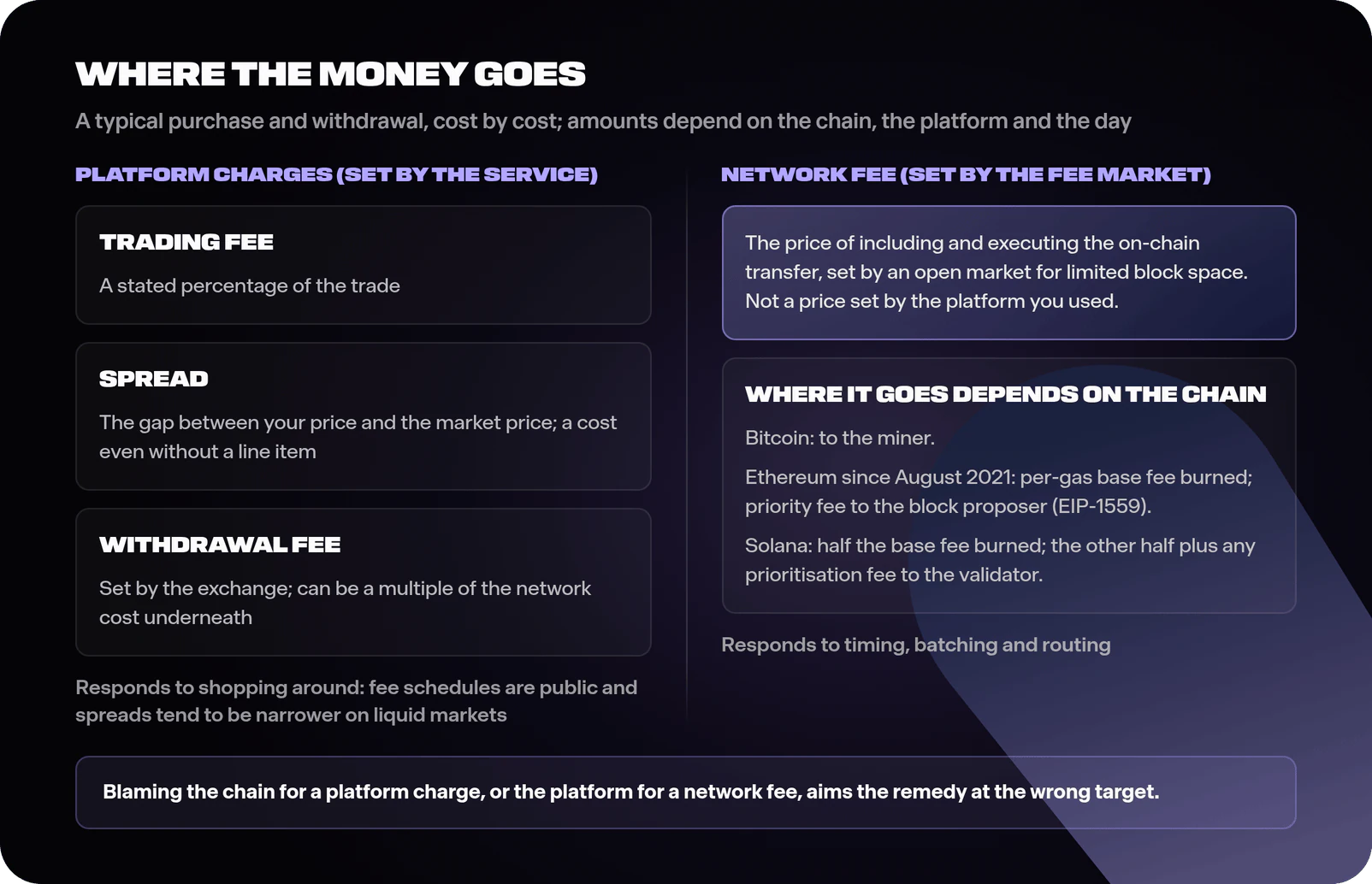
Untangling a typical beginner purchase makes the split visible. Buy crypto on an exchange and you pay a trading fee, a stated percentage of the trade, and usually a spread, the gap between the price you got and the market price, which is a cost even when no line item names it. Withdraw the crypto to your own wallet and the exchange charges a withdrawal fee, which it sets itself and which can be a multiple of the network cost underneath. Each of these is a price published (or, for spreads, implied) by a company.
The network fee
Only when the coins move on the chain does the network fee proper appear. It is the price of inclusion and execution, and each chain's rules decide where the money goes. On a proof-of-work chain such as Bitcoin, it goes to the miner who includes the transaction (Bitcoin developer documentation, transactions guide). On Ethereum since August 2021 it is split: a base fee that the protocol destroys, and a priority fee that goes to the validator proposing the block (EIP-1559). On Solana, half of the base fee is burned and the other half, plus any prioritisation fee, goes to the validator (Solana documentation, fees). Neither part is a price set by the platform you used, although the validator receiving the priority fee may itself be run by a company.
When the fee is abstracted or sponsored
Some applications change who pays the network fee, or in what form, a practice often called fee abstraction. On Ethereum and compatible chains, the ERC-4337 account-abstraction standard defines a paymaster as "a helper contract that agrees to pay for the transaction, instead of the sender itself", and lists among its aims letting users pay fees with ERC-20 tokens and letting developers pay fees for their users (ERC-4337). An app may therefore describe a transaction as "gasless", charge the fee in a token other than the chain's native coin, or fold it into another charge. The network fee still exists and is still paid to the chain under its own rules; what changes is who pays it and how the cost is presented. A sponsor sets its own terms and can limit or withdraw sponsorship, and a sponsored transaction still competes in the chain's fee market, so sponsorship does not by itself guarantee inclusion or completion. Where a fee is abstracted, the platform's terms show whether the cost reappears elsewhere, for example in a spread or service charge.
Separating the two kinds of cost helps because the remedies differ. Platform charges respond to shopping around, which the academy's guide to whether crypto exchanges are safe covers: venues publish fee schedules, and spreads tend to be narrower on more liquid markets. Network fees respond to timing and technique, which the rest of this guide covers. Blaming the blockchain for an expensive exchange withdrawal, or an exchange for an expensive contract interaction, aims the remedy at the wrong target.
Why do network fees exist at all, and why do they spike?
快速解答
Because block space is scarce and priced by demand. A chain can include only so much per block, users bid for inclusion, and when demand exceeds space the price climbs until someone drops out. Fees also do a second job: making spam expensive enough to be pointless.
A blockchain's capacity is deliberately limited. Blocks arrive on a fixed rhythm and hold a bounded amount of data or computation, limits that exist so that ordinary machines can keep following the chain, which supports decentralisation; the pillar's trilemma section explains that trade in full. Scarce space plus open access needs an allocation rule, and the rule chains chose is a fee market. Bitcoin's developer documentation states it plainly: transactions are prioritised by fee per byte, with higher-paying transactions added until the available block space is filled, and each miner chooses the minimum fee it will accept (Bitcoin developer documentation, transactions guide).
Everything a beginner observes about fees follows from that market. Quiet network, low clearing price, transfers for cents. A market frenzy, an NFT rush or a panic, and the same transfer competes with a crowd, so the clearing price multiplies. Fees are a congestion gauge as much as a cost. ethereum.org's scaling documentation gives this as the reason layer 2 designs exist: on the base chain, it says, high demand leads to slower transactions and gas prices that are not viable, because senders outbid each other as the network gets busier (ethereum.org, scaling documentation). Dollar figures for any busy period depend on the day, the transaction type and the ETH price, so this guide does not quote one.
Underpaying has a specific failure mode worth knowing. A transaction offering less than the going rate is not rejected; it waits, in the queue of pending transactions (the mempool), until the price falls to meet it or it is dropped. During sharp moves this produces the familiar beginner experience of a transfer stuck for hours; the guide to how crypto transactions get confirmed explains the queue in detail. Many wallets estimate the going rate and offer speed tiers; the estimate is a forecast of a market, and at chaotic moments forecasts can miss.
What is gas, exactly, and why do some transactions cost more than others?
快速解答
Gas is Ethereum's unit for computational work: operations are priced in gas units, and your fee is units used multiplied by the price per unit, where the price per unit is a base fee set by the protocol plus a priority fee you offer to the validator proposing the block. A plain transfer uses 21,000 units; a smart contract interaction uses more. Other chains price differently, and the same principle holds: you pay for the work you cause.
The three quantities are easy to run together, so here they are separately.
Gas units (how much work)
The name is the engine metaphor: a journey burns fuel in proportion to distance, and a transaction burns gas in proportion to computation. A simple ETH transfer costs exactly 21,000 units (ethereum.org, gas documentation). Swapping tokens on a decentralised exchange runs contract code and uses more; minting an NFT or exercising a complex application, more again. How much more depends on the contract, so any multiple is specific to the application and the moment. Your wallet sets a gas limit, the most work the transaction may consume; unused units are refunded, and a failed transaction still pays for the units it consumed before failing, because validators did the work regardless of the outcome (ethereum.org, gas documentation).
Base fee (the protocol's price per unit)
Since the London upgrade of August 2021, Ethereum's protocol sets a base fee per gas for each block from how full the previous block was: above the gas target, the base fee rises for the next block; below it, the base fee falls; the change is capped at 12.5 percent per block. The base fee is burned, meaning destroyed and paid to no one (EIP-1559). It is quoted in gwei, one billionth of an ETH (ethereum.org, gas documentation).
Priority fee (your tip to the validator)
On top of the base fee, you offer a priority fee per gas to the validator who includes your transaction. Your wallet also sets a maximum fee per gas you are willing to pay in total; the transaction is valid only if that maximum is at least the block's base fee, and anything above base fee plus priority fee is refunded (EIP-1559; ethereum.org, gas documentation). The worked example in the ethereum.org documentation: a 21,000-unit transfer with a 10 gwei base fee and a 2 gwei priority fee costs 21,000 × (10 + 2) = 252,000 gwei, or 0.000252 ETH (ethereum.org, gas documentation). Two practical corollaries: the same application costs more to use than a plain transfer at any congestion level, because it uses more units, and fee estimation is easier than under pure bidding, because the base fee moves by bounded steps. EIP-1559's authors described the aim as letting wallets set gas fees for users "in a highly reliable fashion" (EIP-1559).
How other chains price the same scarcity
Chains that do without the gas model still price the same underlying scarcities, and each has its own units.
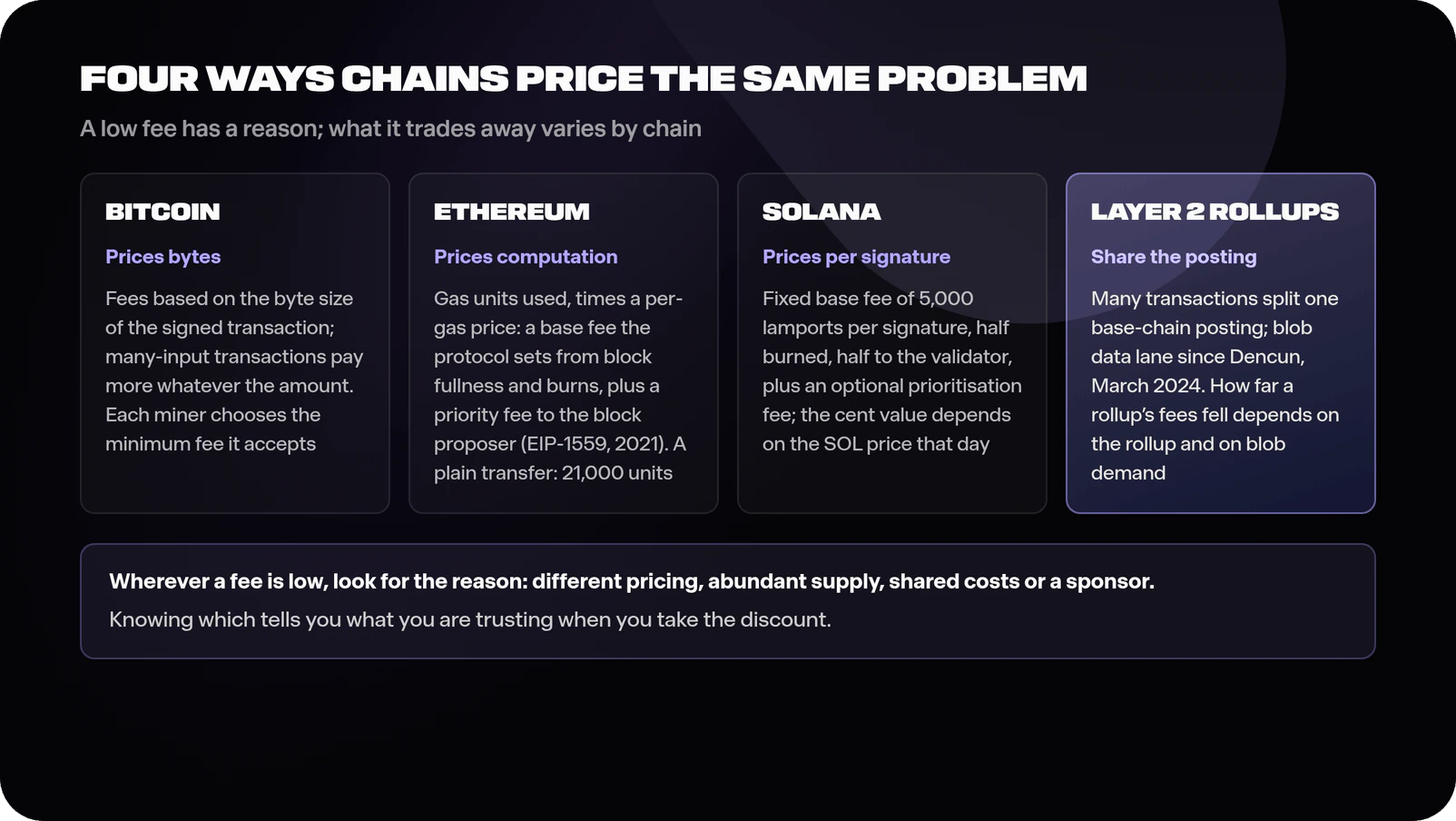
Bitcoin's transactions run only a limited scripting language, and its market prices block space by size: fees are based on the byte size of the signed transaction, so a transaction with many inputs pays more than a small one whatever the amounts involved (Bitcoin developer documentation, transactions guide).
Solana charges a fixed base fee per signature (5,000 lamports, where a lamport is one billionth of a SOL), of which half is burned and half goes to the validator, plus an optional prioritisation fee calculated from a compute unit price and compute unit limit, all of which goes to the validator (Solana documentation, fees). Whether that works out to a fraction of a cent depends on the SOL price on the day; the pillar covers what Solana's abundant capacity trades away.
Layer 2 rollups cut fees a different way, by amortisation: they execute transactions off the base chain and post the data to Ethereum in a single combined transaction, so many users share one posting (ethereum.org, scaling documentation). Since the Dencun upgrade of March 2024, that data can travel in blobs, a separate data lane with its own fee market that was designed to be much cheaper than the previous method (EIP-4844). How far a given rollup's fees fell after March 2024 depends on the rollup and on blob demand, so a dated figure from the rollup's own documentation is the right reference, and this guide does not quote one.
Where a fee is low, some combination of those mechanisms, different pricing, abundant capacity or shared costs, usually explains it, unless an application is sponsoring the fee, in which case someone else is paying it. What each design gives up in return, if anything, is specific to that chain or layer, and how blockchains differ compares them.
How do you keep fees down without cutting corners?
快速解答
Time discretionary transactions for quiet periods, batch what can be batched, match the chain and layer to the job, and do not economise on the transfers where a mistake costs more than the fee. On security-critical moves, a timely, predictable inclusion is worth more than the saving.
Timing is the free lever. Fee markets move with activity, and any discretionary action, consolidating funds, exercising a contract, moving to cold storage, can wait for a lull. Whether a particular hour or day is quieter varies by chain and period, so the reliable habit is looking at the current rate in a wallet or public fee tracker before signing.
Batching is the second lever. Each transaction pays the market once, so ten small transfers cost roughly ten fees where one consolidated transfer costs one. Some exchanges apply this by batching customer withdrawals; you can apply it by planning movements as fewer, larger transfers.
Routing is the third. The map in how blockchains differ is also a price list: a payment-sized transfer has no need of the most expensive lane at the busiest hour, and layer 2 networks exist exactly to carry ordinary activity cheaply. The pillar's caution travels with some discounts: a cheaper lane can add parties or assumptions to trust, depending on its design, so route by the stakes involved, and keep the habit of knowing which network you are on, since a fee quote in the wrong network's terms is a symptom of the wrong-network mistake that the guide to sending and receiving crypto exists to prevent.
The last habit is a refusal. On transfers that matter, the recovery test, the move to a new wallet, the large consolidation, paying the going rate reduces the chance of a stall in an action that is hard to reverse once confirmed. Shaving the fee on such a move brings risks of its own: an underpriced transaction can stall halfway through a planned sequence, and an unfamiliar cheap route taken under time pressure adds a step where a wrong-network or wrong-address mistake can happen. On a large transfer that generally cannot be reversed once confirmed, the saving on the fee is small next to the amount at stake.
Frequently asked questions
Why did my exchange charge more to withdraw than the network fee I can see on-chain?
Because withdrawal fees are prices the exchange sets, covering its costs and margin, and they can sit well above the network fee it actually pays, particularly where it batches many customers' withdrawals into one transaction. Venues publish their fee schedules; comparing them is part of assessing a venue.
Why did my transaction get stuck for hours?
It offered less than the going rate, so validators or miners kept choosing better payers while it waited in the queue. A common cause is congestion rising after your wallet estimated the fee. Many wallets can resubmit with a higher fee; otherwise the transaction eventually clears or is dropped.
Do I pay gas if my transaction fails?
On Ethereum, yes, for the computation done before the failure; changes are reverted but the gas consumed is not returned (ethereum.org, gas documentation). Contract interactions can fail partway through, another reason the guide to what dApps are counsels reading what you sign.
What does it mean when an app says a transaction is "gasless"?
It usually means the app or a third party pays the network fee, or collects it from you in another form, through fee abstraction; on Ethereum-compatible chains, one standard mechanism for this is an ERC-4337 paymaster, "a helper contract that agrees to pay for the transaction, instead of the sender itself" (ERC-4337). The chain still charges its fee. The sponsor's terms decide when it pays, and sponsorship does not make inclusion certain or change how the fee market works.
What is the difference between the base fee and the priority fee on Ethereum?
The base fee is set by the protocol from how full the previous block was, is the same for every transaction in a block, and is burned; the priority fee is the per-unit tip that the validator keeps (EIP-1559). The maximum fee per gas set in the wallet caps the two combined, and a worked example shows what that means. Take a 20 gwei maximum and a 2 gwei priority fee. At a 10 gwei base fee the transaction pays 12 gwei per unit. At a 19 gwei base fee the validator's tip shrinks to 1 gwei, because the tip is whatever fits under the cap. At a 25 gwei base fee the transaction cannot be included in that block and stays pending until the base fee falls to 20 gwei or less, or until it is replaced or dropped (EIP-1559).
Why not just use the cheapest chain for everything?
Because a low fee has a mechanical explanation, and depending on the chain or layer it can come with a trade, such as heavier hardware for validators, a different set of operators, or an extra layer to trust. The trade differs by design, and some differences in fees reflect pricing rules more than any concession. How blockchains differ maps those trades. Matching the lane to the stakes is one way to think about it: cheaper rails for small routine moves, and the most dependable inclusion available for the transfers you cannot afford to redo.
Sources and further reading
- Gas and fees. ethereum.org developer documentation, undated. https://ethereum.org/en/developers/docs/gas/ (accessed 23 September 2026)
- EIP-1559: Fee market change for ETH 1.0 chain. Ethereum Improvement Proposals, activated in the London upgrade, August 2021. https://eips.ethereum.org/EIPS/eip-1559 (accessed 23 September 2026)
- EIP-4844: Shard Blob Transactions. Ethereum Improvement Proposals, activated in the Dencun upgrade, March 2024. https://eips.ethereum.org/EIPS/eip-4844 (accessed 23 September 2026)
- Scaling. ethereum.org developer documentation, undated. https://ethereum.org/en/developers/docs/scaling/ (accessed 23 September 2026)
- Transactions (developer guide, transaction fees and change). Bitcoin developer documentation, undated. https://developer.bitcoin.org/devguide/transactions.html (accessed 23 September 2026)
- ERC-4337: Account Abstraction Using Alt Mempool (paymasters and sponsored fees). Ethereum Improvement Proposals, undated specification. https://eips.ethereum.org/EIPS/eip-4337 (accessed 7 October 2026)
- Fees on Solana. Solana documentation, undated. https://solana.com/docs/core/fees (accessed 23 September 2026)
快速测验:它粘住了吗?
提出了一些检查基本原理的问题。下面是带有解释的答案,除了你未来的作品集之外,没有人给你评分。


你已完成关于“What Are Gas and Network Fees, and Why Do They Change?”的测验!在社交媒体上分享你的成果。
 这有帮助吗?